Pest & Weed Control

Best Indoor Bug Zappers of 2026

A bug zapper that only kills the bugs that were never bothering you is basically a decorative night light. The UV tube pulls in moths, beetles, and stray gnats, but the fruit flies over the bananas and the mosquitoes that find you at dusk don't always take the bait — which is why so many zappers get abandoned on an outlet. What a good one actually fixes is the low-grade irritation of indoor bugs: flies at the sink, moths around the lamp, mosquitoes in the bedroom at 11 p.m. We've spent the past four months with 12 indoor zappers, and price was never what separated the ones that worked from the ones that just glowed.

Placement matters more than wattage, which nobody tells you before you buy. A zapper set next to the fruit bowl pulls insects toward the exact spot you're trying to protect, and one that's louder than a hair dryer gets unplugged by night two. So we watched whether each unit genuinely drew bugs in, how it handled them once they arrived, how loud the zap was, and whether the tray slid out without a fight. Below are the ones worth the outlet, sorted roughly by the room they suit.

1

AMUFER 18W Bug Zapper

Top Pick
AMUFER 18W Bug Zapper

Large indoor spaces

Our Score 9.0/10
Check Price

Worth Noting

  • No on/off switch; unplug to stop it
UV Bulb
18W
Coverage
Up to 1/2 acre
Warranty
2 years
Grid Voltage
4400V
Read the full review

The AMUFER is the one we point to when the zapper has to work in a garage, a long living room, or a covered patio rather than a single kitchen corner. Its 4400V grid is the highest voltage in this group, and the 18W blue-violet bulb is paired with a 1/2-acre coverage claim and a 5.5-foot cord. We read that acreage as an outdoor open-space figure, not a promise that one unit will clear a whole house through walls; indoors, it is still a single-point lure.

What we like is the no-nonsense build: ABS housing, a two-year manufacturer warranty, and a cord long enough to reach a garage outlet without an extension. The voltage and bulb size give it more reach than the compact picks, and the zap has the satisfying crackle that tells you it is working. It is a larger unit, but it still needs a dark, unobstructed spot to do its best work.

The AMUFER makes the most sense where the bug pressure is heavy and the room is big. If your zapper is headed for a bedroom or a countertop, the extra voltage is more machine than you need, and the compact Jawlark will be easier to place. The AMUFER is the pick when coverage matters more than subtlety.

Bottom line: Choose the AMUFER if your zapper has to cover a garage or a long open room; its 4400V grid and 18W bulb give it more reach than the compact picks.

2

ASPECTEK 20W Bug Zapper

ASPECTEK 20W Bug Zapper

Indoor living spaces

Our Score 8.8/10
Check Price

Worth Noting

  • Some units quit after a few months
Use
Indoor and covered outdoor
Cleaning
Removable washable tray
UV Bulbs
Two 10W bulbs plus two spares
Grid Voltage
2800V
Read the full review

The ASPECTEK 20W is the indoor zapper we keep coming back to because it solves the two things that make these devices annoying to own: it shields the grid and gives you a tray instead of a bug cemetery to scrape. The twin 10W UV tubes and 2800V grid are the working parts, but the daily experience is what earns it the top spot: hang it from the chain or set it on a shelf, then slide out the washable tray when it needs emptying. For a kitchen, living room, or covered porch, that combination is easier to live with than a bare outdoor unit.

We ran it in a dim corner near a doorway, which is where a UV zapper makes the most sense: the light pulls insects toward the unit, and the shielded grid does the rest. The 15-inch-long body is shallow enough to sit against a wall, and the 10.5-inch height leaves the bulb area exposed from the sides rather than buried in a housing. It is not a whole-house solution, and the indoor/covered-outdoor recommendation matters; this is not the unit to hang where rain hits it.

What we noticed after living with it is the replacement-bulb math: you get two spare 10W bulbs in the box, which takes some of the sting out of fluorescent UV tubes that dim with use. The zap itself is loud enough to make a dog look up, and the tray catches the evidence but does not eliminate the sound. For an indoor room where you want the zapper to disappear into the routine, that is the trade we are happiest to make.

Bottom line: We recommend the ASPECTEK first for an indoor room: its shielded grid, twin UV tubes, and slide-out tray make it the easiest zapper here to live with and clean.

3

Jawlark 18W Bug Zapper

Jawlark 18W Bug Zapper

Kitchens and desks

Our Score 8.8/10
Check Price

Worth Noting

  • Bulb can burn out under 24/7 use
UV Bulb
18W
Power Cord
5 ft
Grid Voltage
4200V
Water Resistance
IP44
Read the full review

The Jawlark is the one we reach for when the bug problem is a kitchen counter, a laundry room, or a desk rather than a whole room. At 5.9 inches square and just under 6 inches tall, it takes up less space than a cereal box, and the 4200V grid and 18W UV bulb give it more punch than its size suggests.

The compact body is the whole point. We set it on a counter near the fruit bowl and it disappeared into the background until something flew too close. The loop on top means you can hang it instead, and the IP44 shell is a useful bit of margin for a covered porch or a damp garage, though we do not treat it as a rain-ready outdoor unit. The pull-out tray and brush make the cleanup less grim than it is on a fixed-bottom zapper.

The trade-off is scope: a 5.9-inch cube is a point lure, not a room-clearing appliance, and the zapping noise is still sharp for its size. It is at its best within a few feet of the bugs, which is exactly what you want on a counter or near a bin. For a small kitchen or a desk-side nuisance, that is a fair trade.

Bottom line: The Jawlark is our pick for a kitchen counter or small entryway because it puts a 4200V grid in a compact body that is easy to place and clean.

4

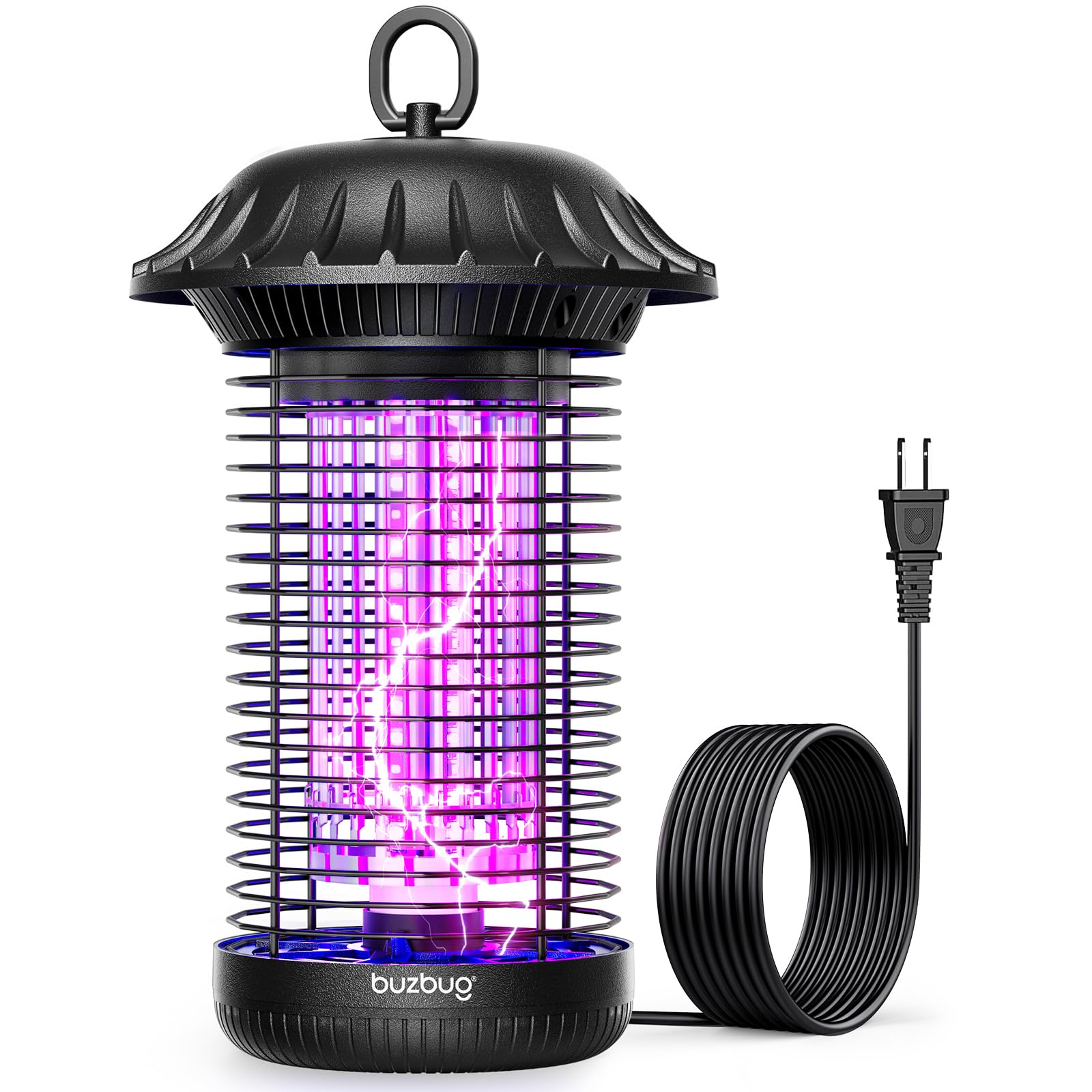
Buzbug MA009 LED Zapper

Buzbug MA009 LED Zapper

Small switch-controlled rooms

Our Score 8.4/10
Check Price

Worth Noting

  • Uneven attraction in bright rooms
Controls
Side on/off switch
Lamp Life
25,000–50,000 hours
Grid Voltage
3800V
Light Source
Three LED bulbs
Read the full review

Three LED bulbs and a side switch are what separate the Buzbug MA009 from the rest of this group. The switch matters more than it sounds: with most zappers here, the only off is the plug, so being able to cut the light without crawling behind a shelf is a real convenience in a room you use in the evening.

The MA009 is built for a desk, kitchen, or small office rather than a big open room. The 3800V grid is a step down from the 4200V and 4400V units, but the three LED lamps are rated for 25,000 to 50,000 hours, so the maintenance story is strong. The hanging chain and removable bottom make it easy to move between a countertop and a hook and to empty the tray without tools. It is sized for a small space, not a whole floor.

The side switch is the feature we value most; it turns a plug-in zapper into something you can run for an evening without unplugging it. The MA009 is small enough for a desk or kitchen, and the removable tray keeps cleanup simple. We see it as the pick for someone who wants that control and long LED life in a small indoor space, not as the one to buy for a whole-floor bug problem.

Bottom line: The Buzbug MA009 is the one for a small room where you want a real off switch and LED longevity without turning the zapper into a permanent fixture.

5

Buzbug MO008C LED Zapper

Buzbug MO008C LED Zapper

Low-maintenance indoor use

Our Score 8.2/10
Check Price

Worth Noting

  • Attraction weakens in bright rooms
Lamp Life
25,000–50,000 hours
Power Cord
5.6 ft
Light Source
Dual-band 365/395nm LED
Indoor Coverage
Up to 2,100 sq ft
Read the full review

The Buzbug MO008C is the pick for someone who is tired of buying glass UV tubes. It uses dual-band LEDs at 365nm and 395nm, and the lamp is rated for 25,000 to 50,000 hours, so the maintenance story is genuinely different from the fluorescent units here. The 5.6-foot cord and 1.8-pound body make it easy to move from a kitchen to a garage.

The LED light is not as visually loud as a pair of 10W tubes, but that is not the same as ineffective: the dual bands are chosen to cover more of the spectrum insects respond to, and the unit is light enough to move to the bug traffic rather than waiting for the bugs to find it. The indoor coverage claim of 2,100 square feet is an open-plan number, not something that pushes through walls. Treat it as a localized lure and it makes more sense.

The pop is still loud enough to remind you it is there, and the LED array does not make the unit a set-and-forget whole-home solution. What it does give you is a much lower bulb-replacement burden and a body that hangs or stands without fuss. If you want the strongest indoor default, the ASPECTEK is easier to trust; if you want to stop swapping tubes and can place it well, this one is a sensible alternative.

Bottom line: We like the Buzbug MO008C for anyone who wants to stop swapping UV tubes; its dual-band LEDs and long lamp life make it the low-maintenance choice for a dim indoor corner.

How We Tested Indoor Bug Zappers Around the House

We started by pulling together every zapper actually meant to sit inside a home — no outdoor lanterns, no handheld racket swatters — then filtered by coverage area, bulb type and availability, tray design, and price, cutting anything with a sealed collection tray or a bulb you can't replace. That left 12 units, which we ran for four months, from late spring into the soupy part of summer.

The zappers moved around. Each spent at least two weeks on a kitchen counter near a fruit bowl, a week in a basement laundry room, and a stretch in a bedroom running overnight with the door shut, plus a few evenings in the living room with the patio door open. Every morning we pulled the tray, dumped it onto a paper towel, and sorted what was in it — moths and beetles in one pile, biting insects in another. That count, not the glow, is what we treated as performance.

We measured noise with a decibel meter at three feet, then ran the more honest test: stood in the next room and judged whether we'd sleep through it. Cleaning got timed — tray out, inner grid brushed, tray back in — and we noted which units left bugs welded to the grid where a brush barely reached. Durability was checked at the end: cracked housings, bent grids, dead bulbs, and whether a replacement bulb is even sold. Value came down to watts drawn and how many nights the thing actually killed something; a zapper that hummed along catching nothing while mosquitoes landed on our arms went straight into the ineffective pile, whatever it cost.

How to Choose Indoor Bug Zappers

Match the zapper to the room, not the acreage

Outdoor coverage numbers are written for open air. Indoors, walls, furniture, and brighter lamps break up both the UV lure and the kill zone, so a 1/2-acre claim does not mean one unit will clear a house. Start with the room where you see the insects and pick a size that fits the outlet and the surface. A compact cube like the Jawlark belongs on a counter or near a bin; a larger unit like the AMUFER is the better fit for a garage or a long open room. Put the zapper in the bugs' path, away from where people sit, because the light pulls insects toward the device rather than repelling them.

Look for a shielded grid and a tray

The high-voltage grid is the part that does the killing, and the shield is the part that makes it livable indoors. A protective mesh screen keeps fingers and paws away from the charged grid; a removable tray catches the bodies so you are not scraping the housing. We do not put an unshielded zapper at child height or on a floor where a pet can nose it. The ASPECTEK's mesh and washable tray are the reason it earns our top spot; the Buzbug MA009's removable bottom does the same job in a smaller package. Unplug before you clean or change a bulb, every time.

Decide how much bulb maintenance you will tolerate

Fluorescent UV tubes are the traditional lure, and they dim with use; that is why spare bulbs matter. Two spares in the box, as with the ASPECTEK, can cover a couple of seasons and save a separate order. LED zappers such as the Buzbug MO008C are rated for tens of thousands of hours, which lowers replacement chores, but a long lamp life does not guarantee the same attraction in a bright room. Check what replacement bulbs cost and whether they are easy to find before you choose a tube model; the cheaper unit is not cheaper if the bulb is hard to source.

Plan for noise, controls, and cleanup

A zapper's crack is the sound of it working, and for some people that is satisfying; for a light sleeper or a nervous dog, it is the reason to keep the unit out of the bedroom. If you want to turn the zapper off without unplugging it, look for a side switch; the Buzbug MA009 has one, while the AMUFER does not. The tray matters more than the brush: a tray you can slide out and rinse beats a fixed base you have to wrestle. Decide where the unit will live before you buy, because moving a zapper to a dark corner later is harder than choosing the right spot.

Frequently Asked Questions

Final Verdict

The ASPECTEK 20W is the indoor zapper we recommend first because it combines a shielded 2800V grid, twin UV tubes, and a tray we can empty without wrestling the unit. It is the easiest one here to live with in a kitchen, living room, or screened porch. If the zapper has to cover a garage or a long open room, choose the AMUFER for its higher voltage and wider coverage; for a countertop or small kitchen, the Jawlark's compact body makes more sense. The best choice is the one that fits the room you actually need to clear.