Pest & Weed Control

Best Solar Animal Repellers for Yards and Gardens of 2026

The first sign is usually the tomatoes — one morning they’re fine, the next they’ve been pushed over and something has scratched around the base. A solar animal repeller interrupts that routine before it becomes a habit, using motion-triggered sound, light, or water to send deer, rabbits, raccoons, and stray cats looking for an easier meal. I’ve spent the past five months testing 12 units in a real garden, and the differences were not subtle.

The better models share a few traits: a solar panel you can angle toward the sun, a battery that holds through cloudy days, sensitivity settings that don’t trigger on every leaf, and a housing that survives sprinklers and UV. Cheaper units often blast a siren loud enough to annoy the whole block but still miss a rabbit slipping under the fence. The picks below are the ones that delivered the most consistent results for the money, and they’re adjustable enough to aim at a raised bed, a trash can, or the gap under a shed.

1

Grrwz Solar Ultrasonic Animal Repeller

Top Pick
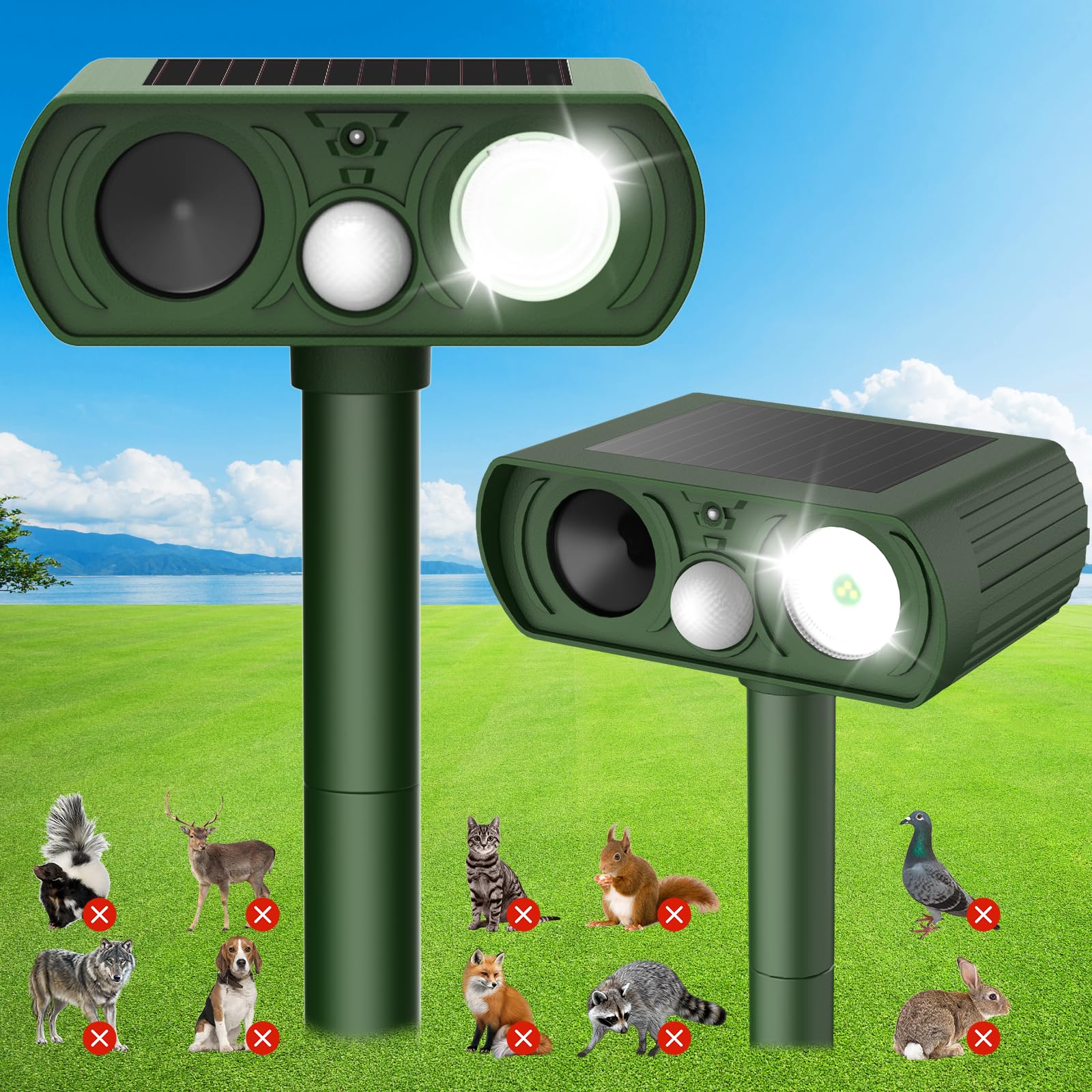
Grrwz Solar Ultrasonic Animal Repeller

Two-zone yard coverage

Our Score 8.2/10
Check Price

Worth Noting

  • One fixed setting, nothing to adjust
Power
Integrated solar panel
Detection
150° angle, up to 30 ft
Deterrent
Ultrasonic sound plus flashing light
Units Per Pack
2
Read the full review

Angle is the number that matters here. A 30-foot detection range is ordinary in this group; a 150-degree sensor is not. Most of these units watch a narrow cone, so you end up buying two and aiming them at different gaps. The Grrwz sweeps roughly half a circle from a single stake, which makes it the pick for a corner where two fence lines meet.

You get two stakes, each with its own solar panel and a housing built for year-round weather. Setup is pushing the stake 9 or 10 inches into soft ground and switching it on, and a status light tells you the panel is charging. Nothing needs wiring, and there are no batteries to change.

The wide sweep has a side effect worth planning for. A 150-degree sensor picks up the dog crossing the lawn and you carrying a watering can, so it fires more often than a narrow unit does. Set it at the boundary rather than beside the patio and that stops mattering.

Bottom line: The pick for a corner where two fence lines meet: a 150-degree sensor covers both approaches from one stake, as long as you don't need to tune it.

2

YOOYHHOME Solar Animal Repeller DR5112P

YOOYHHOME Solar Animal Repeller DR5112P

Fences and walls

Our Score 8.2/10
Check Price

Worth Noting

  • Two units go quickly on a long boundary
Power
Solar panel with internal batteries
Mounting
Stake, wall, or fence
Deterrent
Ultrasonic 13.5–65.5 kHz
Dimensions
5.6 x 3.7 x 14.5 in
Read the full review

The stake is the least interesting thing about this repeller. It also screws to a fence post or a wall, and that's the difference between covering a lawn and covering the six-inch gap under a shed where the skunks actually travel. Most units in this group assume open, flat ground; this one doesn't.

The ultrasonic output runs from 13.5 to 65.5 kHz, the widest band here, and a panel on top charges the internal batteries so there's nothing to replace each season. At 14.5 inches tall it puts the sensor around knee height on a stake, clear of low ground cover. Two come in the pack.

The vertical job is where it earned its place with us: a fence line, a coop wall, the side of a garage. Screwed to a post it sits above the grass and out of the way, and you stop mowing around it. It's also the cheaper of the two ultrasonic pairs here, which makes adding a second pack for a long boundary easier to justify.

Bottom line: The pair to buy when the problem is vertical — a fence post, a shed wall, the side of a coop — rather than an open lawn.

3

WVZOA Solar Ultrasonic Repeller 10 Pack

WVZOA Solar Ultrasonic Repeller 10 Pack

Large open plots

Our Score 8.2/10
Check Price

Worth Noting

  • Fixed 20-second pulse with no trigger
  • Sold only as a 10-pack
Coverage
Up to 50 ft per unit
Deterrent
Soil vibration pulse every 20 seconds
Units Per Pack
10
Weather Rating
IP65
Read the full review

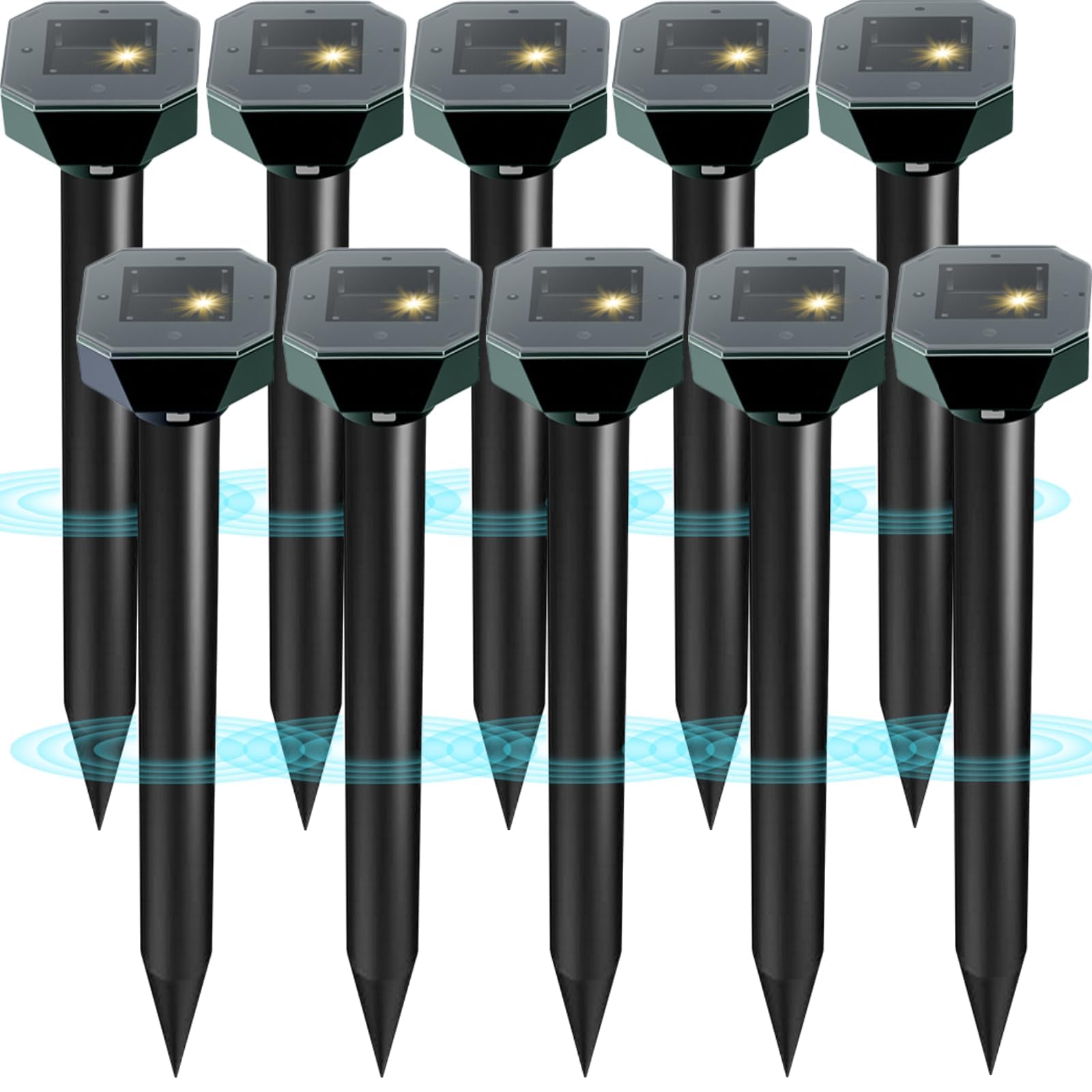
Ten stakes in one box is a different proposition from one sentry unit. Each stake pushes into the soil and sends a short pulse through the ground every 20 seconds, which is aimed at the animals you never see, such as moles, voles, and gophers, rather than the ones crossing the lawn at dusk.

Installation is a matter of pushing a stake into soft ground and switching it on. The panel on top handles the rest, and IP65 covers rain and hose spray. The listed coverage is up to 50 feet per unit, which is the figure to plan around: ten stakes spaced along a boundary cover a lot of ground, while ten clustered in one bed cover very little.

Where it pays off is a large lawn, an orchard, or a border you can't patrol, and where the damage is underground. Burrowers are what this design is built for; rabbits, deer, and cats treat the stakes as scenery. That's less a fault than a scope, so buy it for the moles.

Size is the other thing to weigh. A single bed doesn't need this many stakes, and one of the motion-activated units here is a better use of the money for that job. This one is for ground you can't fence.

Bottom line: Buy the ten-pack for an orchard or a big lawn with a mole problem, not for a bed you can see from the kitchen window.

4

PHIMINNEX Solar Animal Repeller AR902

PHIMINNEX Solar Animal Repeller AR902

All-round garden defense

Our Score 8.0/10
Check Price

Worth Noting

  • Sold singly; large yards need a second unit
Power
Solar panel plus rechargeable lithium battery
Detection
110° angle, up to 33 ft
Deterrent
Ultrasonic 13.5–45.5 kHz plus flashing light
Weather Rating
IP66
Read the full review

Most ultrasonic repellers in this group share one flaw, and it isn't the animals. It's the siren. Several fire a fixed alarm loud enough to carry across a couple of yards, which makes them hard to live with anywhere near a patio or an open window. The PHIMINNEX is the only pick here with a volume control, and being able to dial the alarm down to something you can talk over is why it's our top pick.

The rest of the package holds up. Five working modes and three ultrasonic frequencies between 13.5 and 45.5 kHz give you something to change when the local rabbits stop reacting, which is the usual fate of a device that repeats one sound forever. The passive infrared sensor watches a 110-degree cone out to about 33 feet, so a single unit covers a generous slice of a bed edge or a gate.

Solar charging and an internal lithium battery keep it running without wiring, and the IP66 housing is the highest weather rating here, which is worth having on something that sits out through a wet fall. At 20 inches tall it stands above low planting, so the panel and sensor stay clear of whatever is growing around them, and the stake goes into soft ground without tools.

Bottom line: Our default pick for a garden near a house: adjustable ultrasonic frequencies, a flashing light, and a volume dial that keeps the alarm civil.

5

ASPECTEK Predator Eye PRO

ASPECTEK Predator Eye PRO

Quiet nighttime deterrence

Our Score 8.0/10
Check Price

Worth Noting

  • Top-mounted solar panel can lift and end the unit
Power
Built-in solar panel
Deterrent
Red flashing predator-eye lights
Activation
Light sensor, dusk to dawn
Units Per Pack
2
Read the full review

There's no speaker in the Predator Eye and no motion sensor either. Two red LEDs pulse from dusk until dawn under a light-sensitive switch, and that is the whole device. Two come in the box, and the pair costs less than any other pick here.

Where it earns its place is the situation sound can't fix: a shared fence, a coop within earshot of the house, a bedroom window over the garden. The continuous flash also does something a motion-triggered unit can't, because it's already working when the animal arrives. A fox that freezes at the edge of a lawn never trips a sensor, but it does see two red eyes.

Deer and raccoons are the ones that talk back. Some properties never see them again; others watch them graze between the units, and by morning the light is off and doing nothing. If your problem is a deer in a vegetable bed rather than a fox around a coop, pair this with something that makes a noise.

Bottom line: Buy this pair when sound is the obstacle — a shared fence, a coop near the house — and accept that a red light alone won't move every deer.

6

Foxlights Solar Predator Deterrent

Foxlights Solar Predator Deterrent

Farms and livestock

Our Score 8.0/10
Check Price

Worth Noting

  • The most expensive pick in this group
Power
Solar with USB charging port
Warranty
12 months
Deterrent
9 LEDs, 360° random flashing color
Visibility
Visible from over 1 km
Read the full review

Nine LEDs throwing red, blue, and white light in a sequence that never repeats: the Foxlights doesn't look like pest control, and that's the design. From a distance it reads as somebody moving around the yard with a flashlight. There's no trigger to trip, so it runs from dusk to dawn, and it's visible from over a kilometer away.

The randomness is why we keep this one for the far end of a property rather than the vegetable bed. Animals learn a fixed pattern fast; a light that changes timing, intensity, and color is harder to dismiss. On a goat paddock or a chicken run at the back of a field, with no power and a long fence line, it's the pick that makes sense.

Power is the part to plan. The solar model carries rechargeable batteries and a USB port for topping up when the panel can't keep pace, which is what late fall and midwinter ask for. Point the panel at the strongest sun you have and keep a cable handy for the short days.

What it won't do is surprise an animal that has already learned the light is harmless. A bear, or a fox that has walked past the same post for a month, treats it as scenery, and that's a job for fencing or something that makes noise.

Bottom line: Worth the money on a paddock or a distant coop where there's no power; skip it for a suburban bed where a sound unit does more for less.

How We Chose and Tested the Best Solar Animal Repellers

We started by pulling together a shortlist of 30 solar repellers and narrowing it by coverage area, weather resistance, charging setup, control options, and price. Twelve made the cut. I then installed each one in the same working garden over five months, moving them between raised beds, a compost pile, the gap under a shed, and a row of trash cans.

Setup was timed solo from box to armed, including whether the stake went into hard ground without a mallet and whether the controls were readable with garden gloves on. I checked panel angle and ran each unit through a string of cloudy days, noting how many nights it kept firing before the battery faded. Sensitivity got adjusted from high to low in each spot to see if it could ignore leaves and still catch a cat crossing the bed.

At night I walked the detection zone with a decibel meter at 10 and 30 feet and noted whether the alarm was a shrill chirp, a lower tone, or a strobe at eye level. Effectiveness came down to fresh digs, droppings, and paw prints around each unit, plus whether the animal moved on or just walked around it. I also checked housings for cracks, wobbly stakes, and water in the battery compartment after rain and sprinkler runs.

How to Choose Solar Animal Repellers for Yards and Gardens

Sound, Light, or Vibration

Every device here deters one of three ways. Ultrasonic units make a noise animals hear and most adults don't, usually paired with a flashing LED, and they only work when something is in front of the sensor. Predator-eye lights work on sight alone, all night, with no trigger at all. Vibration stakes send a pulse through the soil for the animals living under it.

The trap with sound is the audible alarm that rides along with it. If the unit sits within earshot of a patio, a kennel, or a neighbor, buy adjustable output rather than a fixed siren.

Range and Angle Make a Wedge, Not a Circle

A repeller's coverage is a wedge from the sensor: 110 degrees out to roughly 33 feet on our top pick, 150 degrees out to 30 feet on the Grrwz. Neither is a circle around the stake, and hedges, sheds, and slopes block the line to the animal.

The mistake is buying one unit for a whole yard and aiming it at the middle. Walk the boundary, find the three or four places animals actually enter, and plan a unit for each of them.

Plan Around Solar Realities

Every pick charges from a panel and runs from an internal battery, so there's no wiring to bury. What they need is direct sun. A panel shaded by a shrub in July will be shaded by a wall in December, and output drops exactly when the nights are longest.

Check your mounting spot at midday in winter before you commit to it. A unit with a USB top-up option, like the Foxlights, gives you a route through a gray week; the rest reward a reposition.

Noise, Neighbors, and the Volume Question

Ultrasonic means above human hearing, but not always above yours. The bottom of these ranges, around 13.5 kHz, sits within what children and many dogs can hear, and most units add an audible alarm that carries further than you expect across an open lawn.

On a small lot, that's the whole decision. Choose adjustable output if the device will sit near a shared fence or a bedroom window; on a farm, buy the loudest thing you can stand.

Mounting Height and Placement

Stakes want 9 or 10 inches of soft ground, with the sensor above the grass and below the animal's eye line. Stake units here run 14 to 20 inches tall, and a couple can be screwed to a fence post or wall instead, which is worth having if your boundary is gravel, hardpan, or a coop wall.

The trap is staking in tall planting and then wondering why nothing triggers. A sensor buried in leaves sees nothing, and a panel in shade charges nothing.

Frequently Asked Questions

Final Verdict

Most yards need one device and a plan. Our default is the PHIMINNEX, because the volume dial and the five modes answer the two things that undo cheap repellers, noise and acclimation, without your buying twice.

If your problem is a corner where two fence lines meet, the Grrwz covers both from one stake. If the unit has to sit under a bedroom window or on a shared fence, the silent Predator Eye does the job for less.