Watering & Irrigation

Best Impact Sprinklers of 2026

A lawn sprinkler should be the easiest thing you own — set it, walk away, and let it do its job. In practice, most of us have watched a cheap impact sprinkler tip over on a slope, spray half the sidewalk, or quit rotating by the second week. A good one fixes all three: it stays upright, covers the area you aimed at, and keeps ticking season after season without fuss. I've lost my share of $15 specials to cracked bases and stuck arms, which is why I was curious whether spending a little more actually buys reliability.

This spring, my team and I put 14 impact sprinklers to work on real lawns for four months. We timed how long each one took to set up, watched how evenly they rotated, and checked whether the adjustment collars actually held their position after a month of use. The best ones earned their spot by doing the boring things right — staying put, covering what they promised, and not springing a leak by July.

1

Rain Bird AG-5

Top Pick
Rain Bird AG-5

In-ground systems

Our Score 9.2/10
Check Price

Worth Noting

  • Plastic body can crack after a season
Nozzles
5 color-coded
Pattern
20°-360°
Inlet Size
1/2 in
Spray Distance
24-45 ft
Read the full review

Five color-coded nozzles are the reason the Rain Bird AG-5 is our pick for a buried system. Swap the nozzle and you change the flow to suit the zone instead of forcing one head to cover every run. The 24-to-45-foot radius and 20-to-360-degree pattern give it a wide working range, and the head is built for hard, dirty, or reclaimed water — the kind of supply that clogs a fussier sprinkler.

The pop-up body is the practical part: it rises to water and drops back out of the mower's path. We appreciate the diffuser screw for trimming the radius by up to 25% without changing nozzles; that is the adjustment we reach for when a walkway or bed is in the way. The five nozzles also make the same body useful in different parts of the yard, which is more flexibility than a fixed-nozzle impact head gives you.

This is a bare pop-up head, not a hose-end sprinkler. It needs a canister and buried pipe, so it makes sense for an existing system or a planned install, not for someone who wants to hook up a hose and move it around the lawn. Check the nozzle bag before you start; a missing nozzle is a nuisance when you are already on your knees at the valve box.

Bottom line: For a buried system, we choose the AG-5: five nozzles let you match flow, and the pop-up head is built for hard or dirty water.

2

Rain Bird 25PJDAC

Rain Bird 25PJDAC

All-purpose head

Our Score 8.8/10
Check Price

Worth Noting

  • Rotation can bind at the end of a pass
Pattern
20°-360°
Inlet Size
1/2 in
Body Material
Brass
Spray Distance
20-41 ft
Read the full review

Brass, bronze, and stainless steel set the 25PJDAC apart from the plastic-bodied heads here, and the 20-to-360-degree pattern with a 20-to-41-foot radius gives it a useful range for a lawn or a long garden bed. The body feels dense and solid in the hand, and the metal parts give the adjustment a direct, mechanical feel. It is the kind of head that makes a cheap plastic sprinkler feel disposable.

The combination of material and adjustment is what earns this head the top spot. The deflector flap and diffuser screw change the distance without tools, and the 20-to-360-degree pattern covers everything from a narrow strip to a full circle. We like that the adjustment is direct: you can see what the arm is doing and correct it by hand. That matters more than a long feature list when the wind picks up and you want the spray off a walkway.

The 1/2-inch inlet is the detail that decides whether this is a quick swap or a trip to the hardware store. It fits many existing impact spikes and risers, but not a standard 3/4-inch hose end without an adapter. If you already have a mount, this is the head to screw on; if you need a complete sprinkler, the tripod pick is the easier start.

Bottom line: We recommend the 25PJDAC as the default brass head for anyone who already has a mount or riser: it adjusts widely, throws 20 to 41 feet, and feels built to outlast plastic.

3

Wexo Palindrog Tripod

Wexo Palindrog Tripod

Adjustable-height tripod

Our Score 8.8/10
Check Price

Worth Noting

  • Head can stop rotating after a few uses
Inlet Size
3/4 in
Height Range
16-37 in
Spray Radius
20-35 ft
Head Material
Zinc
Read the full review

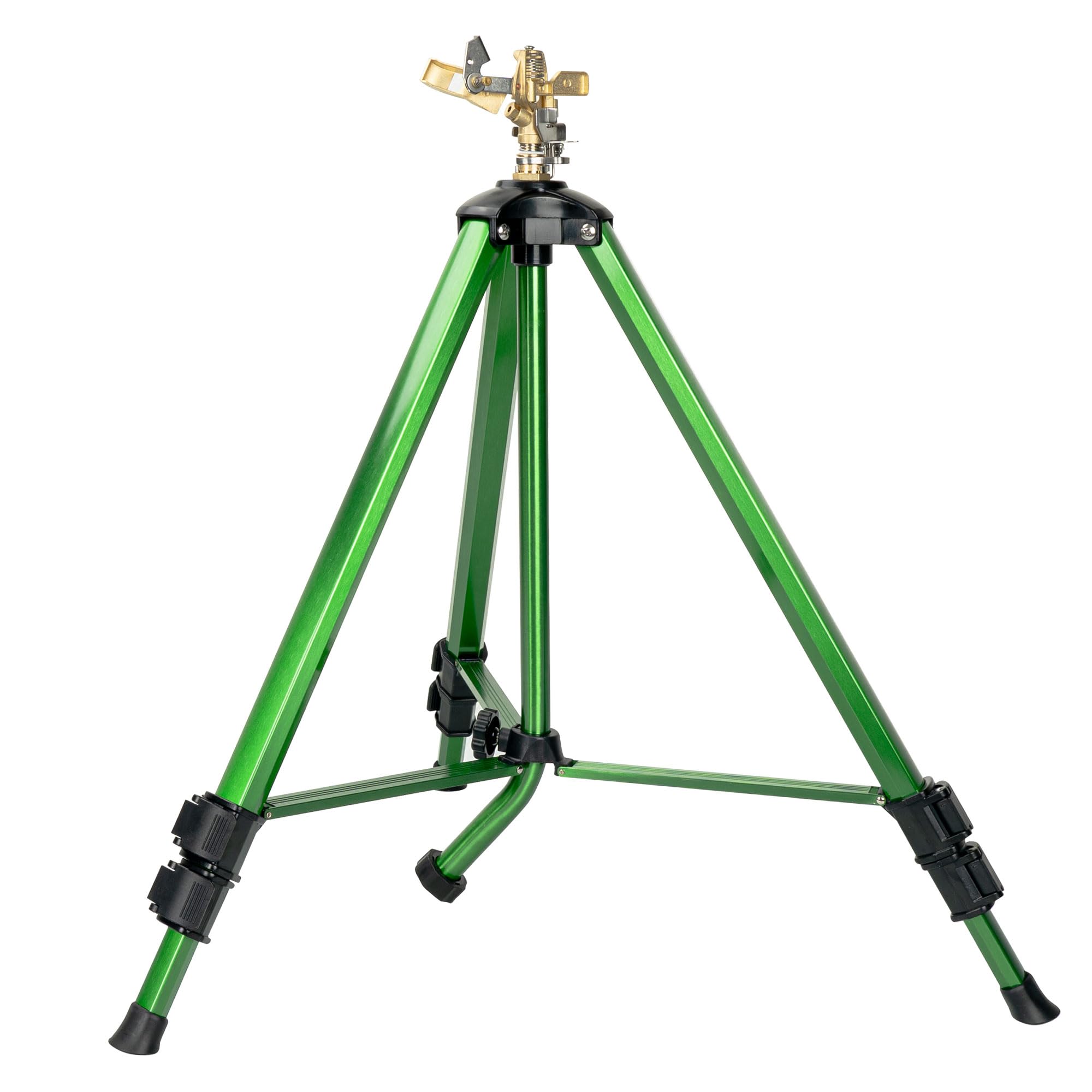
The 16-to-37-inch height range is the first thing we noticed about the Wexo Palindrog. That is enough lift to clear tall grass and low shrubs, and the flip locks let you change height without tools. The 3/4-inch inlet also threads onto a standard garden hose, so the tripod is ready to use without an adapter.

We think the tripod is the reason to choose this one. Set it low for a new lawn or high for a bed behind a hedge; the head rotates nearly 360 degrees and covers a 20-to-35-foot radius. That is a smaller reach than the Rain Bird heads, so it suits a modest lawn or a spot where you can move the tripod once or twice. The zinc head and alloy legs feel more substantial than the price suggests, and the flip locks make height changes quick.

The head is the part that gives us pause. It is not a brass head, and the zinc body is the piece to watch over time. The tripod is the sturdy part, and the whole unit is easy to move and set up. The height adjustment is the feature you notice every time you move it, and that is why it earns a spot.

Bottom line: We reach for the Wexo when height matters: its tripod lifts the head to 37 inches and its 3/4-inch inlet fits a standard hose without fuss.

How We Tested Impact Sprinklers

We started by pulling together a shortlist of 22 impact sprinklers from brands we trusted, then narrowed it to 14 based on price, available spray patterns, and whether replacement parts were sold separately. We unboxed each one and noted what was in the box — two arrived missing a nozzle or a base stake, which we counted against them. Then we set them up on home lawns, community garden plots, and a sloped backyard over four months, from May through August.

Each sprinkler ran on a standard garden hose at whatever pressure the site had — we didn't adjust anything to make them look better. We watched the first ten minutes of operation to see how quickly each one found its rotation and whether the arms stuck or stuttered. Then we measured coverage by placing cups across the lawn and checking how much water landed at the edges versus the center. We also adjusted the spray distance and pattern daily, noting whether the collars moved smoothly or seized up after a few weeks.

Stability got its own test: we set each sprinkler on a 10-degree slope and gave it a nudge to see if it tipped. Durability came from living with them all summer — we checked for cracked bases, rusted springs, and arms that lost their spring. Value for money came last: we compared the price against how well each one held up and how easy it was to adjust, not just what it cost upfront. The ones that made the list are the ones we'd buy again with our own money.

How to Choose Impact Sprinklers

Start With the Mount

An impact head is only one part of a sprinkler. A head-only model like the Rain Bird 25PJDAC has a 1/2-inch inlet and expects a spike, tripod, or riser with a matching fitting. A tripod sets the head above tall grass and lets you change height; a pop-up head like the AG-5 is designed for buried pipe and a canister. The common mistake is buying a bare head and then discovering the hose will not thread on. Match the mount and thread first, then choose the head.

Read the Throw Against Your Pressure

Every radius on the box assumes enough pressure and flow behind it. A 41-foot throw on a weak line can turn into a heavy, short spray that puddles near the head. Before you buy for distance, test the pressure at the hose bib or run the sprinkler on the same line you plan to use. The AG-5's 24-to-45-foot range and the Wexo's 20-to-35-foot range are useful comparisons, but they are not promises at every tap.

Treat Rotation as a Wear Part

Impact sprinklers turn because a weighted arm trips a reversing mechanism. Grit, mineral scale, or a bent arm can make the head stick at one end of the pass, which is the failure that matters most in this category. A brass head with a simple, cleanable arm is the safer long-term choice than a plastic mechanism buried under trim. Flush the inlet before installation, use a filter with dirty water, and check the sweep before you set the final position.

Match the Body to the Water

Brass and bronze resist corrosion and handle hard water better than zinc or plastic, but they cost more. Zinc alloy is a reasonable middle ground for a tripod head; plastic is common in pop-up bodies because the canister protects it underground. If your supply is gritty or reclaimed, choose a head with a larger nozzle orifice and a filter you can clean. The AG-5's five nozzles are useful here because you can match flow to the zone rather than forcing one orifice to do everything.

Frequently Asked Questions

Final Verdict

For a sprinkler setup you can build around, we recommend the Rain Bird 25PJDAC. Its brass and stainless-steel body is the most durable material story here, and its 20-to-41-foot throw and 20-to-360-degree pattern handle a range of yards. It is a head, not a complete sprinkler, so you need a mount or riser. If your sprinklers are buried, the AG-5 is the better fit; if you want a complete tripod, choose the Wexo.