Watering & Irrigation

Best Lawn Sprinklers of 2026

A lawn sprinkler should be the least dramatic thing in your yard: set it down, aim it, and get back to your Saturday. Instead, most of us have spent a summer evening dragging one across dry grass, chasing a spray pattern that puddles the driveway or misses the garden bed. The right model puts water where you point it, holds its position under hose pressure, and survives the sun. I don’t need a fountain; I need the lawn wet when I unclip the hose.

Over three months, my team and I tested 14 sprinklers through weekend deep soaks and quick after-work watering, with garden beds, a patchy front lawn, and a slight slope giving every base a stability test. We compared material quality and durability, adjustability, oscillation, coverage, weight, and basic function, plus how easily each one moved when dragged by the hose. The best values made setup and repositioning feel simple; the rest made me babysit a spray pattern. The picks below are the ones that earned a permanent spot.

1

Eden 95124 Mini Turbo

Top Pick
Eden 95124 Mini Turbo

Strips and corners

Our Score 9.0/10
Check Price

Worth Noting

  • Needs more repositioning than a wide oscillator on a full lawn
Weight
1.8 lb
Nozzles
16
Coverage
Up to 4,069 sq. ft. (378 sq. m.)
Adjustment
Four-way: width, length, flow, angle
Read the full review

Most sprinklers are built for a rectangle. The Eden 95124 is built for the parts of a yard that are not one — the two-foot strip between the fence and the driveway, the bed along the front walk, the wedge where the lawn narrows to a point. Four adjustments, covering width, length, flow and a 360-degree angle, let you shut the spray down to a strip instead of soaking the fence to reach the grass.

The flow dial is the part we appreciate most. Turning the water down at the head rather than at the tap keeps the pattern even at low volume, which is what new seed and young plants want, and the turbo-drive motor is rated to work at low and high pressure alike. The H-shaped base is weighted, enough to keep a 1.8-pound sprinkler from wandering when the tap opens, and the whole thing stores on a shelf. The trade-off is pace: 4,069 square feet from a compact head means you will move it more often than a wide oscillator on a full lawn. For side yards, narrow runs and beds, that is the entire point.

Bottom line: Buy the Eden 95124 if your lawn is strips and corners rather than a rectangle — its four-way adjustment puts water where a wide sweep cannot reach without soaking the fence.

2

Eden 94110 Metal Oscillating

Eden 94110 Metal Oscillating

Wide lawn coverage

Our Score 8.8/10
Check Price

Worth Noting

  • Covers less ground than the 3,600 sq. ft. models here
Body
Aluminum
Nozzles
18
Coverage
Up to 3,315 sq. ft.
Max Pressure
100 psi
Read the full review

Metal where most of this group is plastic is the short version of why the Eden 94110 leads our list. The body is aluminum, the 18 nozzles sit in a bar that sweeps up to 3,315 square feet, and the cleaning pin is built into the housing, so a blocked jet is a thirty-second job instead of a hunt through the kitchen drawer. None of that is exciting. It is exactly what an oscillating sprinkler needs and rarely gets.

The controls are the sliding-tab kind, and we like the restraint: two range adjusters set how far the bar travels, and there is nothing else to fiddle with. The tabs are big enough to move with wet hands, which matters more than it sounds when you are standing over the thing with the water running. Eden also bundles a quick-connect starter set, and at a shared tap that is a real convenience — one twist, the water stops, and you swap to a wand without walking back to the spigot.

The limit is coverage. At 3,315 square feet it is a little smaller on paper than the 3,600-square-foot models here, and in a real yard that gap shows up as a strip at the far edge that needs a second position. The turbo-drive motor is rated for a longer gear life and the one we have been running sweeps smoothly, but it is still a plastic gear train inside a metal shell, and no sprinkler here escapes that. What you are buying is the shell and the pin. For a lawn you water every week of summer, we think that is the right trade.

Bottom line: We recommend the Eden 94110 because its aluminum body and built-in cleaning pin outlast the plastic housings that end most sprinklers' lives, and it covers a normal lawn from one position.

3

Melnor 65148 Turbo Oscillating

Melnor 65148 Turbo Oscillating

Small yards

Our Score 8.6/10
Check Price

Worth Noting

  • Light body shifts when the water comes on hard
Nozzles
16
Coverage
Up to 2,800 sq. ft.
Warranty
7 years limited
Max Pressure
80 psi
Read the full review

Seven years is the longest warranty in this group, and it sits on the least expensive wide-coverage oscillator here. That combination is the argument for the Melnor 65148, and it is a good one: a sprinkler is a cheap plastic thing that lives outdoors and dies young, so the maker's willingness to replace it counts for more than a spare spray setting.

The sprinkler itself is plain in a way we find easy to live with. Sixteen nozzles, sliding range tabs, an InfinityDrive turbo motor and a quick-connect bundle — no dials you will never touch. It is light, which cuts both ways: carrying it between zones is nothing, but a body this light will shift when the tap opens hard. Two lawn staples through the base, or a brick across it, settles the matter, and the range tabs let you aim the overspray away from the patio in the meantime.

Coverage is the honest limit. 2,800 square feet is the smallest of the wide oscillators in this group, so it suits a front lawn, a courtyard, or a garden you water in two passes rather than a half acre in one go. If that is your yard, the warranty and the price make this the sensible buy. Just budget for something to hold it down.

Bottom line: Our pick for a small yard on a budget: the Melnor 65148 carries the longest warranty here, and at 2,800 square feet it suits a front lawn you can water in two passes.

4

Orbit 58322 Traveling Tractor

Orbit 58322 Traveling Tractor

Large flat lawns

Our Score 8.6/10
Check Price

Worth Noting

  • Needs level ground and a clear hose path
  • Nearly 16 pounds to haul out and put away
Body
Cast iron
Speeds
Three
Weight
15.8 lb
Warranty
6 years
Read the full review

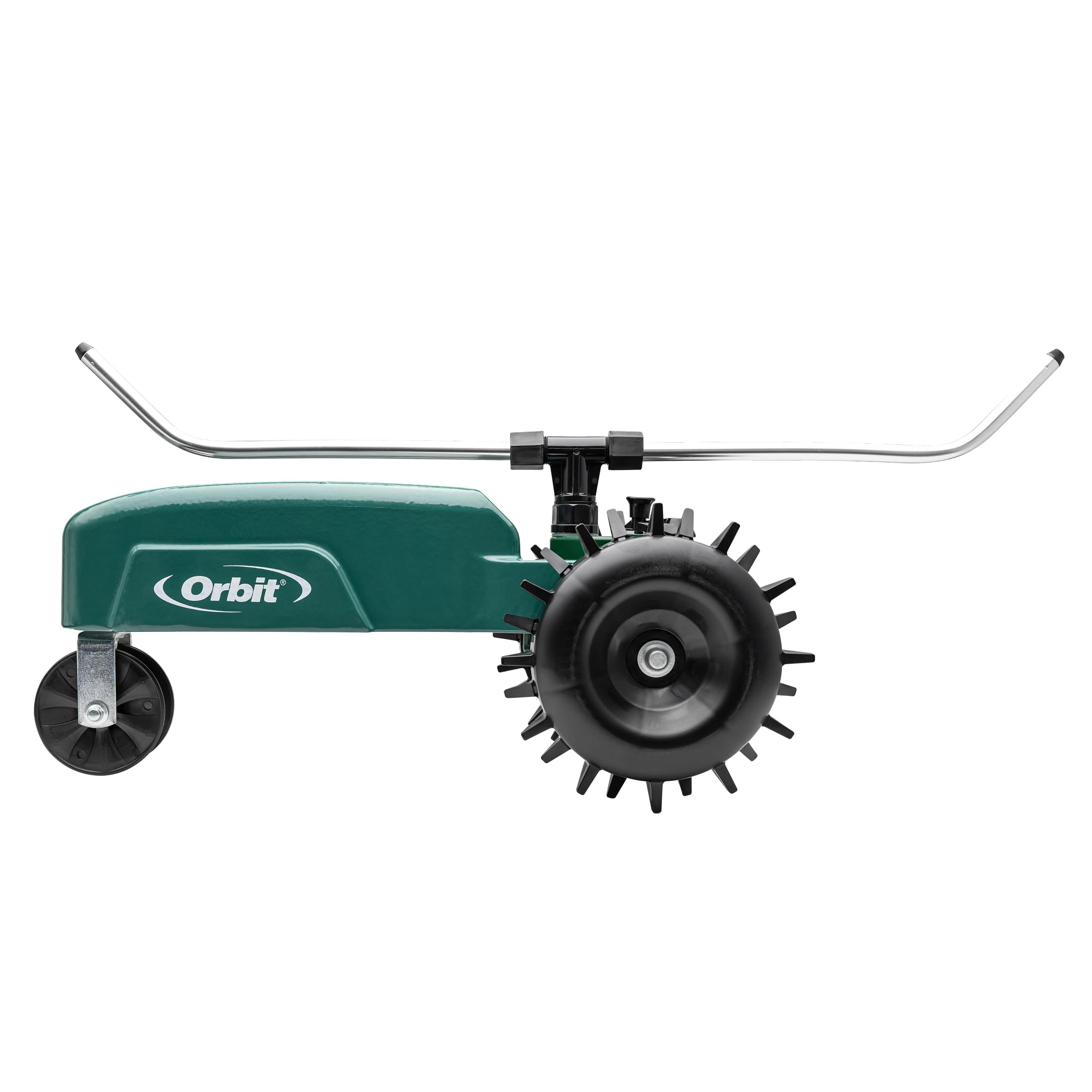
The Orbit 58322 is less a sprinkler you place than one you lay a track for. Run the hose out to the far end of the lawn, hook the front wheel over it, turn the water on, and the machine climbs the hose line spraying as it goes, then shuts itself off at the end. For a big, flat, rectangular lawn it replaces the whole routine of moving a sprinkler three times.

The hardware is serious: a cast-iron body, spiked wheels that bite into turf, three speeds and adjustable spray arms. At nearly 16 pounds it is heavy enough to keep traction, which is the whole trick with a traveling sprinkler — a light one stalls and sits. Orbit covers it for six years, second only to Melnor in this group.

Two conditions decide whether it works for you. The ground has to be reasonably level and reasonably clear, because the front wheel follows the hose: a kink, a crossing or a slope can stop the run, and you will discover that at the far end of the yard. Leave a few feet of straight hose beyond the finish so the shut-off has something to stop against. Pace the path out before the first run and buy a hose long enough to reach the far corner in one line. Do that, and it is the most pleasant way to water a large lawn that does not involve installing anything.

Bottom line: For a big, level lawn, the Orbit 58322 drives itself along the hose and shuts off at the end, so you set it once instead of moving a sprinkler all evening.

5

Joeys Garden 360° Rotary

Joeys Garden 360° Rotary

Round yards

Our Score 8.6/10
Check Price

Worth Noting

  • Spinning head is the part that stops first
Arms
3 adjustable
Inlet
0.5 in.
Rotation
Full 360°
Max Pressure
80 psi
Read the full review

An oscillating bar sweeps a rectangle, which is fine until your lawn is not one. The corners of a round yard, or the middle of a circular bed, end up soaked while the edges stay dry. The Joeys Garden sprinkler solves it the blunt way: three arms on a spinning head, throwing water in a full 360-degree circle.

We think the daisy-chain connection is the real feature. The hose screws into the base and a second hose screws into the top of the same fitting, so two or three of these run off one tap and cover a long border in a single session. The weighted base holds on grass, patio or gravel, and each arm turns to shorten or lengthen its throw, so the circle fits your space rather than the other way round. For a round lawn or a big border, this is the one we reach for.

It is plastic, and it is light, and the spinning head is the part that stops first — the same story as the oscillators here, only with a turret instead of a bar. What you get in exchange is even circular coverage, a base that stays where you put it, and room to add another unit as the planting spreads.

Bottom line: Round lawns and long borders are where the Joeys Garden earns its place — full circle, no dry strips, and a through-connection for chaining a second one to the same hose.

6

Aqua Joe SJI-OMS16

Aqua Joe SJI-OMS16

Sloping, windy sites

Our Score 8.6/10
Check Price

Worth Noting

  • Sweep gear is the part that fails
Base
Solid metal
Nozzles
16 clog-resistant
Coverage
Up to 3,600 sq. ft. (335 m2)
Max Pressure
120 psi
Read the full review

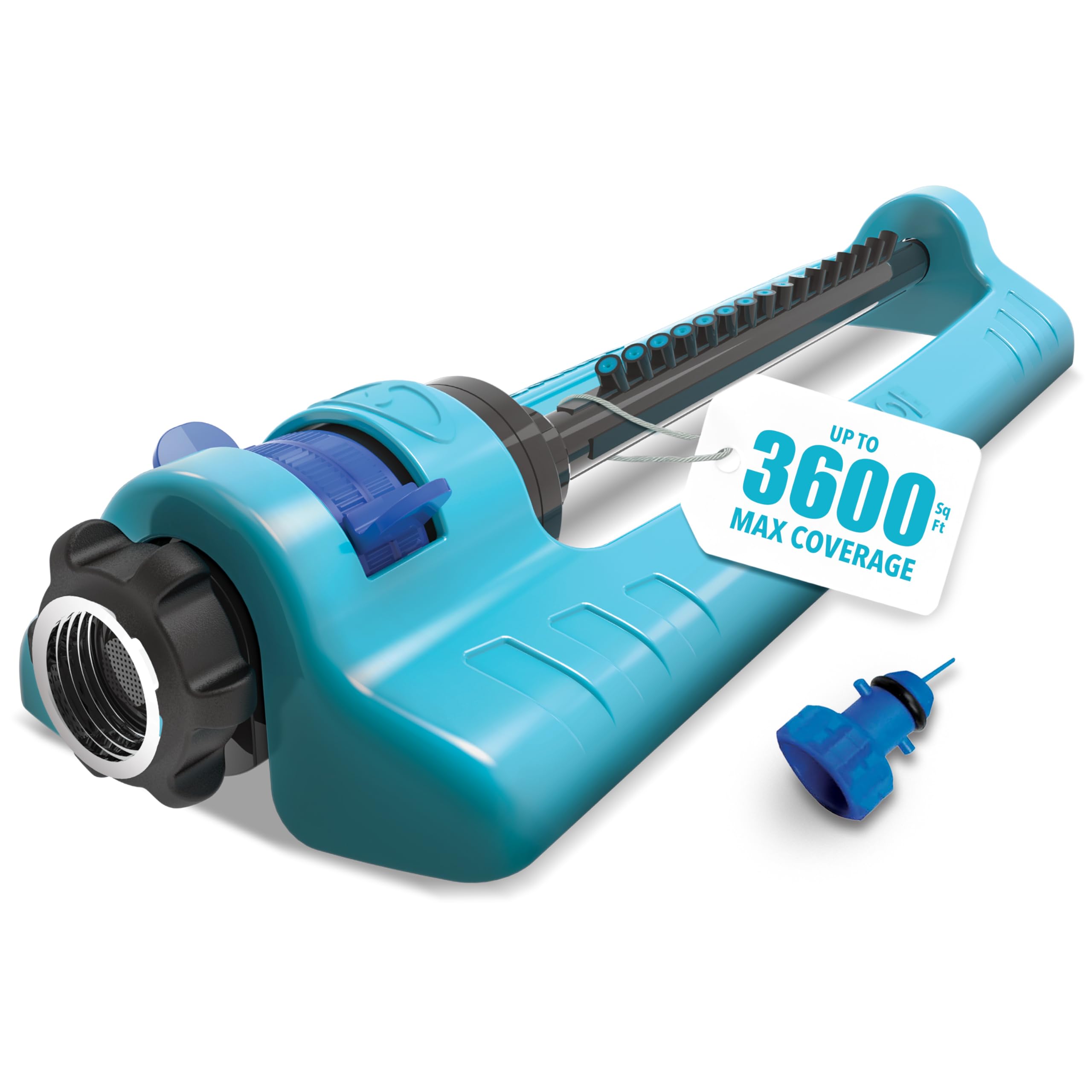
The base is the first thing you notice: an extra-large slab of solid metal under a slim spray bar. On a lawn that is not perfectly level, that base is the difference between a sprinkler that stays where you put it and one that walks into the flowerbed the moment the tap opens.

The rest of the package is well thought out. Sixteen clog-resistant nozzles throw up to 70 feet at 120 psi, the sealed turbo-drive gear unit is rated for a long gear life, and the clean-out pin lives in the body, so a blocked jet takes seconds to clear. Adjusting it is genuinely easy — the range and width controls move with a thumb, and aiming the sweep away from a patio is a two-second job.

So why is it not our top pick? The sweep. The bar runs on a plastic gear train inside the housing, and when that strips, the head parks in one position and the sprinkler becomes a very sturdy hose ornament. It is the same failure every oscillator here shares, and on this one it is the single thing most likely to end the sprinkler's life — the metal base will outlast the gearbox by years.

Buy it for the base, then: a sloping yard, a windy site, a spot where the hose tugs as you walk past. The two-year warranty is ordinary for the category, and the clean-out pin keeps the nozzles honest. If your sprinkler live somewhere it gets clipped by a hose or knocked by a mower wheel, the metal underneath is worth the trade.

Bottom line: The Aqua Joe is worth it when stability matters most — that solid metal base stays put on a slope — but accept that the sweep gear, not the base, decides how long it lasts.

7

Orbit 58257N 3-Arm

Orbit 58257N 3-Arm

Small gardens

Our Score 8.6/10
Check Price

Worth Noting

  • Too small a circle for a whole lawn
  • Arms can stop spinning or work loose
Arms
3 metal
Body
Metal
Weight
11.2 oz
Coverage
Up to 50 ft. diameter
Read the full review

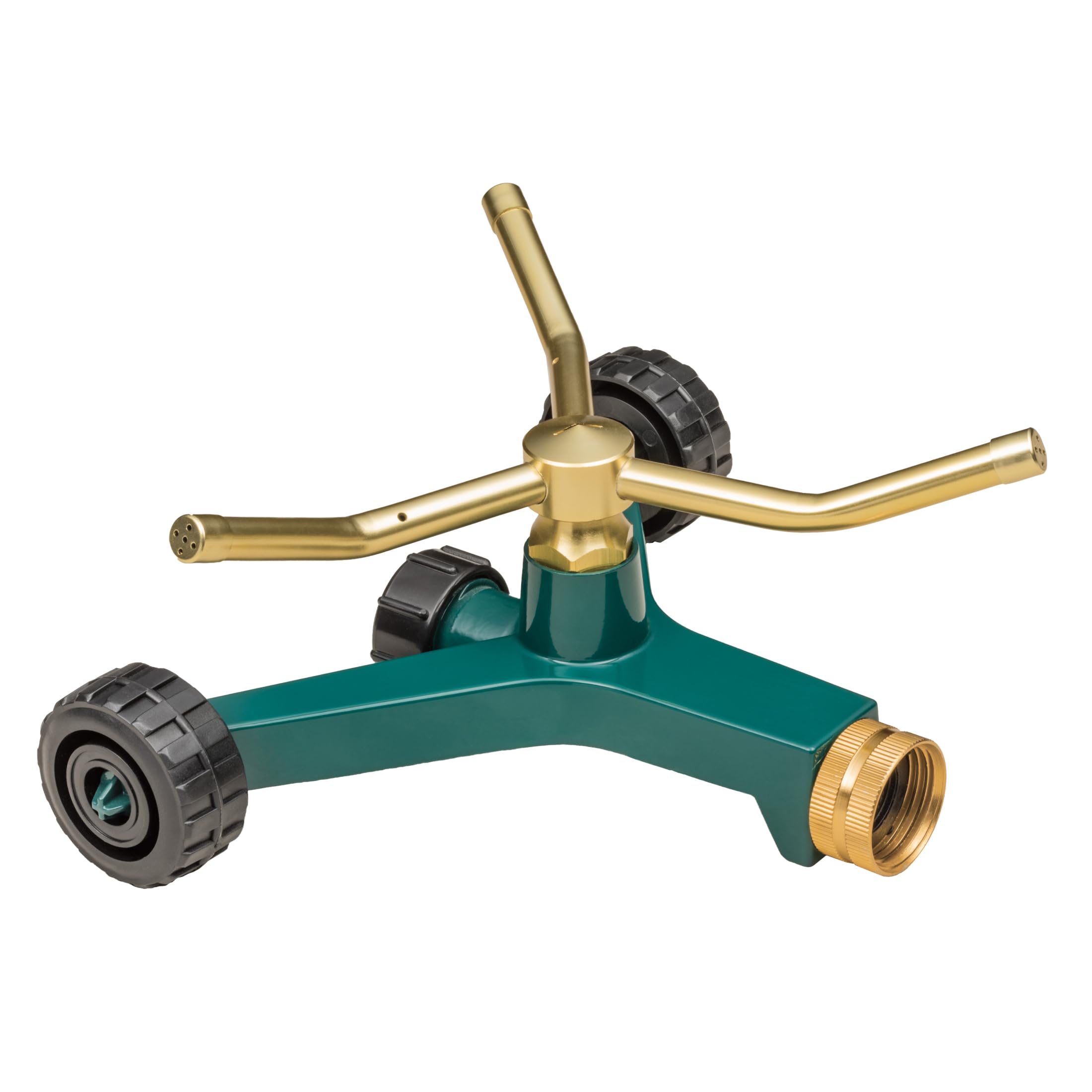
There is not much to the Orbit 58257N: three metal arms on a spinning head, a wheeled base, and a hose fitting. No gearbox, no sweep tabs, no flow dial. That is the appeal — fewer parts means fewer things to strip.

The head throws a full circle up to 50 feet across, and the nozzles turn to shorten or lengthen each arm's spray, so you can nudge the pattern off a walkway or push it further over a bed. The little wheels are more useful than they look: you can drag it to a new spot by the hose without tearing up wet turf.

Fifty feet across covers a courtyard, a front garden or a vegetable patch, not a whole lawn, so expect to move it or buy two. It is a water-driven spinner with no governor, so the arms turn faster at high pressure and the circle can break up into mist. What we like is the honesty of the thing: metal arms, a metal body, a coated finish, and nothing in the middle to wear out quietly. For a small yard or a bed you are currently watering by hand, that is exactly the right sort of sprinkler.

Bottom line: We keep this one for courtyards, beds and new seed: metal arms, full-circle coverage and no gearbox to strip, at a price that makes buying a second painless.

How We Chose and Tested the Best Lawn Sprinklers

We built the shortlist by scanning the sprinklers sold for home lawns, comparing spray style, footprint, listed coverage, connector and arm material, and price against owner feedback. From that pool, we chose 14 models that represented oscillating, rotary, and stationary styles, then tested them for three months. We skipped anything that arrived with vague setup instructions, mismatched fittings, or a base that looked likely to tip in real use.

Each sprinkler lived by the hose, not on a lab bench. We ran it on a patchy front lawn, along garden beds, and on a slight side-yard slope, using shallow cans spread across the spray zone to see where water landed evenly and where it pooled or missed. We adjusted arc, range, and pattern by hand, noting whether the controls moved smoothly or felt vague, and we let each one oscillate through full sweeps to catch sticking, uneven travel, or a mechanism that reversed with a jerk. Setup and moves were done solo, with the hose attached, to see whether a sprinkler stayed put when pulled or tipped over at the first tug.

We weighed each one dry and after a soaking, because a sprinkler that is light on the shelf can become a nuisance to drag across wet grass. Material quality and durability got the same real-world treatment: we left units out through hot afternoons and repeated hookups, then checked for cracked plastic, bent arms, sun fade, leaky connectors, and bases that had started to wobble. At the end, we compared what each one delivered against what it cost, since a simple sprinkler can be a bargain if it covers evenly and holds up, and a waste if it needs constant repositioning. The models that moved easily, held their settings, and kept an even pattern earned the top spots.

How to Choose Lawn Sprinklers

Start with the shape of the coverage, not the square footage

An oscillating bar lays down a rectangle. A rotary head throws a circle. A traveling sprinkler draws a line along the hose. A full-circle spinner on a wheeled base does a small circle you move around. Match that shape to your lawn before you compare anything else, because a sprinkler that covers the wrong shape badly is worse than a smaller one that fits.

The square-footage figure is measured at full pressure, on level ground, with the spray opened all the way up. Narrow the sweep to keep water off a driveway and you are watering a smaller strip than the box promises, and the corners of an L-shaped yard still need a second position. Buy for the strip, then plan where the second position goes.

The drive mechanism decides how long it lasts

Every oscillator and rotary here runs on a small gear train or a water-driven spinner, and that drive is the first thing to fail: the head parks in one position and the sprinkler becomes a fountain. Three things push the odds your way — a sealed or turbo-drive gearbox rather than an exposed one, a body that does not go brittle in ultraviolet light, and a warranty the maker will actually honor.

Warranty length is the clearest signal of how much confidence a maker has in its own gear train. Melnor backs this group's longest cover at seven years, Orbit offers six on its premium models, and two years is common elsewhere. Where two sprinklers look identical on the shelf, that number is the tiebreaker.

Weight, base and the ground you put it on

A sprinkler that moves is a sprinkler wasting water on the driveway. Weighted bases, ground spikes, wheeled frames and cast-iron bodies all exist for this one problem, and the lighter the sprinkler, the more help it needs: a light oscillator will shift the moment the tap opens hard, so plan on two lawn staples or a brick across the base.

On a slope, weight alone is not enough. A flat base slides, a spike holds, and a tripod or a set of spiked wheels holds better still. Check the ground before you blame the sprinkler — a sprinkler placed on a tilt will always throw an uneven pattern.

Fittings, pressure and the maintenance nobody mentions

Most of these take a standard half-inch or three-quarter-inch hose thread, and the quick-connect bundles are worth having if you swap between a sprinkler and a wand at the same tap — the collar shuts the water off, so you are not trotting back to the spigot every time. Pressure matters less than you expect: the maxima in this group run from 80 to 125 psi, comfortably above a household tap, so flow is usually the limit, not pressure.

What does matter is grit. A blocked jet disturbs the spray pattern and puts strain on the drive, so flush the hose before the first run of the season and keep the clean-out pin where you can find it. That single habit is the cheapest maintenance this category offers.

Frequently Asked Questions

Final Verdict

The Eden 94110 is what we tell people to buy. It is the sturdiest oscillator in this group, with an aluminum body, 18 nozzles and a cleaning pin that stays attached to the sprinkler, and it covers a normal front or back lawn from a single position.

If your yard is mostly strips and corners, spend the money on the Eden 95124 instead — its four-way adjustment reaches places a wide sweep cannot. And if the lawn is big and flat and you would rather not think about it at all, the Orbit 58322 walks the hose line for you.