Watering & Irrigation

Best Rotating Lawn Sprinklers of 2026

A Saturday morning with the hose out should be the easy part of lawn care. Instead, a bad rotating sprinkler sends you walking the yard: one pass floods the flower bed, the next misses a corner, and the hose connection drips down your wrist whenever you nudge it. What you want is even coverage you can set once, a rotation that doesn’t stall, and a unit light enough to move without a wrestle. Over six months, my team and I tested 14 rotating sprinklers on real lawns, from narrow city strips to patchy backyards.

The surprise is that coverage isn’t a distance number: a sprinkler can throw water far and leave dry crescents near its base. Adjustability matters just as much on irregular lawns, where you’re watering around beds, walkways, and bare patches. Ease of use is cumulative, too—a stiff dial or a fussy connector becomes a daily annoyance. Quality shows up in the material and weight — the best feel planted without being cumbersome, and the picks below handled all of it without asking much in return.

1

Joeys Garden 360° Sprinkler

Top Pick
Joeys Garden 360° Sprinkler

Whole-yard coverage

Our Score 8.6/10
Check Price

Worth Noting

  • Top arm assembly can break on a hard drop
  • Plastic inlet threads need a gentle hand
Base
Weighted plastic
Hose Inlet
1/2 in standard hose
Max Pressure
80 psi
Spray Pattern
360° circle, 3 adjustable arms
Read the full review

Drop a light sprinkler on the lawn, walk away, and come back to find it has crept three feet closer to the house. The Joeys Garden doesn't do that. Its base is weighted, and on grass, patio or gravel it stays where it lands even with the hose pulled tight across the yard. At 9.8 by 7.9 by 3.4 inches it takes up about as much room as a dinner plate — small enough to tuck between beds, stable enough that a tug on the hose doesn't send it skidding.

That staying-put quality is the main reason it's our top pick. The three arms spin a full circle rather than sweeping back and forth, so there are no dry strips at the ends of a run, and each arm's nozzle adjusts: open them wide over open lawn, close them down to keep spray off a fence or a freshly planted bed. We got more use than we expected out of the link-up fitting too — put a second unit in line and one tap waters two zones.

Two things to know before you buy. The spinning head can slow to a stop after a few weeks of grit or hard water; back the head off the base a quarter turn, flush it under the tap, and it turns again. Then fit a quick-connect at the tap end so you're not screwing the hose on and off every time you shift the sprinkler to a new spot.

Bottom line: We recommend the Joeys Garden as the default rotating sprinkler: the weighted base keeps it exactly where you set it, and three adjustable arms cover a wide circle without dry strips.
2

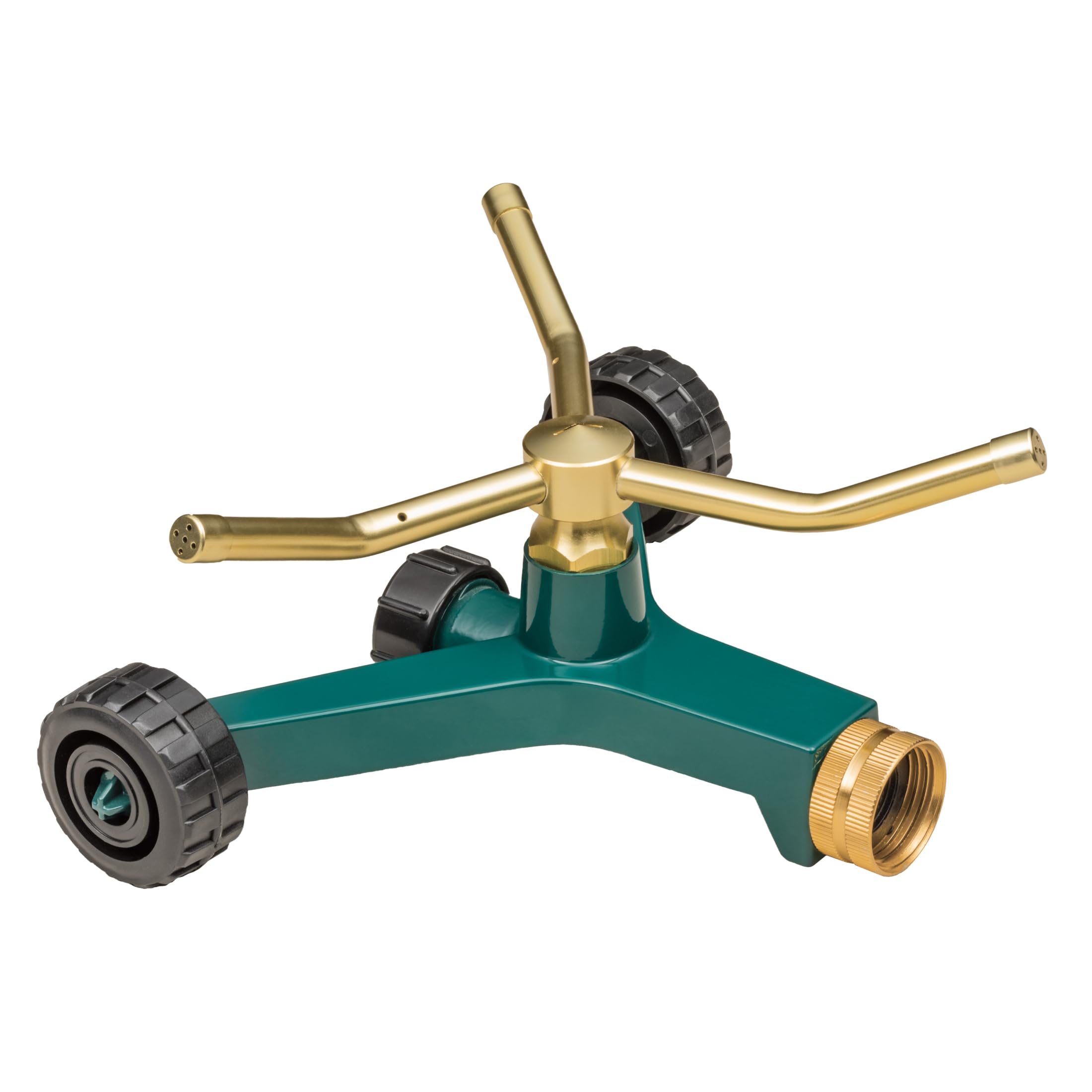
Orbit 58257N 3-Arm Sprinkler

Orbit 58257N 3-Arm Sprinkler

Easy repositioning

Our Score 8.6/10
Check Price

Worth Noting

  • Thin metal arms can snap on a hard drop
Base
Wheeled
Weight
11.2 oz
Coverage
Up to 50 ft diameter
Material
Metal, coated finish
Read the full review

Metal, wheels and a light body: three small things that add up to the sprinkler we reach for when the hose is already in hand. At 11.2 ounces the Orbit is easy to tow along behind you, and the little wheels under the base roll it over wet turf instead of ploughing a furrow through it. The head and the three arms are metal with a coated finish, which is more than any of the plastic options here can claim.

Coverage is the other half of the case. It throws a full circle up to 50 feet across, the widest circle anyone here states outright, and the nozzles adjust so you can pull that pattern in for a smaller yard. The water goes down evenly across that spread, and the spray stays gentle enough that it doesn't flatten flowers at the edge of a border.

What we can't promise is a decade of service. The head can stop turning after a few minutes if grit gets into it; a rinse and a quarter-turn back-off usually restores it. Give the unit a hook in the garage over winter — the coating resists rust, but standing water sitting in a metal head doesn't do it any favours.

The trade you're making is weight against heft. This is a sprinkler you move without thinking about it, which is the whole point of a wheeled base, and it's the only metal-bodied unit in this group. For a small-to-medium yard worked in two or three passes a session, that's the right set of compromises.

Bottom line: The Orbit is the one for movers: a metal head, a wheeled base and a full circle up to 50 feet across make it the easiest sprinkler here to shift between zones.

3

Kadaon 360° Garden Sprinkler

Kadaon 360° Garden Sprinkler

Small patches

Our Score 8.4/10
Check Price

Worth Noting

  • Thin plastic stake snaps in hard ground
  • Uneven spray at the edge of the throw
Mount
Ground stake
Weight
1.44 oz
Coverage
24–32 ft diameter at 40 psi
Material
ABS plastic
Read the full review

At 1.44 ounces, with a base a little over two inches across, the Kadaon is the cheapest way into this whole category — and the only one here that stakes into the ground instead of sitting on a weighted base. Push it into soft turf or a bed, screw on the hose, and it turns a full circle with no setup at all. For a patch of new seed, a small garden bed, or something to leave running while kids charge through it, that's hard to argue with.

What it isn't is a lawn sprinkler for a big yard. The 24-to-32-foot circle at 40 psi means you'll be moving it between spots, and the spray tends to land harder out at the edge of the throw than close in. This is the unit here we'd call seasonal — the plastic is thin, and careful handling and soft ground are what keep it going.

Which is a fair trade at the bottom of the market. If you want one sprinkler to leave in place on a real lawn, spend more and get a weighted base; if you want three of them along a hedge line or one for a birthday party, this is the way to do it for the least money.

Bottom line: The Kadaon is the cheap, light option for a small bed or a kids' water day; don't expect the thin plastic or the stake to last many seasons.

4

WOVUU 360° Garden Sprinkler

WOVUU 360° Garden Sprinkler

Large open lawns

Our Score 8.2/10
Check Price

Worth Noting

  • Needs 28.4 psi before the head turns
  • Top housing cracks if dropped or stepped on
Range
32.8–49.2 ft at 80 psi
Nozzles
36, three patterns per arm
Hose Fitting
Quick-connect or threaded
Minimum Pressure
28.4 psi to spin
Read the full review

Thirty-six nozzles, twelve to an arm with three patterns on each — that's the number the WOVUU leads with, and you can see where it goes. The spray comes out finer than the simpler three-arm spinners here, more mist than hammer, which matters if you're watering seed or seedlings that a heavy stream would flatten.

The number that decides whether it works in your yard is 28.4 psi. Below that the head won't turn at all, and a long hose run, a well system or a second sprinkler in line can put you there. Give it full household pressure and it throws 32.8 to 49.2 feet at 80 psi, which is near the top of this set.

We rate the fitting as highly as the spray. It ships with a quick-connect adapter that takes a plain rubber hose, and a threaded hose end works too, so there's no hunting through the garage for a converter. On a big, flat lawn with a strong tap this is the one we reach for; on a weak one, it's the first to sulk.

Assembly catches people out. The head screws onto the base, and screwing it down hard is exactly what stops it turning — snug it, then back it off a fraction, and the arms spin freely. It's worth checking that before you conclude the sprinkler is broken.

Bottom line: We recommend the WOVUU for large, open lawns with solid water pressure: 36 nozzles throw a fine spray a long way, and the head turns freely once it's set up right.

5

Melnor MiniMax Turbo Sprinkler

Melnor MiniMax Turbo Sprinkler

Beds and borders

Our Score 8.2/10
Check Price

Worth Noting

  • Hose connector can pop off and leak
  • Light base shifts under a tight hose pull
Coverage
Up to 4,000 sq ft
Warranty
Limited lifetime
Adjustment
Width, range, flow, 360° head
Max Pressure
125 psi
Read the full review

Most sprinklers here ask one question: how big a circle do you want? The MiniMax asks three. Width, range and flow each have their own control under a 360° head, so you can lay a strip of water down a border, pull it back off a fence, or dial the flow down so a bed soaks in instead of running off.

That control is genuinely useful, and it's why this is the most adjustable sprinkler in the group by a clear margin — nothing else here lets you set width and distance separately. The catch is the shape. It's happiest laying down a strip you define, up to 4,000 square feet of it, so a round lawn gets watered in overlapping passes rather than in one go. Buy it for beds, borders and awkward narrow ground, and keep a spinner for the middle of the lawn.

The hose inlet is where it lets you down. The connector can pop off, and it leaks at the threads — the kind of thing you notice every single time you walk past the sprinkler. Melnor's limited lifetime warranty is the backstop if it fails outright, and the dirt-resistant drive is a real help if your water comes from a well.

None of that makes it a bad sprinkler; it makes it a specialist. If your problem is a long, narrow strip that a round sprinkler keeps soaking into the fence, this solves it better than anything else in the group, and the flow-through base lets you link a second unit down the line.

Bottom line: Buy the MiniMax for beds, borders and narrow strips you want to water precisely; it's the most adjustable sprinkler here, though its hose inlet is the weak point.

How We Tested the Rotating Sprinklers

To build the shortlist, I started with the rotating sprinklers that were widely available, then narrowed by stated coverage, adjustable arc or range, material, hose fitting, and price. That left 14 models, which my team and I ran for six months on working lawns — not a lab setup. We watered narrow strips, irregular backyard patches, and full sun-baked sections, moving each unit by hand from garage or shed to hose bib, then back again after every session.

For coverage, we set out identical shallow cans in a grid and ran each sprinkler through a full cycle, then compared how much water landed at the center, edges, and corners. We timed rotation speed and watched whether the arm stalled, skipped, or failed to return to its starting point. Adjustability got tested the way it actually gets used: we changed the arc and distance to keep water off walkways and flower beds, then tried to fine-tune the same settings after the unit had been sitting in the sun.

We connected and disconnected every hose coupling repeatedly, watching for drips at the threads and checking whether a washer stayed put. Weight and ease of use were judged on the move — carrying each sprinkler across the lawn, setting it down, and repositioning it without soaking our shoes. For durability, we dragged units over concrete edging, left them out through hot afternoons, and checked the arms, bases, and fittings for cracks or wobble. At the end, we compared how reliably each one functioned against what it cost, since a cheap sprinkler that leaks or stalls is no bargain.

How to Choose Rotating Lawn Sprinklers

Start with the shape of the area, not the size

Almost every rotating sprinkler throws a circle, and almost no yard is a circle. A three-arm spinner like the Joeys Garden or the WOVUU is the right tool for an open middle, but it will always overshoot into a fence, a path or a bed unless you close the nozzles down or bring the unit in for a second pass. Where the ground is a strip — a side yard, a hedge line, a border — a sprinkler with adjustable width and range, like the MiniMax, does what a circle can't.

Pace out the widest and narrowest dimension of what you're watering before you buy and decide which shape you actually need. Most yards want one of each.

Pressure decides whether it turns at all

These heads turn because moving water pushes them, so the pressure at the sprinkler — not at the tap — is the number that matters. Long hose runs, a well pump, a splitter or a second sprinkler in line all take pressure away, which is why the same unit can spin happily in one yard and sit still in the next. Run one sprinkler at a time, use the shortest hose that reaches, and test a new sprinkler at the tap before deciding it's faulty. A rating of 60 or 80 psi is a ceiling, not a target.

How it stays where you put it

Weighted base, wheels or a ground stake — the choice follows the surface. A weighted base is the one for patio, gravel or a lawn you cross with the hose, because it resists being dragged. Wheels suit anyone who shifts the sprinkler two or three times a day. A stake only works in soft turf or a bed; in hard or stony ground it leans, and a leaning head turns a circle into a puddle. Whichever you pick, leave a loop of slack hose at the sprinkler so the pull is taken up before it reaches the base.

Expect the inlet to fail first

On every sprinkler here the hose connection is the smallest, most stressed part, and it's usually the first thing to give: plastic threads cross-thread, quick-connects pop off, and a leaking inlet wastes water all season. Tighten by hand, fit a quick-connect at the tap end so you're not working the thread every time you move the unit, and drain the body before the first frost, because trapped water splits plastic. We treat a hose-end sprinkler as a few-season purchase rather than a lifetime one and budget for replacing it.

Frequently Asked Questions

Final Verdict

Our pick stays the Joeys Garden. The weighted base means you set it down once and it stays there, the three arms adjust to the shape you actually have, and the link-up fitting turns one tap into two zones — that combination is what most yards need, and nothing else here does all three as well.

Change the requirement and the answer changes. If you move the sprinkler between zones every day, the Orbit's wheels and metal head are worth having. If the problem is a narrow strip rather than a lawn, the MiniMax's width and flow controls beat any circle.

And if you just need three cheap sprinklers along a hedge line, the Kadaon does that job for the least money.