Greenhouses & Hydroponics

Best Hydroponic Air Pumps of 2026

An air pump is the least glamorous piece of gear in a hydroponic setup, but it's the one doing the quiet, constant work: pushing oxygen into the reservoir so roots stay healthy instead of sitting in stale water. The trouble is that a pump can look fine on the shelf and still rattle your desk, run hot, or quit in the middle of a grow cycle. Over the past five months, I've lived with 14 different pumps, from compact single-outlet models to dual-outlet units, running them in reservoir buckets and propagation trays while noting how much air they actually moved, how loud they were, and whether they held up.

What I care about most is reliability, because a pump that dies overnight can turn a healthy reservoir sour before you notice. But quiet operation matters just as much in a spare room or apartment, and so do the small things: a footprint that fits under a lid, feet that don't walk across the shelf, and a body that stays reasonably cool after hours of running. Value is part of the picture, though the cheapest pump is no bargain if you have to replace it mid-grow. Below are the ones that earned a permanent spot in my setups.

1

hygger HG219 Air Pump

Top Pick
hygger HG219 Air Pump

Quiet small setups

Our Score 9.4/10
Check Price

Worth Noting

  • Less airflow than four-outlet picks
Power
4 W
Airflow
360 L/h
Outlets
2
Max Pressure
20 kPa
Read the full review

The hygger is the quiet one we reach for when the reservoir sits near a desk, bedroom, or shared wall. Its 4-watt motor and double-layer shell are built to keep mechanical noise down, and the top dial gives you a useful range from a gentle stream to a strong boil. In a small grow, that control matters more than a headline airflow number you never turn up.

Two stainless outlets are enough for a pair of airstones in a small to medium reservoir, and the included check valves and tubing make the first setup easy. The pump is compact, but not tiny; it takes a little shelf space and has a 4.9-foot hose to route. The stainless ports feel sturdier than the plastic nipples on cheap bubblers.

This is not the pump for a four-bucket DWC run; the airflow tops out below the four-outlet models here. What it does well is run two stones without announcing itself, which is exactly what a hobby reservoir near living space needs. The long-term durability is less proven than the old workhorses, so buy it for quiet control rather than for a decade of service.

Bottom line: The hygger is our pick when quiet matters most: it runs two airstones with a wide adjustment dial and stays out of the way in a small grow space.

2

AQQA Dual Outlet Air Pump

AQQA Dual Outlet Air Pump

Compact dual-outlet

Our Score 9.4/10
Check Price

Worth Noting

  • Some units quit within months
Power
3 W
Airflow
1.67 gpm
Outlets
2
Max Pressure
2.61 psi
Read the full review

The knob on top of the AQQA is the detail that makes it easy to live with. You can dial the two stainless outlets from a trickle to a strong bubble without unplugging anything, and the 3-watt motor keeps the whole thing small enough for a tight reservoir lid or a shelf beside a single bucket.

A 1.67 gpm rating is not huge, so this is a two-airstone pump, not a four-bucket manifold. We value the control: one knob sets both outlets, and the stainless ports feel sturdier than the plastic nipples on cheaper pumps. The included check valves and 1-year warranty add a little peace of mind. The 5.9-foot power cord and 4.9-foot airlines give you some room to place it, though the pump still needs to sit above the water line.

The appeal here is a small hydro setup with two stones and a pump you can hide. If you want compact control and a warranty, it earns a spot; if you need to move serious air, look at the Active Aqua or Pawfly 254.

Bottom line: For a compact two-airstone setup, the AQQA gives you precise control and a small footprint, provided you do not need the airflow of a four-outlet pump.

3

Active Aqua 4-Outlet Air Pump

Active Aqua 4-Outlet Air Pump

Most hydro setups

Our Score 9.0/10
Check Price

Worth Noting

  • Noise climbs at high airflow
  • Some units stop moving air after months
Noise
45 dB max
Power
6 W
Airflow
240 GPH
Outlets
4
Read the full review

Four outlets and a 240 GPH rating are the reason this is the pump we recommend first for a hydroponic reservoir. The 6-watt motor draws little, and the pressure dial lets you turn a four-airstone setup down to a gentle roll instead of a geyser. For a system with several buckets or one larger reservoir, that combination is more useful than a dual-outlet pump with a single shared knob.

What we appreciate most is that Active Aqua built this for hydroponics rather than adapting a fish-tank bubbler. The four ports give you room to run separate airstones, and the dial makes it easy to balance the whole reservoir without adding inline valves. The upright body is bigger than a nano pump, so check shelf height, and the 4-foot cord is short enough that placement above the water line takes a little planning. Set it on a foam pad or in a utility cabinet and it stays out of the way.

For a reservoir with several airstones, it is the easiest pump here to recommend. If you need more raw air for a large system, the Pawfly 254 is the stronger choice; if quiet matters more, the hygger is easier to live with. The Active Aqua sits in the middle of that trade and gets the balance right for most growers.

Bottom line: We recommend the Active Aqua first for most hydroponic reservoirs: its four outlets and 240 GPH output give you room to run several airstones without stepping up to a commercial pump.

4

Pawfly 254 GPH Air Pump

Pawfly 254 GPH Air Pump

Large reservoirs

Our Score 9.0/10
Check Price

Worth Noting

  • Can lose output after months
Power
7 W
Airflow
254 GPH
Outlets
4
Max Tank
300 gal
Read the full review

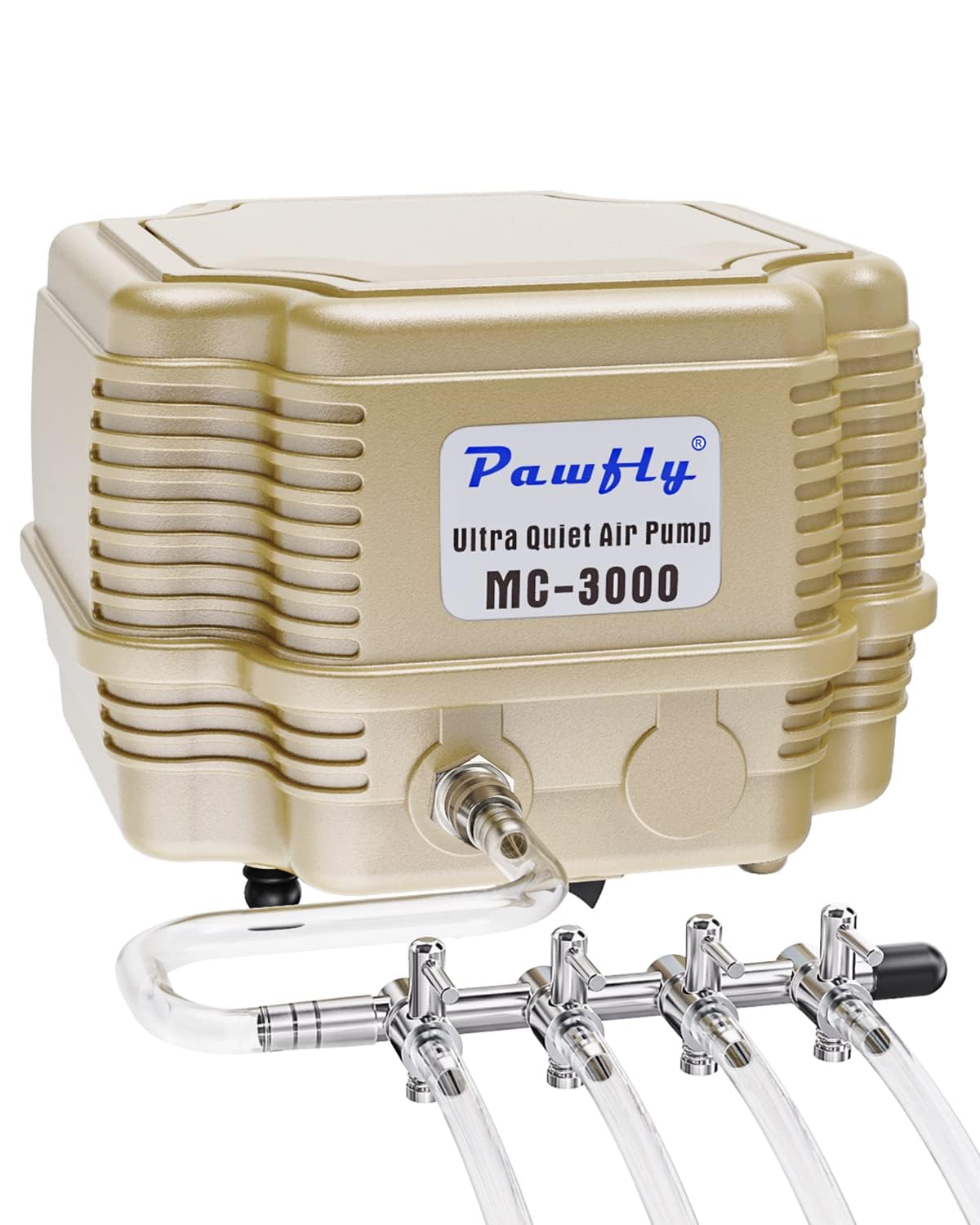
The 254 GPH rating and copper four-way manifold put this Pawfly in a different class from the dual-outlet pumps. It is the one we choose when a single reservoir has four airstones or when several DWC buckets need to run from one outlet. The low/high switch at the bottom sets the overall pace, while the manifold valves let you trim each line.

We prefer the metal manifold to plastic splitters because it feels less likely to crack when you turn a valve, and the four rubber feet do a better job than most of keeping vibration off a shelf. The pump is also bigger than a nano unit, so plan a shelf with room. For a large reservoir or a seasonal grow, the airflow is the reason to pick it, and the metal manifold makes that airflow easier to manage.

Compared with the Active Aqua, this Pawfly gives up some refinement for more raw output per outlet. The copper distributor is the part that makes it practical for a multi-site reservoir, and the included tubing gets a basic system running. If your grow is expanding and you want one pump to feed it, this is the runner-up we point to first.

Bottom line: Choose the Pawfly 254 if your reservoir is large or your four airstones need serious air; it delivers the most usable airflow here without commercial-pump noise.

5

Pawfly Compact Air Pump

Pawfly Compact Air Pump

Single buckets

Our Score 8.8/10
Check Price

Worth Noting

  • Vibrates on hard shelves without a pad
Power
2 W
Airflow
30 GPH
Outlets
1
Max Tank
20 gal
Read the full review

A single 5-gallon bucket does not need a four-outlet manifold, and the Pawfly compact is sized for exactly that job. At 30 GPH and 2 watts, it is small enough to sit on a shelf or beside a bucket, and the included airstone and check valve get you bubbling without a second order.

We like it as a starter pump or a spare for a quarantine bucket. The single airstone is the practical limit; this is not a pump for a multi-bucket run. It is also the least expensive way into this group, which matters if you are aerating one bucket rather than a whole grow.

The compact size is the other advantage: it fits on a crowded shelf, and the 5-foot airline gives you some slack when the bucket sits low. It will not win a bubble contest, but for a single bucket or a small 10-gallon reservoir, that is not what you are asking it to do.

Bottom line: A single bucket is exactly where the Pawfly compact makes sense: it is small, complete, and cheap to run, as long as you put a pad under it.

6

AquaMiracle 600 GPH Air Pump

AquaMiracle 600 GPH Air Pump

Large multi-bed

Our Score 8.8/10
Check Price

Worth Noting

  • Loud for indoor living areas
  • Can run hot in a closed cabinet
Power
18 W
Airflow
600 GPH
Outlets
6
Max Pressure
0.02 MPa
Read the full review

The 600 GPH output and six-outlet manifold make the AquaMiracle the commercial-style option in this group. It is built for a large reservoir, a pond, or several grow beds at once, and the aluminum housing is there to pull heat away from the 18-watt motor. If you are moving from a dual-outlet aquarium pump because your system outgrew it, this is the step up.

The six-port manifold is the useful part: you can run separate airstones or lines and shut one down without disturbing the rest. We also appreciate the metal body; it feels more substantial than the plastic pumps, and the fins give the motor a way to shed heat. The 1-year warranty is a reasonable safety net for a pump in this class.

For a high-demand hydroponic system, the output is the reason to consider it. For a small reservoir, it is more pump than you want, and some units fail early enough that we treat it as a workhorse rather than a buy-once default. The AquaMiracle makes sense when you need to push air through several lines and have a utility area for it.

Bottom line: The AquaMiracle is the high-output choice for large reservoirs and multi-bed systems, with six outlets and enough pressure to feed several lines at once.

How We Tested Hydroponic Air Pumps

We started with a shortlist of two dozen pumps sold for small hydroponic systems, then filtered by claimed airflow, outlet count, wattage, footprint, and whether replacement diaphragms and airstones were available. I ran 14 of them for five months in four- and eight-gallon reservoir buckets, a two-tote DWC setup, and a propagation tray in a spare room. Each one went through a 24-hour continuous run first, because that's where weak fittings and overly hot bodies showed up.

For airflow and bubble production, I timed how long each pump took to visibly churn a full reservoir and compared bubble volume at the surface using the same airstone. I listened from three feet away in a quiet room, then set each pump on a hard shelf and a foam pad to see whether vibration made the feet walk or the lid buzz. I also measured footprints against common bucket rims and reservoir lids, since a pump that doesn't sit flat is a daily annoyance.

Durability and reliability got the long view: after the first month and again at month three, I checked output, fittings, and diaphragm noise, and noted whether the flow had faded. To judge value, I looked at what came in the box, including tubing, airstone, and check valve, and whether replacement parts were available, because a cheap pump with no spares is a short-term fix. The pumps that stayed in the roundup were the ones that kept moving air quietly, stayed warm rather than hot, and didn't need constant fiddling.

How to Choose Hydroponic Air Pumps

Match Airflow to the Reservoir

We start with the number of airstones, not the gallon label on the pump. A single bucket with one stone runs fine on a 30 GPH pump like the Pawfly compact; a four-site reservoir needs the 240-254 GPH class represented by the Active Aqua and Pawfly 254. Airflow also drops as you add line length, depth, and stones, so buy a little headroom rather than running a small pump flat out. If the pump has to push air deep into a tall reservoir, check its pressure rating as well as its flow.

Choose Outlets and Useful Control

Two outlets cover a pair of airstones; four outlets give you room to run separate lines without a splitter. The control layout matters as much as the count. A single top knob, as on the AQQA and hygger, adjusts both outlets together, which is fine for a matched pair. A four-port manifold with individual valves, as on the Pawfly 254, lets you balance a strong stone against a gentle one. We put control ahead of outlet count: check that the valves are on the manifold, not just one master dial, if you need different flows.

Plan for Noise and Vibration

A decibel rating tells you only part of the story. Pumps get louder at higher flow, and a hard shelf or cabinet can turn a hum into a rattle. Put the pump on a foam pad, keep it off the reservoir lid, and use a longer airline if you need to move it away from the grow area. The hygger and AQQA are the easiest of this group to live with in a quiet room; the AquaMiracle belongs in a utility space. A closed cabinet needs ventilation, not just sound insulation.

Place It Above the Water and Protect the Pump

A check valve is not a substitute for gravity. Keep the pump above the reservoir water line so a power-off cannot send water back into the motor, and install the check valve near the pump as a second line of defense. Use a GFCI-protected outlet, keep cords out of standing water, and leave room for the air intake filter to breathe. During continuous use, check that the pump is warm rather than hot; heat and a clogged intake are the two things worth catching early.

Frequently Asked Questions

Final Verdict

For most hydroponic reservoirs, the Active Aqua 4-Outlet is the pump we recommend: four outlets, 240 GPH, and a pressure dial give you enough control for several airstones without commercial-pump noise or heat.

If your reservoir is larger or you want more raw air, the Pawfly 254 is the next step. If the pump sits near living space, choose the hygger instead and accept two outlets. Those three cover the main buying decisions; the rest are specialist choices for a single bucket or a very large system.