Birding & Garden Decor

Best Hummingbird Feeder Cameras of 2026

A hummingbird feeder camera has two jobs that can fight each other: the feeder has to draw birds in, and the camera has to catch them without becoming a bulky, leaky object that scares them off. I’ve kept feeders outside my kitchen window for years, and a busy feeder usually comes down to small details—how the perch sits, how bright the plastic is, whether the nectar stays in the base. What you’re buying is a front-row seat to birds that move faster than you can blink, so video quality, camera quality, and reliable connectivity matter as much as bird attraction.

A good feeder camera also has to survive rain, refills, and clumsy hands. Over six months, my team and I tested nine units, noting ease of setup, leakage, durability, and value for money. Some looked great on paper but dropped Wi-Fi the moment a bird arrived; others were plain but dependable. The picks below are the ones that held up and kept hummingbirds coming back.

1

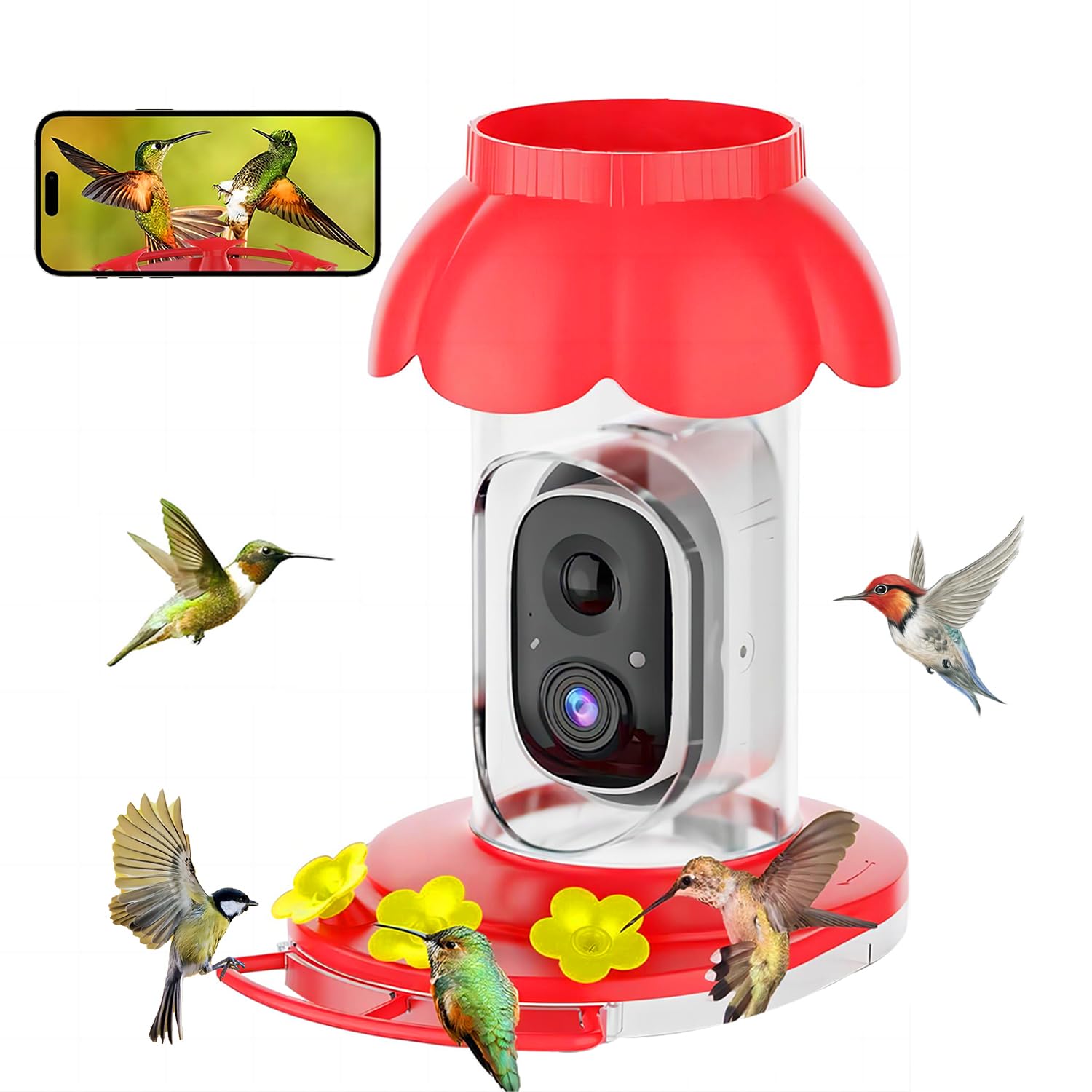
LUJII Smart Hummingbird Feeder

Top Pick
LUJII Smart Hummingbird Feeder

Busy backyards

Our Score 9.2/10
Check Price

Worth Noting

  • Nectar can drip if the reservoir is not seated squarely
  • Glass reservoir demands more care than plastic
Power
Solar panel with USB-C backup
Camera
2K HD live view
Feeding Ports
6
Reservoir Capacity
32 fl oz
Read the full review

Thirty-two ounces is the number that kept this feeder on the hook. It is the biggest reservoir in this group, more than double the Birdfy, and it meant we refilled roughly once a week through the busiest stretch of summer while the smaller feeders beside it needed attention every couple of days. Six ports do the rest of the work: hummingbirds guard a food source, and extra flowers give a second bird somewhere to feed instead of being chased off.

The 2K camera is the part we checked every morning. Motion alerts come through the app, clips save for later, and the live view is close enough that a hummingbird's throat reads as iridescent rather than a smudge. It is not the sharpest camera here, since the Humbirdy shoots 4K and shows noticeably more feather detail, but the framing is tight and the footage settles the question of what is visiting your yard.

Cleaning is where a feeder lives or dies, and the wide mouth makes this a rinse, a brush, a refill, a couple of minutes. The teal hand-blown glass is genuinely handsome hanging against a window, and unlike painted plastic it will not fade to a tired pastel after a season in the sun. The solar panel kept the camera topped up in our setup, and the USB-C port is the fallback for a shady spot or a run of gray days.

The ant moat and S hook come in the box. That is a small thing, but it meant the feeder went up the afternoon it arrived instead of waiting on a hardware run, and the moat has kept the ports clear without any fuss from us.

Bottom line: The one we recommend for most yards: the largest reservoir and port count here, a 2K camera we actually checked each morning, and a wide mouth that makes cleaning quick.
2

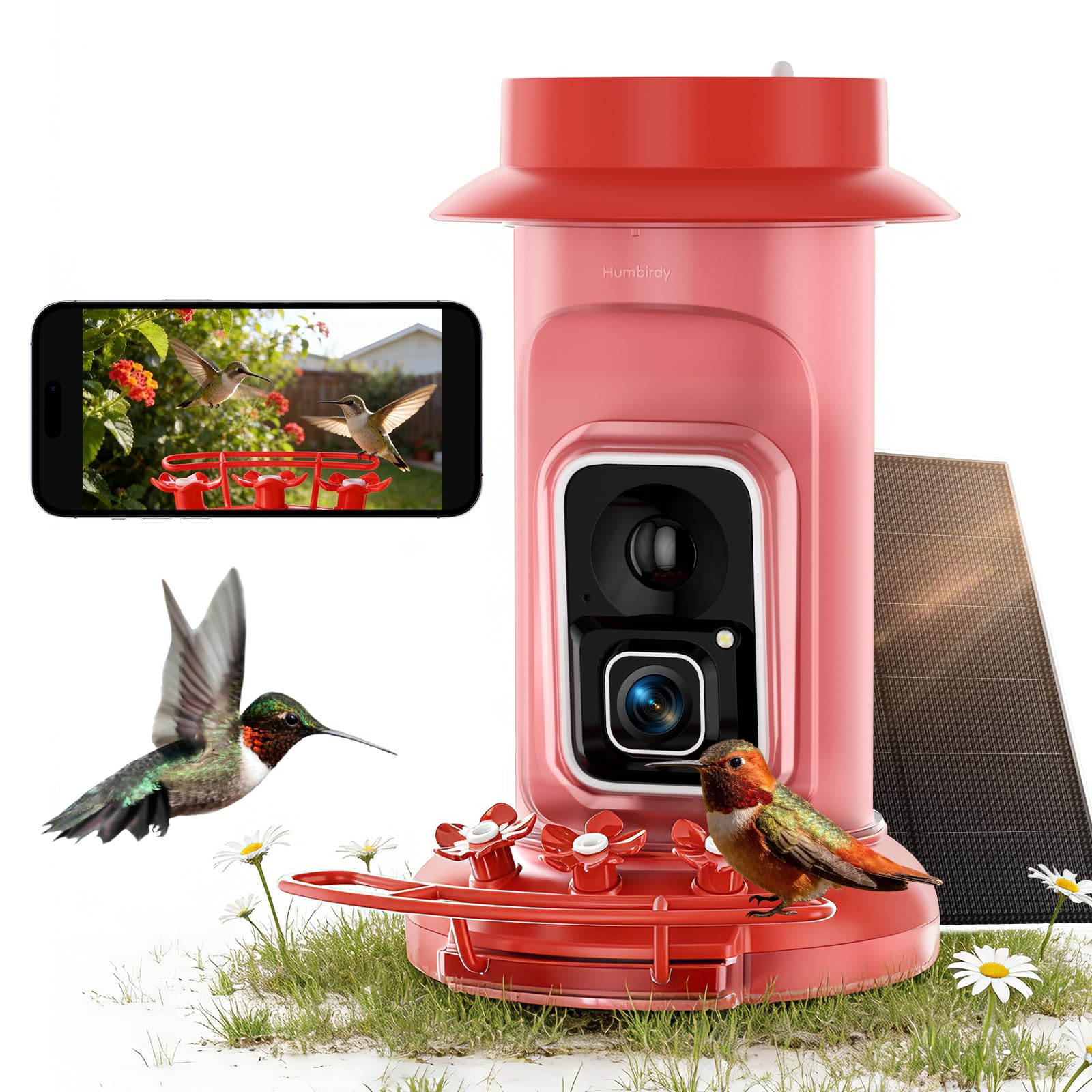
Humbirdy 4K Hummingbird Feeder

Humbirdy 4K Hummingbird Feeder

Sharpest footage

Our Score 9.0/10
Check Price

Worth Noting

  • Most expensive feeder in this group
Wi-Fi
2.4G and 5G dual-band
App Fees
None for AI identification
Slow Motion
10x at 120fps
Video Resolution
4K 8MP at 30fps
Read the full review

You are paying for the camera here, and it is the best one in this group. The 8MP sensor shoots 4K at 30 frames a second, and the lens focuses down to about 1.9 inches, close enough that a bird at the port fills the frame rather than sitting in the middle of a wide shot you have to crop. The 10x slow motion at 120 frames per second is the feature we kept coming back to, because a wingbeat stops being a blur and becomes something you can actually follow.

The other half of the pitch is what it does not charge you for. Identification, alerts, and clips run without a subscription, which is not true of everything here, and the app handled species naming on its own. Setup was quick on our end. Dual-band Wi-Fi is the right call for a backyard, though 5 GHz is short-range, so a feeder at the back of a deep lot should go on 2.4 GHz. Check the signal on your phone at the spot before you commit to it.

The solar panel mounts separately from the feeder, which sounds minor until you have tried to angle a panel bolted to a hanging feeder toward a low winter sun. It is the most expensive feeder here, and that is the honest trade: you are buying the sharpest footage in the group rather than the biggest reservoir or the longest feature list.

Bottom line: Buy this one if the footage is the reason you want a camera feeder: it has the sharpest picture and the best slow motion here, and no subscription gets in the way.

3

SOLIOM Smart Hummingbird Feeder

SOLIOM Smart Hummingbird Feeder

No-hang yards

Our Score 9.0/10
Check Price

Worth Noting

  • Pole mount needs ground you can plant it in
Power
5200mAh battery with 3W solar panel
Mounting
Pole mount with bird stand
Species ID
300+ hummingbird species
Video Resolution
2K
Read the full review

Not every yard has an eave, a branch, or a shepherd's hook in the right place. This feeder comes with a pole stand, so you plant it in a border and choose the camera's height yourself, which solves the problem of a sunny spot with nothing overhead. The ant moat pole holder and bird stand are both in the box, along with a cleaning brush.

The feeder side is the most thoughtfully equipped here. The top comes off for cleaning, turning a job we usually dread into a two-minute rinse, and a perch is included. That matters more than it sounds: hummingbirds sit between sips, and a perched bird stays in frame far longer than one that hovers and leaves. Dual ant moats, one at the hook and one at the lid, give you a second line of defense in a wet summer.

The 2K camera does close-up work well in daylight, and the identification database is the largest claimed here at more than 300 hummingbird species, against 150 on the Birdfy. That is worth something if you are the sort of person who wants to know whether you are looking at a rufous or an Allen's. A 5200mAh battery paired with an independent 3W solar panel means you can chase the sun with the panel instead of moving the feeder.

Bottom line: The pick for a yard with nothing to hang from: plant the pole, set the camera at your own height, and let the included perch keep birds in frame.

4

NETVUE by Birdfy Hummee

NETVUE by Birdfy Hummee

Seed and nectar

Our Score 9.0/10
Check Price

Worth Noting

  • AI identification requires a paid subscription
  • 1080p video is the softest in this group
Seed Capacity
1.5 L granary
Weather Rating
IP65
Video Resolution
1080p
AI Identification
Requires subscription
Read the full review

This is two feeders sharing one camera: a 1.5-liter seed hopper up top and a nectar attachment with four flowers under a big red cover. If your yard already draws cardinals and finches alongside hummingbirds, that combination is genuinely useful, since one mount and one app cover both crowds and the mounting kit includes pole, tree, and wall brackets.

The hummingbird half is the weaker half. Nectar sits in a smaller reservoir with fewer ports than a dedicated feeder, so it is the part you refill constantly while the seed hopper coasts along. That is not a flaw so much as the shape of a two-in-one: it is a good seed feeder that also handles nectar, not a nectar feeder that happens to hold seeds.

The housing is rated IP65 and the solar panel is a 3W unit, so weather is not the worry. The camera going quiet after a few months is, and it is worth buying from a seller that will honor the warranty without an argument. If you want one device covering the whole yard, this is the flexible choice; if hummingbirds are the entire reason you are shopping, put the money into a dedicated feeder.

Bottom line: Worth it only if you want seed eaters and hummingbirds on one camera; for nectar alone, a dedicated feeder here does the job better.

5

Birdfy Smart Solar Hummingbird Feeder

Birdfy Smart Solar Hummingbird Feeder

Small spaces

Our Score 8.4/10
Check Price

Worth Noting

  • Smallest nectar reservoir here at 14 ounces
Power
5200mAh with 3W solar panel
Species ID
150+ hummingbird species
Video Resolution
1080p
Reservoir Capacity
14 fl oz
Read the full review

At six and a half inches across and under a pound, this is the feeder that disappears into a balcony corner or a narrow courtyard. It is also the easiest of these to give as a gift: the app runs without a subscription, identification covers 150-plus hummingbird species, and there is no limit on how many family members can watch the same live feed. For a parent or grandparent who likes birds but not technology, that combination is hard to beat.

There is no perch in the box, and that is not a small omission. Hummingbirds like to sit between sips, and with nowhere to land they hover, drink, and go, which makes for shorter clips and fewer chances to see a bird at rest. The perch is sold separately, so order it with the feeder rather than after the first week of frustratingly brief videos.

The rest of the hardware is sensible: 1080p video, a 5200mAh battery with a 3W solar panel, an ant moat, and a cleaning brush in the box. This is the feeder for someone who wants the pleasure of a camera feeder without a big installation, and who will happily trade resolution and capacity for something light enough to move with one hand when the season turns.

Bottom line: A small, light, gift-ready feeder with free AI identification and unlimited sharing, provided you add the perch and refill more often.

6

SECUHOME Hummingbird Feeder

SECUHOME Hummingbird Feeder

First camera feeder

Our Score 8.2/10
Check Price

Worth Noting

  • No solar panel, so the camera comes down to charge
  • Built-in battery cannot be swapped for a spare
Camera
High-definition with AI identification
Battery
Built-in, 1-3 months per charge
Mounting
Hanging hook
Reservoir Capacity
20 fl oz
Read the full review

Here is the surprise: the least expensive feeder in this group does not feel like the cheap one on the camera side. Video is clear in daylight, the app is straightforward, and setup took minutes rather than an evening, the same routine as the premium picks here. It is also the feeder we hand to people who are not sure they want a camera feeder at all, because it answers that question without asking much of them.

The trade is power. There is no solar panel in the box, so the camera comes down every month or so for a charge, and the listing puts a single charge at one to three months. In practice that means a regular trip up a ladder during the season, which is the single biggest difference between this and the solar picks. What it buys you is a feeder that goes up anywhere with a hook and never needs a panel angled at the sun.

Twenty ounces of nectar is more than most here, and the clear tank lets you read the level from the ground, a small thing we appreciated more than we expected. Identification runs through the app, and the built-in ant moat is already part of the design. Wi-Fi is the part to plan for: hang it near the house rather than at the back fence and you will have far fewer interruptions.

Bottom line: The budget answer for a first camera feeder: clear daylight video and easy setup for the least money here, as long as you accept charging it yourself.

How We Chose and Tested Hummingbird Feeder Cameras

We started by pulling together the feeder cameras sold by established birding and smart-home brands, then filtered the list by camera resolution, field of view, power source, feeder capacity, and whether replacement parts were available. That left nine units, which we hung outside from early spring through late summer—six months—in a mix of yards and balconies. Every feeder went up the same way: filled to the line, mounted at eye level, and connected to the same home Wi-Fi so we could compare setup and connectivity fairly.

Setup was timed from opening the box to the first live feed. We noted how many app-pairing attempts it took, whether the mount needed tools, and how messy refilling was. To check leakage, we filled each reservoir, hung it through several rainstorms, and looked for sticky rings on the camera housing and drips down the base. We also watched for color fading and perch wobble after weeks in the sun, and whether any unit needed re-pairing or resetting without warning.

For the birds, we logged visits at dawn and dusk and reviewed clips for blurred wingbeats, washed-out iridescence, and whether the camera caught birds at the ports rather than the sky behind them. We compared feeder colors and perch styles to see which got approached first, and walked inside to the kitchen and to the far end of the yard to see whether the live feed stuttered or dropped. At the end, we weighed each unit's performance against its price and the extras in the box—because a camera that needs constant fiddling is not a bargain.

How to Choose Hummingbird Feeder Cameras

Resolution matters less than how close the camera sits

The box numbers run 1080p, 2K, 4K, and it is tempting to buy the biggest one. But a hummingbird at the port is only inches from the lens, and at that distance framing and focus do more for the picture than pixel count. A tight 2K shot beats a wide 4K one you have to crop.

If you want clips worth sharing and enough detail to sort one species from another, treat 2K as the sensible floor. The 4K on the Humbirdy is the exception here, and it earns its price only if you will actually watch the footage on a television.

Find out what the app costs after the feeder arrives

Live view is usually free. Species identification and cloud clip storage often are not. One feeder in this group charges for identification, two include it, and the rest say nothing about it, which is exactly the detail to confirm before you order.

If a monthly fee does not appeal, look for a model that saves clips to a memory card and includes identification in the purchase price. It is the difference between a feeder you own and a feeder you rent.

Solar power, and where the panel can go

A feeder in full sun with an attached panel rarely needs attention. A feeder under an eave, or in a yard that turns gray for a week, does. Panels that mount separately from the feeder, as on the SOLIOM and the Humbirdy, can be angled at the sun independently, and USB-C charging is the backup to look for.

Without either, budget for bringing the camera indoors on a schedule. That chore always lands in the middle of the season, when the birds are busiest.

Capacity, ports, and the refill you will actually do

Capacity buys time between refills, but the port count decides how peaceful the feeder is. Hummingbirds guard a food source, and six flowers give a second bird somewhere to feed while the first is busy chasing. Four is workable if your traffic is light.

Match the reservoir to how often you will walk outside. A big tank you leave until the nectar looks cloudy serves the birds worse than a small one you rinse every few days.

Seals, drips, and where you hang it

Drips are the first thing to check on any feeder, and they usually start where the reservoir meets the base. Fill it, seat it squarely, and look for a bead of liquid before you hang it in place.

Then pick a spot where a drip does not matter: gravel, mulch, or a planting bed rather than a deck or a path. A perch is worth having too, because a bird that can sit between sips stays in frame far longer than one hovering.

Frequently Asked Questions

Final Verdict

Our pick for most yards is the LUJII. The 32-ounce reservoir and six ports cut the work down to roughly a weekly refill, and the 2K camera is detailed enough to tell one hummingbird from another.

If footage is what you are really shopping for, the Humbirdy earns its higher price with 4K, slow motion, and no subscription attached. On a tight budget, the SECUHOME films better than it costs, as long as you do not mind charging the camera yourself.