Birding & Garden Decor

Best Birdhouse Cameras of 2026

A birdhouse camera is a small lens tucked behind the entrance hole, paired with a motion sensor that starts recording the moment something lands on the perch. Most are built like security cameras and sold as garden decor, so you end up with footage of a swaying branch or a battery that quits mid-nesting season. What you want is to know who's visiting, in focus, without parking yourself behind the window with binoculars. The clips worth keeping come down to how fast the sensor wakes, how close the lens sits, and whether the house survives weather.

Over the past eight months, my team and I have kept 11 birdhouse cameras running from early spring through nesting season. A few boxes drew tenants within days; others sat empty into July, which taught me what no spec sheet will tell you: birds pick the house before they pick the camera. A hole a fraction too big, or a box that bakes in afternoon sun, keeps them away however sharp the video is. Each pick below suits a different yard.

1

Humbirdy SH66 4K Feeder

Top Pick
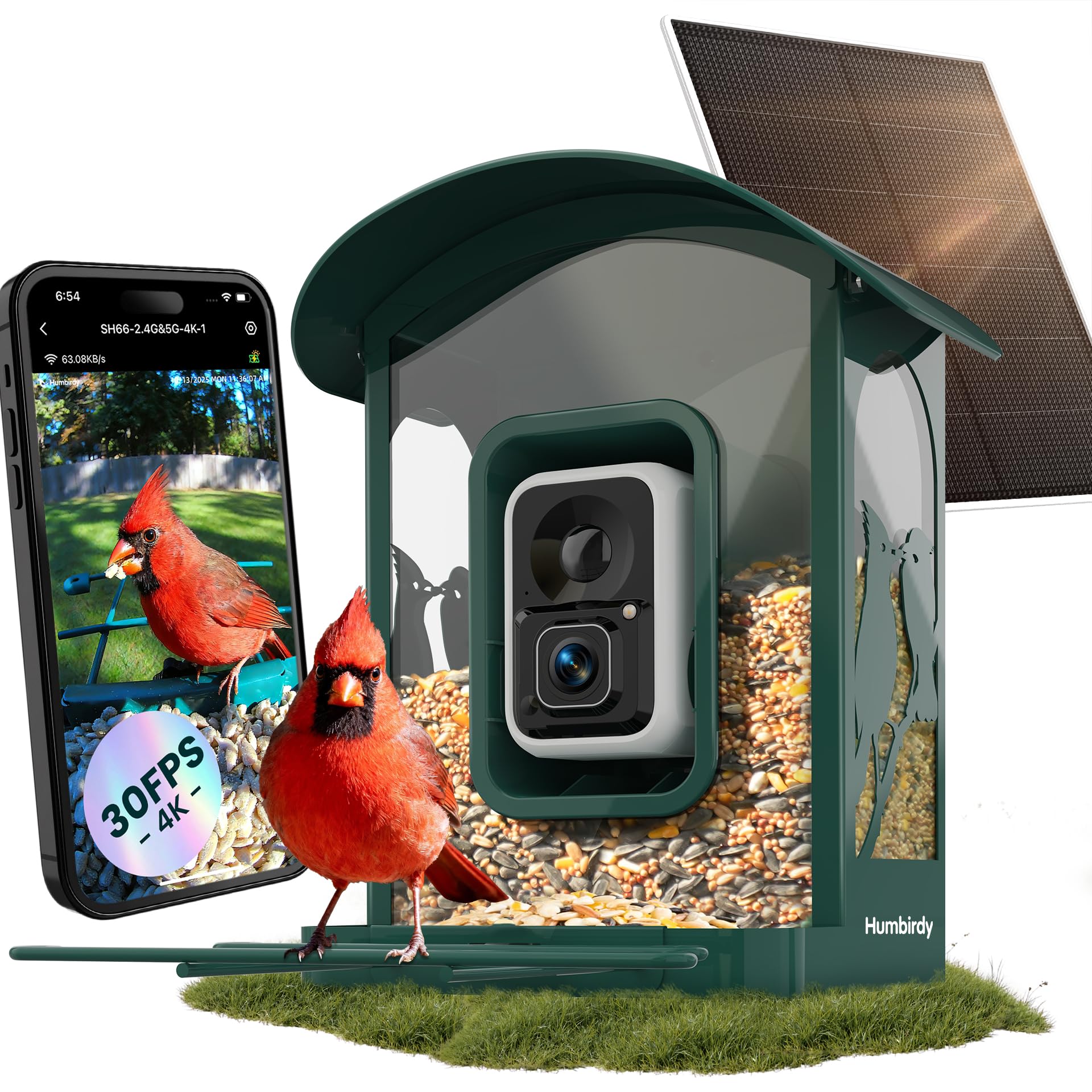
Humbirdy SH66 4K Feeder

Top image quality

Our Score 9.2/10
Check Price

Worth Noting

  • Highest price tier in this group
  • Single 3W panel leaves less margin than dual panels
Camera
4K at 30fps, 8MP photos
Field Of View
169°
Seed Capacity
1.8 liters
AI Identification
Free, no subscription
Read the full review

The camera on the Humbirdy lifts off the feeder body, and that one decision changes the chore everyone complains about. Instead of unbolting a seed-filled house and carrying it to an outlet, you pop the camera off, charge it indoors over USB-C, and click it back on. It is also the only feeder here that lists 5GHz Wi-Fi alongside 2.4GHz, which matters if your router has stopped offering a 2.4GHz band.

The picture is the reason to pay for it: true 4K at 30 frames per second, 8MP stills, and a 169-degree view, the widest in this group. The slow-motion mode records at 1080p and 120 frames per second, and a chickadee landing at quarter speed is a far better look at wing bars than a paused still.

It is built like an outdoor fixture: metal body, 3.5 pounds, waterproof, 1.8 liters of seed, a 32GB card in the box, and free identification for life rather than a trial. Two things to accept. It is the costliest feeder here, and the single 3W panel gives you less margin than the dual-panel models, so mount it where it sees real sun or plan on charging by cable.

Bottom line: When picture quality and no monthly fee matter most, we point you to the Humbirdy: true 4K, free identification, and a camera you can carry inside to charge. The premium buy, and it earns it.

2

HARYMOR Q8 Smart Bird Feeder

HARYMOR Q8 Smart Bird Feeder

Shaded yards

Our Score 9.0/10
Check Price

Worth Noting

  • Species identification needs a paid subscription
  • No memory card in the box
Power
3W roof panel + 3W remote panel
Camera
2K
Field Of View
120°
Seed Capacity
2 liters
Read the full review

Two solar panels is the detail that made us look twice at the HARYMOR Q8. One 3W panel is built into the roof; a second 3W panel rides on a lead, so the feeder can hang where the birds want it while the panel reaches for the sun. Add a 2-liter hopper, tied for the biggest in this group, and you have a feeder that asks very little of you between refills.

That combination is why it's our pick for most yards. The 2K camera is sharp on the tray, and the 120-degree lens is narrower than the 155-degree models here, which we count in its favor: put one bird in the frame and you can see the markings that separate a house finch from a purple one. The 4K models give you more room to crop afterward; at the tray itself, this one holds its own.

Two costs to know before you order. Species identification runs through a paid app subscription. The camera, alerts, and live view work without it, but the name-that-bird feature does not. And there is no memory card in the box, so plan on buying one, up to 128GB, if you want clips kept locally rather than in the cloud.

Charging is the other thing we watch. With both panels shaded, or through a run of short gray days, the battery can fall behind and you will be running a cable out to it. Cloud recording runs on a three-day loop with a long trial attached, which is enough to scroll back through a morning's visitors without paying for a plan.

Bottom line: We recommend the HARYMOR as the default: two solar panels you can aim separately, a 2-liter hopper, and a 2K camera that keeps birds big in the frame. Best for a partly shaded yard.

3

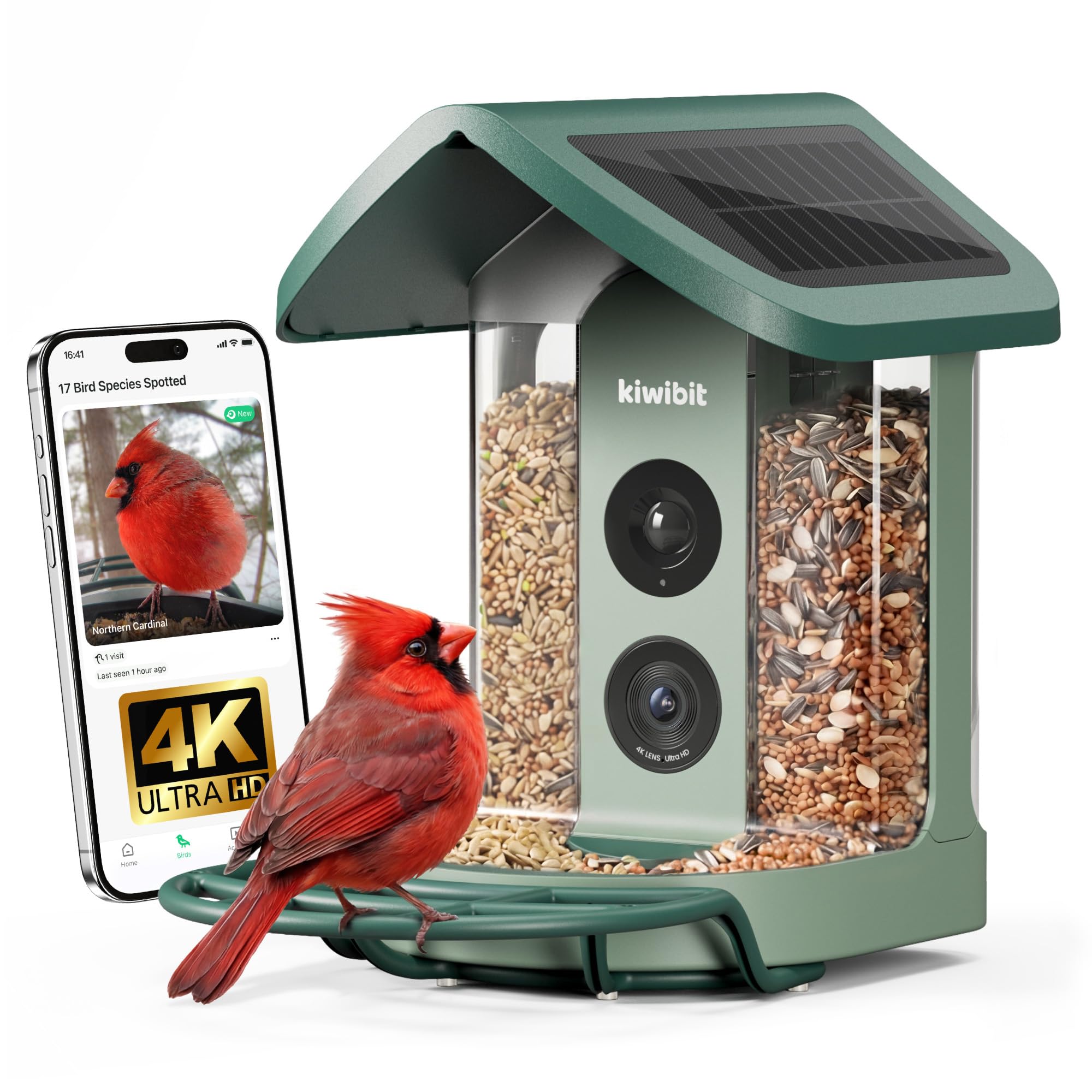
Kiwibit BW512 4K Feeder

Kiwibit BW512 4K Feeder

Two seed blends

Our Score 9.0/10
Check Price

Worth Noting

  • 1 liter split between two compartments
  • Roof panels are fixed, so deep shade limits charging
Audio
Two-way speaker and mic
Power
Dual solar roof panels, 5200mAh
Camera
4K HDR, 8MP photos
Seed Capacity
1 liter, two compartments
Read the full review

Two compartments, two seed blends, one feeder. Fill one side with sunflower hearts and the other with a mixed seed and within a week you know which one your yard actually turns up for. That is information a single-hopper feeder cannot give you, and it is the reason this Kiwibit holds a place in this group.

The rest of the specification is premium: a 4K HDR sensor with 8MP photos, dual solar panels built into the roof, a 5,200mAh battery, two-way audio through the app, and a seed container that lifts out for refilling and cleaning. The camera frames the feeder rather than the yard, which is deliberate. It watches the tray and leaves your garden out of the picture.

Where it earns its place for us is the pairing of that two-hopper design with solar panels that need neither a cable nor a separate panel to place. The trade-off is capacity: 1 liter split two ways leaves half a liter a side, so a busy tray empties faster than the 2-liter feeders here. And because the panels are fixed to the roof, a feeder hung in deep shade has nothing you can move toward the light.

Bottom line: We recommend the Kiwibit if you want to test seed blends against each other: two hoppers, 4K video, and a solar roof with no cable to run.

4

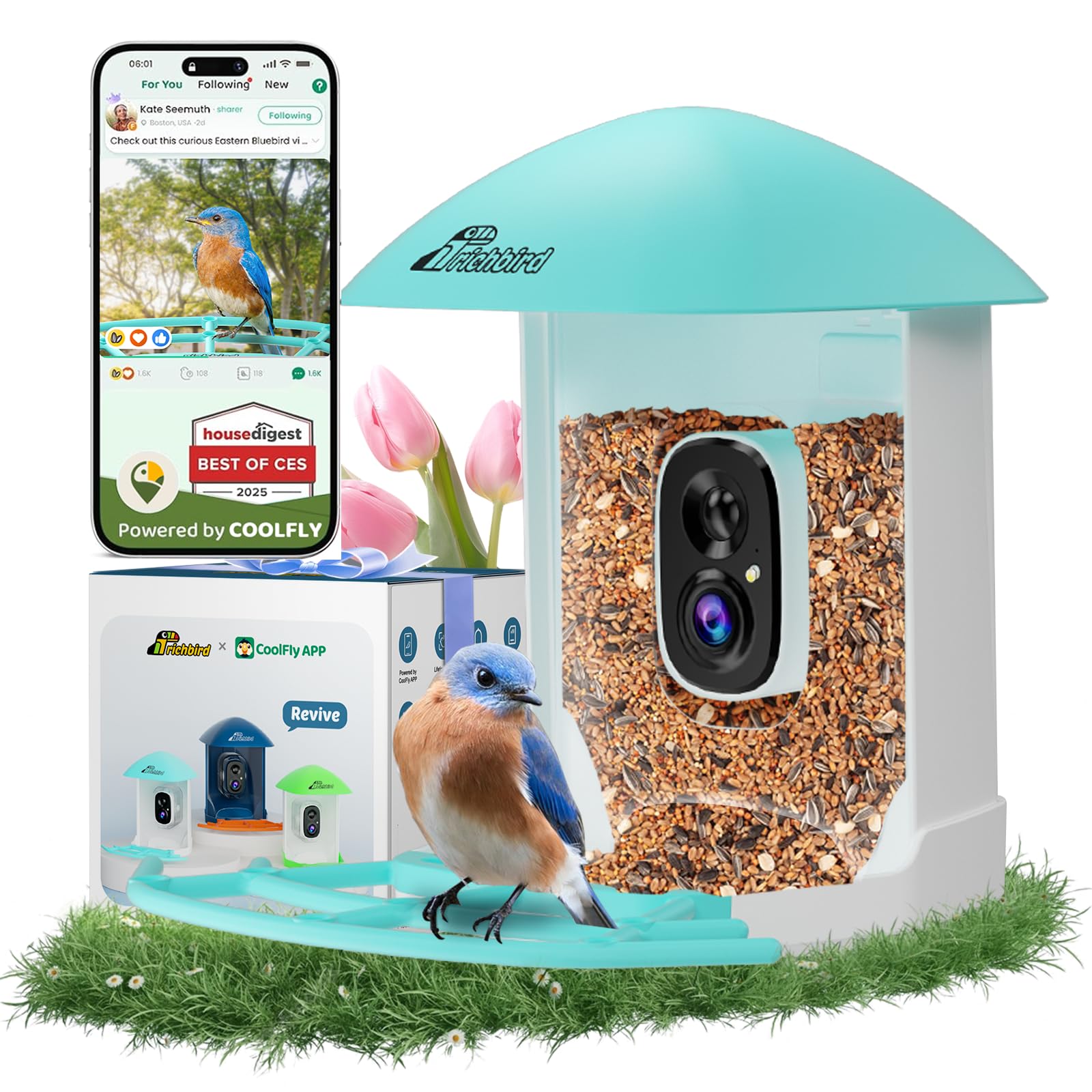
RichBird Revive Smart Feeder

RichBird Revive Smart Feeder

Budget identification

Our Score 9.0/10
Check Price

Worth Noting

  • Identification takes a manual upload
  • 4.5 pounds needs a sturdy mount
Power
4400mAh battery + solar panel
Camera
2K
Seed Capacity
2 liters
AI Identification
Free via app upload
Read the full review

Free bird identification usually means free until the trial runs out. RichBird's version really is free, but there is a step: you upload a clip or photo to the app's Chirpchat community and the identification comes back, rather than the alert naming the bird the moment it lands. If that extra tap does not bother you, this is the best-value feeder camera in the group.

Two liters of seed, a 4,400mAh battery with a solar panel on top, 2K video, and a four-step assembly the app walks you through. The COOLFLY app carries a birdwatching community alongside your own clips, which is either the best part or the part you ignore, depending on how much you want to compare notes with strangers.

Reliability is the open question. Units have quit working, so buy somewhere with a straightforward return window and put it through a full week before it goes up permanently. Beyond that it is a plain feeder that gets out of the way, which is most of what you want at this price.

Bottom line: We recommend the RichBird for a tight budget with no subscription: 2 liters of seed, solar charging, and free identification, provided you do not mind uploading a clip to get the name.

5

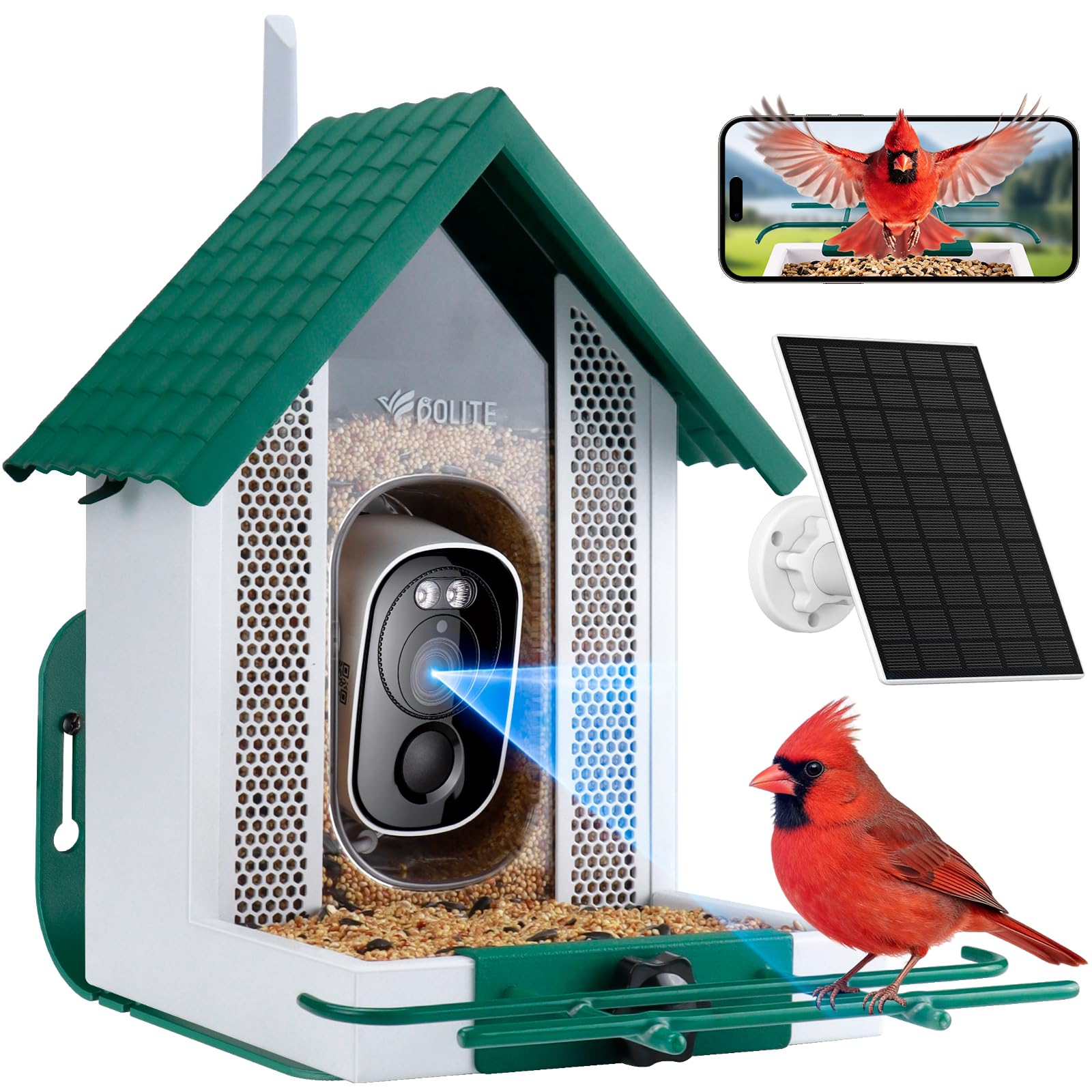
BOLITE UH2502 Smart Feeder

BOLITE UH2502 Smart Feeder

Local recording

Our Score 9.0/10
Check Price

Worth Noting

  • 1.8-liter hopper trails the 2-liter feeders
Power
4W adjustable solar panel
Camera
2.5K
Storage
64GB card included
Seed Capacity
1.8 liters
Read the full review

There is a 64GB card in the BOLITE box, and that inclusion saves you a purchase and a decision. Clips land on the card, so you can pull it, read it, and keep what you want without a cloud plan or a monthly bill.

The rest of it is quietly competent: 2.5K video, a 4W solar panel on an adjustable bracket, a metal housing, and 1.8 liters of seed. The 130-degree lens is the narrowest here after the HARYMOR's 120, and we like that trade for the same reason: fewer birds in the frame, more detail on each one.

The gap is the app. Species identification runs through it, and the listing does not say whether that part is free or paid, so confirm with the seller before ordering. Nothing about the camera, the alerts, or the card recordings depends on the answer.

Where it fits for us: this is the pick if you want the footage to be yours and you would rather not think about a subscription at all. If identification is the feature you are buying for, the birdsnap costs a little more and throws in free ID and three feeding accessories.

Bottom line: We like the BOLITE for anyone who wants 2.5K video and recordings that stay on a card they own. The adjustable 4W panel is the most flexible here.

6

birdsnap 2K Smart Feeder

birdsnap 2K Smart Feeder

Fruit and jelly

Our Score 8.8/10
Check Price

Worth Noting

  • Single 3W solar panel
  • 12.5-inch width needs measuring first
Camera
2K
Field Of View
155°
AI Identification
Free, no subscription
Included Accessories
Fruit fork, jelly box, hummingbird feeder
Read the full review

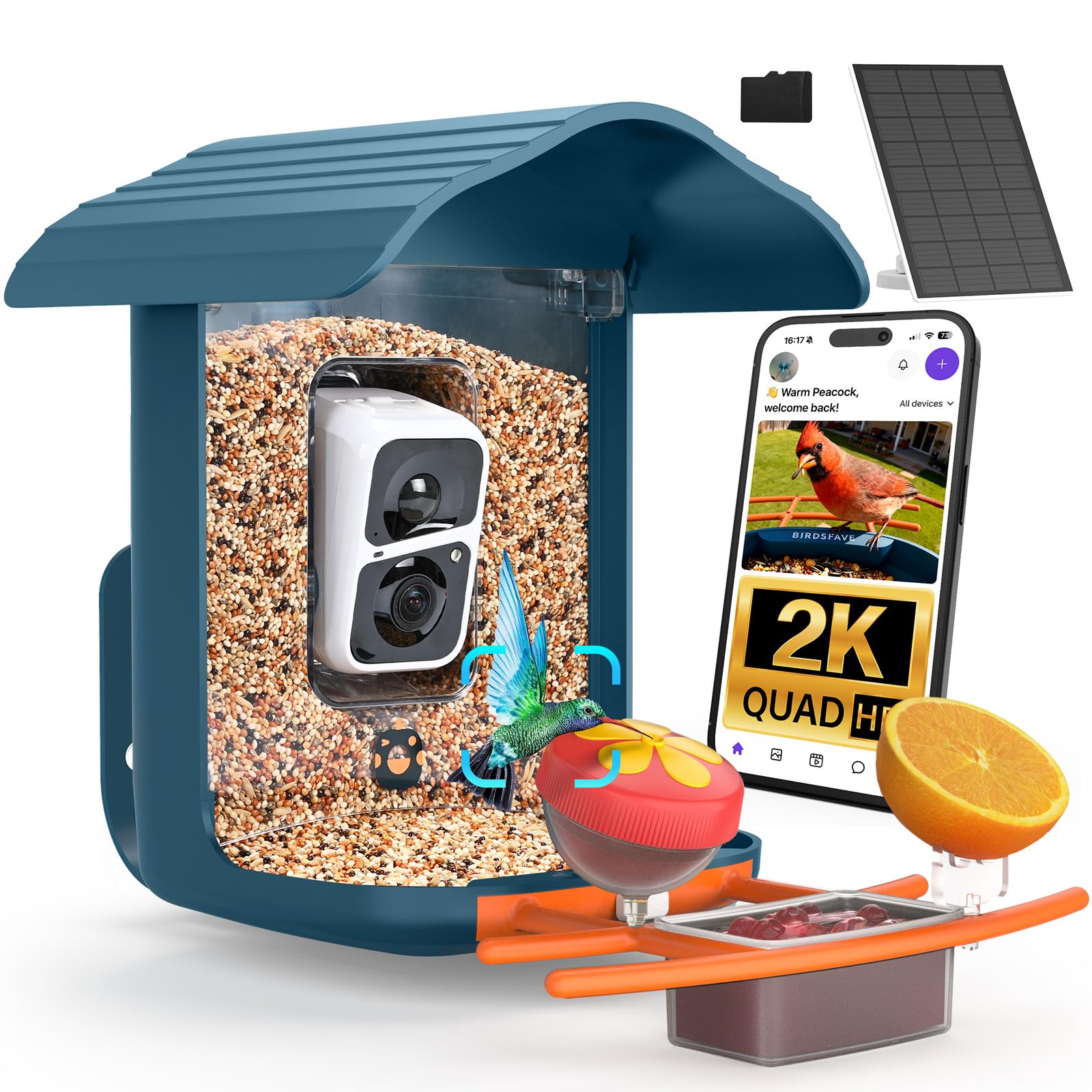
Three accessories come in the birdsnap box that none of the other feeders here include: a fruit fork, a jelly box, and a hummingbird feeder attachment. That turns one camera into a rotating buffet, with an orange half for the orioles, jelly for the catbirds, and nectar for the hummers, and it is the quickest way to find out what is already living in your yard.

The camera side is solid without being flashy: 2K video, a 155-degree view that is as wide as anything here, free species identification with no subscription attached, and a 32GB card in the box so clips live on your shelf rather than in someone else's cloud. IP65 housing, 1.8 liters of seed, and a 2.6-pound body that hangs easily from a branch.

What we appreciate most is the accounting. Free identification and included storage mean no second bill arriving in month two, and that is the difference between a feeder you keep running and one you quietly stop paying for. Shade costs you more here than it does on the dual-panel HARYMOR, since the solar side is a single 3W panel.

One practical note on siting: the wireless antenna is the part that has given trouble, so hang it at arm's reach rather than at the top of a ladder, and check it after a storm. The housing is also 12.5 inches across, worth measuring against a balcony rail before you commit.

Bottom line: For a yard where you want to feed more than seed, the birdsnap is the pick: fruit, jelly, and nectar accessories, free identification, and a card in the box.

7

NETVUE Birdfy N12 2K Feeder

NETVUE Birdfy N12 2K Feeder

First-time buyers

Our Score 8.8/10
Check Price

Worth Noting

  • No solar panel in the box
  • Species identification needs a subscription
Power
Rechargeable battery, USB charging
Camera
2K
Field Of View
155°
Seed Capacity
50 oz
Read the full review

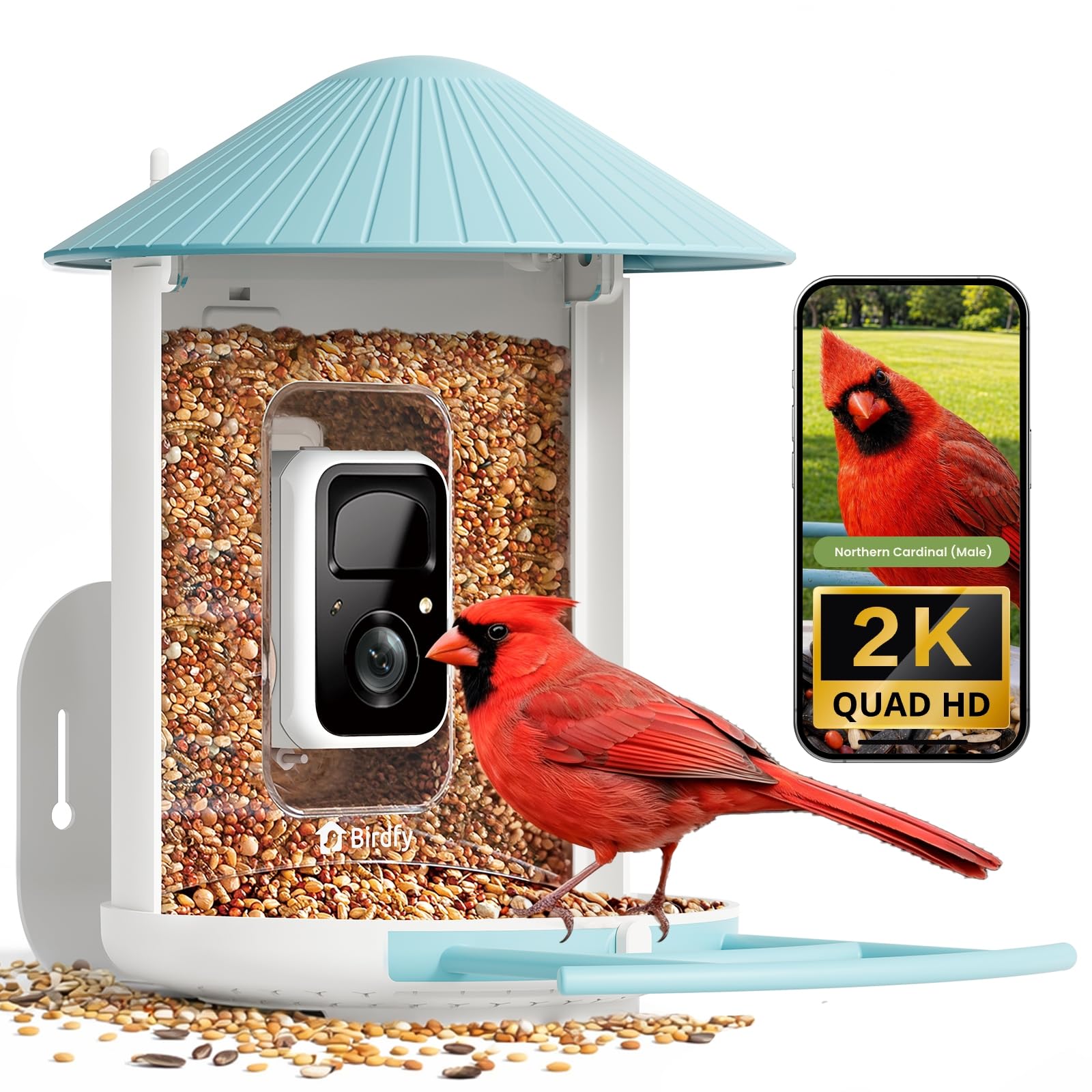
This is the Birdfy version aimed at people buying their first camera feeder, and the feature list reads like a beginner's checklist: 2K video, a 155-degree view as wide as anything here, a 50-ounce hopper with a top-fill lid, and pole, wall, and tree mounting hardware in the box.

Setup is where it earns the beginner label. The feeder snaps together, the app walks you through pairing, and the mounting kit covers the three placements most people actually want. Three pounds hangs easily from a bracket or a stout branch. It is a 2.4GHz-only device, though, and pairing on a mesh network is where this one trips, so get a 2.4GHz band confirmed before it arrives.

Two catches. There is no solar panel in this box, so factor in taking it down to charge over USB more often than you would with the solar models. And species identification needs the subscription, so the app's best trick sits behind a fee.

Our take: it is the one we point a first-timer toward, and the wide frame shows you the whole pole, including the squirrel working its way up. The HARYMOR's narrower lens gives you a bigger bird for roughly the same money, which is why the Birdfy sits below it here.

Bottom line: For a first camera feeder, the Birdfy is the least fiddly of these to set up, with a wide 155-degree view and a generous top-fill hopper. Plan on USB charging, since there is no solar panel here.

8

Fazoxo B1 Camera Feeder

Fazoxo B1 Camera Feeder

Tight budgets

Our Score 8.6/10
Check Price

Worth Noting

  • AI and cloud need a subscription after one month
  • 1.3-liter hopper fills fast on a busy tray
Power
Solar panel + battery
Camera
FHD
Seed Capacity
1.3 liters
AI Identification
One-month trial, then subscription
Read the full review

What you give up near the bottom of the price range shows up on the Fazoxo in the app. Species identification and cloud storage are a one-month trial that becomes a paid plan. The camera, the alerts, and live viewing do not need it.

We still think it earns the budget slot, because the parts you use daily work. The camera is sharp in daylight and the included solar panel keeps it out of the house. The trade is resolution, since this is the only FHD camera in the group and feather detail thins out at distance. If you want the whole experience without a recurring bill, buy it for the camera and treat the AI as a demo.

Two practical notes. It is a 2.4GHz-only device and pairing is the step that goes wrong, so get it onto the network indoors, confirm a live picture, then mount it outside. And the 1.3-liter hopper is on the small side, so a busy tray has you refilling more often than the 2-liter feeders demand.

Bottom line: The cheapest feeder here we are happy to recommend: a good picture and a solar panel, as long as you are content to skip the subscription features. Best for tight budgets.

What Eight Months and 11 Birdhouse Cameras Taught Us

I started by narrowing the field to cameras built into an actual wooden or composite house rather than clip-on lenses, then filtered out anything with an entrance hole wider than 1.5 inches or a required cloud subscription just to save a clip. That left 11 houses, which we mounted over eight months, from early spring through the first hard frost, on fence posts, shed walls, and one sunny maple.

Setup was timed with one phone and a stopwatch: unbox, pair, mount, and wait for the first alert. For picture quality, I paused clips mid-visit to see whether I could pick out an eyebrow stripe or a wing bar without squinting, then watched the same visit at night to judge how much grain the infrared threw over the frame. Connectivity meant walking to the far end of the yard with live view open to find where the stream dropped, and noting whether alerts arrived in seconds or after the bird had already flown.

Battery and solar got the most scrutiny, since that's what spoils a season. I logged charge every Sunday, flagged the units that fell off a cliff after a below-freezing night, and watched whether a panel could recover a drained battery through three overcast days. Durability meant leaving every house out through two heavy rainstorms and a wind event, then opening each one to check for fogging behind the lens, water in the seams, and cracked mounts. I tallied visitors weekly — lookers, repeat visits, actual nests — because a box nobody uses is a bad buy at any price, and I weighed each camera's cost against the clip it actually produced. The models that made the cut are the ones my family kept opening the app for.

How to Choose Birdhouse Cameras

Resolution and field of view pull against each other

A 155-degree lens takes in the whole perch, the pole, and the squirrel working its way up it. A 120-degree lens fills the frame with one bird, which is what you need to tell a house finch from a purple one. Neither is better; they are different jobs, and it is worth deciding which you want before you start comparing numbers.

Resolution matters less than the marketing suggests. 2K is enough to name a bird sitting at the tray. The step up to 4K, as on the Humbirdy, buys you room to crop a clip afterwards and slow footage down, not a sharper view of a bird four inches from the lens.

How it stays charged, and where the panel sits

Solar is the difference between a feeder you forget about and one you take down every week. Panel placement matters more than panel wattage: a roof-integrated panel looks tidy but does nothing in deep shade, while a panel on a lead, like the HARYMOR's second one, can sit in sun while the feeder hangs under a branch.

A feeder with no panel at all, like the Birdfy value version, charges over USB and needs a plan for that. Short winter days and heavy overcast are when any of these fall behind, so expect an occasional cable top-up and you will not be disappointed.

What the app charges for

Two features may sit behind a subscription: species identification and cloud storage. Some feeders here include both free, some ask you to upload a clip before the name comes back, some name a subscription up front, and one runs a one-month trial before billing.

Storage is the easier half to solve. A memory card in the feeder keeps clips local, and three of these ship with one. Before you choose between two feeders, price a year of the subscription: the cheaper box can end up the more expensive feeder.

Capacity, seed, and how often you refill

Capacity across this group runs from 1 liter to 2, and the difference is how often you are outside with a scoop. A busy tray empties fast in summer, and a two-liter hopper buys you days rather than hours. A lid that opens one-handed matters more than most features on the box.

Two-compartment designs, like the Kiwibit, let you run two blends at once and find out which one your yard prefers, at the cost of less of each. A detachable hopper that lifts out for rinsing beats a narrow neck you have to shake seed through.

Wi-Fi, mounting, and getting to it

Almost every feeder here is 2.4GHz only, with the Humbirdy the exception that also lists 5GHz. If your router folds both bands under one network name, sort that out before the feeder arrives, because pairing is where these setups fail.

Then think about height. You will be refilling, rinsing, and occasionally re-pairing, so mount it where you can reach it rather than where it looks best from the kitchen window.

Frequently Asked Questions

Final Verdict

For most yards, the HARYMOR Q8 is the one to buy. The second solar panel on a lead solves the placement problem most people hit, the 2-liter hopper keeps refills infrequent, and the 2K picture is sharp enough to identify what lands.

If the footage itself is the point and a monthly fee is not, the Humbirdy's true 4K, free identification, and detachable camera justify the step up.