Watering & Irrigation

Best Hose Timer of 2026

A hose timer is one of those purchases you make to stop thinking about watering — and then you spend the summer thinking about the timer instead. A dripping connection can waste water and rot a hose bib; a confusing dial can leave a bed dry while you're at work; a battery that dies quietly can undo a week of good intentions. The right model fixes all of that: it screws onto the spigot, holds a schedule without fuss, and keeps the pressure steady whether you're watering raised beds, containers, or a small lawn.

I've lost more basil to bad timers than to drought. So this spring I gathered 14 hose timers — dial, digital, and app-connected — and ran them through one full summer in my yard and a neighbor's community garden. We timed setup from box to first cycle, checked every connection for drips after a week under pressure, and noted which displays stayed readable after a month in the sun. The keepers made programming feel obvious, not feature-packed.

1

LinkTap G2S

Top Pick
LinkTap G2S

Smart, remote watering

Our Score 9.0/10
Check Price

Worth Noting

  • Most expensive unit in this group
Control
App and web via gateway
Fittings
Composite, lead-free
Battery Life
2 years
Waterproof Rating
IP66
Read the full review

A garden you're not standing in is the whole argument for the G2S. It talks to a small gateway wired into your router and puts the schedule, the live flow rate and an on/off switch in an app — so a soak can start from the office, and a flow rate that drifts out of range becomes a notification instead of a dead hedge two weeks later.

The extras are the interesting part. Weather-adaptive scheduling skips or shortens a cycle when rain is coming, the anti-freeze setting opens the valve below a temperature you choose, and because it measures volume, a drip line gets a set number of gallons rather than a guessed run time. Volume-based watering and the freeze valve are things nothing else in this group offers.

It's the most capable timer here, and the one we recommend for a weekend place. The gateway is the catch: it wants a wired Ethernet port and USB power, so you need a router port within cable reach of wherever it sits, plus a spare socket. Between that and the gateway, it's a commitment — but nothing else here tells you what's happening at the spigot while you're away.

Bottom line: If the garden is somewhere you can't walk out and check, the LinkTap G2S earns its price with flow alerts, weather skipping and a valve that opens before a freeze.

2

RAINPOINT 1-Outlet Timer

RAINPOINT 1-Outlet Timer

Most single-hose gardens

Our Score 8.8/10
Check Price

Worth Noting

  • One-year warranty, the shortest coverage here
  • Plastic inlet thread is the weak point
Outlets
1
Rain Delay
24, 48 or 72 hours
Watering Duration
1 min to 3 hr 59 min
Watering Frequency
Every 1–12 hr or 1–7 days
Read the full review

One minute of water, once an hour, is the number that put this one at the top of our list. Run time goes from a 1-minute soak to 3 hours 59 minutes, repeated every 1 to 12 hours or every 1 to 7 days — enough range for a tray of seedlings, a row of new trees, or a lawn. Rain delay pauses the whole program for 24, 48 or 72 hours and then resumes it on its own, which is the right behavior for a wet week in September.

Living with it is the part we care about, and this is the timer we point a first-timer at. A dial picks the field, the buttons set the value, and the screen shows run time, interval and battery state without paging through menus. There's no app, no pairing, no gateway: you put in two AA batteries (not included), set the clock, and you're watering.

Shut the spigot off when you leave for a fortnight — a valve that sticks open costs a lot more than the timer did, and no schedule is worth coming home to a swamp. Otherwise it's the least fussy thing on our spigot: nothing to page through, nothing to reconnect, nothing to pair.

Bottom line: We recommend the RAINPOINT to anyone watering one hose on a schedule: the widest timing range here, a real rain delay, and a budget price.

3

Orbit Single-Dial Timer

Orbit Single-Dial Timer

Reliability and warranty

Our Score 8.8/10
Check Price

Worth Noting

  • Plastic hose-end fitting rather than brass
Power
AA batteries
Outlets
1
Warranty
Six-year limited
Faucet Connection
Brass swivel
Read the full review

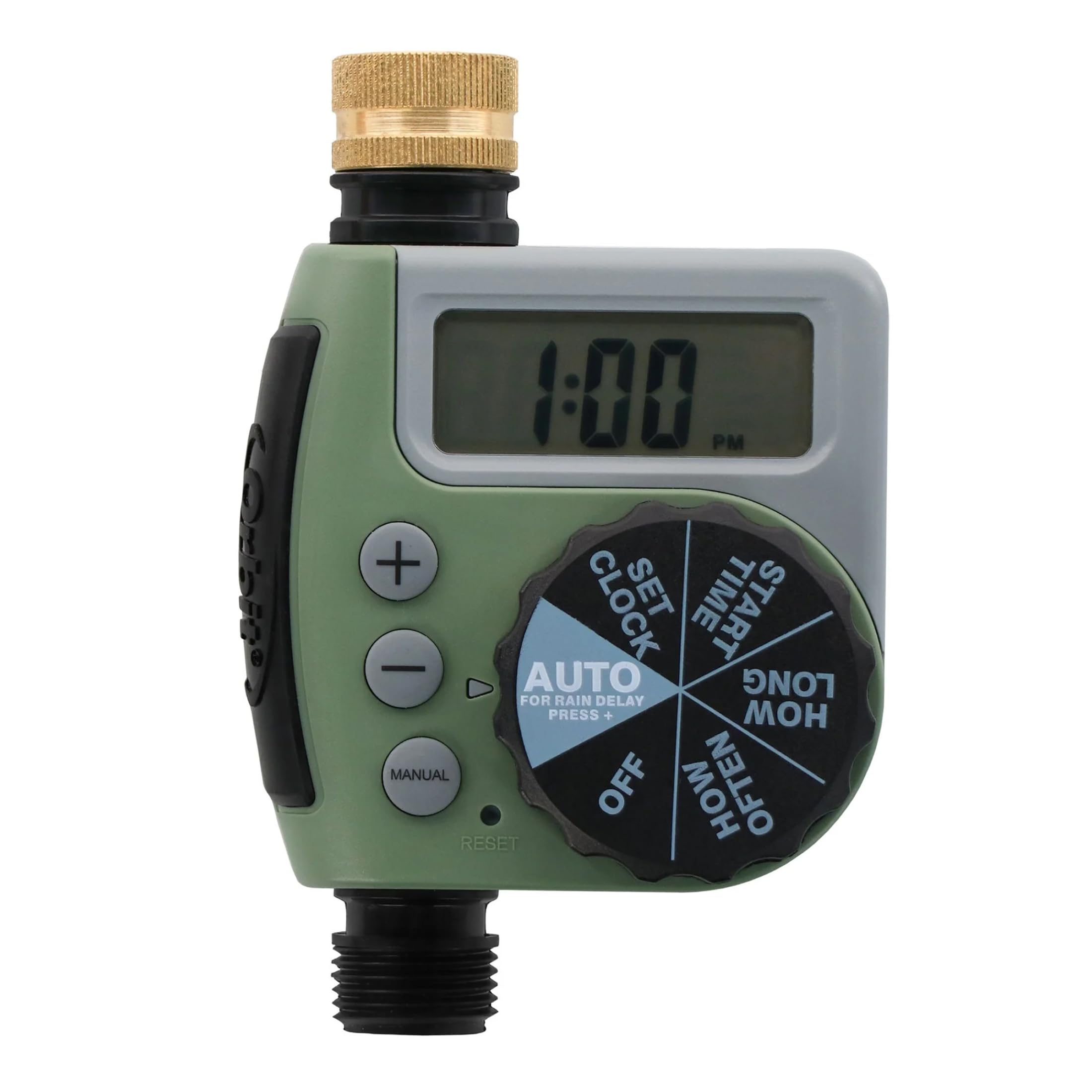
Six years of coverage is why this one made the list. In a group where the shortest warranty runs twelve months, Orbit backs the 62056 for six, and that number says something about how the brass swivel inlet and the sealed body are expected to hold up. On top of the paperwork, we rate it the most dependable of the digital single-outlet timers here — the one least likely to leave a bed dry while you're away.

The dial is the whole interface, and it works with wet hands: turn to the field, press to set, move on. There's no interval shorter than 12 hours, so a newly seeded lawn or a tray of cuttings that wants a short soak every couple of hours is out of reach — that job belongs to the RAINPOINT. For a lawn, a shrub bed or a soaker line on a daily or every-third-day cycle, the limit never comes up.

The faucet side is brass, which is where it matters most. Use a fresh washer, add a turn of plumber's tape and don't overtighten, because the seal is what keeps that joint dry. Bring it in before the first hard freeze, too — ice inside the housing cracks it, and that's the end of the conversation.

Bottom line: For a timer you bolt on and forget, we point to the Orbit: the longest warranty here, brass where it meets the spigot, and a dial anyone can work.

4

Rain Bird 1ZEHTMRP

Rain Bird 1ZEHTMRP

Slopes and clay

Our Score 8.8/10
Check Price

Worth Noting

  • Screen seal can take on water over a season
Fittings
Brass inlet and outlet
Rain Delay
96 hours
Start Times
Up to 4 a day
Max Run Time
6 hours per cycle
Read the full review

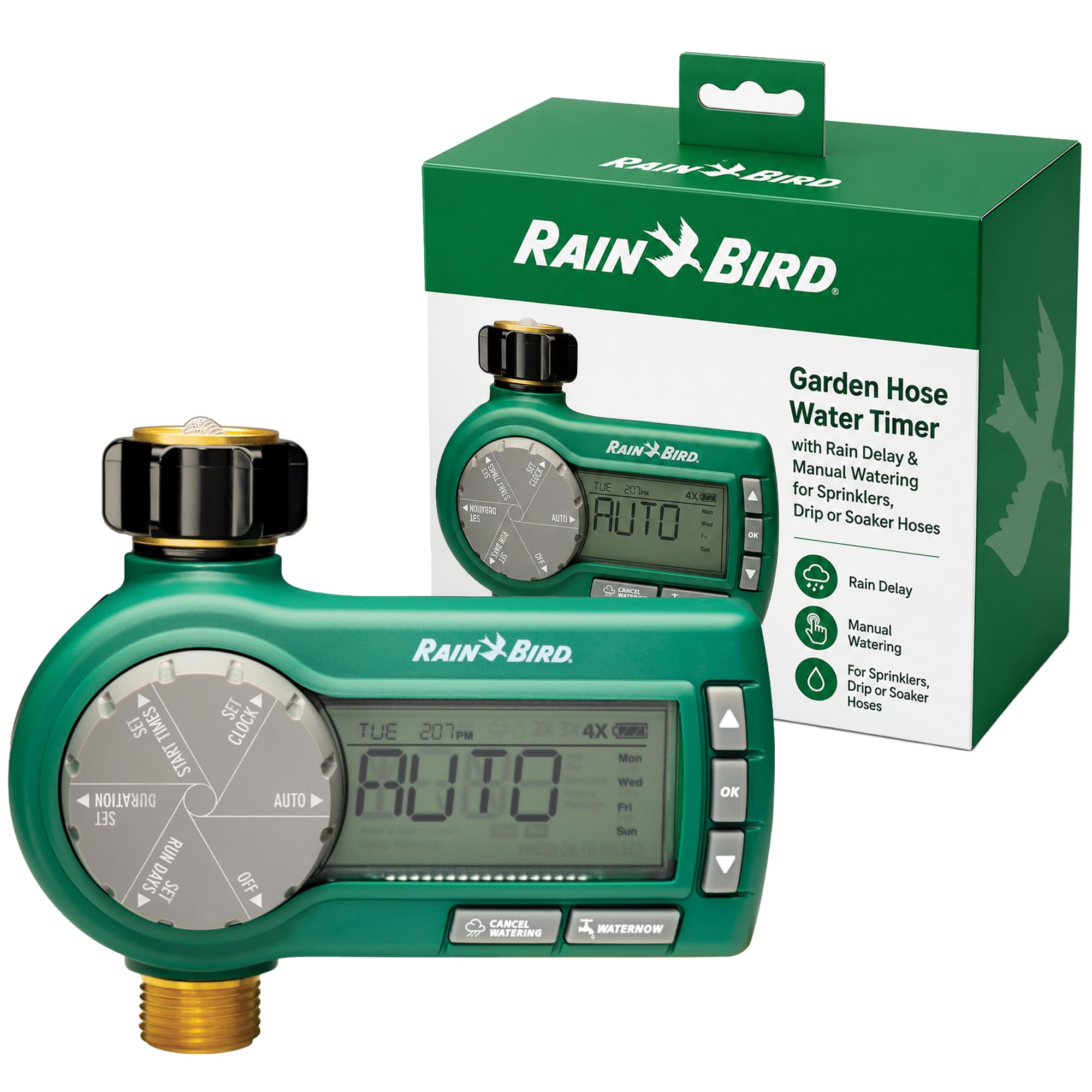
Slopes, clay, and beds that need a long soak are where this Rain Bird earns its keep. It runs four separate start times a day, each up to six hours, on a seven-day cycle — the longest single run and the most starts per day of the single-outlet timers here. Split a deep watering into two passes and the water sinks in instead of running off the mulch.

Brass at both ends is the detail we keep coming back to. Inlet and outlet are both metal, which neither the Orbit nor the RAINPOINT manages, and the body has a heft that makes the plastic units feel like what they are. Setup runs off a large program dial and a four-inch screen that names the next watering cycle, with the 96-hour rain delay and the Water Now button on the front where you can find them.

This is the one we hand to a buyer who's tired of replacing timers. Nothing here is immune to a bad season, and it's the heaviest, chunkiest unit we handled — hanging off a spigot like a small lunchbox. Metal fittings, a real dial and four programmable starts are what buying once looks like in this category, and the bulk is what you pay for it.

Bottom line: Our pick for slopes, clay and anyone who wants metal at both ends — the Rain Bird schedules deeper soaks than anything else here and feels built for them.

5

Insoma 2-Pack Timer

Insoma 2-Pack Timer

Two separate beds

Our Score 8.4/10
Check Price

Worth Noting

  • No day-of-week scheduling
  • Rain delay has to be set by hand
Inlet
Brass, metal thread
Pack Size
2 timers
Battery Life
180 days
Waterproof Rating
IP55
Read the full review

Two beds, two taps, two timers. That's the arrangement we prefer over a multi-zone controller for most gardens, and this pair is a straightforward way to get there: when one unit dies, only the bed attached to it goes dry while you sort a replacement, and you're not running both hoses off one screen and one set of buttons.

Each timer is the same plain dial-and-buttons unit: brass inlet with a metal thread, a big LCD, a child lock, and auto, manual and rain-delay modes. The brass is the part we care about — that's the joint that fails first on plastic-bodied timers — and having two means a soaker on one tap and a sprinkler on the other, with no splitter and no shared schedule.

What's kept these on our taps is the lack of ceremony. Set the interval, set the run time, press auto, and the pair just waters — no app, no pairing, no account. The quoted 180 days of battery life works out to a fresh set of AAs about twice a year, which is the main running cost.

Bottom line: For two beds on separate taps or a splitter, we choose this pair: brass inlets, dead-simple programming, and a failure that only takes down one hose.

How We Tested Hose Timers Through a Full Summer

We started by narrowing a long list of hose timers down to 14 models based on manufacturer specs, retail best-seller lists, and customer reviews that kept mentioning the same trouble spots: cracked collars, fogged screens, and schedules that drifted. We filtered out anything with non-standard fittings or a programming flow that required a manual to decode, and we made sure the shortlist covered a range of prices rather than just premium units. Then we installed each timer on a standard outdoor spigot — some at my house, some at a neighbor's community garden — with hose runs to raised beds, containers, and one patch of lawn that never gets enough water.

Over one full summer, we lived with them the way you would: setting early-morning and evening cycles before work, changing schedules on weekends, and checking connections after a week under pressure. We timed setup from unboxing to first cycle, then timed a schedule change a week later without the instructions. We ran a dry paper towel around every threaded collar and noted any drips; we watched whether the timer actually opened and closed when it said it would, and whether the display stayed readable after a month in direct sun. Every few weeks we checked battery indicators and logged any unit that needed fresh batteries before the season ended.

Durability showed up in small ways — a dial that stiffened in the heat, a collar that cross-threaded after a few removals, a battery door that never felt secure. At the end, we matched each timer's features against what we actually used: a simple dial that held its schedule beat an app that needed re-pairing. Value came down to whether the price bought more reliable watering, not more settings.

How to Choose the Right Hose Timer

Start With the Schedule, Not the Feature List

Decide how often you water before anything else. A mechanical timer counts down from 15 to 120 minutes and closes; it can't hold a weekly plan, so it suits a soaker hose you turn on yourself. A digital timer stores interval, run time and start time, and that's the class where rain delay lives. Smart timers add forecasts and volume measurement. The trap is buying a countdown unit expecting it to water every third day — it won't, and no amount of dial-twisting changes that.

Fittings, Washers and Pressure

Almost every leak starts at a joint, not in the electronics. Brass inlet threads survive repeated connecting far better than plastic, and brass on the outlet side protects the hose end too. Whichever you buy, fit a fresh washer, add a turn of plumber's tape, and tighten by hand plus a nudge — overtightening a plastic thread cracks it. If your spigot comes straight off the main, put a pressure regulator ahead of the timer; the fittings that sprayed water were the ones on high-pressure taps.

One Box or Several Timers

A two- or four-zone controller looks tidy and gives you one screen for the whole garden, but it's also one device and one failure: when a valve sticks, every zone on that box is affected. Two single timers on a Y-splitter cover the same ground with independent failure, and each is easier to replace. Choose the multi-zone box when you want one rain delay and one schedule for everything; choose separate timers when the beds matter individually or sit on different taps.

Weather, Water and Winter

An IP rating describes water hitting the case, not frost, UV, or a sprinkler soaking the same spot for an hour. What actually finishes these units is water inside the body and ice in the valve. Take the timer off the spigot before the first hard freeze, drain it, and store it indoors — a frozen valve cracks the housing and ends its season early. If the spigot sits in a sprinkler's path, give the timer a hood or move it to a sheltered tap.

Frequently Asked Questions

Final Verdict

Start with the RAINPOINT. It covers the widest spread of schedules here — a minute every hour through a four-hour soak once a week — resumes itself after a rain delay, and sits at the budget end of the group, which is the right way to spend on something that lives outdoors and won't last forever.

If longevity is the whole point, the Orbit's six-year warranty and brass faucet fitting justify the step up. And for a garden at a house you visit monthly, go straight to the LinkTap — the flow alerts are the difference between reading about a burst line and finding it.