Watering & Irrigation

Best Garden Hose Reel Carts of 2026

A hose reel cart should make watering feel effortless: pull it to the bed, crank the handle, and get on with your evening. A flimsy one turns every trip into a negotiation with a wobbling frame, a kinking hose, or a handle set so low you feel it in your back. The right cart rolls over grass and patio edges without tipping, holds its shape season after season, and keeps water where it belongs.

I have dragged enough hoses around my own yard to care about wheels, handles, and connections that do not drip down your arm. Over the past six months, we tested 12 hose reel carts, assembling each one and using it for everyday watering, full-hose loads, and trips across lawns and patios. The best shared sturdy frames, materials that did not flex, easy mobility, sensible design, and a handle height that felt natural at different heights; leakage, assembly, and long-term value separated the rest. The picks below are the ones that earned their place.

1

Liberty Garden 304 Explorer

Top Pick
Liberty Garden 304 Explorer

Rust-free all-around

Our Score 9.0/10
Check Price

Worth Noting

  • Some hose connections are plastic, not brass
Weight
17.3 lb
Hose Capacity
250 ft of 5/8 in. hose
Frame Material
Anodized aluminum
Wheels And Tires
Two PU flat-free tires
Read the full review

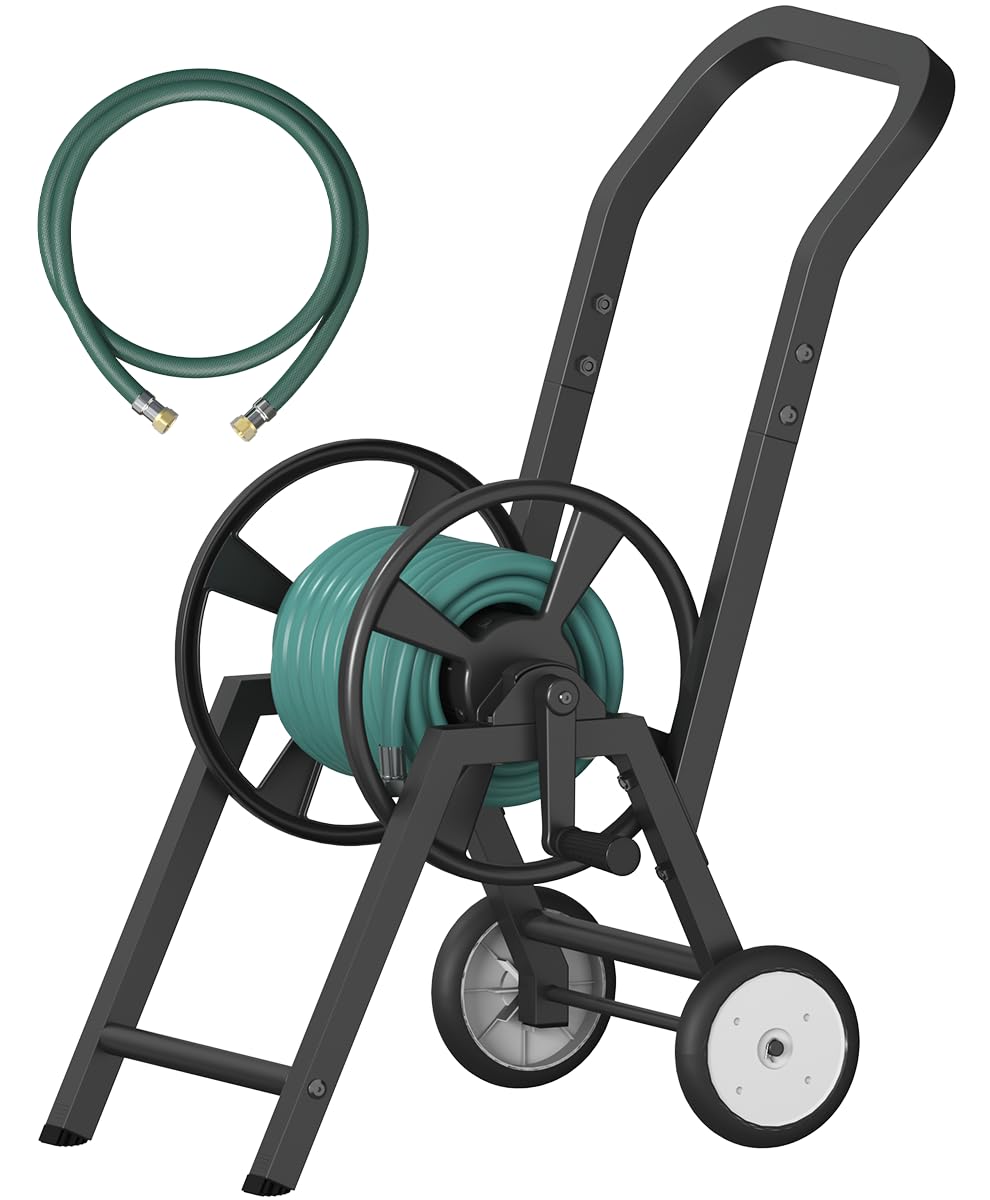
An anodized aluminum frame and 250 feet of 5/8-inch hose capacity are the two facts that define the Liberty Garden 304 Explorer. Aluminum means you are not repainting rust spots each spring, and 250 feet is enough for most suburban lots without turning the drum into a bulky spool. At 17.3 pounds, the cart is light enough to lift into a shed or shift around a patio, and the PU tires are flat-free, so there is no air pump ritual.

That combination is why we recommend it as the default. The two-wheel layout is more nimble than a wide four-wheeler, and we appreciated the smaller footprint when tucking it beside a garage. You do give up some of the set-and-pull stability of a four-wheel cart: when the drum is full, pull in a straight line and take a slope slowly. For a typical yard with a nearby spigot, that is a fair trade for a cart that is easier to store and move.

We also like the small tool tray for a nozzle or gloves; it keeps the wet little pieces off the ground. The reel turns smoothly, and the cart rolls over turf and pavement without a compressor. This is not the cart for someone who wants a massive four-wheel platform or a storage basket. It is the one for a homeowner who wants a rust-free, manageable reel that disappears into the corner of a shed.

Bottom line: We recommend the Liberty Garden 304 for most yards: its rust-free aluminum frame, 250-foot capacity, and flat-free tires make a long hose easier to handle.

2

Gorilla Mobile Aluminum

Gorilla Mobile Aluminum

Lightweight guided winding

Our Score 9.0/10
Check Price

Worth Noting

  • Handle sits low for taller users
Weight
12.7 lb
Fittings
Forged brass
Hose Capacity
225 ft
Frame Material
Aluminum
Read the full review

The feature that separates the Gorilla from a plain hose cart is the built-in alignment guide. It feeds the hose back onto the drum in a straighter line, so you spend less time steering the hose by hand. A removable accessory tray is the second useful detail; it gives a nozzle or a pair of gloves a place to ride instead of sliding around in the grass.

The rest of the cart is built to stay outside. The aluminum frame is rust-proof, and at 12.7 pounds the cart is light enough to pull out of a shed with one hand. Forged brass connections are the right material around a spigot, and the 225-foot drum handles a typical suburban hose run. The included hardware and simple assembly keep it from becoming a weekend project.

We think that package earns the premium over the steel carts here: the guide reduces hand-over-hand work, the brass avoids the plastic fittings on some rivals, and the low weight matters every time you move a full drum. It is not the biggest capacity, but it is the premium cart for a one-person routine.

Bottom line: We recommend the Gorilla for anyone who wants the lightest rust-proof cart and the easiest winding; its alignment guide and brass fittings justify the premium.

3

WERMAH Upgrade Hose Cart

WERMAH Upgrade Hose Cart

Large-yard four-wheel

Our Score 8.4/10
Check Price

Worth Noting

  • Steel frame needs rust care
Weight
35 lb
Hose Capacity
300 ft of 5/8 in. hose
Frame Material
Alloy steel
Wheels And Tires
Four 10 in. airless tires
Read the full review

If your hose runs to 300 feet, the WERMAH Upgrade is the cart we point to first. The four-wheel base and 10-inch airless tires carry that much hose without the cart feeling like a wheelbarrow, and the 300-foot capacity is measured in 5/8-inch hose, the size most long garden hoses use. The angled brass connector is designed to keep the hose from kinking right at the spigot, a detail that saves a lot of tugging.

We like the sealed connector and the 6.5-foot leader hose. That extra length gives you room to position the cart away from the faucet, and the pre-installed fitting is meant to solve the leak-prone joint before it starts. The four-wheel layout is the reason to choose this over a two-wheel cart: with a long hose, it tracks behind you instead of asking you to balance the load. The 35-pound body feels planted, but you will not want to carry it up steps.

The crank handle and foam grip make winding less punishing on your hands, and the wide base keeps the drum steady when you pull. This is a big cart for a big run; if your hose is 100 or 150 feet, the Real Hose Storage or GrillTown is easier to store and move. For a large yard with a long hose, the WERMAH is the four-wheeler we reach for.

Bottom line: For a long hose and a big yard, we recommend the WERMAH: 300 feet of capacity, four airless tires, and an angled brass connector that helps prevent kinks.

4

Real Hose Storage 4-Wheel

Real Hose Storage 4-Wheel

Value four-wheel cart

Our Score 8.4/10
Check Price

Worth Noting

  • No hose guide for heavy hose
Weight
22 lb
Hose Capacity
250 ft of 5/8 in. hose
Frame Material
Powder-coated steel
Wheels And Tires
Four airless tires
Read the full review

The Real Hose Storage cart gives up 50 feet of capacity to the WERMAH and asks for less money, which is the trade most four-wheel buyers should take. It holds 250 feet of 5/8-inch hose, rolls on four airless tires, and weighs 22 pounds, light enough for one person to move without the planted, heavy feel of the bigger steel carts.

We like it because the basics are right: powder-coated steel, a 6-foot leader hose, and a wide base that keeps the drum steady when you pull. Assembly is straightforward with the included hardware, and the cart rolls easily on turf. The finish is the part to watch; steel is not aluminum, and a chip in the coating is where rust starts. A few minutes with touch-up paint at the end of the season is cheaper than replacing the cart.

The 250-foot drum is the sweet spot for most home lots, and the cart's footprint is easier to tuck away than the 300-foot WERMAH. It has the stable four-wheel layout without the bulk of a commercial-style cart, and the 6-foot leader gives you some slack at the spigot. For a typical yard, this is the four-wheeler that makes the most sense.

Bottom line: We recommend the Real Hose Storage cart as the value four-wheeler: 250 feet of capacity, a light 22-pound frame, and four airless tires for less than the premium picks.

5

Artigarden Steel Cart

Artigarden Steel Cart

Compact small-yard cart

Our Score 8.4/10
Check Price

Worth Noting

  • Assembly takes tools and patience
Height
32.7 in.
Hose Capacity
165 ft of 5/8 in. hose
Frame Material
Powder-coated steel
Wheels And Tires
Two wheels
Read the full review

The Artigarden is the compact metal option: a powder-coated steel frame, a 165-foot capacity for 5/8-inch hose, and a 32.7-inch height that keeps the crank within easy reach. Two wheels make it narrower than the four-wheel carts, which matters if you thread it through a gate or park it in a crowded shed.

We like the metal build at this size. The 3.9-foot leader hose and stainless faucet fitting save you from hunting for an adapter, and the all-metal frame feels more substantial than a resin cart. The 32.7-inch height is a useful middle ground: tall enough to save a lot of bending, low enough to stay stable. The drum is sized for a small yard, so this is not the pick for a 200-foot run; it is for a front bed, a patio, or a second spigot.

The drum does not lock, so a heavy nozzle can make the reel creep when you set it down. That is a small annoyance on a flat patio and more noticeable on a slope. The two-wheel layout also asks you to balance a full hose, so keep the load within the 165-foot rating.

For a small yard, the Artigarden is a tidy metal cart that takes up little room and handles a short hose without fuss. If you need a bigger drum or a cart that arrives ready to use, look at the Real Hose Storage or the Hosemobile. For a compact metal cart, this is the one we recommend.

Bottom line: We recommend the Artigarden for a small yard and a short hose: its compact two-wheel metal frame is easy to store and rolls through tight spaces.

6

GrillTown Hosemobile

GrillTown Hosemobile

No-assembly budget pick

Our Score 8.2/10
Check Price

Worth Noting

  • Wheels can feel wobbly
Height
45 in.
Assembly
Fully assembled
Hose Capacity
175 ft of 5/8 in. hose
Frame Material
Resin
Read the full review

The Hosemobile is the only cart here that arrives fully assembled. That is not a small convenience: no bag of bolts, no Allen key, no hour on the driveway before you can water. It stands 45 inches tall, so the crank is closer to waist height than the low-slung handles on some metal carts, and the resin body will not rust.

It holds 175 feet of 5/8-inch hose, which is enough for a small yard, a front bed, or a second spigot. The 22-by-45-by-22.8-inch body is stable enough to pull a hose across a lawn, and the wheels roll easily through grass. The resin will not feel as solid as aluminum when you thump it, but it will not rust, and it does not need paint touch-ups.

For the right buyer, someone with a shorter hose, a single spigot, and no interest in assembly, this is the easiest cart to live with. It will not carry 250 feet, and the resin body is not the choice for a commercial job. But it is the one we point to when the priority is getting watering done this afternoon rather than spending the weekend building a cart.

Bottom line: We recommend the Hosemobile for a short hose and a no-fuss setup: it arrives fully assembled, stands tall, and its resin body will not rust.

7

VINGLI 300ft Cart

VINGLI 300ft Cart

Budget long hose

Our Score 8.2/10
Check Price

Worth Noting

  • Coated steel frame needs rust care
Storage
Storage basket
Hose Capacity
300 ft of 5/8 in. hose
Frame Material
Coated steel
Wheels And Tires
Four wheels
Read the full review

The VINGLI gets you 300 feet of 5/8-inch capacity and a storage basket for less money than the other long-hose carts here. The basket is the detail that separates it: gloves, a nozzle, or a small trowel get a place to ride instead of rolling around in the grass. For a farm or a big backyard, it is a cart with room for the whole run.

We think this is the cart to choose when capacity matters more than finish. The four-wheel base and 37.5-pound body give it a planted feel, and the non-slip crank and foam grip make winding a long hose less punishing on your hands. The tires are the first thing we check on any cart at this end of the range, because a bad tire turns a four-wheeler into a sled; give them a spin and a visual check before you load the full hose.

The 32.68-by-36.22-by-22.83-inch footprint is larger than the two-wheel Liberty, and the basket adds bulk, so measure the corner where it will live. If you have a long run and a shed with room, the VINGLI covers the job without the premium of an aluminum cart. The four wheels and wide base are the reason it feels steady with a full drum, and the basket means fewer trips back to the shed. If your hose is shorter, the GrillTown is simpler to live with.

Bottom line: We recommend the VINGLI when you need 300 feet of capacity on a budget; the basket and four-wheel base make a long hose easier to manage.

How We Tested Garden Hose Reel Carts

We started by reading owner reviews and spec sheets, then narrowed the field by hose capacity, wheel type, frame material, price, and assembly instructions, looking for carts that could handle a full hose without acting like a shopping cart with a bad wheel. From that pool, we bought 12 carts and assembled each one ourselves, timing how long it took and noting whether the hardware lined up without extra force.

For six months, those carts lived in our yards, not a lab. We filled each with a full hose, pulled it across grass, over patio seams, around flower beds, and through tight side-yard turns, then watched whether it tracked straight or needed two hands and a foot to correct. We checked handle height while walking upright and while leaning into a pull, and we looked at how the wheels and frame held up after being left in sun and rain.

At every connection, we ran water for several minutes and felt around the fittings for drips; then we reeled the hose back in to see whether water pooled in the cart or ran down the frame. We also noted design details that made a difference in daily use, like a crank that turned smoothly, a reel that did not rub, and a cart that stayed balanced when full. At the end, we compared what each cart cost against how it looked and worked after six months, scratches, rust, wobble, and all, so value reflected the whole season rather than the unboxing.

How to Choose Garden Hose Reel Carts

Start with hose capacity, not the biggest drum

Cart capacity is usually stated as feet of 5/8-inch hose. A 1/2-inch hose packs more length onto the same drum, while a 3/4-inch hose takes more room, so treat the number as a 5/8-inch guide and expect less with thicker hose. For a typical suburban lot, 200 to 250 feet is plenty. The 300-foot WERMAH and VINGLI make sense when you really need the reach; the 175-foot Hosemobile is easier to store for a short run. Measure your longest hose before you choose, and do not buy extra capacity you will never fill.

Wheels, tires, and loaded weight

Two wheels make a cart narrower and easier to turn; four wheels make a fully loaded drum more stable on uneven ground. Tire type matters as much as count. Airless or PU tires, found on the Liberty, WERMAH, and Real Hose Storage, skip the pump and the slow leak. Pneumatic tires cushion better but need pressure checks. Weight is the other half of the equation: the aluminum Liberty is 17.3 pounds empty, while the steel VINGLI is 37.5, and a long hose adds several more pounds of water. Choose the cart you can move when it is full, not when it is empty.

Rust is the long-term test

An outdoor cart lives with wet hose, damp grass, and winter. Anodized aluminum, used on the Liberty and Gorilla, will not rust, and resin like the Hosemobile avoids the problem entirely. Powder-coated steel can last, but rust starts wherever the coating chips, especially at the base and around fittings. If you store the cart in a shed and can touch up chips, steel is fine. If it stays out all year, pay for aluminum or accept more maintenance. Check the frame material before the capacity number; a big drum is no help if the cart is flaking apart.

Winding comfort and connections

The crank height decides whether winding a long hose is a chore or a backache. A tall cart like the 45-inch Hosemobile keeps the handle closer to waist height; the Gorilla sits lower, which taller users will notice. A hose guide is the other comfort feature; the Gorilla uses one to keep the hose from bunching on one side of the drum. For connections, brass or aluminum with good seals beats plastic at the spigot. If your faucet sits in full sun or stays pressurized, spend more on fittings and less on extra capacity.

Assembly and storage footprint

Some carts arrive fully assembled, like the Hosemobile; others are kits that take an afternoon. If you are not comfortable with tools, that difference matters more than an extra 25 feet of capacity. Measure the footprint before you buy: the four-wheel carts run roughly 24 to 32 inches wide, and a loaded cart needs clearance to turn. Check your gate, shed door, and the path to the spigot. A two-wheel cart like the Liberty or Artigarden tucks into tighter spots, while a 300-foot four-wheeler needs a dedicated corner.

Frequently Asked Questions

Final Verdict

For most yards, the Liberty Garden 304 Explorer is the cart we recommend. Its anodized aluminum frame will not rust, the 250-foot drum covers a typical lot, and the flat-free tires and 17.3-pound body make it easy to move and store. If you need four wheels and 300 feet of capacity, choose the WERMAH; if you want a cart that arrives assembled, the Hosemobile is the simpler buy. The Liberty is our first choice.