Watering & Irrigation

Best Garden Hose Splitters of 2026

Two hoses, one spigot, and a Saturday morning of watering ahead — that's when a splitter earns its keep. The trouble is that cheap ones announce themselves the moment the water comes on: a drip down the thread, a spray across your shins, a valve that stiffens up by July. A good one does a single unglamorous job, sending water where you point it without soaking you in the process, and it lets you shut off one line while the other keeps running.

I've burned through a few plastic ones that cracked at the collar after a cold snap, so when my team spent late April through August with 16 splitters on real outdoor spigots — raised beds, a two-zone lawn, a pressure washer — we were paying attention. What separated them was material, threads, and valve feel, roughly in that order. And here's the thing nobody tells a first-time buyer: the leak is usually not the body. It's the rubber washer inside the female end, so check that spares come in the box. The ones that held up are below, sorted by what they're actually good at.

1

SNUTUYA Stainless 2-Way Splitter

Top Pick
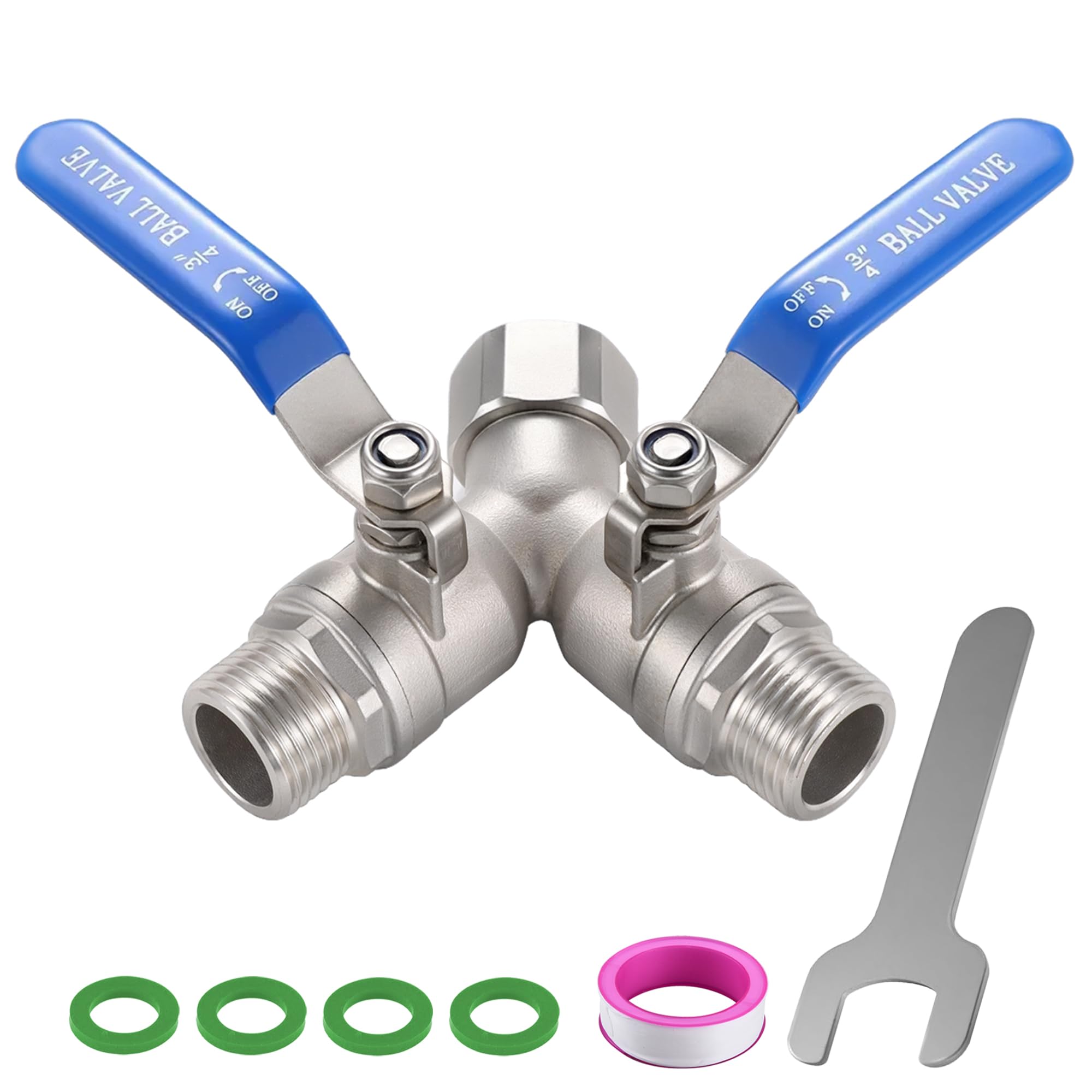
SNUTUYA Stainless 2-Way Splitter

Corrosion-prone spots

Our Score 9.6/10
Check Price

Worth Noting

  • Internal gasket can fail well before the body does
  • Costs more than the brass two-ways here
Valve
Full-port, 0.59 in
Thread
3/4 in GHT
Outlets
2
Material
304 stainless steel
Read the full review

Brass is the default for a reason, but it does not love every yard. Put a brass body under a sprinkler's arc, within reach of coastal air, or on water with a lot of mineral in it and the threads will eventually pit and go green. This splitter sidesteps the question entirely: body and handles are 304 stainless steel, the material you would pick if corrosion were the only thing that mattered.

It is not just a material play. The ball valve is full-port at 0.59 inches, the widest passage of the two-ways we looked at, so a sprinkler or a pressure washer gets close to the full line rather than a throttled trickle. The rotary nut turns 360 degrees for lining the outlets up, and the long stainless levers are easy to catch with wet hands - the kind of handle you can work with two fingers while the other hand holds the hose.

Where it gives ground is cost and one wear item. It runs more than the brass two-ways, and the internal gasket is the part to keep an eye on, since a gasket is what eventually retires any of these splitters regardless of how good the body is. Against that, the body and valve assembly are the last things here likely to fail. On a punishing spigot - the one in full sun by the driveway, the one at the beach house - that trade makes sense.

Bottom line: Buy this if your spigot lives in salt air, sprinkler spray, or hard water and you are tired of watching brass go green - it is the most corrosion-proof splitter here.

2

RAINPOINT 2-Way Hose Splitter

RAINPOINT 2-Way Hose Splitter

Everyday two-hose use

Our Score 9.4/10
Check Price

Worth Noting

  • The most expensive two-way splitter here
  • Two outlets only; four zones need a manifold
Valve
Stainless steel ball valve
Thread
3/4 in GHT
Handles
1.9 in metal
Outlets
2
Read the full review

Most hose splitters are designed around the brass and forget the part you actually touch. RAINPOINT went the other way, with a pair of 1.9-inch metal levers shaped to sit under the fingers, and that single detail put this one at the top of our list. Turning a line on with wet hands, or with a glove on, takes one push instead of a pinch and a wrestle.

The rest of the build holds up that first impression. The body is metal wrapped in a rubberized grip, so it does not slip in wet hands the way slick brass can, and at 0.8 pound it feels substantial without dragging on the faucet. Inside, a stainless steel ball valve with a 0.42-inch port and 1.04-inch outlets keeps the passage wide - the specification that separates this from the narrow-bore Y splitters that quietly starve a sprinkler at the end of a long hose. Rated to 200 PSI, for whatever that is worth on a household spigot.

Sealing is the part we watched closest, since a drip at the swivel nut is the complaint that follows this category around. Ours seated by hand on standard 3/4-inch GHT threads with no tape and no drip, and the anti-twist nut kept it put when we pulled a loaded hose sideways. One thing to check before you commit: the wide T shape wants a little room, so measure the clearance on a spigot tucked into a tight valve box.

What you pay for all of this is the highest price among the two-way splitters here, and that is the honest case against it. On a bib you touch twice a season, a plain brass Y does the same job for less. On the spigot you work every evening, switching between a hose reel and a sprinkler, the handles alone earn the difference back inside a summer.

Bottom line: If you want one splitter that seals, turns with one wet hand, and does not choke your sprinkler, this is the one we point people to - especially if gloves or stiff hands are part of the picture.

3

BILAL Brass 2-Way Splitter

BILAL Brass 2-Way Splitter

Budget brass

Our Score 9.4/10
Check Price

Worth Noting

  • Narrow bore trims flow to big sprinklers
Weight
3.2 oz
Handles
Extended metal
Outlets
2
Material
Brass
Read the full review

Cheap brass splitters usually save their money somewhere: a plastic lever, a thinner casting, burrs left in the thread. This one doesn't, at least not in the ways that matter to us. The body is solid brass, the shutoff levers are brass as well rather than the plastic tabs you see at this end of the range, and nothing about it feels like the budget option it is. That is why it takes the value slot in this guide instead of a more expensive brass Y.

The handles are extended rather than stubby, which is the whole point if your grip is not what it used to be, and the octagon top takes a wrench when hand-tightening will not do. Spare washers come in the box and the swivel nut lets the body hang where you want it. The trade-off is bore size: the passage through a Y this small is narrower than your hose, so a big oscillating sprinkler on the end of a long run will notice. For a hand nozzle, a soaker line, or filling a can, it never comes up.

Bottom line: The least you can pay for an all-brass splitter with brass levers, and it turns like one that costs more - our budget pick for anyone who wants brass without the premium.

4

Morvat Brass 2-Way Splitter

Morvat Brass 2-Way Splitter

Classic brass build

Our Score 9.2/10
Check Price

Worth Noting

  • Valve handles often start stiff and need breaking in
Outlets
2
Included
3 washers, thread tape
Material
Brass
Warranty
1 year
Read the full review

Open the box and there is more in it than the splitter: three spare rubber washers and a roll of thread tape, which is exactly the collection of small parts you would otherwise be hunting for the first time a joint drips. Morvat also backs the thing with a one-year warranty, and the body is full brass rather than brass-colored pot metal.

In the hand it feels like the brass splitter people picture - 8 ounces of it, with a hexagonal top you can put a wrench on and a swivel nut that turns a full 360 degrees so the body can hang the way your hoses need it to. We rate it the best of the conventional brass Ys here, and the reason is unglamorous: it does the plain job with no drama, and nothing about it feels like the weak link.

Two things worth knowing. The handles can start stiff and work in over a few weeks; a dab of silicone grease on the stem hurries that along. And the joint to protect is where the body meets the hose thread, because a loaded hose hanging off a small brass fitting is a lot of leverage - a short leader hose between the spigot and the splitter takes that weight off the threads and is the cheapest insurance in the garden.

Bottom line: A proper brass Y with the small parts already in the box and a warranty behind it - the pick for anyone who wants a familiar brass splitter and does not need long levers.

5

Twinkle Star 4-Way Splitter

Twinkle Star 4-Way Splitter

Four watering zones

Our Score 9.2/10
Check Price

Worth Noting

  • 1.1 pounds hanging off the spigot needs support
  • Valve handles are small and stiff
Thread
3/4 in
Weight
1.1 lb
Outlets
4
Material
Heavy-duty brass
Read the full review

Four outlets off one bib sounds like a plumbing job. It is not: this is a single brass block that screws onto the spigot, with a valve on each of the four 3/4-inch outlets. Drip line on the first, an oscillating sprinkler on the second, the hose reel on the third, and the fourth closed until the day you need it. That is the entire install.

What we appreciate is that each outlet gets a real ball valve you can shut down individually, so swapping a hose does not mean repressurizing the whole manifold or walking back to the faucet. The block weighs 1.1 pounds and feels like it will outlast the plastic manifolds at the hardware store - which is both the appeal and the catch, because that weight is hanging off your faucet threads.

One thing to plan around: opening four outlets splits the flow four ways. Run a drip line and a sprinkler together and you will never notice. Open two full-circle sprinklers at once and both will underperform, which is physics rather than a fault in the block. It is why we treat a four-way as three live lines and one spare rather than four equal ones.

Bottom line: One spigot, four independently valved lines - the pick for a drip system, a sprinkler, and a hose reel all hanging off the same bib.

6

Biswing 2-Way Splitter 2-Pack

Biswing 2-Way Splitter 2-Pack

Two spigots

Our Score 9.2/10
Check Price

Worth Noting

  • ⚠️ Not rated for drinking-water systems
  • Small knobs stiffen with age
Pack
2 splitters, 4 O-rings
Thread
3/4 in GHT
Outlets
2 per splitter
Material
Brass
Read the full review

Most yards do not have a splitter problem, they have a two-spigot problem: one bib at the front, one at the back, and a hose dragged between them all summer. Buying these in a pair solves it in one order - two brass Y splitters, each with its own pair of ball valves, plus four spare O-rings in the bag.

The build is the standard brass Y done properly: 3/4-inch garden hose thread in and out, a valve on each outlet, and enough heft that it does not feel like a toy in the hand. Installation is a hand-tightening job - ours went on without tools, though a wrap of thread tape is worth the two minutes on a pitted old spigot.

Two caveats come with the pair. Biswing labels these as not suitable for drinking-water systems, so they are for the yard, not for filling a camper tank or a bottle. And the valves are the small-knob type: they turn, but a stiff hand will feel them, especially after a season outdoors. Neither is a dealbreaker at this end of the range, and together they are why this is a value pick rather than the top one.

Bottom line: Two complete brass splitters with spare O-rings for roughly what one costs elsewhere - the sensible buy when you have a front bib and a back bib.

7

Twinkle Star 2-Way Splitter

Twinkle Star 2-Way Splitter

Occasional watering

Our Score 9.2/10
Check Price

Worth Noting

  • Small handles need a firm pinch
  • Outlet threads are the weak point
Thread
3/4 in GHT
Outlets
2
Material
Brass
Dimensions
3.2 x 2.8 x 1.8 in
Read the full review

The first thing your fingers find on this splitter is a pair of small plastic-covered handles, and they are the reason it sits in also-consider rather than higher up. They work. They also ask for more of a pinch than the long levers on our favorites, and if you are turning water on and off every evening, that difference adds up over a summer.

Everything else is a conventional brass Y done competently: two outlets, a valve on each, standard 3/4-inch garden hose thread, and a compact body at 3.2 by 2.8 by 1.8 inches. It screws onto a standard spigot by hand and shuts off cleanly on both sides, which is the entire job description.

The failure to watch for is at the outlet threads rather than the body, and it is the kind of thing that happens to a splitter left outdoors year after year with a hose hanging off it. Support the body when you pull a hose free instead of yanking, and unscrew it before the first hard freeze - that one habit does more for its life than anything else you can do.

Where it makes sense is the second bib, the rental, the hose you hook up for the kids' pool in June and forget about until August. Put it somewhere the water gets turned on and left on, and the handles stop mattering entirely.

Bottom line: A competent brass Y for very little money; buy it for a spigot you do not work hard, and skip it if you want the valves to feel good in your hand.

8

Sanpaint Brass 2-Way Splitter

Sanpaint Brass 2-Way Splitter

Spare or rental

Our Score 9.2/10
Check Price

Worth Noting

  • Plastic handles are the first thing to break
Thread
3/4 in GHT
Outlets
2
Material
Brass
Dimensions
4 x 3 x 0.74 in
Read the full review

At 0.74 inches deep, this is the flattest splitter in the group, and on a spigot set back into siding or crowded into a valve box where a fat brass block simply will not fit, that profile is the whole argument for it.

The body is brass with two valved outlets and standard 3/4-inch garden hose thread, and it does the job without ceremony: screw it on, turn a handle, water comes out where you pointed the hose. The handles are plastic, and that is the compromise the low price buys. They are comfortable and big enough to grip, but plastic is what fails first on a splitter that lives outdoors.

Sealing is the usual brass-Y story. It holds when the washer is seated and the nut is snug, and it drips when it is not. Ours wanted a second look at the spigot joint before it ran dry, and a fresh washer sorted it in under a minute - which is worth knowing before you conclude the threads are bad.

Buy it as a spare, a second-bib splitter, or something to leave on a property you do not want to think about. It is the least expensive way to split a line here, and if it dies in a couple of seasons you will not feel it the way you would with a premium splitter.

Bottom line: The least expensive splitter we recommend - fine for a spare bib or a hose you connect a few times a season, as long as you know the plastic handles are the weak link.

How We Tested Garden Hose Splitters (and Where They Leaked)

We started with about 40 splitters sold at major retailers and narrowed the field by the things that matter once one is screwed onto a spigot: body material, thread type, whether each outlet has its own shutoff, and price per outlet. We cut anything that shipped without replacement washers or that used a plastic collar where the hose threads on. That left 16 units, which we ran from late April through August.

Each splitter went onto an outdoor spigot and stayed there for the season, running a sprinkler, filling watering cans and a five-gallon bucket, and switching back and forth to a pressure washer. To check for leaks, we dried every joint with a paper towel, turned the water on full, and came back five minutes later to see where the paper stuck. We also threaded on three different hoses — a cheap vinyl one, a heavy rubber one, and a coiled one — and noted which collars hand-tightened cleanly and which cross-threaded.

Valve operation got its own pass: we turned each one on and off with wet hands, then with muddy garden gloves, counting how many turns it took to shut off completely and whether the handle stiffened after a few weeks in the sun. Durability was a matter of watching rather than guessing — we left them mounted through heat and rain, looked for hairline cracks at the collar, and noted which bodies chalked or seized. Fit and value rounded it out: we tracked whether a splitter held two hoses at once without a pressure drop at the far end, and whether the price made sense given what the body was made of.

How to Choose Garden Hose Splitters

The seal is the washer, not the brass

A brass splitter is not automatically a dry one. The seal at the spigot is made by the rubber washer inside the swivel nut, and it holds when the nut is snug - not when it has been cranked down hard enough to crush the washer flat. If a joint drips, take it apart before you tighten it further: a missing, hardened, or doubled-up washer is the usual culprit, and a wrap of thread tape helps on worn faucet threads.

Also check the thread standard. Standard 3/4-inch garden hose thread (GHT) is what nearly every U.S. spigot and hose uses; NPT is pipe thread and belongs on plumbing, not on a hose end. A splitter that ships with spare washers saves you a trip the first time one goes missing.

How many outlets you actually need

Two is right for most yards: one line to a hose reel, one to a sprinkler or a watering can. Four starts making sense when a drip system, a sprinkler, and a hose all need to be live off a single bib, and the four-way manifolds here let you shut each one off individually.

Two things scale with outlet count: the size of the block hanging off your faucet, and the flow each line gets when several are open at once. A heavy manifold with hoses tugging at it puts real leverage on the faucet threads, so give it support.

Handles matter more than you think

You will touch the handles more than any other part of the splitter, usually with wet hands, often with gloves, sometimes in the cold. Long metal levers - 1.9 inches on our top pick - take a push. Small plastic nubs take a pinch, and they get stiffer as they age.

If arthritis or a weaker grip is part of the picture, this is the one specification worth paying more for. A ball valve that turns smoothly with two fingers beats a cheaper one that needs both hands and a knee.

Full-port versus narrow bore

Look through the inlet of a cheap Y and you will often see a hole far smaller than your hose. That is the restriction people feel when a sprinkler at the end of a long run stops throwing as far as it used to.

Splitters with full-port ball valves - our top pick and the stainless option here - keep the passage close to the hose's own diameter. If you mostly fill cans and use a hand nozzle, bore size will never trouble you. If you run sprinklers or a pressure washer, it is the specification that decides the purchase.

Winter is what kills splitters

The damage you cannot undo happens when water freezes inside the body. Brass splits, cast housings crack, and the fault shows up in spring as a drip you cannot trace back to anything.

The fix is a two-minute habit: shut off the spigot, open both splitter valves to release the pressure, unscrew it, shake it out, and store it indoors. Do that and a decent brass Y will give you years. Skip it and even the good ones become a gamble, which is why a little thread tape and a spare washer in a shed drawer are worth keeping.

Frequently Asked Questions

Final Verdict

The RAINPOINT is the one we keep on the spigot: long metal handles that turn with one wet hand, a full-port valve that does not starve a sprinkler, and a metal body that has held its seal without fuss. It costs more than a plain brass Y, and for a bib you touch twice a week a plain brass Y is the smarter buy - the BILAL if you want brass on a budget, the Morvat if you want spare washers and a warranty in the box.

If your spigot sits in salt air, sprinkler spray, or hard water, go stainless with the SNUTUYA instead. And if you are watering three or four zones off one bib, the Twinkle Star four-way is a different tool for a different yard.