Beekeeping

Best Honey Extractor of 2026

Harvest day should smell like warm wax and end with jars on the counter, not honey across the garage floor. A honey extractor is a simple machine—spin frames fast enough and centrifugal force pulls honey out of the comb—but the wrong one turns that physics into a workout: a drum that walks, a crank that binds, a gate that drips. The right extractor keeps your honey clean, saves your arms, and makes cleanup something you can finish before the bees come back.

I keep a few hives, and over the past seven months my team and I ran eight extractors through harvests, from small manual crank models to larger electric ones. The ones that earned a spot share the same traits: they go together without a second pair of hands, sit sturdily on uneven ground, spin smoothly without vibrating across the driveway, and come apart for cleaning without hiding honey in a seam. Price matters, but value is measured in seasons, not the sticker. These picks are for actual beekeepers, not a photo shoot.

1

VIVO 8-Frame Manual Extractor

Top Pick
VIVO 8-Frame Manual Extractor

Most backyard apiaries

Our Score 9.0/10
Check Price

Worth Noting

  • Hand cranking caps a day's throughput
Drive
Manual crank
Drum Size
25.2 in tall, 18.5 in dia
Gate Height
15.4 in from floor
Frame Capacity
8 shallow or 4 deep
Read the full review

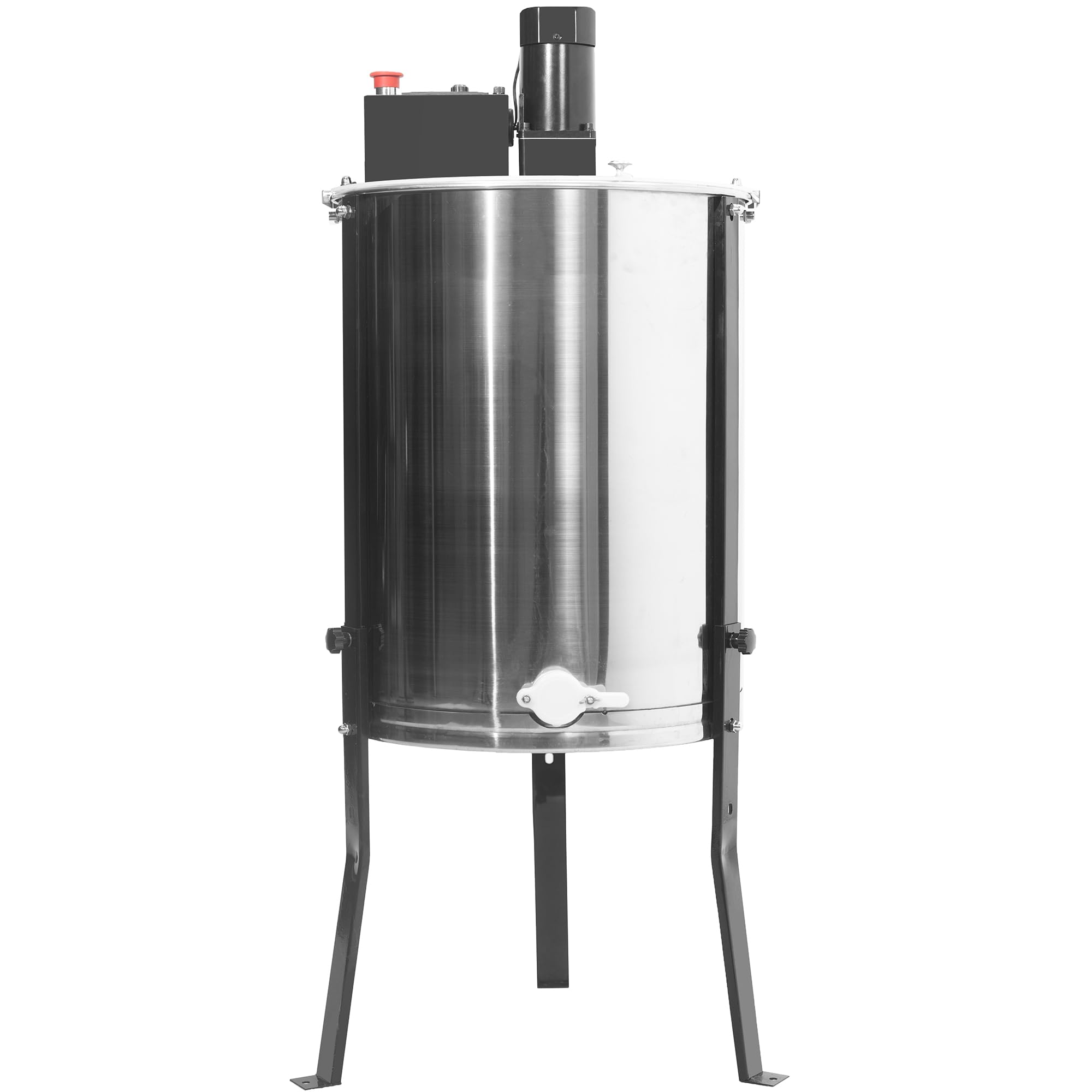
A drum 25.2 inches tall and 18.5 inches across doesn't sound like much until four deep frames drop into it. That's the case for this one: a full harvest load in a footprint that tucks into a garage corner, at 34 pounds, light enough to drag out of storage alone — though once it's brimming with honey you want it sitting on something solid.

The gate is what we keep coming back to. It opens half an inch above the drum floor and sits 15.4 inches off the ground, so honey drains almost to the bottom instead of stopping short, and a bucket slides underneath without gymnastics. The clear lid lets you watch the flow, the drum comes apart for cleaning, and a one-year warranty covers a machine that otherwise asks nothing of you. That last part is the real argument: no controller, no cord, no cool-down.

Loading takes more care than the specifications suggest. The basket doesn't hold a pair of frames apart, so two can sit face to face and the honey on their touching sides never leaves; leave a gap and flip the frames partway through. Once a load goes unbalanced at speed the drum starts rocking, and a plywood base or bolts through the feet settles it for good.

Bottom line: The extractor we recommend to most backyard beekeepers: four deep frames per load, a gate that drains almost dry, and no motor to maintain.
2

VIVO Electric 4/8 Frame Extractor

VIVO Electric 4/8 Frame Extractor

Big harvest days

Our Score 8.8/10
Check Price

Worth Noting

  • Motor gets hot after back-to-back cycles
  • Leg welds are the weak point
Motor
120V AC
Drum Size
25.5 in tall, 18.5 in dia
Gate Height
17.2 in from floor
Frame Capacity
8 shallow or 4 deep
Read the full review

What a motor buys you isn't speed, it's a smooth start. This one spins up gradually instead of snapping to full revs, which is the difference between a loaded basket settling into balance and an unbalanced load hammering the drum. We rate that above raw power, and it's why this is the electric we hand to anyone with more than a few boxes to get through.

The drum runs 25.5 inches tall and 18.5 inches across — four deep frames, or eight shallow and medium ones — and the gate sits half an inch off the floor and 17.2 inches up, enough clearance to get a bucket under it. We also like that the gears sit enclosed, since honey in a gear train is a sticky afternoon nobody needs. At 35.3 pounds it's a two-hand lift, not something you tuck on a shelf between seasons.

Balance is what you manage. Run it fast with the load spaced unevenly and the basket can start rubbing, so load opposite frames in pairs and let the ramp-up do the work. Otherwise it's the least fussy machine here: lid on, gate open, honey out.

Bottom line: The electric we point to for a real harvest: it ramps up smoothly, holds four deep frames, and its gate clears a bucket with room to spare.

3

VEVOR 2/4 Frame Manual Extractor

VEVOR 2/4 Frame Manual Extractor

First-time buyers

Our Score 8.6/10
Check Price

Worth Noting

  • Walks across the floor unless bolted down
Weight
21.4 lb
Stand Height
39.3–42.5 in
Drum Material
Polished stainless steel
Frame Capacity
2 deep or 4 shallow
Read the full review

This is the smallest sensible step into owning an extractor. It spins two deep frames, or four shallow and medium ones, in a polished stainless drum under a clear lid — the same basic shape as the bigger machines here, with less capacity and no motor. For a first harvest, that is most of what you need.

The stand is the pleasant surprise. It adjusts between 39.3 and 42.5 inches, so the crank lands where your arm wants it instead of leaving you stooped over a bucket, and the drum comes apart for cleaning without a puzzle. Assembly is quick work, which matters on the day you'd rather be extracting.

Where the money went missing is the running gear. Crank against a full basket and the machine walks, so plan on bolting the feet to a sheet of plywood before your first harvest. The fasteners deserve a wrench pass too — bolts that hold the legs work loose while you crank, and the ones that drop end up in the honey, which is the kind of thing we check for now before every run. Do both and it extracts cleanly enough for a small apiary; skip them and the afternoon goes on chasing it around the garage.

Bottom line: A starter extractor that earns its keep: two deep frames a load, a stand you can raise to your own height, and money left over for jars.

4

VEVOR 4/8 Frame Electric Extractor

VEVOR 4/8 Frame Electric Extractor

Budget electric setups

Our Score 8.2/10
Check Price

Worth Noting

  • Legs and clear lid are the fragile parts
Motor
140W, adjustable speed
Weight
21.4 lb
Stand Height
39.3–42.5 in
Frame Capacity
Up to 4 deep frames
Read the full review

Of the two electrics here, this is the one that makes motorized extraction affordable for a smaller apiary, and it turns four deep frames at a time in a polished stainless drum. What it doesn't buy you is consistency: the variable-speed control is the part that varies most from one machine to the next.

The good parts come first. We were surprised how quiet the 140W motor runs at moderate speed, and it ramps up gradually, so a full basket doesn't slam into the drum wall. The stand adjusts from 39.3 to 42.5 inches, which matters more than it sounds once you're lifting a loaded basket all afternoon, and the drum wipes clean without a fight.

Then run it before you build it. Plug the motor in and work the dial through its range while the unit is still in pieces, because a control that only gives you one speed is far easier to sort out before assembly than after. That single check is what separates a useful cheap electric from a frustrating one, and it's the first thing we do with a machine like this.

Bottom line: The cheaper electric here: four deep frames, a stand that raises to your height, and a speed dial worth testing before you assemble anything.

5

Hardin 2 Frame Manual Extractor

Hardin 2 Frame Manual Extractor

Small apiaries

Our Score 8.0/10
Check Price

Worth Noting

  • Short legs leave little room for a bucket
Gears
Sealed bearings
Stand
Optional leg stand
Tank Material
16 gauge stainless
Frame Capacity
2 frames
Read the full review

Two hives is a different job from ten, and this extractor is built around that. Two frames go in the basket at a time, in a 16-gauge stainless tank with steel gears on sealed bearings and a clear Plexiglas top you can watch the honey run under.

The sealed bearings are the detail we appreciate most. The messiest part of cleaning an extractor is usually the axle and gear area, and bearings that keep honey out of it save you the worst of the job. For a hive or two, two frames a load is a rhythm rather than a hardship — you're not standing there all evening for a hobby harvest, and the tank wipes out in minutes.

The mounting hardware comes loose in the box, so tip it out and count it before you start turning bolts; a missing washer is much easier to find on a clean bench than on a garage floor at dusk. Beyond that, this is a machine that asks little of you — we had it together and running without touching the instructions.

Bottom line: Sized for a hive or two: sealed bearings, a 16-gauge stainless tank, and a shape that fits on a bench.

How We Tested Honey Extractors

We started by narrowing the field to extractors sold by established beekeeping suppliers and compared drum capacity, frame count, manual versus electric operation, materials, and replacement-part availability. Price was noted but not used as a shortcut: a cheaper unit with a thin drum and a plastic gate can cost more in lost honey and repair time. We landed on eight models, from small two-frame manual extractors to larger electric units, and used each one across at least two harvests during a seven-month stretch that covered spring and summer flows.

Assembly happened in the garage, usually with one person and a socket set. We timed how long each took from box to first spin, noted whether the instructions matched the hardware, and checked whether legs, drum, basket, and gate lined up without forcing. For the spinning tests, we loaded each with freshly uncapped frames from our hives, then ran it at full speed on a level concrete floor. We watched for vibration, listened for rattles, and marked whether the unit walked, rocked, or stayed put. We also spun frames in both directions where the mechanism allowed it, checking whether the crank turned smoothly under load and whether the basket stayed centered.

Cleaning came next: we hosed out the drum, scrubbed the basket and gate with warm water and food-safe detergent, and checked seams, welded corners, and the honey gate for sticky residue. We noted which parts came apart without tools and which collected honey where a brush could not reach. Over the seven months, we inspected welds, leg thickness, handle play, and gate wear after repeated use, and compared what each extractor cost against its capacity, build, and how much honey it actually left in the comb. The units that held up without constant fuss rose to the top.

How to Choose the Right Honey Extractor

Count deep frames, not frame slots

In extractor listings the first number is usually the deep-frame capacity and the second the shallow one, so a 4/8 drum takes four deep frames or eight shallow and medium ones per load. Plan around deeps, because those are the frames you'll be hauling around full of honey. Two deeps per spin suits a hive or two; four deeps turns a weekend harvest into an afternoon.

Nobody ever regretted going one size up, but a drum that's too big is harder to balance, harder to store, and no faster when it's half empty. Buy the deep-frame count you actually pull, not the one you hope to.

What an electric motor actually buys you

Not speed — control. A corded motor that ramps up gradually lets a loaded basket settle instead of slamming into the drum wall, and that saves comb as much as it saves your arm. The trade is a controller and a cord, a machine that needs an outlet, and a cool-down between back-to-back runs.

Under a handful of hives, a hand crank costs you an afternoon and nothing else, which is why the manual VIVO is our default. Past that, the motor earns its keep fast, and the VIVO electric is the pick for volume.

The specification nobody prints: stability

Every extractor is steady when it's empty. The test comes with an unbalanced basket at speed, when the machine decides whether to stay put or travel across the floor. Legs and welds are the first thing to give on lighter units, and no motor controller saves a drum that's hopping.

Decide how you'll hold it down before the first harvest — bolts through the feet into a plywood pad, or weight on the base — and load opposite frames in matching pairs so the basket stays even. This is the one area where spending more visibly helps.

Gate height, drain-down, and the cleaning you'll actually do

Two numbers decide how pleasant the pour is. A gate that opens half an inch above the drum floor drains nearly everything without tipping; one that sits higher leaves you chasing the last pint out of the bottom. Gate height off the floor decides whether a bucket fits underneath — the two VIVO drums sit at 15.4 and 17.2 inches, while the Hardin's short legs leave much less room — so check your pail before you pick a machine.

Then look at how the basket and axle come apart. Cleaning is won or lost there, and it's the difference between a rinse and an evening.

Frequently Asked Questions

Final Verdict

The VIVO 8-frame manual is the extractor we recommend first for most backyard beekeepers. Four deep frames a load, a gate that drains almost to the bottom of the drum, and a machine that comes apart for cleaning without a fight — all without a motor that can quit halfway through your harvest.

If your season runs past a few boxes, the VIVO electric earns its higher price with a smooth ramp-up and real throughput. If the budget is tight or you're working two hives, the VEVOR manual does the job once you bolt it down and keep a wrench handy.