Beekeeping

Best Honey Strainers of 2026

Raw honey comes out of the comb with wax crumbs, bee parts, and the odd bit of propolis, and nobody wants that in the jar. A strainer is just a mesh basket and a rim, but the gap between a good one and a bad one shows up fast on harvest day — mesh that lets honey glide through versus mesh that clogs after a quart, a rim that sits level versus one that tips and dumps. What it buys you is a cleaner jar and a shorter, less sticky afternoon.

I've done the cheesecloth thing; I'd take a real strainer. Over four months, my team and I put 14 through backyard harvests and garage setups, weighing how fast honey moved through, how securely each fit the bucket or jar beneath it, and how much scrubbing it took after. Price was a weak predictor: a couple cheap ones were excellent, and one spendy stainless model wasn't. One thing first-timers get wrong — finer mesh isn't automatically better. Wax packs the surface and the honey crawls, so the picks below cover both ends.

1

VIVO Double Sieve Honey Strainer

Top Pick
VIVO Double Sieve Honey Strainer

Most harvests

Our Score 9.6/10
Check Price

Worth Noting

  • 201 stainless, not the 304 grade of cheaper picks
Arm Span
Up to 15.5 in
Material
201 stainless steel
Mesh Bowl
9 in diameter x 4 in deep
Mesh Stages
1875 / 650 microns
Read the full review

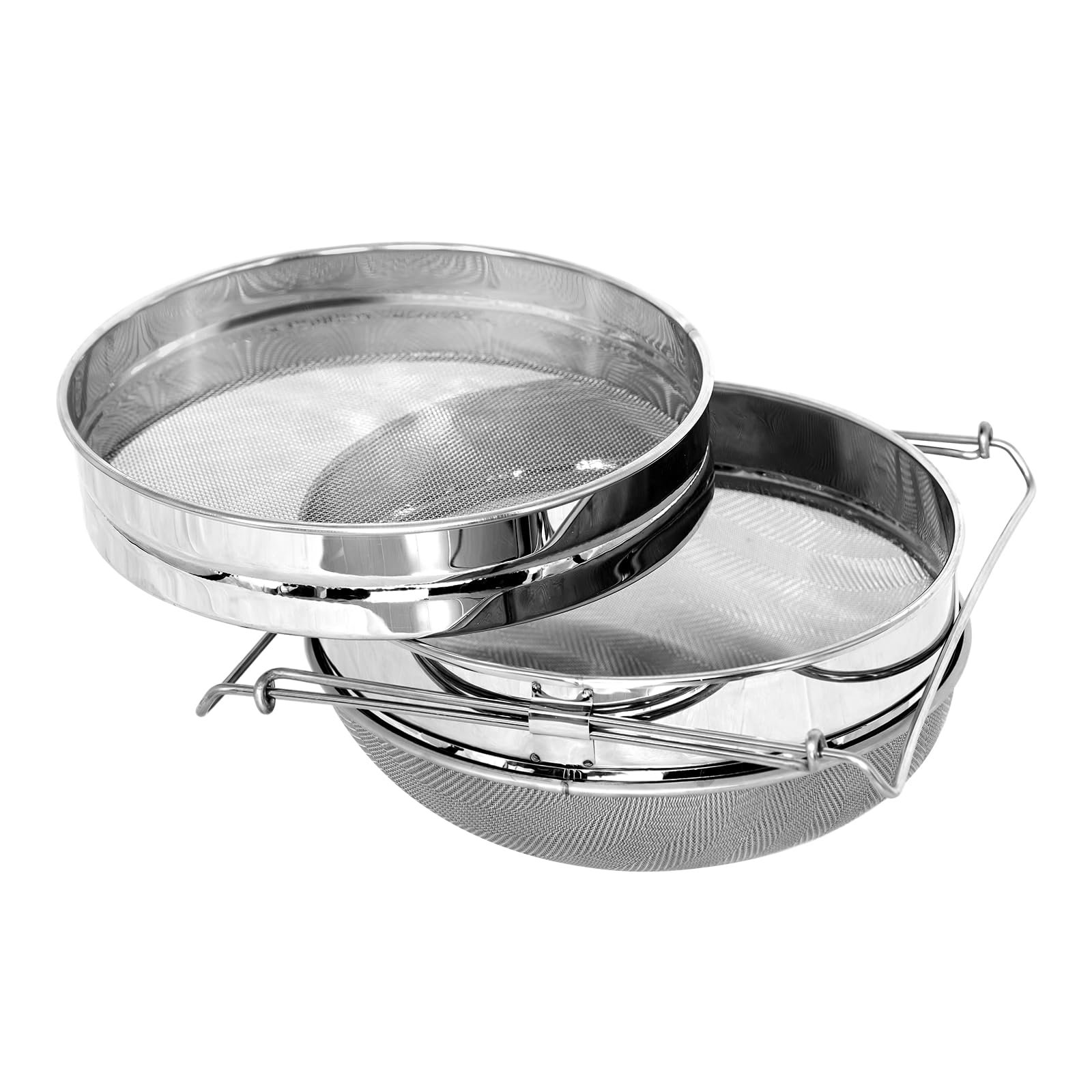
Two screens in one frame is the whole idea, and it holds up. The upper mesh is coarse at 1875 microns and takes the cappings, bee parts and stray comb; the 650-micron screen underneath does the polishing, so what lands in the bucket is bright and even instead of cloudy with fines. Run a warm batch through both and the wax gathers on top where it lifts away in a sheet rather than smearing into a single fine screen and choking the flow.

What makes it our default is the fit. The bowl is 9 inches across and the arms pull out to 15.5 inches, which spans a standard five-gallon bucket with the rim clear; on a stock pot they slide back and it perches just as steadily. It sits level with a full load of honey in it, and that matters more than it sounds — it's the difference between walking away to uncap the next super and standing there with a hand on the frame.

Cleaning is the part we expected to dread. Cold water first is the trick: it lifts the beeswax without melting it into the mesh, and warm water and soap afterward finishes the job quickly. Leave the hot water until the wax is off, not before, and the whole thing takes less time than wiping down the extractor.

Bottom line: The VIVO is the strainer we point new beekeepers to: two screens, a 9-inch bowl and arms that hold a five-gallon bucket steady, with cleanup that doesn't fight back.

2

AukBeeFun Extendable Strainer

AukBeeFun Extendable Strainer

Wide containers

Our Score 9.6/10
Check Price

Worth Noting

  • Costs more than other stainless sieves without filtering finer
Arm Span
9.8 to 16.5 in
Material
Stainless steel
Mesh Bowl
10.24 in x 3.94 in
Mesh Stages
1875 / 650 microns
Read the full review

Sixteen and a half inches is the number that sets the AukBeeFun apart. Its arms reach further than any other frame here, which matters if your honey goes into a barrel, a wide tub or a tote rather than a standard bucket.

The rest is the familiar arrangement done well: 1875 microns up top for cappings, 650 underneath for the fines, in a stainless bowl just over 10 inches across and a little under 4 inches deep. It's also the one that lists as dishwasher-safe, which is worth knowing on a sticky extraction day.

It costs more than the BEEXTM and the BeeCastle for the same two-stage filtration, so be honest about what the extra buys: a wider span and an easier cleanup, not clearer honey. If every container you own is a standard five-gallon pail, the cheaper sieves do the identical job.

Bottom line: Choose the AukBeeFun if your containers run wider than a five-gallon pail; its 16.5-inch arms are the longest span in this guide.

3

Little Giant Honey Strainer

Little Giant Honey Strainer

Clarity

Our Score 9.4/10
Check Price

Worth Noting

  • Needs a bucket rim; it slumps in a stock pot
Fits
5-gallon bucket
Mesh
400 microns
Type
Washable fabric filter
Weight
1.13 oz
Read the full review

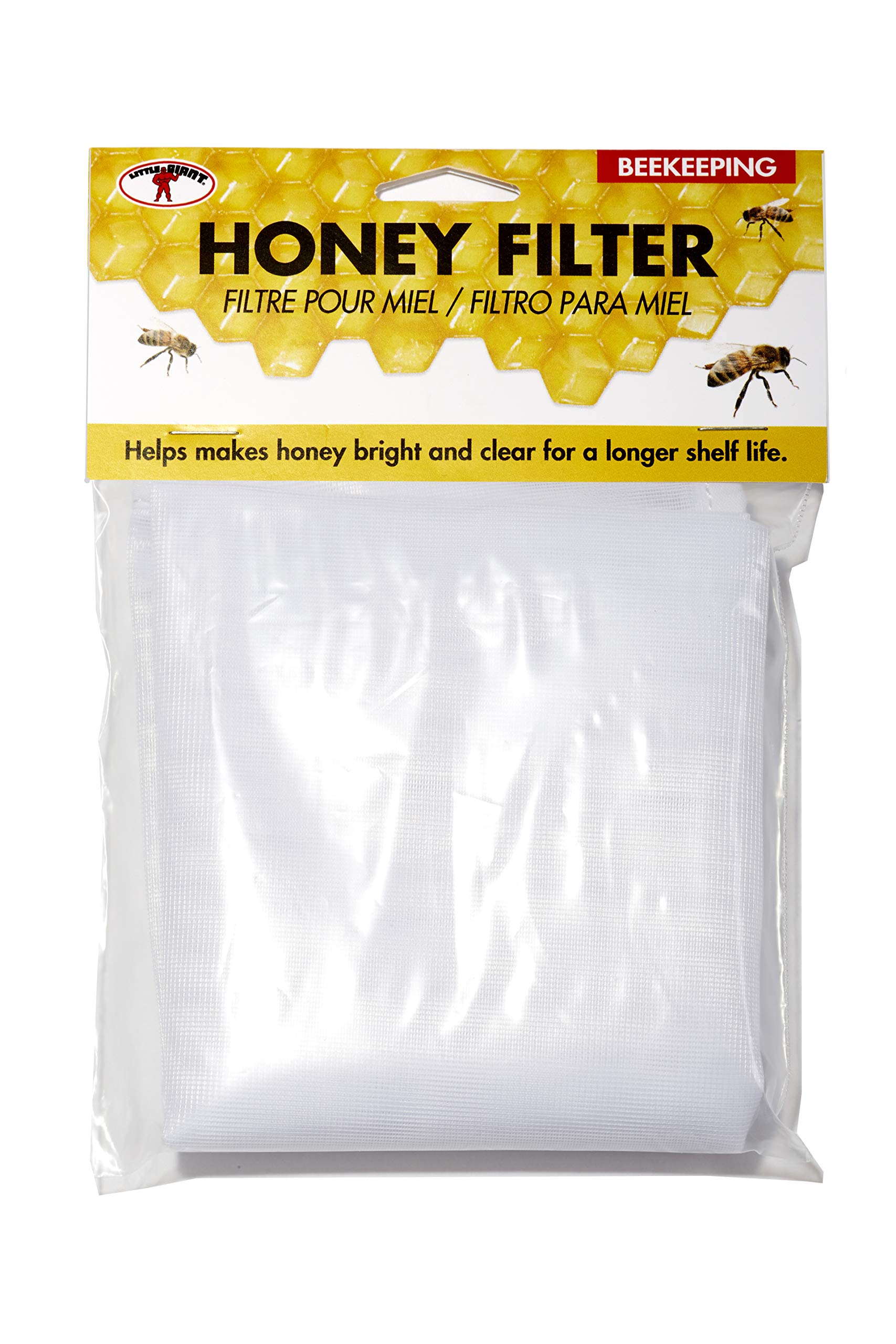
If you want honey you can read a page through, a fabric filter gets you closer than a sieve does. The Little Giant is a 400-micron washable mesh cone that hangs over the rim of a five-gallon bucket, and it catches the fines a 650-micron stainless screen passes straight through.

It is also the least fussy thing here to own. It weighs next to nothing, folds down flat, and can be washed and used again; there's no frame to bend and no arms to adjust. Set it over the bucket, pour, and walk away.

The trade-off is speed. Four hundred microns is fine enough that cool, thick honey takes its time getting through, so you'll get the best out of it with honey that's still warm from the extractor.

Our preferred way to run it is behind a coarse screen rather than instead of one: let a stainless sieve take the cappings, then hang the bag under it for the pass that makes the jar. That sequence is where this filter earns its place in a kit, and it's a small addition for anyone who already owns a sieve.

Bottom line: For the clearest honey in this group, hang the Little Giant over your bucket: 400 microns of washable mesh that folds flat between harvests.

4

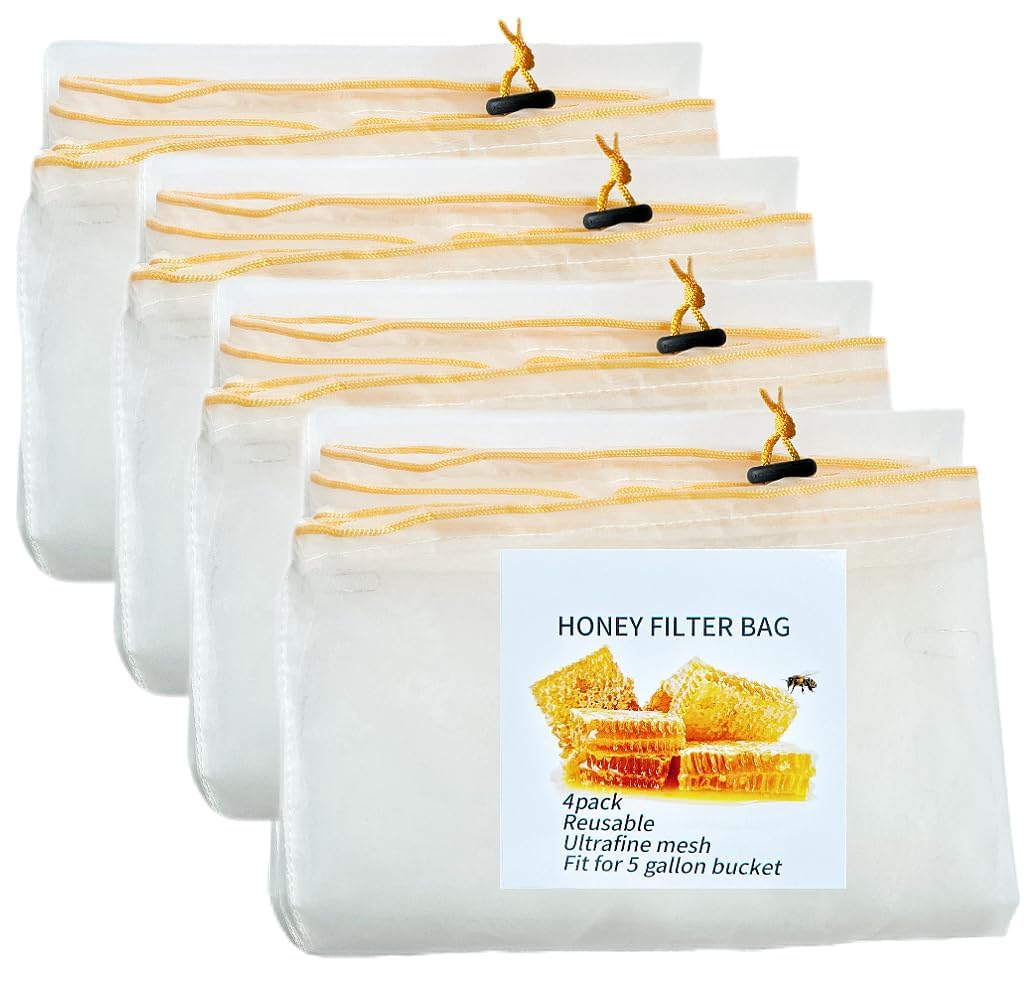
SPMKTQK Honey Filter Bags, 4 Pack

SPMKTQK Honey Filter Bags, 4 Pack

Small batches

Our Score 9.4/10
Check Price

Worth Noting

  • Finest mesh here, so the slowest drain
Fit
Elastic band, buckets
Mesh
125 microns
Bag Size
23.6 x 17.7 in
Pack Size
4 bags
Read the full review

Four bags for less than any single sieve here, and the finest mesh of the lot at 125 microns. That combination tells you most of what you need to know: this pack is for slow, small-batch polishing, not for dumping an extractor through in one go.

The elastic band is the useful part. It stretches over the rim of a five-gallon bucket and holds the bag upright so it doesn't sag into the honey, and with four in the pack you can set two buckets draining at once and still have clean spares on the shelf. We found them handiest for cappings, where the volume is small and the wax load is heavy.

Wash them in warm water, dry them fully, and they're ready for the next batch. The elastic hasn't gone slack on ours and the weave has stayed clear after washing, which is about all you can ask of a filter that costs less than one stainless bowl.

Bottom line: For small batches and a final polish, the SPMKTQK four-pack gives you 125-micron bags with elastic rims at the lowest outlay in this guide.

5

Foxhound Bee Company Filter Bags

Foxhound Bee Company Filter Bags

Keeping pollen

Our Score 9.4/10
Check Price

Worth Noting

Mesh
600 microns
Size
20 x 18 in
Closure
Adjustable drawstring
Pack Size
2 filters
Read the full review

A drawstring sounds like a small detail until you're holding a full bag over a one-gallon jar with both hands. The Foxhound filters cinch closed and adjust to fit anything from a gallon jar to a five-gallon bucket, so the bag stays where you put it instead of sliding off the rim mid-pour.

The weave is 600 microns, which is a deliberate choice: coarse enough to let pollen through into the jar, fine enough to stop wax and bee parts. If you like your honey with everything the bees put in it, that's the number you want; if you want it stripped clear, it isn't. Double stitching and heat-safe nylon mean they take warm honey and a washing without complaint.

Load one with wet cappings and the seams carry all the weight, so support the bag rather than letting it hang free over the bucket. Two come in the pack, which is the right number — one draining, one clean.

Bottom line: For honey with the pollen still in it, the Foxhound drawstring bags cinch onto a gallon jar or a five-gallon bucket and wash up for next season.

6

BeeCastle Double Sieve Strainer

BeeCastle Double Sieve Strainer

Low-cost 304

Our Score 9.4/10
Check Price

Worth Noting

  • 9.4-inch bowl is smaller than the BEEXTM's 9.8
Arm Span
9 to 16 in
Material
304 stainless steel
Mesh Bowl
9.4 in x 4 in
Mesh Stages
1875 / 650 microns
Read the full review

The cheapest route into 304 stainless is the BeeCastle, and it doesn't read like the budget option. The frame adjusts from 9 inches to 16 inches like the rest, the bowl is 9.4 inches across and 4 inches deep, and the mesh is the standard 1875 over 650 pairing.

At 1.81 pounds it's the heaviest stainless sieve here, and that weight is most of why it feels as planted as it does: nothing flexes when you set it on a bucket rim. The screens rinse clean, and the stainless has the dull, even look of a tool rather than a showpiece.

For a second strainer — a spare that lives in the truck, or one that goes into a club's loaner box — the BeeCastle makes obvious sense: the 304 bowl and both screens for the lowest outlay of any stainless sieve here. Buy it on that basis and it won't disappoint.

Bottom line: The BeeCastle is the least expensive way to get a 304 stainless double sieve, and it feels heavier and more solid than that position suggests.

7

BEEXTM Double Sieve Strainer

BEEXTM Double Sieve Strainer

Best steel grade

Our Score 9.2/10
Check Price

Worth Noting

  • Arms top out at 16 inches, so very wide tubs are out
Arm Span
9 to 16 in
Material
304 stainless steel
Mesh Bowl
9.8 in x 4.3 in
Mesh Stages
1875 / 650 microns
Read the full review

Stainless is not one material, and the BEEXTM is the pick that makes the point. It lists 304 stainless, the grade that resists rust and oxidation better than the 201 in the VIVO, and it does the same two-stage job for less money. It also carries the widest mesh bowl of the stainless sieves here at 9.8 inches across and 4.3 inches deep, which means fewer top-ups on a heavy pour.

The screens are the familiar pairing, 1875 microns over 650, so the wax stops on top and the fines stop below. The arms run from 9 inches out to 16 inches, which covers a stock pot at one end and a five-gallon pail at the other with a little margin left over.

At 16 ounces it's light enough to lift off a full bucket with one hand, and the open mesh rinses clean before the wax has a chance to set. The 304 grade is also the reason we'd not fuss about where it gets stored — hmm, that's a would. Rewrite: The 304 grade means a damp corner of the extraction shed isn't something you have to think about, and that's usually what decides whether a strainer is still pleasant to use by the second season.

Bottom line: A 304 stainless double sieve with the widest bowl in this group and a lower price than the top pick — the one to buy when the steel grade is what you care about.

How We Tested the Best Honey Strainers

We started by gathering every strainer we could find that was actually built for honey rather than repurposed kitchen equipment, then narrowed the list by mesh size, rim diameter, material, and price until 14 were worth testing. Our rule was simple: if it couldn't sit steady on a standard five-gallon bucket or a quart jar, it didn't make the cut.

Testing ran across four months, mostly on harvest days in a backyard and a garage, plus smaller kitchen batches when a friend brought over a few frames. We poured warm honey through each strainer and timed how long a quart took to pass, noting where wax and debris collected, whether the mesh blinded over partway through, and whether the honey ran clear or still carried a haze of fine particles. We set each one on a bucket, a food-grade pail, and a wide-mouth jar to see how much rim actually made contact and whether a bump from a sleeve sent it sliding. After each session we rinsed in warm water, then washed with dish soap, checking how much wax clung to the mesh and frame and whether corners and seams trapped residue.

We also flexed each frame, looked at how the mesh was attached, and compared what you got for the money — a cheap strainer that lasted the season beat a pricier one that bent at the rim. The best shared a few traits: mesh fine enough to catch wax but open enough to keep honey moving, a rim that gripped without scratching, and a shape that rinsed clean without a brush. We're still using the standouts and will update if anything fails.

How to Choose Honey Strainers

Rigid sieve or fabric bag

These are two tools with the same job. A double-sieve strainer sits on extendable arms across a bucket, swallows a full extractor dump in one pour, and lets you lift the wax out in a sheet. A fabric bag or cone hangs from the rim, drains slower, and filters finer for the same effort.

If you extract once a season into standard five-gallon buckets, take the sieve. If you bottle small batches and want the clearest honey you can get, take a bag and run it after a coarse screen. A bag needs a full rim to hang from, though; over a stock pot it slumps into the honey.

Read the mesh numbers, not the adjectives

The standard two-stage arrangement is 1875 microns on top and 650 underneath: the coarse screen takes cappings and bee parts, the fine one takes what's left. Fabric bags run 400 and 600 microns, and a few go down to 125 for a final polish.

Finer isn't automatically better. A 125-micron bag will hold a bucket for a long time, and it takes the fine suspended particles out along with the wax. Choose the finest mesh you actually want and expect the pour to slow as the number drops.

Fit is decided by the arms

Listings quote bowl diameter because it's easy to measure, but what seats a strainer on your bucket is the arm span. The stainless frames here adjust from about 9 inches out to between 15.5 and 16.5 inches, which covers a stock pot at one end and a five-gallon pail at the other.

Measure across the opening you'll pour into, rim included, and pick a frame that reaches past it. A bowl that only just spans the rim tips the moment it's loaded to one side. Bags rely on an elastic band or drawstring instead, so check the band will stretch to your container.

Steel grade and what fails first

Stainless isn't one material. 201 stainless, which the VIVO uses, is fine for a strainer that's rinsed and dried after every use; 304, which the BEEXTM and BeeCastle list, resists corrosion better if yours lives in a damp shed between harvests. Run a dishwasher cycle only where the maker lists it.

Expect the mesh joints and the bag seams to go before anything else does — that's where these tools fail, not in the bowl. A heavier frame generally means a mesh that stays taut instead of sagging into the honey.

Frequently Asked Questions

Final Verdict

If you want one strainer and no more shopping, buy the VIVO. Two screens, a 9-inch bowl and a 15.5-inch span cover a standard five-gallon bucket, and the wax lifts off with a cold rinse.

Choose the BEEXTM instead if the 304 stainless grade matters to you or your buckets run wide — it costs less than the top pick and gives up very little. And if the clearest possible honey is the goal, no sieve here will match the Little Giant bag run behind a coarse screen.