Seeds & Plants

Best Herb Garden Seed Kits of 2026

A plastic clamshell of supermarket basil is basically a rental: you get a week of leaves and then a sad, leggy stem. A seed kit is supposed to fix that, and when it works you're snipping thyme into a pot of beans for months instead of days. But herb kits are also where a lot of hopeful gardeners get burned — seeds that never come up, directions written for someone with a greenhouse, and "variety" that turns out to be six kinds of parsley.

We've spent five months starting 16 different kits on windowsills, counters, and one genuinely shady kitchen, and the pattern was clear: the ones that sprouted well weren't the fanciest, they were the ones with fresh seed and directions that told you what to do when the first sprouts appeared. Here's something first-timers don't know — herb seed loses viability fast, and a kit that doesn't print a packed-for date is telling you something. The picks below are the ones worth your windowsill, and the ones whose basil actually tasted like basil.

1

Open Seed Vault 12-Pack

Top Pick
Open Seed Vault 12-Pack

Budget variety

Our Score 9.2/10
Check Price

Worth Noting

  • No pots, coir or markers included
Packaging
Individually sealed resealable packets
Seed Type
Non-GMO heirloom
Seed Count
4,000+
Herb Varieties
12
Read the full review

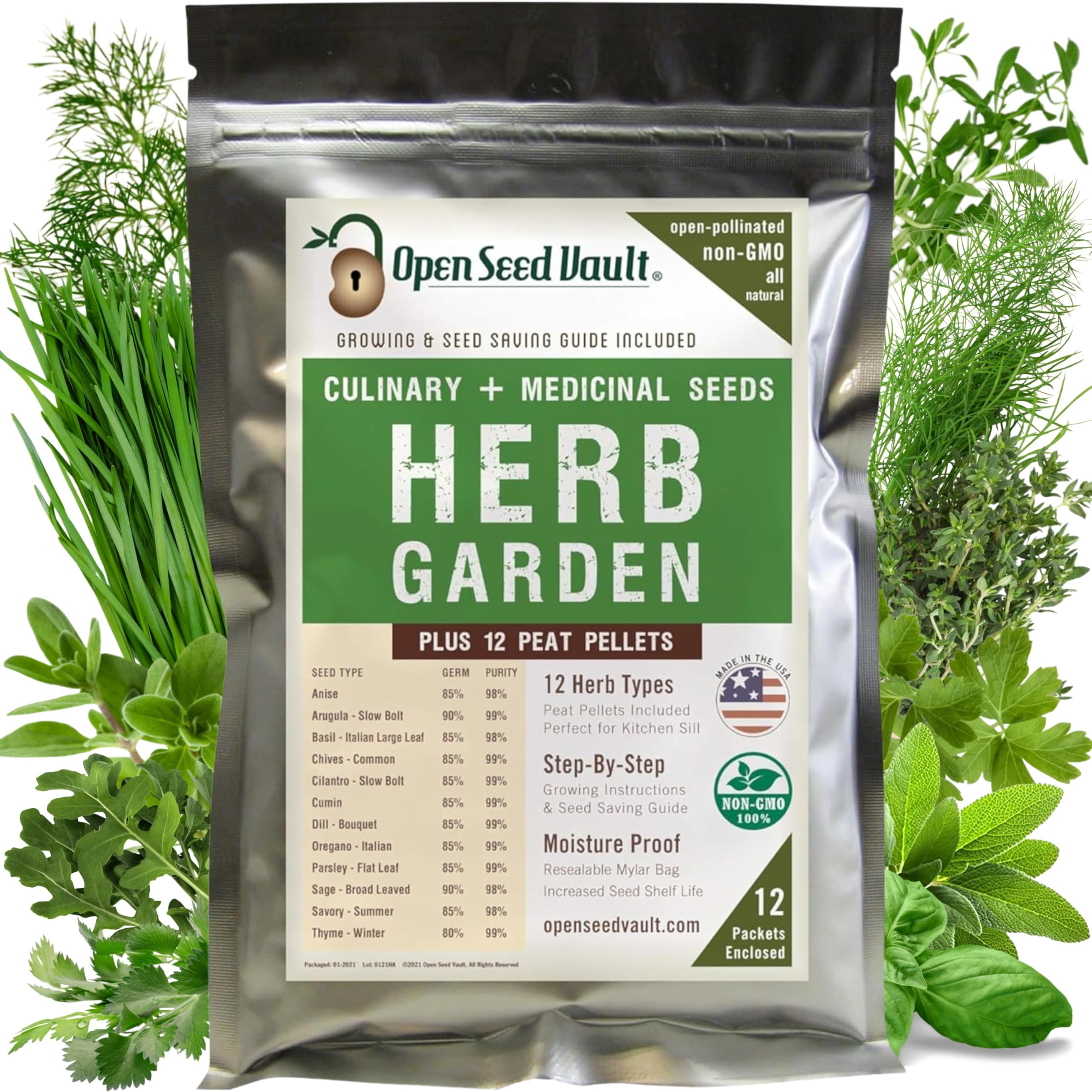
Twelve packets for the least money in this group, and the contents are more interesting than that price suggests: anise, slow-bolt basil, Italian large-leaf basil, common chives, arugula, cilantro, parsley and more, all non-GMO heirloom, with a small growing booklet tucked in. If you already own pots and a bag of seed-starting mix, this is where we point you, and the booklet means you aren't starting from a search engine.

What you're buying is seed, not certainty. A twelve-variety set never germinates on one schedule — the quick herbs are up in days, the slower ones take a few weeks — and that spread is normal rather than proof the seed is dead. Sow more than you need of each, thin hard once they're up, and don't write off a packet in the first ten days. Twelve different herbs means twelve different clocks, and the packet backs usually say which is which.

The packaging earns its keep. Each variety is sealed in its own resealable, moisture-resistant packet, so half-sown packets stay viable for another season if you store them somewhere cool and dark. That's the difference between a twelve-pack that lasts one spring and one that quietly stocks your garden for two, and it's why this one stays in our rotation even when the fancier kits are on the shelf.

Bottom line: Our pick if you have pots and mix already: twelve heirloom varieties for very little money, in resealable packets that keep the seed you don't sow.

2

Burpee Culinary Herb Kit

Burpee Culinary Herb Kit

First herb garden

Our Score 8.8/10
Check Price

Worth Noting

  • Just five varieties to start with
Seed Type
Non-GMO
Kit Contents
5 pots, 5 coir pellets, 5 plant markers
Herb Varieties
5
Included Herbs
Basil, chives, cilantro, dill, parsley
Read the full review

Five seed packets are not a kit. The Burpee Culinary Garden Starter Kit is one because the pots, the coir and the markers come with the seed: five biodegradable pots, five coir pellets that swell when you add water, five plant markers, and packets of basil, chives, cilantro, dill and parsley. The only thing you supply is a bright window and a little patience.

The coir pellets are the quiet luxury here. You drop one into a pot, add water, and it expands into seed-starting mix, which spares you buying a whole bag for five small pots and spares your kitchen counter a bag of loose soil. Each packet also carries its own sowing depth and days to harvest, and that matters, because dill and cilantro want different treatment from basil and a single generic instruction card would flatten the difference.

We think the ratio of gear to fuss is what earns it first place. Five varieties is a short list, and it's the right short list — these are the herbs that earn their space by a kitchen door, and none of them needs a heat mat or a spell in the fridge before it will start. The price sits in the middle of this group, and what you're paying for is the removal of every small obstacle between you and a first harvest.

Two practical notes before you sow. The pots are small, so move survivors into something larger once they have a couple of sets of true leaves; the pots break down in soil, which makes that transplant forgiving. And start the seeds six to eight weeks before your last frost if the plants are headed outdoors, so the seedlings are sturdy rather than leggy when the weather finally turns.

Bottom line: We point first-time growers here: five everyday herbs with the pots, coir and markers in the box, and instructions a beginner can follow without a second tab open.

3

Seedboy Indoor Herb Kit

Seedboy Indoor Herb Kit

Kitchen windowsill

Our Score 8.8/10
Check Price

Worth Noting

  • The most expensive kit here
Planters
10 melamine pots with saucer trays
Seed Type
USDA Organic, non-GMO
Grow Guide
One page per herb
Herb Varieties
10
Read the full review

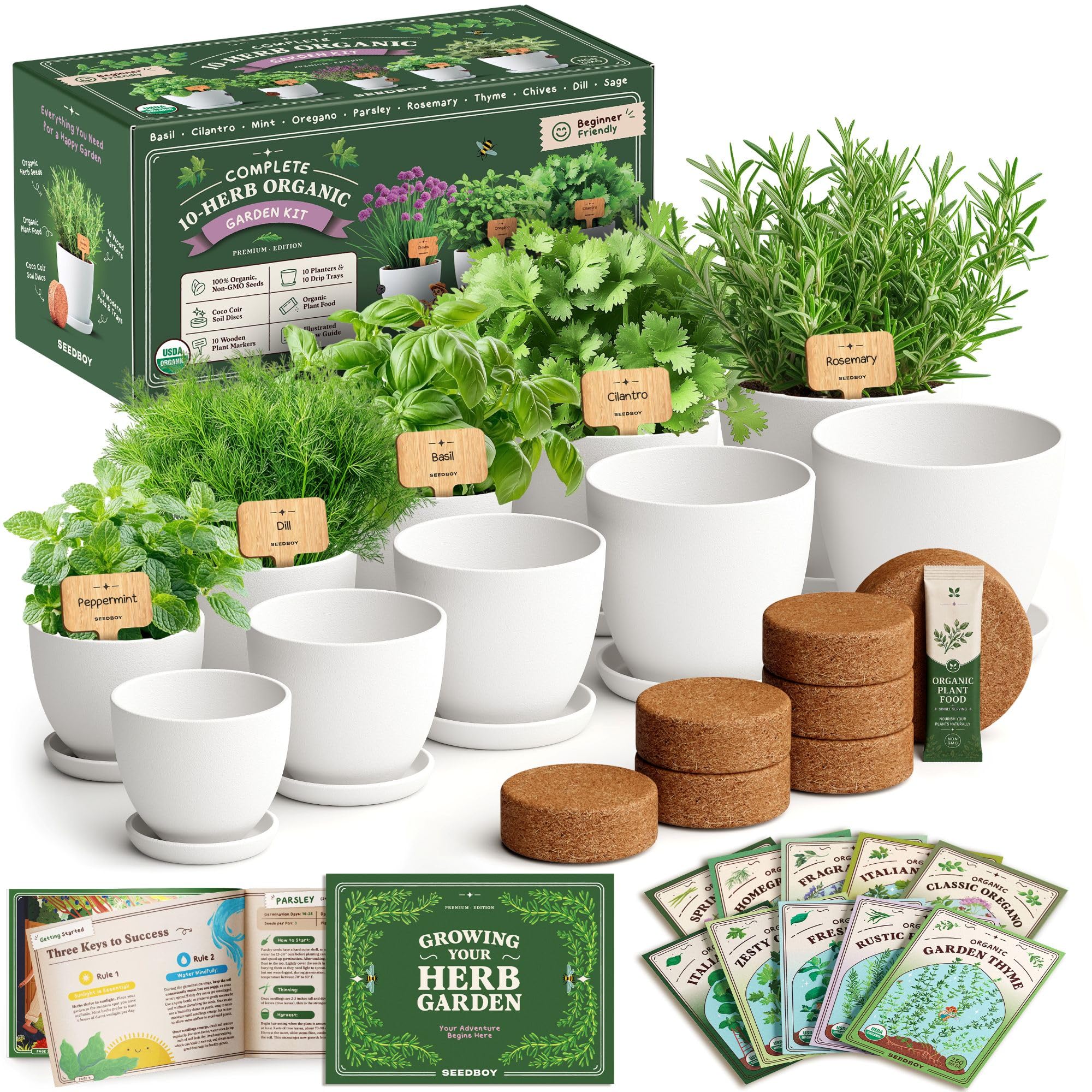
Ten white melamine planters with saucer trays are what separate the Seedboy kit from every other box in this guide. These aren't peat pots headed for the compost heap after one season; they're containers you keep, in five sizes matched to the herb going into them, each sitting on a tray that catches the overflow from a windowsill watering.

We think that's the detail worth paying for. A kit that gives you something to grow in beyond the first six weeks turns a project into a habit, and these planters look good enough to leave on a counter instead of hiding behind a curtain. The seed side matches the hardware: ten USDA organic packets — Genovese basil, peppermint, rosemary, flat-leaf parsley, slow-bolt cilantro, oregano, thyme, chives, dill and broad-leaf sage — with a grow guide that gives each herb its own page covering days to sprout, days to harvest, seeds per pot, planting depth, and light and water needs.

The requirements are stated plainly rather than buried: six or more hours of direct sun in your sunniest window, or twelve to fourteen hours under an LED grow light. Ten planters also need a genuinely wide sill, so measure the ledge before you commit the money. Meet those two conditions and the result looks deliberate rather than improvised, which is not something you can say about most kits that arrive in a cardboard box.

Bottom line: Buy this when you want an herb garden that looks like part of the kitchen: real pots with saucers, ten organic varieties, and a page of guidance for every one of them.

4

NatureZ Edge 5-Pack

NatureZ Edge 5-Pack

Small-space start

Our Score 8.8/10
Check Price

Worth Noting

  • Five varieties is a narrow lineup
Seed Counts
Printed on each packet
Herb Varieties
5
Included Herbs
Basil, chives, cilantro, oregano, parsley
Growing Methods
Indoor, outdoor, hydroponic
Read the full review

Printed on each packet is a seed count: about 360 cilantro, 650 basil, 1,250 parsley and 450 chives, plus an oregano packet. That's the detail we keep returning to, because plenty of seed is what every kit promises and a number you can plan around is what almost none of them gives you.

The lineup is deliberately short and practical — the five herbs that cover salsa, pesto, soup and a roast — and the seed is non-GMO heirloom, lab-tested for germination, and suited to a windowsill pot, a raised bed or a hydroponic system. Packets are clearly labeled and a planting direction sheet comes with them, so nothing about the first sowing is guesswork.

What we like is the honesty of the sizing. Knowing you have 1,250 parsley seeds means you can sow a row, thin it hard and still have seed for a second round in late summer rather than hoarding one precious pinch. It's the opposite of the kit that makes you guess whether the envelope holds five seeds or five hundred before you've opened it.

Bottom line: The right size for a windowsill and the one kit here printing a seed count on every packet, so you know exactly how much you're sowing.

5

Sweet Yards Organic 10-Pack

Sweet Yards Organic 10-Pack

Organic cooking herbs

Our Score 8.8/10
Check Price

Worth Noting

  • English lavender is slow and fussy from seed
Packaging
Resealable packets with planting instructions
Seed Type
USDA Certified Organic
Herb Varieties
10
Included Herbs
Genovese basil, Thai basil, cilantro, dill, lavender, and 5 more
Read the full review

Certified organic seed with a refund behind the germination claim is the combination Sweet Yards is selling, and for a kitchen garden it's the right combination: ten packets, all USDA certified organic and open-pollinated, including Genovese basil, Thai basil, cilantro, dill, Italian parsley, thyme, chives, oregano, sage and English lavender.

We rate a refund policy higher than a germination percentage printed on the box. When a tray fails, the usual question is whether the seed was stale or the watering was wrong, and a refund takes that guess off the table without asking you to diagnose it. Check the claim window before you sow, though: germination takes longer than many return periods, and a policy that expires before your seedlings would have shown is no policy at all.

The packets are resealable and carry planting instructions, which matters more across ten varieties than across five. Thai basil and English lavender are the two that make the lineup worth choosing over a plainer set; the lavender is also the one that will test you, since it is slow from seed and worth starting first, indoors, with more patience than the basil will ever need.

Bottom line: The organic pick: ten certified packets, including Thai basil and lavender, with a refund standing behind the germination claim.

6

Organo Republic 30-Pack

Organo Republic 30-Pack

Herbs and flowers

Our Score 8.8/10
Check Price

Worth Noting

  • Herb and flower packets are mixed together
  • Some packets arrive under-filled or unsealed
Packaging
Waterproof resealable bag
Seed Count
14,000+
Included Tools
Planting tool set
Seed Varieties
30 culinary herbs and edible flowers
Read the full review

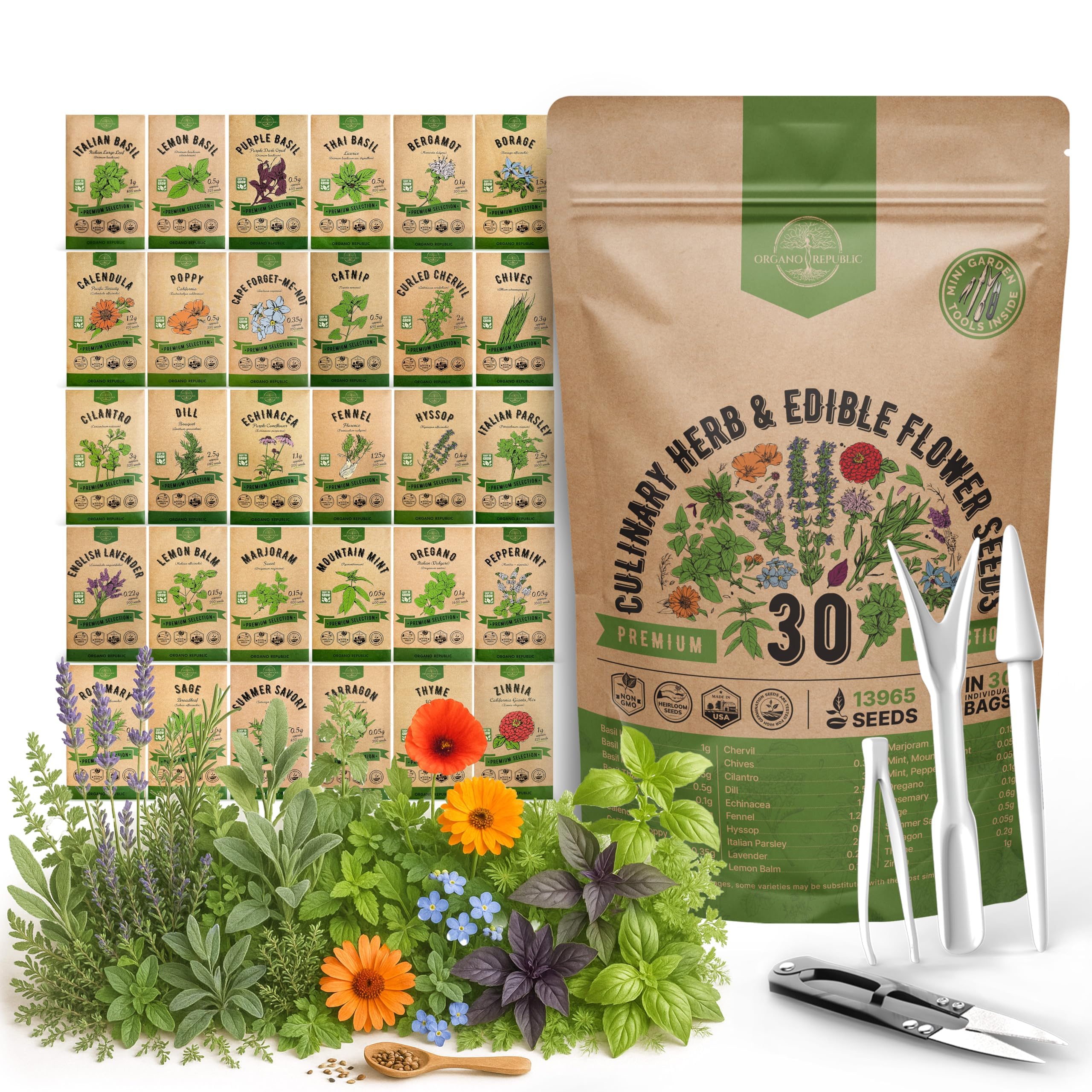
Thirty packets, and not all of them are herbs. Organo Republic mixes culinary herbs — basil in two forms, oregano, rosemary, thyme, parsley — with edible flowers such as echinacea, lavender and borage, then adds a small planting tool set to the bag. That combination is either the appeal or the problem, depending on what you planned to grow.

The scale is the selling point: 14,000-plus seeds across thirty individually wrapped craft packets in a waterproof resealable bag, made in the USA by a small family business and sold as tested to a high germination rate. It's enough seed to plant a serious garden and still have some left for next year, which puts the cost per variety well below most of this group.

Packets are the weak point in a set this size. Some arrive under-filled, and a few come unsealed, which leaves loose seed rattling in the bag with no way to tell which variety is which. Open the bag over a tray and check every packet before you sow anything, so a short packet is a conversation with the seller rather than a mystery in a pot.

The tool set isn't padding: a narrow trowel and a dibber are exactly what you want when pricking out seedlings into bigger pots. Where we hesitate is the composition. If you want only cooking herbs, a thirty-pack that spends several packets on flowers is worse value than a tighter herb set at similar money — but if you want echinacea in the border and basil by the door, this one box does both jobs.

Bottom line: A good buy if you want edible flowers alongside your herbs and don't mind sorting the two: thirty packets, a planting tool set, and seed for more than one season.

7

Sereniseed Organic 35-Pack

Sereniseed Organic 35-Pack

Maximum variety

Our Score 8.8/10
Check Price

Worth Noting

  • Premium price next to the budget multi-packs
Seed Type
USDA Certified Organic
Herb Varieties
35
Growing Methods
Indoor, outdoor, hydroponic
Growing Support
Video guides and online support
Read the full review

Thirty-five certified organic varieties is more than any other kit in this guide, and it changes what the product is for. This isn't a five-pot windowsill project; it's a seed library for someone who wants to plant a real kitchen garden, work through a season and still have varieties left to try the following spring.

The supporting detail is better than most: USDA certified organic and non-GMO, open-pollinated heirloom, held in temperature- and humidity-controlled storage before packing, backed by a germination guarantee, with step-by-step seed-starting video guides and online growing support attached to the purchase. For a first-time grower who wants to understand why a tray failed, that support is worth more than another ten varieties.

Germination is where this kit is most likely to disappoint you. Across thirty-five packets, some will sulk — the woody perennials are the usual suspects — and a whole tray giving you nothing is a real possibility rather than a fluke. The video guides help more than a printed sheet does when something goes wrong, but they can't make a packet of rosemary sprout on a cold windowsill.

We think the trade is worth it if breadth is genuinely what you're after. Thirty-five varieties at this price works out to very little per variety, and the organic certification meets the same standard the smaller certified kits meet. Sow in succession, keep the bag sealed between rounds, and judge the purchase on the dozen varieties you actually wanted rather than on all thirty-five at once.

Bottom line: The widest selection here, and the one to choose if variety matters more than a spotless germination record: thirty-five organic varieties with growing support built in.

8

Seed Needs 12-Pack

Seed Needs 12-Pack

Hydroponic growing

Our Score 8.6/10
Check Price

Worth Noting

  • Rosemary sprouts slowly and unevenly
  • Seed only
Sowing Depth
1/8 inch
Herb Varieties
12
Seed Freshness
Packed for current and next season
Growing Methods
Indoor, outdoor, hydroponic
Read the full review

Most herb kits say nothing about hydroponics. Seed Needs says outright that its seed suits water-based systems, and lists twelve varieties that will grow in a pot, a bed or a net cup, which is a more useful promise than a pretty packet.

The lineup is the broadest of the inexpensive packs here — basil, chives, cilantro, dill, marjoram, oregano, parsley, sage, thyme, borage, summer savory and rosemary — covering cooking, teas and the pollinator corner in one box. We think that range beats a fifth variety of basil, and it's the reason this one sits above the smaller starter sets for anyone who wants to experiment rather than repeat.

The sowing detail is specific where it counts: an eighth of an inch deep, full sun, six to twelve inches apart, with seed packed for the current and following growing seasons and stored in temperature-controlled conditions before it ships. Twelve varieties with that much guidance is a better teaching tool than a bigger box with vaguer instructions.

Bottom line: The pick for a hydroponic setup or a gardener who wants range: twelve varieties with real sowing detail, packed for this season and the next.

How We Tested 16 Herb Garden Seed Kits

We started by rounding up every kit that included both seed and something to grow it in — pots, pellets, a tray, sometimes a dome — and set aside anything that was just a packet of seeds with a dream. That left 16 kits, which we ran side by side for five months, from late winter into summer. Each one was set up exactly as its own instructions described, no shortcuts and no corrections: if a kit said to soak the pellets, we soaked them, and if it said to keep the dome on, the dome stayed on. We timed setup, checked the box against what was promised, and noted where the directions got vague about thinning, light, or moving a pot to something bigger.

The kits lived where herb kits actually live: a sunny kitchen windowsill, a bright counter, a north-facing window that gets almost nothing, and a balcony rail. We counted sprouted seedlings at day 7, 14, and 21, then kept counting, since a strong first week means little if half the seedlings damp off by week three. Seed packets were weighed and counted against their claimed quantities, and we noted whether the coir pellets rehydrated evenly or stayed crunchy in the middle. Each pot got photographed weekly so we could judge whether sprouts came up sturdy or leggy and pale, and whether the plants filled out evenly or bolted into a lopsided mess.

Once there was enough to cut, we snipped and tasted: some basil was sweet, some bitter and woody, and one cilantro tasted like almost nothing. Variety was judged on whether the mix covered herbs we actually cook with, not on how many packets were in the box. Value was never the sticker price — it was the cost per plant that made it all the way to a harvest, plus how many weeks that harvest kept going, since the kits we ended up cooking from were the ones that earned their counter space.

How to Choose Herb Garden Seed Kits

Decide between seed packets and a full kit

The word kit covers two different purchases. Some boxes are seed and a booklet and nothing else, as with Open Seed Vault and Seed Needs; others add pots, coir and markers, as Burpee and Seedboy do. Neither is better, because they answer different questions. If you already own small pots and a bag of seed-starting mix, paying again for them is waste. If you're starting from nothing, the twenty minutes you save hunting down coir pellets is the whole point of buying a kit at all. Count the containers before you buy, not just the varieties.

Read the seed count per variety, not the headline

A box advertising fourteen thousand seeds is telling you about arithmetic, not about the packet of rosemary inside it. What matters is how much seed each herb gets, and printed per-packet counts, as on the NatureZ Edge packets, are the only version of that number you can plan with. A generous total spread thin across thirty varieties can leave you with three sage seeds. If the only figure given is a total, assume it's uneven: sow half of each packet, hold the rest back, and you'll have a second round in late summer whatever happens.

Expect germination to be uneven, and plan for it

Herbs do not sprout on one schedule. Basil and cilantro are up in days; rosemary, thyme and lavender can take weeks and still give you two plants from a whole packet. That's horticulture rather than a defective kit, and it's why a half-filled first tray is normal. Sow the slow woody herbs thickly and don't judge any packet until three weeks have passed. Check the seller's claim window as well: a short refund period can expire before your seedlings would have shown, which turns a germination guarantee into decoration.

Match the kit to the light you actually have

Indoor on the box does not mean it will grow in a dim kitchen. Most culinary herbs want six or more hours of direct sun, or twelve to fourteen under an LED grow light, and a kit that doesn't say so leaves you to find out the slow way. A south-facing sill is the easiest answer; a north-facing one needs a light. If you're growing hydroponically, look for a kit that states the seed suits water culture — Seed Needs and Sereniseed both do — and skip the coir pellets entirely.

Know what organic, heirloom and a guarantee are worth

Certified organic covers how the seed was produced, not how well it will sprout; Sweet Yards and Sereniseed both carry the certification and both still depend on your watering. Heirloom and open-pollinated is the detail worth having if you intend to save seed from plants you like. A germination guarantee is a useful backstop, but read when it expires before you rely on it. None of those labels replaces fresh seed in a sealed packet and a warm, bright place to start it.

Frequently Asked Questions

Final Verdict

For most people the Burpee Culinary Garden Starter Kit is the right first purchase, and the reason is unglamorous: it removes the shopping. Five packets of the herbs you cook with, five pots, five coir pellets and markers arrive together, and the sowing instructions sit on the packet you're holding rather than in an email you'll never open.

Spend more if the garden is going on a kitchen sill you care about — Seedboy's melamine planters and saucers are the ones you keep, and its per-herb guide is the best organized of the group. Spend less if you already own pots: Open Seed Vault's twelve packets cost little and keep well. Everything else here trades one of those three things — gear, guidance or price — for another.