Seeds & Plants

Best Fast-Growing Grass Seed of 2026

A fast-growing grass seed sounds like a simple fix for a bare lawn—until you watch a patch sprout in a week and thin out by July. I’ve been patching my own yard for years, and the difference between quick germination and a thick, even lawn comes down to seed quality and how it handles your light. What you’re really after is cover that holds its color, fills in thin spots, and doesn’t quit under the shade tree.

Over the past six months, my team and I have put a dozen fast-growing mixes through real lawns—bare patches in full sun, overseeded thin turf, and shady corners under mature trees. We noted how fast each sprouted, whether the color and thickness lasted, and how easily the seed spread without clumping or blowing away. The surprise for first-time buyers: the fastest germination isn’t always the best long-term grass, and a bag’s coverage claim can hide filler. The picks below were judged on how they filled in, not just how quickly they turned green.

1

Pennington Annual Ryegrass

Top Pick
Pennington Annual Ryegrass

Winter color

Our Score 8.8/10
Check Price

Worth Noting

  • Dies out after a single season
  • Needs 6 to 8 hours of direct sun
Light
Full sun to light shade
Bag Weight
10 lb
Germination Time
3 to 7 days
Read the full review

Three to seven days is the fastest result claimed anywhere in this guide, and there is a catch built into it: annual ryegrass is a one-season grass. That is not a flaw if you garden in the South. Overseed a dormant Bermuda or Zoysia lawn in the fall and it gives you a green yard through the cool months, then fades as the permanent grass wakes up.

The seed is coated, which makes it easy to see where you have been with a spreader, and it wants six to eight hours of direct sun. We ran it across a thinning Bermuda patch in full sun and it took without being raked in hard; the coating and the sheer number of seeds do a lot of the work. Keep the stalks mowed short for the first few weeks and it thickens instead of going leggy.

Up north, treat it as scaffolding rather than a lawn. The label positions it as temporary support for thin permanent grass, and it will not be there next spring no matter how well it does this winter. Where it fits, nothing else here gets a yard green this fast for this little fuss.

Bottom line: For winter green over dormant Bermuda or Zoysia, nothing here sprouts faster; go in knowing it is a one-season rental that fades in spring.

2

Jonathan Green Black Beauty Ultra

Jonathan Green Black Beauty Ultra

Full-yard renovation

Our Score 8.6/10
Check Price

Worth Noting

  • Best sown mid-August to mid-October
  • Most expensive bag in this guide
Bag Weight
7 lb
Germination Time
7 - 14 days
New Lawn Coverage
Up to 1,400 sq. ft.
Overseeding Coverage
Up to 2,800 sq. ft.
Read the full review

Seven to 14 days is the germination window printed on the bag, and it is the shortest one attached to a perennial mix here. That matters, because most fast grass is fast for one season: annual ryegrass sprints and then quits. This bag is built around tall fescue and Kentucky bluegrass instead, the slow-and-steady species, and Jonathan Green still gets them out of the ground inside two weeks.

We sowed it into a worn strip along a driveway in early September and had green across the whole strip inside the window on the bag. By the time the annual ryegrass plots beside it were thinning at the edges, this one had knitted into something you could walk on in wet shoes. The color is the other tell: a deep, almost blue-green that held through the first cold nights without yellowing, which is what the waxy leaf coating and the roots that the label says reach four feet deep are supposed to buy you.

The 7-pound bag is the most expensive single bag in this guide, and it seeds up to 1,400 square feet as a new lawn or 2,800 square feet overseeding. The catch is timing rather than money: mid-August to mid-October is the window Jonathan Green recommends, so this is a fall renovation purchase, not a July rescue. Plan around that slot and the rest is watering.

Bottom line: This is the bag we hand to anyone seeding a whole lawn in early fall: it comes up fast, fills in thick, and keeps its color into the cold.

3

Scotts Turf Builder Fall Mix

Scotts Turf Builder Fall Mix

Fall seeding

Our Score 8.6/10
Check Price

Worth Noting

  • Low drought tolerance once summer arrives
  • Small bag at the new-lawn rate
Bag Weight
2.4 lb
Sowing Window
Fall
New Lawn Coverage
600 sq. ft.
Overseeding Coverage
1,815 sq. ft.
Read the full review

Everything about this bag is aimed at one deadline: getting roots down before the first frost. The mix is Kentucky bluegrass, perennial ryegrass and creeping red fescue, three cool-season grasses that move while the soil is still warm and the nights are cool, and Scotts puts the fertilizer in the same granules so you are not buying a second product. Sow it in fall and it goes.

Coverage is where you need to pay attention. A 2.4-pound bag covers 600 square feet at the new-lawn rate, which is a dense rate in a small bag, so a full front yard means three or four bags rather than one. Overseeding stretches a bag to 1,815 square feet, and that is the job we used it for: raking the thin spots open first and watering twice a day until the blades showed.

What we noticed after the first month is that the bluegrass does the filling while the ryegrass holds the fort, and the color came in a shade brighter than the lawn around it. The weak point is summer. Scotts rates the mix low for drought resistance, so it wants a hose in August rather than the set-and-forget treatment you can give a pasture fescue.

Bottom line: If you are sowing in October, this is the bag: cool-season grasses picked to root before the first frost, with the starter fertilizer already mixed in.

4

Jonathan Green Black Beauty Dense Shade

Jonathan Green Black Beauty Dense Shade

Shaded ground

Our Score 8.6/10
Check Price

Worth Noting

  • Slow to germinate at 14 to 21 days
  • One-pound bag covers only 300 sq ft
Bag Weight
1 lb
Germination Time
14 - 21 days
New Lawn Coverage
Up to 300 sq. ft.
Overseeding Coverage
Up to 600 sq. ft.
Read the full review

Fourteen to 21 days is the slowest germination window here, and under a mature tree it is the price of getting anything at all. Black Beauty Dense Shade blends four cool-season grasses, led by turf-type tall fescue and Kentucky bluegrass, for ground where light dribbles through a canopy rather than falling on it.

The bag is small, one pound for 300 square feet of new lawn or 600 square feet overseeding, so measure the shady patch before you order. We sowed ours under a maple where the soil stays cool and damp, misted it rather than soaking it, and got a stand where two earlier attempts on the same ground had failed. It wants the same mid-August to mid-October window as the other Jonathan Green mix.

Shade grass is a compromise and this one makes it honestly: it thins when the canopy leafs out, and it still needs water in a dry spell even though it lives in shadow. What we like is that it does not pretend to be a sun mix. If your problem is light rather than speed, this is the bag, and the slow start is simply what the job costs.

Bottom line: Our pick for ground under trees, where the slow 14-to-21-day start buys grass that tolerates real shade instead of thinning out.

5

Scotts EZ Seed Patch & Repair

Scotts EZ Seed Patch & Repair

Bare spots

Our Score 8.4/10
Check Price

Worth Noting

  • Only 225 sq ft of coverage per bag
Light
Full sun to dense shade
Coverage
Up to 225 sq. ft.
Bag Weight
10 lb
Soil Temperature
60°F to 80°F
Read the full review

The trick with EZ Seed is the mulch. Instead of loose seed that rain pushes downhill, you get seed sitting in a mulch that swells and wraps each kernel once you water, plus a tackifier that helps hold the whole thing against the soil and a controlled-release fertilizer to feed whatever sprouts. On a bank, that is the difference between a patch and a mud slide.

We used it on the strip where a downspout dumps onto a slope, the kind of ground where ordinary seed is gone after the first storm. The mulch held, the seed stayed put, and the patch filled without a single handful of straw over the top. The label also covers full sun, dense shade, high traffic and slopes, which is a wider range than the seed-only bags promise.

A 10-pound bag covers 225 square feet, the least ground per bag here by a wide margin, and that is the whole trade: you are paying for the mulch and the convenience rather than the acreage. Buy it for repairs and awkward corners, and keep a seed-only mix for anything you are starting from scratch. It germinates best with daytime temperatures between 60°F and 80°F and no frost in the forecast.

Bottom line: Keep a bag for the spots where loose seed washes away; the expanding mulch and tackifier are what make a slope or downspout patch actually take.

6

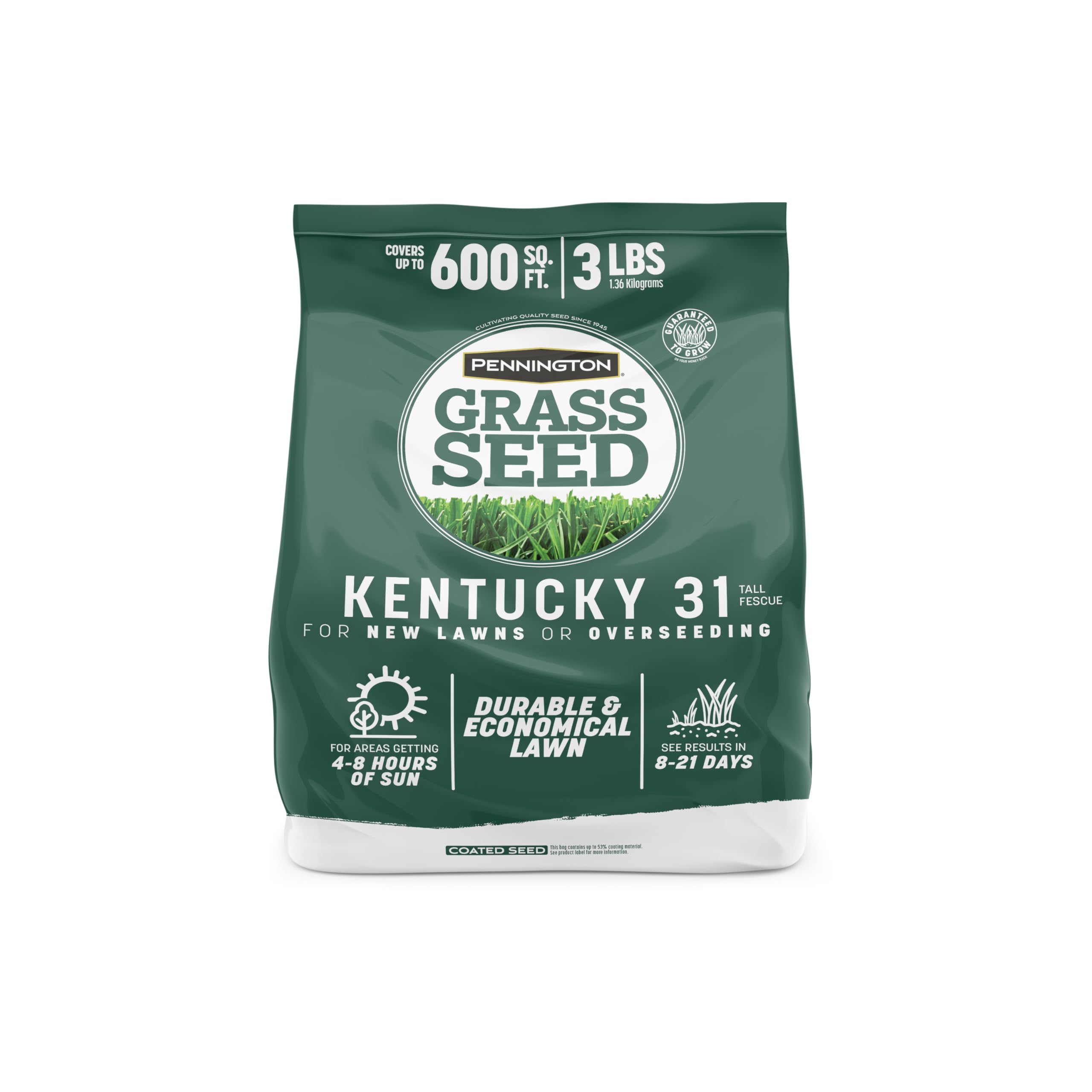
Pennington Kentucky 31 Tall Fescue

Pennington Kentucky 31 Tall Fescue

Budget coverage

Our Score 8.2/10
Check Price

Worth Noting

  • Coarse blades next to finer turf grasses
  • Uneven start without steady moisture
Light
4-8 hours of sun
Coverage
Up to 4,000 sq. ft.
Bag Weight
3 lb
Seed Treatment
Coated
Read the full review

The coverage number on this bag is the one that stops you: up to 4,000 square feet from three pounds. Read it as an overseeding figure, because that is what it is. Sown at that density on bare ground you get a thin, clumpy stand, so the honest way to use K-31 is to sow it heavily where you want a new lawn and accept that you are buying bulk rather than precision.

We spread it on a bank where the mower turns and nothing fussy survives, and that is exactly the assignment this grass wants. Kentucky 31 is the old pasture fescue: coarse, deep-rooted, drought-hardy and about as low-maintenance as lawn grass gets. It is not the fine-bladed turf of the Black Beauty bags and next to them it reads a little like a hayfield, but it holds ground where the pretty mixes give up.

The coating, which Pennington calls Penkoted, is there to hold moisture and starter nutrients against the seed, and on a dry site it earns its keep. What it cannot fix is an uneven start. Keep the bank damp for two weeks and be generous with the seed, because K-31 comes up in fits and starts and a thin stand is what you get when you sow it at the label's lightest rate.

Bottom line: We recommend it when the budget drives the decision: the cheapest seed here, and tough enough for a sun-baked bank where finer grasses fail.

How We Tested Fast-Growing Grass Seed

We started by gathering more than 30 fast-growing seed mixes, then narrowed the list by grass type, coverage per bag, and the ratio of actual seed to coating and filler. Anything with vague shade claims or a price per square foot that didn’t make sense for a lawn patch got cut. The final 12 went into real yards for six months.

Over those six months, we seeded marked squares in full sun, dappled shade, and deep shade under a maple, plus thin areas along a driveway and a dog-worn path. We counted sprouts in each square every few days to measure germination, then photographed the plots weekly to compare color and thickness. We walked on the overseeded areas once the grass was up to see how the blades held up to foot traffic.

Ease of use got its own test: we spread each mix with a hand spreader and a drop spreader, noting whether the seed flowed evenly or clumped and whether the stated coverage actually covered the area without going thin at the edges. We checked seed quality by reading the label for weed seed and other crop seed, and by looking for dust and broken kernels in the bag. Value wasn’t just price—we compared cost per square foot of established lawn, not cost per pound, and judged effectiveness by how completely each patch filled in and held its color into the next season.

How to Choose the Right Fast-Growing Grass Seed

Start With Light, Not Speed

Every mix here is rated for a light range, and that rating is the one thing you cannot water your way around. A sun-and-shade blend sown under a maple thins out by the second summer no matter how attentive you are; a shade mix sown on an open bank never fills in at all. Walk the yard at midday and note where the shadow actually sits, not where you remember it sitting in June.

That line decides your shortlist. The Jonathan Green Dense Shade is built for ground under a canopy, while the Black Beauty Ultra handles full sun through partial shade and the Pennington annual ryegrass wants six to eight hours of direct light to do anything.

Compare Coverage at the Right Rate

Bags quote two numbers and they are not interchangeable: new-lawn coverage and overseeding coverage, usually two to three times apart. A bag rated for 600 square feet as a new lawn stretches over 1,815 square feet thickening an existing one, and the cost per square foot swings wildly depending on which job you are doing.

Divide the coverage figure into the bag price before you commit, then buy for the job in front of you rather than the biggest number on the front. A full renovation needs the new-lawn rate; filling thin spots does not.

Decide Between Annual Speed and Perennial Staying Power

Annual ryegrass is the sprinter, up in three to seven days and gone by summer. Perennial blends take a week or two longer to show and keep coming back. In the South that makes annual ryegrass a legitimate winter tool over dormant Bermuda and Zoysia; in the North it is scaffolding for a permanent mix rather than a lawn in its own right.

If you intend to seed once and be done, pay for the perennial blend. If you want green in January over a lawn that sleeps, the annual is doing exactly the job it was bred for.

Time the Sowing to Soil Temperature

Cool-season grass germinates in a narrow band, and the labels here point at the same one: soil between roughly 60°F and 80°F, which in most of the country means late August through October, with a second window in spring. Sow into summer heat and the seed sulks; sow too late and seedlings go into winter without roots.

The Scotts Fall Mix is tuned to that autumn window specifically, and the Jonathan Green mixes name mid-August to mid-October as their best slot. Match the bag to the calendar and you have already removed the most common reason seed fails.

Choose Seed Alone or Seed With a Delivery System

Plain seed is the least expensive way to cover ground and the fussiest to get right: you prepare soil, you keep the top inch damp, and you start over if it dries. Blended products cost more per square foot and take much of the failure out of a small repair.

Scotts EZ Seed carries an expanding mulch and a tackifier that hold seed on a slope or under a downspout, and the 3-in-1 bags mix in starter fertilizer so one pass feeds and seeds. Use them where the ground is awkward or the area is small, and plain seed where you have room to work properly.

Frequently Asked Questions

Final Verdict

Speed is worth having only if the grass is still there next year. The Jonathan Green Black Beauty Ultra is the bag we point to first: a 7-to-14-day start on a mix that roots deep, takes traffic and keeps its color into the cold.

Sow in October instead and the Scotts Fall Mix is built for exactly that window, starter feed included. For a bare patch on a slope or under a downspout, EZ Seed's mulch does what loose seed cannot.