Lawn Care

Best Handheld Pump Sprayers of 2026

A handheld pump sprayer is a small pressure vessel you carry: fill it, pump it up, and trapped air pushes the liquid out the nozzle until the pressure fizzles. Simple — except the difference between a good one and a cheap one shows up about ten minutes in, when a seal starts weeping onto your wrist, the spray thins to a dribble, or the adjustable nozzle quietly stops adjusting halfway down the fence line. The right one disappears into the job, whether that's spot-treating weeds, feeding tomatoes, or hitting the cracks in a driveway. The wrong one sends you back to the garage for the hose.

I've used these on everything from potted herbs to a gravel driveway full of weeds, and the failures are almost never the bottle — they're the seal, the nozzle, and the lid. Over the past six months, my team and I put 14 sprayers through a full season of mixing, pumping, and hauling, and the ones that held up shared a few unglamorous traits. Sizes below run from a quart for houseplants to a gallon-and-a-half for the back fence, and none of them will leave you with a wet forearm.

1

SOLO 418 1-Liter

Top Pick
SOLO 418 1-Liter

Indoor plants

Our Score 9.2/10
Check Price

Worth Noting

  • One-liter tank runs dry on a full bed
Weight
9.9 oz
Capacity
1 liter
Dimensions
7.5 x 5.25 x 10 inches
Read the full review

Under ten ounces and about the size of a large water bottle, the SOLO 418 is the sprayer we reach for when a hose and wand would be in the way: seedlings on a windowsill, a nest under the eaves, the inside of a wheelbarrow before you fill it. Its mist is the finest of anything we filled here, and the trigger slides to a lock so your hand doesn't cramp holding it on.

Twisting the nozzle takes it from that fine mist through a shower to a straight stream, and it sprays at an angle, which is how we ended up using it on the undersides of potted ferns. Pressure comes up in a handful of strokes and lasts through a shelf of plants, and the whole thing works one-handed, so the other hand stays on the pot.

The nozzle is a small plastic part, so rinse it after every use rather than letting fertilizer set in it, and keep the bottle out of the sun between jobs. A sprayer this size rinses in under a minute, which is the quiet advantage of owning a small one: you clean it because it's easy, not because you have to.

Bottom line: We reach for this one for pots, seedlings, and spot spraying — the finest mist here, one-hand pumping, and a lock-on trigger that saves your grip.

2

PetraTools HD101 1-Gallon

PetraTools HD101 1-Gallon

Most yard jobs

Our Score 9.0/10
Check Price

Worth Noting

  • 30 psi ceiling shortens the throw at height
Nozzles
Adjustable and fan tip
Capacity
1 gallon
Hose Length
52 inches
Maximum Pressure
30 psi
Read the full review

The hose on this one measures 52 inches, and that is the specification we kept coming back to. It's longer than the 34 inches on the Chapin pair, long enough that we could stand at the edge of a bed and reach the far row without hauling the tank around, and the 16-inch wand gets under low foliage without a crouch. The funnel-shaped mouth takes a jug pour without a funnel, and the translucent tank shows the level from the side.

Pressure is where a sprayer lives or dies. The HD101 tops out at 30 psi, well under the Chapin's rated 60, and we went in expecting to pump constantly. What we found is that a tank holding what it builds beats a big number on the box: it sprayed steadily through a session of bed-edging and fence-line work, and the large handle is easy on the palm when you do top it up.

The two nozzles split the work cleanly. The adjustable one goes from a soft mist for seedlings to a pencil stream for cracks in the patio, and the fan tip covers a fence line in fewer passes than a cone. There are filters at the pickup and at the nozzle, which is the answer to the gritty mixes that clog most sprayers halfway through a job, and the relief valve is the detail we used every single time — twist, listen for the air, and the cap comes off without a fight.

The parts to watch on this design are the trigger spring and the nozzle, so keep the spare tip where you can find it and rinse the wand rather than leaving mix to dry in it. As a default for a yard with beds, a fence line, and a driveway to edge, this is the one we hand people: a gallon is enough for a real session, the hose and wand save your back, and nothing else here puts reach and a relief valve in the same sprayer.

Bottom line: We recommend it for most yards: the long hose and two nozzles do more for a real garden than a bigger tank does.

3

Husqvarna 48-Ounce

Husqvarna 48-Ounce

Careful spot spraying

Our Score 8.8/10
Check Price

Worth Noting

  • Premium price for a 48-ounce tank
Pump
Built into the handle
Nozzle
Brass, stream to cone to mist
Capacity
48 ounces (0.38 gallon)
Warranty
5-year limited
Read the full review

The pump on this one sits in the handle, which means you work it with the same hand that holds the sprayer and keep your other hand free for the plant you're bending back. That sounds like a small thing until you've balanced a bottle between your knees to pump it, and it's the reason this is the sprayer we pick up when the other hand is busy.

The nozzle is brass rather than plastic, and it holds its setting: a pencil stream for cracks, a cone for a shrub, a mist for seedlings. A pressure release valve lets you bleed the tank before you unscrew the top, which is exactly the sort of small fitting that separates a tool you keep from one you replace.

Capacity is 48 ounces, so think of it as a spot-treatment sprayer: a rose bed, a run along the foundation, the greenhouse bench. It carries comfortably at 16 ounces empty, and the five-year limited warranty is the longest of any sprayer here — worth more than usual in a category where seals are what fail.

Where it earns its premium is in the hand. The pump-in-handle design, the brass nozzle, and the relief valve make it the nicest small sprayer of the bunch to actually use, and the warranty means a worn seal doesn't end the argument. If your jobs are big and flat, the tank is too small; if they're careful and close, this is the one.

Bottom line: Our pick for careful spot work near the house: a pump built into the handle, a brass nozzle that holds its setting, and five years of warranty behind it.

4

Harden 0.53-Gallon

Harden 0.53-Gallon

Balcony and patio

Our Score 8.8/10
Check Price

Worth Noting

  • Two liters won't cover a large lawn
Nozzle
Adjustable copper
Capacity
2 liters (0.53 gallon)
Body Material
ABS
Read the full review

Copper is unusual at this size, and we think the adjustable nozzle is the detail that lifts this Harden above the plain plastic bottles around it: it turns from a mist to a stream with some carry to it, and it holds that adjustment instead of drifting between settings halfway through a row of pots.

At two liters it's the tweener of this group — bigger than a hand bottle, smaller than anything you'd carry around a lawn — and that's exactly the size for a balcony, a patio, or a bathroom you're cleaning down. Thirteen inches tall, so it lives on a shelf, and light enough that filling it isn't a decision. If your spraying happens within a few steps of a tap, this is a good honest choice.

Bottom line: Two liters and a copper nozzle make this our balcony and patio sprayer — precise for pots, small enough to keep indoors.

5

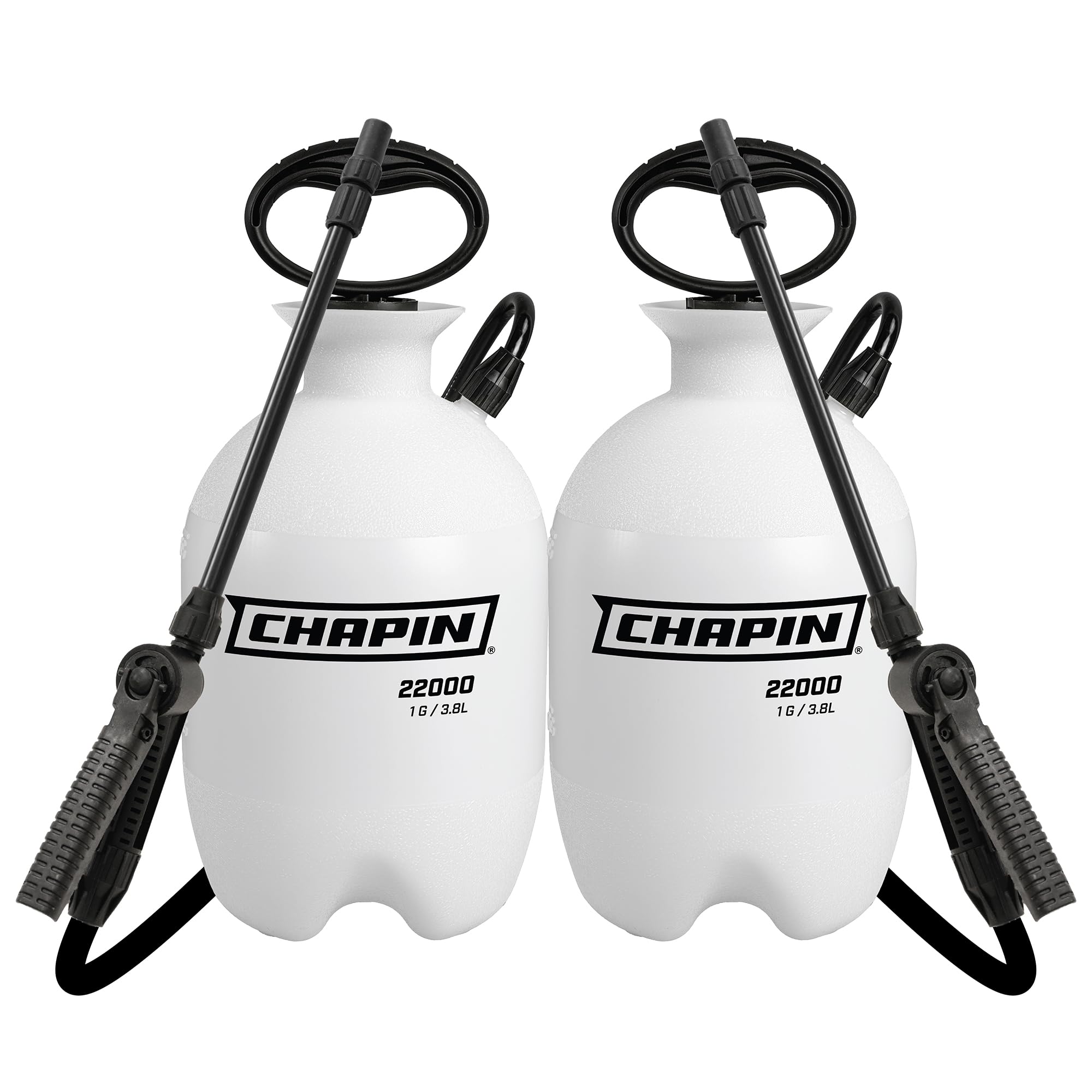
Chapin 22000 1-Gallon 2-Pack

Chapin 22000 1-Gallon 2-Pack

Two separate mixes

Our Score 8.6/10
Check Price

Worth Noting

  • Cap seal can weep air when pressurized
  • No pressure-relief valve
Nozzle
Adjustable cone
Capacity
1 gallon, 2-pack
Hose Length
34 inches
Maximum Pressure
60 psi
Read the full review

Two one-gallon tanks for about the money of one premium sprayer is the pitch, and it answers a real problem: you want weed killer in one and fertilizer in the other, and rinsing a single tank between them is the chore that stops you spraying at all. The funnel-shaped top is why we like filling these — a wide mouth swallows a jug pour without a funnel and without concentrate running down the side.

We think this pair is the sensible buy for anyone who sprays two different things every season. Each tank runs a 34-inch hose and an adjustable cone nozzle that goes from a fine mist to a solid stream, and the rated 60 psi gives it more punch than the PetraTools. At 18 inches tall and 8 wide, they store on a shelf without taking over the shed.

The trade-off is a one-year limited warranty where the Husqvarna gives you five, and the pumping is old-fashioned — you earn the pressure. Buying two covers you in the way that matters most: if one develops a fault in July, your season doesn't end while you sort it out.

Bottom line: If you keep two mixes going, buy the pair: two gallon tanks, a wide funnel mouth, and a cone nozzle that switches from mist to stream.

6

VIVOSUN 50-Ounce

VIVOSUN 50-Ounce

Bench and windowsill

Our Score 8.4/10
Check Price

Worth Noting

  • No hose or wand, so reach stops at your arm
Nozzle
Adjustable brass
Capacity
50 ounces (1.5 liters)
Pressure Relief Valve
Included
Read the full review

A brass nozzle and a pressure relief valve on a 50-ounce bottle is an unusual pairing, and it's the reason we kept this VIVOSUN on the list: the nozzle is the part that usually lets a small sprayer down, and brass keeps its adjustment where plastic tips wear. The translucent body carries a printed scale, so a measured dose of fertilizer goes in without a second jug.

The handle locks on, which matters when you're misting a shelf of seedlings, and the relief valve means you can drop the pressure before the top comes off. It builds pressure quickly and holds it long enough to work through a bench of houseplants, which is the job this bottle is built for.

Bottom line: We like this one for houseplants and bench work: a brass nozzle and a relief valve we usually only see on bigger tanks.

7

MyLifeUNIT 35-Ounce

MyLifeUNIT 35-Ounce

Leaf undersides

Our Score 8.2/10
Check Price

Worth Noting

  • 35-ounce tank is for spot work only
Nozzle
Multi-direction adjustable
Trigger
Locking
Capacity
35 oz
Read the full review

The nozzle on this one sprays from angles a normal bottle can't: tipped down, held sideways, even turned under a leaf, because the design is meant to work in positions other than upright. If you've tried to spray the underside of a tomato leaf with a bottle that quits the moment it tips, you know why that matters.

The rest is sensible: a locking trigger so your hand doesn't cramp, a stainless steel rod that won't bend every time it's knocked, and an anti-drop base that keeps the bottle off the ground when you set it down on concrete. Thirty-five ounces and just over eleven ounces empty, which puts it in the same carrying class as a large water bottle — we had no trouble working one-handed through a bench of pots.

Where it earns a place is underside work — mites, whitefly, the leaves you can't reach from above — and for a shelf of houseplants or a row of tomatoes it does the whole job. It's also the one here most likely to be kept filled and within reach, which in practice is what makes a sprayer useful.

Bottom line: The one we keep for leaf undersides: a nozzle that sprays at any angle, a locking trigger, and a stainless rod in a shelf-sized bottle.

8

Munyonyo 0.5-Gallon

Munyonyo 0.5-Gallon

Budget small jobs

Our Score 8.0/10
Check Price

Worth Noting

  • One-year warranty is the shortest here
Nozzle
Adjustable brass
Capacity
0.5 gallon
Warranty
1 year
Safety Valve
Automatic pressure release
Read the full review

The surprise here is the safety valve. We were not expecting one on the least expensive tank in the group, and it's why this one is on the list instead of the other budget bottles: excess pressure vents on its own rather than waiting for you to notice. The nozzle is brass too, rather than the plastic tip usual at this price.

Half a gallon is a patio and small-bed size — a few pots, a strip of weeds along the path, a bin you want to rinse and disinfect. The translucent tank shows how much is left, the brass nozzle turns from a jet to a fine mist, and it's light enough to carry full.

What you give up is cover: half a gallon goes quickly once the nozzle is open, and you'll refill more often than with a gallon tank. For a patio and a few beds that's a fair trade, and it makes a sensible first sprayer or the second one to keep under the sink with a different mix in it.

Bottom line: We rate this the best budget half-gallon here: brass nozzle, automatic safety valve, and a translucent tank that shows the level.

How We Tested Handheld Pump Sprayers

We started by pulling together every handheld pump sprayer we could find in the $15 to $60 range, then sorted them by tank size, nozzle type, seal and gasket materials, and whether replacement parts were sold. We read through customer reviews looking for patterns rather than one-off complaints — drips at the cap, pumps that lost pressure early, nozzles that seized after a few weeks — and used those to cut the field down to 14 models spanning one-quart, half-gallon, one-gallon, and gallon-and-a-half capacities.

Each sprayer got filled with water and a splash of dish soap to mimic the way fertilizer and herbicide solutions actually behave, then pumped to its stated working pressure. We timed how long it held a steady spray before weakening, which is the number that decides whether you're re-pumping every third plant or every third row. Every unit was tipped, carried at an angle, and laid on its side on the driveway to see where liquid showed up — at the pump collar, the lid threads, or the nozzle — and each one was dropped from waist height onto concrete to check how the housing and cap survived.

For spray performance, we measured how far the stream actually reached and how evenly the mist coated a row of weeds, then twisted each nozzle from mist to jet with wet, slippery hands to see if the adjustment held or slipped. We counted pumps to full pressure, checked whether the fill opening was wide enough to get a measuring cup into without a funnel, and watched whether the graduation markings stayed readable after a season in the sun. Everything lived outside on a deck between sessions, so hardened seals and sticky triggers had time to reveal themselves — the same slow wear you'd get leaving one in a shed from spring through fall. Where a higher price only bought a bigger label and not better seals or a sturdier nozzle, we said so.

How to Choose Handheld Pump Sprayers

Capacity Is Really a Weight Decision

A gallon of mixed solution weighs about 8 pounds before you add the tank, pump, and wand, and you carry it out at arm's length. That makes a gallon right for a fence line you can set down beside and wrong for a slope you have to walk. A half gallon or a liter bottle suits pots, spot weeds, and indoor work.

Hose length buys reach without adding weight. The PetraTools reaches further on that basis than any tank here, which is why we'd rather have 52 inches of hose than another half gallon of liquid. Work out how far you have to walk to a tap before you choose a size.

Pressure, Pump Effort, and the Relief Valve

Pressure figures run from 30 to 60 psi in this group, and higher isn't automatically better. A 60 psi tank throws further but takes more strokes and works its seals harder; a 30 psi tank that holds what it builds is less work across an afternoon. The trap is buying on the psi number alone, because retention is what you actually feel.

A relief valve is the fitting to look for. It lets you vent the tank before you open it, and on a warm day with a half-full tank that's the difference between a job ending calmly and a cap coming off under pressure. Without one, back the pump cap off slowly and wait for the hiss to stop.

The Parts That Fail First

The cap O-ring, the pump plunger seal, the trigger spring, and the nozzle are where these sprayers give out. A brass or copper nozzle holds its adjustment longer than a plastic tip, an in-line filter is worth having if you mix powders, and a locking trigger saves your grip on long jobs.

Before you buy, check that replacement nozzles and O-rings are sold for that model — a sprayer you can re-seal is a sprayer you keep. Store it dry, cap loose, out of the sun, and expect the seals to be the first thing you replace rather than the last.

Match the Nozzle to the Job

An adjustable cone covers most of it: a pencil stream for cracks and spot weeds, a mist for seedlings. Add a fan tip for flat surfaces — a fence line, a driveway, a shed wall — because it covers width in fewer passes than a cone. Fine mist has its own job on houseplants, where a stream gouges the soil out of the pot.

If you spray under leaves, an angle-capable nozzle like the MyLifeUNIT's saves you tipping the bottle and losing the pickup. For anything overhead, a wand beats a nozzle every time.

Frequently Asked Questions

Final Verdict

For most yards, the PetraTools HD101 is the one to fill: 52 inches of hose and a 16-inch wand spare your back, the fan tip and adjustable nozzle handle a bed and a fence line, and the relief valve makes the end of a job quick instead of tense. If your spraying is pots, seedlings, and spot work, buy the SOLO 418 instead — a liter of the finest mist here, pumped and held in one hand.

Whichever you choose, rinse it after every mix and store it dry with the cap loose. That habit, more than the price you pay, decides how many seasons you get.