Lawn Care

Best Backpack Sprayers of 2026

The hose stops twenty feet short of the back fence, and the pump sprayer you've been hauling around by the handle has begun leaving a damp stripe down your back. A backpack sprayer solves both problems in one move: several gallons of mix ride on your shoulders, your hands stay free for the wand, and you stop pumping every thirty seconds to keep the pressure up. What separates a good one from a frustrating one isn't the spec sheet headline — it's where the shutoff valve sits, how the harness shoulders a full load, and whether the lid stays sealed when you bend over to pull a weed.

I've spent the past growing season putting 11 of these through everything from fence-line weed control to fertilizing fruit trees, and the differences showed up fast. One thing I'd tell any first-time buyer: a bigger tank is not automatically better. Every extra gallon is roughly eight pounds on your back, and a full four-gallon unit can push past forty, which you'll feel by the second hour. The picks below are the ones that kept spraying without soaking my shirt — a few lean toward light and compact, others toward capacity and long-haul comfort.

1

DEWALT DXSP190681B

Top Pick
DEWALT DXSP190681B

DEWALT 20V users

Our Score 9.2/10
Check Price

Worth Noting

  • Sold as tool only, no battery or charger
  • Heavy at 16.3 pounds before liquid
Weight
16.3 lb
Hose Length
50 inches
Power Source
20V battery, tool only
Tank Capacity
4 gallons
Read the full review

At 16.3 pounds empty, the DEWALT is one of the two heaviest sprayers here, and we think that weight is the honest trade for what it does. A 20V pack drives a pump that holds pressure for the whole tank, the flow adjuster is stepless rather than a few preset clicks, and the 50-inch nylon-reinforced hose is long enough to set the tank down and keep spraying. Triple filtration handles wettable powders, and the 3-year limited warranty is there for the long haul.

Runtime isn't the limit: the pack outlasts the tank, so four gallons is one fill and one battery for a normal yard. Control is what separates it from the cheaper battery sprayers. You can slow the flow to a trickle along a bed edge and open it up for a driveway with the same tip, and the pump holds that setting instead of fading halfway down the row.

It's sold as a tool only, with no battery or charger, which is cheap if you already run 20V packs and a real expense if you don't. Buy it for the platform and the control rather than for a light carry.

Bottom line: For a shelf already stocked with 20V packs, we recommend it without much hesitation: stepless flow, a 50-inch hose, and no pumping.

2

Field King 190328

Field King 190328

Most lawns

Our Score 9.0/10
Check Price

Worth Noting

  • Pressure tapers as the tank empties, so you pump as you go
  • 12.8 pounds empty before you add water
Weight
12.8 lb
Nozzles
6 included
Max Pressure
150 psi
Tank Capacity
4 gallons
Read the full review

The pump on the Field King 190328 sits inside the tank, and that one decision is why it's our top pick. A piston mounted outside the tank has seals between you and the chemical; this one is submerged in the solution it's pushing, so a weep runs into the tank rather than down your back. The rest follows the same logic: 150 PSI at the top end, the highest of the manual sprayers here, a 21-inch wand, a lockable brass shut-off with its own in-line filter, and six nozzles covering mist, fan, jet, and a foaming tip for marking where you've sprayed.

What we noticed after a long fence line is how little the tank interferes. Chest and waist straps pull a full load flat against your back instead of letting it swing, and the pump handle sits under the hand that isn't holding the wand, so topping up pressure costs two strokes rather than a stop. Six nozzles sounds like a line on a box until you're switching between a fan for a bed of weeds and a jet for a gravel drive; then it's the difference between one pass and three.

The catch is built into every manual sprayer: pressure tapers as the tank empties, so a big job means pumping every few minutes, and four gallons of water adds more than 30 pounds to a 12.8-pound unit. We still rank it first because there is almost nothing to fail. When a seal starts to weep at the shut-off or the cap, the pump comes apart by hand and new seals go in without tools, which is more than the rest of this group offers.

Bottom line: We point most homeowners to this one: 150 PSI, six nozzles, and an in-tank pump that keeps chemical off your back, with only your arm doing the work.

3

Chapin 61500

Chapin 61500

Tight budgets

Our Score 9.0/10
Check Price

Worth Noting

  • 60 PSI ceiling limits reach
  • Thin padding on the straps and back
Weight
10.1 lb
Hose Length
48 inches
Max Pressure
60 psi
Tank Capacity
4 gallons
Read the full review

A translucent tank sounds like a minor spec until you've filled a sprayer in the shade and guessed at the line. On the Chapin 61500 you watch the level come up, and you can check what's left mid-job without shaking the unit. That tank holds four gallons, the whole sprayer weighs 10.1 pounds empty, and it's the lightest manual model on this list.

It pumps easily and sprays further than 60 PSI suggests, helped by a 48-inch hose and a cone nozzle that dials from a coarse stream to a shower. Two filters fight clogs: a basket in the cap catches what you pour in, and a second sits in the shut-off. Nitrile seals cover the usual fertilizers, weed killers, and pesticides, so it handles the jobs most people buy a backpack sprayer for.

We treat it as the sprayer to buy when you want a dedicated tank for herbicide and don't want to spend much on one. The 60 PSI ceiling is the honest limit: it wets a bed or a fence line at close range but won't throw a stream into a mature tree, and the padding is thin at the shoulders and against your back. The pump is also the part with the shortest fuse, so run a full tank through it while the return window is open.

Bottom line: We recommend it as a first backpack sprayer or a dedicated herbicide tank: a see-through four-gallon body, easy pumping, and enough spray for most yards.

4

Husqvarna 596765901

Husqvarna 596765901

Long-term ownership

Our Score 9.0/10
Check Price

Worth Noting

  • Priciest manual sprayer in this set
  • Straps are the first part to wear
Weight
12 lb
Warranty
5-year limited
Max Pressure
150 psi
Tank Capacity
4 gallons
Read the full review

A five-year limited warranty is the longest on any sprayer in this set, and it's why we look at the Husqvarna before the cheaper manuals. It's a hand-powered four-gallon unit with 150 PSI, a 50-inch hose, and a 12-pound body, which is the spec sheet of a serious manual sprayer. What you're actually paying for is the rebuild: the seals are replaceable, so a sprayer that starts dripping after a few seasons can be brought back instead of retired.

In use it's the least fussy of the manuals. The pump strokes are long and smooth, the wand switches between a mist for foliage and a direct stream for wasp nests and fence lines, and the harness sits comfortably on a full tank. It's a sprayer you buy once and keep rather than one you replace the first time a seal goes.

Bottom line: We recommend it to anyone buying a manual sprayer to keep: 150 PSI, replaceable seals, and a five-year warranty that outlasts everything else here.

5

EGO BSP3500

EGO BSP3500

Maximum reach

Our Score 9.0/10
Check Price

Worth Noting

  • Battery and charger sold separately
  • 16.7 pounds before the tank is filled
Weight
16.7 lb
Flow Rate
0.6 GPM
Max Pressure
350 psi
Tank Capacity
15 liters
Read the full review

At 350 PSI, the EGO puts out more pressure than anything else on this list — more than double the next highest battery unit and several times the 60 PSI manual. A brushless motor drives it, flow runs up to 0.6 GPM, and the pressure knob sits on the wand rather than back at the tank, so you can dial down to a fan over a flower bed and open up for a fence line without taking the pack off.

That pressure is the whole point. It's the sprayer here that puts material into the top of a fruit tree or reaches the far bank of a ditch from the near one, and it does it without the stream sagging as the tank drains. Four nozzles — cone, fan, shower, and foam — cover the usual jobs.

The trade is commitment rather than the spray itself. No battery or charger comes in the box, so this is a sprayer you buy into the EGO platform rather than on its own, and the unit is only the first thing you pay for. The back padding and waist support are the most elaborate harness here, which counts for a lot on a full tank and a slope.

This is the pick when your problem is reach, not price: a hillside, an orchard, a long fence line where the manual sprayers run out of stream before they run out of hose. If your spraying happens within 20 feet of where you stand, that extra pressure is money better spent elsewhere.

Bottom line: We keep it for the jobs that need distance: 350 PSI, a knob on the wand, and enough reach to put spray in a canopy or across a ditch.

6

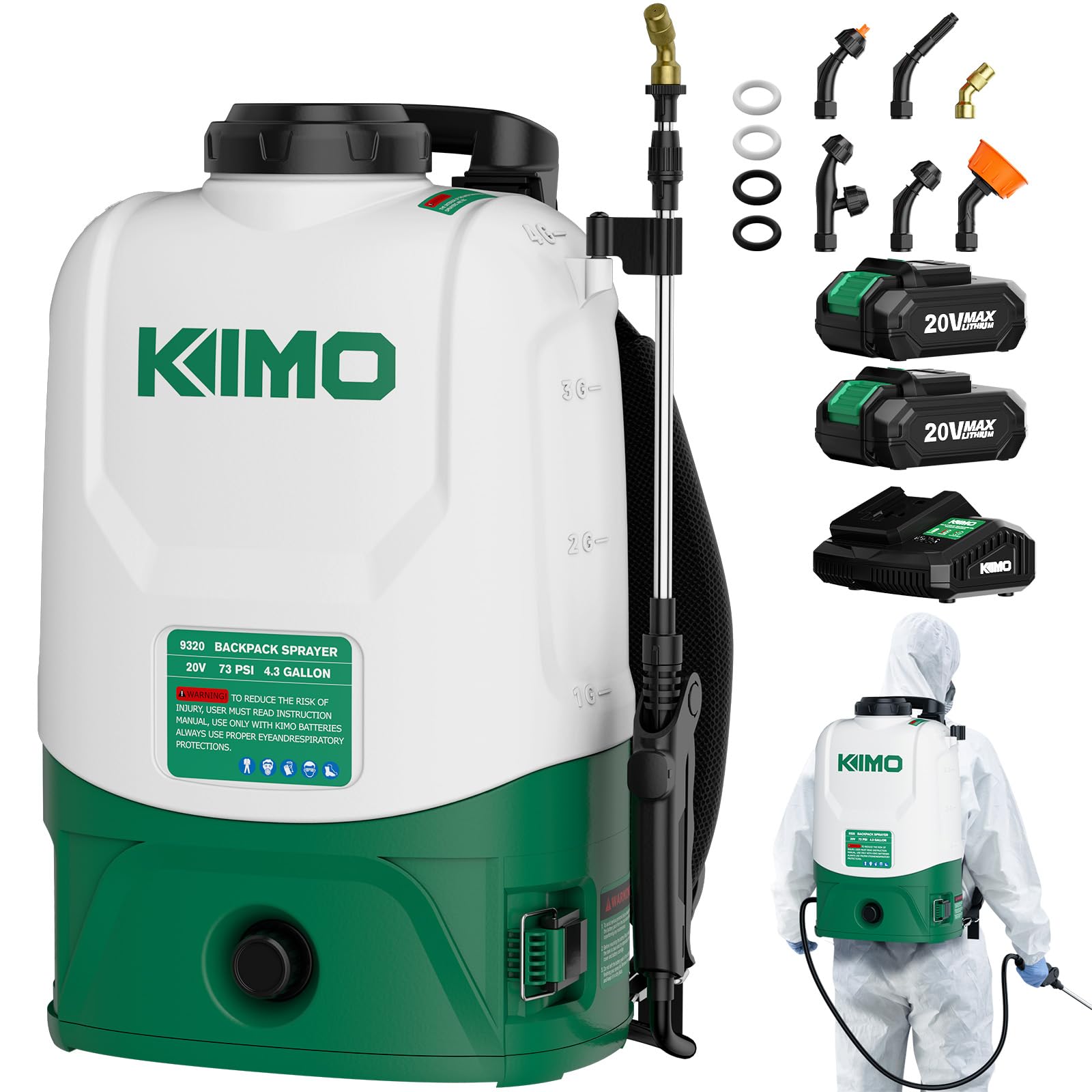
KIMO 9320

KIMO 9320

Low, close work

Our Score 9.0/10
Check Price

Worth Noting

  • Straps are the weakest part of the harness
Nozzles
6 included
Batteries
Two 2.0 Ah 20V
Max Pressure
73 psi
Tank Capacity
16.3 liters
Read the full review

Two 2.0 Ah batteries come in the box with the KIMO, which is unusual for a battery sprayer and the main reason it makes this list. One charges while the other sprays, so an afternoon doesn't end when the first pack does, and the compartment that holds them is sealed against water — useful when you hose chemical residue off the outside of the tank.

The pump tops out at 73 PSI. That's plenty for beds, fertilizer, driveway weeds, and sanitizing a coop, and it won't reach the top of a mature tree; the six nozzles and 35-inch telescopic wand stretch the reach you do have. The 4.3-gallon tank is the largest capacity in this group, which means fewer refills and a heavier walk back to the spigot.

We rate it as the sprayer for someone with a lot of low work and no interest in pumping: half an acre of beds, a fence line, a driveway, a run of fruit bushes. The sealed battery bay also makes it the easiest of the battery units to live with in wet weather. Treat 73 PSI as a ceiling rather than a starting point, and save the tall jobs for a different machine.

Bottom line: We rate it for a lot of low spraying and no interest in pumping, since the second battery keeps it running past the first tank.

7

VAXMAY XAR4000G

VAXMAY XAR4000G

Makita 18V users

Our Score 8.6/10
Check Price

Worth Noting

  • 39-inch hose is short for the class
  • Nozzle and wand joints can drip
Weight
8.95 lb
Battery
2.6 Ah 21V included
Max Pressure
100 psi
Tank Capacity
4 gallons
Read the full review

If the garage already runs on Makita 18V packs, the VAXMAY is the least expensive way into battery spraying. It accepts those packs and also ships with its own 2.6 Ah battery and charger, so you're not locked into either route. The rest is a four-gallon backpack with a 100 PSI pump, five nozzles, a telescopic wand, and a digital voltage readout you can see while wearing it.

We like it best as a second sprayer rather than an only one. It's light for a four-gallon unit, the trigger and pressure knob fall where your hands expect them, and the voltage display answers the question that matters halfway through a job — whether there's another tank in the battery.

Where it stops is reach. A 39-inch hose and 100 PSI make this a ground-level sprayer: it wets what's in front of you and won't put a stream into a mature canopy the way the 150 PSI manuals do. On a quarter-acre lot with beds, a driveway, and a shed of Makita tools, that's a fair trade — the same no-pumping convenience for a fraction of what the premium battery units cost.

Bottom line: For a Makita household with beds and a driveway to keep clear, we think it's the value pick: 100 PSI, five nozzles, and no pumping.

How We Tested Backpack Sprayers

We started with roughly 40 models sold at garden centers and online, then narrowed by tank size, pump type, wand length, and whether replacement parts and a stated warranty were available. Price factored in too — we wanted a spread of budgets, not just the top end. That left 11 sprayers, which we ran through a full growing season of about seven months: spring weed control, summer fertilizer and fungicide, and fall cleanup.

Each unit was filled to its rated capacity and carried for a full afternoon along a fence line and up a sloped yard, with a stopwatch on how long it took to build working pressure and a count of pump strokes. We weighed every sprayer empty and full on a luggage scale so the numbers weren't guesswork, and noted whether the gauge was readable at a glance with the tank on your back. To judge spray performance, we ran a tinted mix over cardboard and watched the pattern hold or fade as pressure dropped, and we worked the shutoff valve with garden gloves on to see how easy it was to feather the flow.

Leaks got their own round of abuse. We filled each tank, tipped it past forty-five degrees, laid it on its side in a truck bed, and checked the lid, hose fittings, and wand connection for drips. Sprayers were left in the sun between sessions, loaded and unloaded off a tailgate, and rinsed and stored per the manufacturer's instructions to see how the harness padding, straps, and seals held up. Ease of use came down to small things: filling without a funnel, getting the straps on over a jacket, and whether the wand holster actually kept the lance out of the way while we walked.

How to Choose Backpack Sprayers

Manual or battery: decide who does the pumping

On a manual unit you build pressure by hand, and it tapers as the tank drains, so a long run means pumping every few minutes. A battery unit holds a steady spray for the whole tank, which is worth a lot on an acre, but you're now buying a motor, a battery, and a part that ages even when it sits on a shelf.

Our rule of thumb: a few beds and a fence line a few times a season, buy manual and put the savings into a better harness; weekly spraying or commercial work, buy battery and pick a unit that shares packs you already own. The four-gallon manual sprayers here run from 10.1 to 12.8 pounds before you add a drop.

Tank size is really a weight decision

Four gallons is the standard, and four gallons of water weighs more than 30 pounds before the sprayer itself is counted — 10.1 pounds for the Chapin, 16.3 for the DEWALT. That gap is the difference between a unit you finish the job with and one you set down halfway through.

Ignore 'compact' in a listing, which describes the shell rather than what hangs on your shoulders. If you're new to a backpack, fill it halfway for the first job; finishing a half tank beats abandoning a full one.

Pressure and nozzles set your reach

Pressure is how far the spray travels and how hard it lands. The units here run from 60 PSI on the Chapin to 350 on the EGO: 60 wets a bed at close range, 150 throws a stream to a fence line or a low branch, and 350 reaches into a canopy.

Nozzles do the rest — a fan for even coverage, a jet for distance, a foaming tip for marking, a shower for rinsing. Watch flow as well as pressure. A high-pressure pump can empty a tank quickly, so more pressure is not automatically more coverage.

Where leaks start, and why the pump's home matters

The pump is either inside the tank or bolted to the outside, and that decides where a worn seal sends liquid: back into the mix or down your back. Internal designs such as the Field King's are the safer layout for chemical work, which is why it's the one we hand to people spraying herbicide.

Filtration comes next. Two or three stages, one in the cap basket and one at the shut-off, catch debris before it reaches the nozzle. If a sprayer only filters at the nozzle, plan on pulling and rinsing it after anything containing a wettable powder.

Harness, hose, and parts you can replace

Shoulder straps alone put the whole load on two points. A chest strap and a waist belt pull the tank flat against your back and make four gallons manageable, and padding against the tank matters as much as padding on the straps.

Hose length is the quiet factor: the 48- to 50-inch hoses here let you set the tank down and keep spraying, while a 39-inch hose ties you to the pack. Last, check what can be replaced — seals, wands, shut-offs. A five-year warranty like the Husqvarna's only helps if the parts exist to back it.

Frequently Asked Questions

Final Verdict

Buy the Field King 190328. It has the pressure to reach a fence line, the filtration and brass shut-off of a sprayer costing more, and a pump inside the tank that can't drip chemical down your back — and for most yards that is the whole job.

If pumping is the part you want gone, the VAXMAY is the sensible spend for a Makita household and the DEWALT is the one to pair with a shelf of 20V packs. The EGO earns its place when the spray has to reach a canopy, and no other unit here gets it there.