Garden Tools

Best Hand Weeders of 2026

A hand weeder looks like a simple hook or fork until you meet a taproot in dry clay. The wrong one skids across the surface, snaps the stem, or bends at the neck while the weed stays put; the right one gets under the root, gives you a bit of leverage, and lets you move on. I keep one by the back steps for the dandelions that appear between sidewalk cracks and another in the shed for the vegetable bed.

Comfort matters more than most shoppers expect, because you are often kneeling, twisting, and pulling in awkward spots. Over the past six months, my team and I tested 14 hand weeders in raised beds, lawn edges, and a patch of rocky ground, judging how sturdy each felt under load, how easily it sank in, and whether it was worth keeping in the trowel bucket. The best ones made weeding feel less like a fight with the soil; the rest are a reminder that a cheap tool can still cost you a whole afternoon.

1

CobraHead Original Weeder

Top Pick
CobraHead Original Weeder

Mixed beds

Our Score 9.6/10
Check Price

Worth Noting

  • Highest price of the tools here
Head
Curved forged steel blade
Handle
Recycled plastic
Weight
1.76 oz
Made In
USA
Read the full review

The blade is the whole argument. Where most weeders come at a dandelion with a pair of prongs, the CobraHead ends in a curved, tempered steel hook that slides into the soil and slices under the crown, so the taproot comes up instead of snapping off at ground level. That shape is also why it is our top pick: it is the one tool here that handles a mixed border — weeds, compacted soil, a gap that needs opening for a tomato seedling — without you changing implements.

At 1.76 ounces it is the lightest tool in this group by a wide margin, which sounds like a spec-sheet detail until you have spent an hour on your knees with it. The handle is shaped for either hand, and the curve of the head does the prying for you: you rock the tool back on the soil rather than yanking at the weed, which is easier on the wrist than any straight-handled fork here.

What you pay for that is the highest price in this group, and that is where the grumbling lands. The edge also arrives workmanlike rather than razor-sharp; a few passes with a file sort that out, and because it is steel it takes an edge and keeps one. If you want a single weeder that will outlast the bed it was bought for, this is it. If you are only chasing grass out of a strip of pavers, it is more tool than the job needs.

Bottom line: We keep reaching for this one because the curved blade lifts whole taproots and then loosens soil for planting — buy it if you want one tool for a mixed garden.
2

Fiskars Xact Hand Weeder

Fiskars Xact Hand Weeder

Deep taproots

Our Score 9.4/10
Check Price

Worth Noting

  • Too much blade for tight seedling rows
Blade
Stainless, sharpened and serrated
Handle
SoftGrip, multiple holds
Length
15.63 in
Read the full review

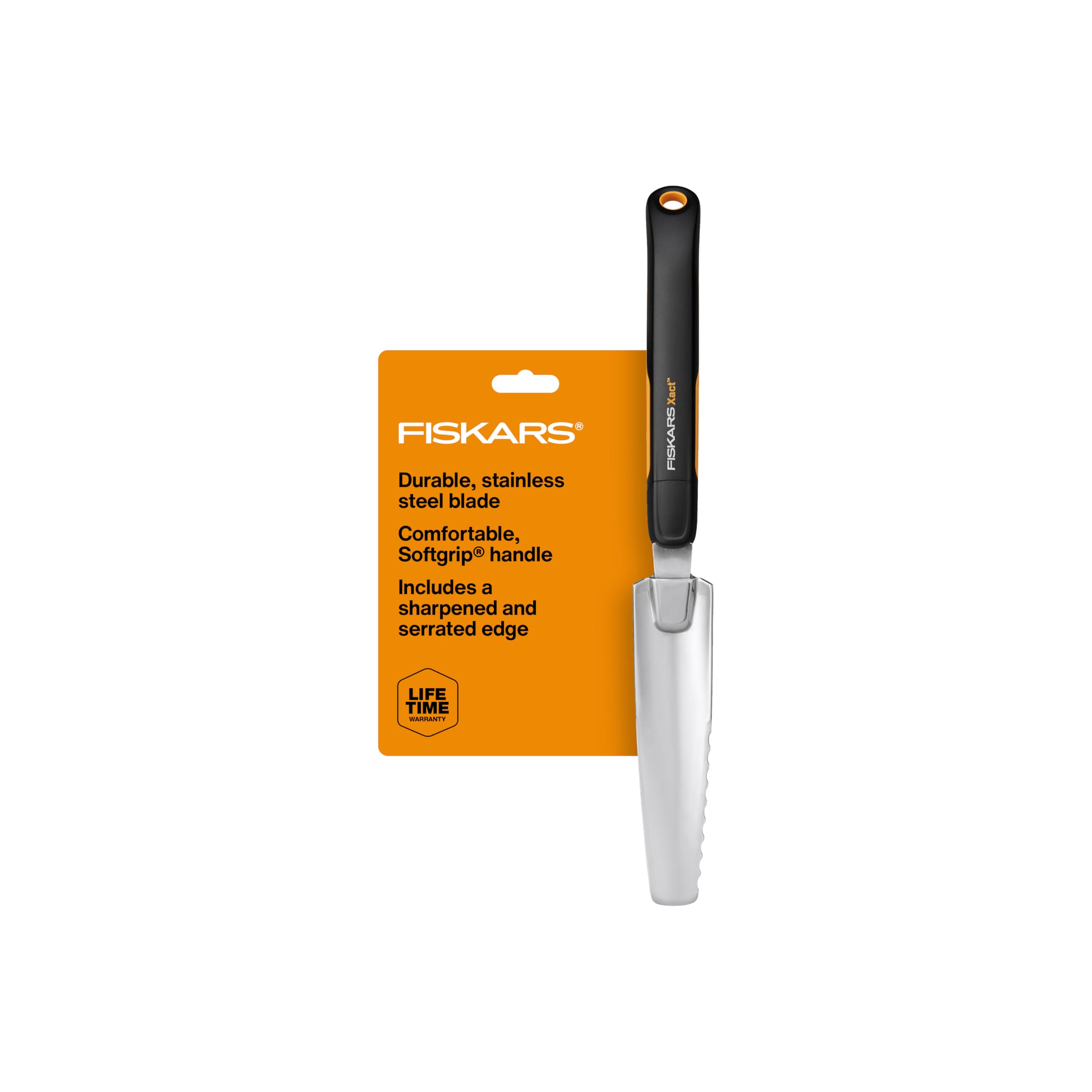
At 15.63 inches overall, this is the longest tool in the group, and that length is the point. The blade puts you deep into a bed without kneeling in wet soil, and its narrow profile slips between established plants where a trowel would take out a neighbor along with the weed.

Two edges do two jobs: a sharpened side for splitting and slicing, a serrated one for sawing through roots that will not cut cleanly. We used the serrated edge more than we expected to. It is the difference between a root coming out and a root snapping off and growing back, and it scrapes dirt off a taproot so you can see what you are pulling.

On a tool this long, the handle matters as much as the blade. SoftGrip with several hold positions lets you choke up for control or slide back for leverage, and the weighted handle balances the blade so it does not tip out of your hand. The head-to-handle joint is fastened rather than pushed on, and that joint is the failure point on cheaper long-bladed weeders.

Where it earns its place is deep-rooted perennials in a planted bed — docks, thistles, dandelions with a taproot the length of your finger. The edge is deliberately not razor-sharp, which we think is right for something you wave around near roots you want to keep. In a tight row of seedlings, though, it is a lot of blade.

Bottom line: If your worst weeds are deep-rooted perennials in a crowded border, this long stainless blade splits and lifts them with less kneeling and less collateral damage.

3

WORKPRO Dandelion Weeder

WORKPRO Dandelion Weeder

Dandelion patches

Our Score 9.4/10
Check Price

Worth Noting

  • Short handle limits leverage in hard ground
Head
Two-prong stainless fork
Handle
Soft-grip plastic
Length
11.5 in
Weight
5.3 oz
Read the full review

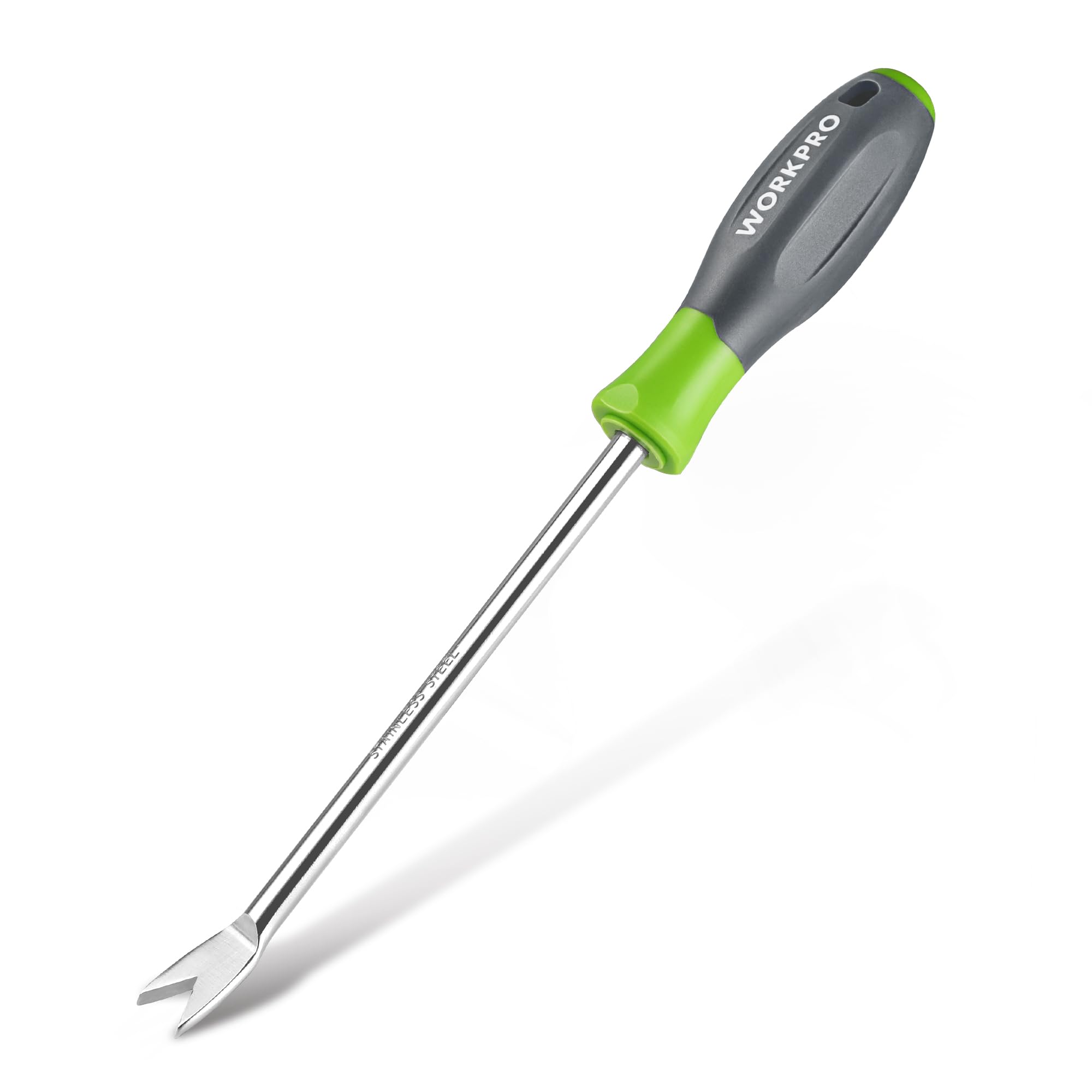
This one does not dig, and that is not a criticism — the WORKPRO is a puller. Two polished stainless prongs go down either side of a dandelion's taproot, and a lean back on the handle brings the whole thing up, root and all.

It weighs 5.3 ounces and measures 11.5 inches, so it disappears into a pocket or a tool bag and comes back out for one weed at a time. The non-slip handle is comfortable, there is a hang hole and a lanyard, and the prongs are hardened stainless that resists rust and corrosion. Nothing about it flexes or feels like it is about to give.

Where it gives ground to the rest of the picks is leverage. At 11.5 inches it does not have the throw of the longer tools here, so in ground that has baked hard you will work noticeably harder than you would with Grampa's lever base. In ordinary bed soil it is quick, simple, and small enough to keep by the shed door — and for anyone who wants a dedicated dandelion tool and nothing else, it is the easiest recommendation on this page.

Bottom line: A light, simple two-prong fork that gets a dandelion's whole taproot in one pull — the one to keep by the door for spot weeding.

4

WORKPRO 5-in-1 Weeder

WORKPRO 5-in-1 Weeder

Small gardens

Our Score 9.4/10
Check Price

Worth Noting

  • Good at several jobs, master of none
Head
Forked, serrated edge
Handle
Non-slip soft grip
Length
12.2 in
Weight
5.6 oz
Read the full review

Five jobs in one 12.2-inch tool: a forked head for weeds and deep digging, a serrated edge, a scraping edge, a depth scale for planting, and — because someone in the design meeting had a sense of humor — a bottle opener.

The serrated edge is the part we did not expect to use as much as we did. It saws through a mat of grass roots and cuts a clean edge along a border, which is the sort of job you normally stop weeding to go find another tool for. The fork end does the actual weeding, and the depth scale is genuinely handy when you are setting out bulbs and want them all at the same level.

It is stainless, it weighs 5.6 ounces, and the soft-grip handle has a hang hole and lanyard. The tip is slim enough to go into the ground without levering up half the bed, which is where a trowel usually makes a mess of things, and it holds up in clay that sends lighter tools skating.

The honest trade-off is that it is good at five things rather than excellent at one. If weeding is the only job on your list, a dedicated fork or blade beats it every time. But if you keep a single tool in a small garden and want it to plant, edge and weed, this is the one that earns its space in the bucket.

Bottom line: One handle that weeds, digs, edges, and measures planting depth — the sensible single tool for a small garden with more jobs than shelves.

5

Radius Garden 102 Weeder

Radius Garden 102 Weeder

Weak grip

Our Score 9.2/10
Check Price

Worth Noting

Blade
Serrated aluminum
Handle
Contoured TPE grip
Weight
7.2 oz
Warranty
Lifetime
Read the full review

The handle on the Radius 102 is bent into a curve, and that curve is doing more work than any blade feature on this page. It puts your wrist at the angle it sits at when it is relaxed, so the pull comes from your arm instead of a locked wrist, and the over-molded grip is soft without feeling squishy.

We would steer anyone with arthritic hands, a weak grip, or a history of carpal tunnel toward this tool before any other in the group. It weighs 7.2 ounces, the serrated aluminum blade is reinforced and beveled so it breaks up compacted soil rather than bouncing off it, and aluminum will not rust if it spends a night out in the rain. For a tool aimed at people who find gripping painful, that combination makes more sense than another fancy edge.

One thing to know: the working end is a V-shaped, serrated blade rather than a fine point, so it tears and lifts instead of slicing a clean plug, and the fixed curve gives you a single hold. For most gardeners that is a fair trade for the comfort. If you switch grips constantly through a session, the Fiskars Xact offers more positions; if your hands ache by the second bed, this one wins.

Bottom line: Comfort is the feature here: the curved grip spares your wrist on long sessions, and the serrated aluminum blade keeps working in heavy soil.

6

Fiskars Ergo Weeder

Fiskars Ergo Weeder

Tight budgets

Our Score 9.0/10
Check Price

Worth Noting

  • Fat tip struggles in gravel and tight joints
Head
Angled cast aluminum
Length
12.5 in
Weight
6.72 oz
Warranty
Lifetime
Read the full review

At the bottom of this group's price range sits the tool we hand to anyone setting up a first garden. The Ergo is a cast-aluminum head on a 12.5-inch body, 6.72 ounces in the hand, and it comes with a lifetime warranty — a strange thing to get on a tool this cheap.

The angle is the smart part. Because the head sits at a bend rather than in line with the handle, you can rock the tool back and let the curve do the lifting, and that leverage shows up in hard soil where a straight weeder skids off the surface. It is rust-resistant, the head does not shift on the shaft, and the SoftGrip handle stays comfortable through a long session.

What it is not is a precision instrument. Treat it as a bed tool that lives on a nail by the door — there is a hang hole for exactly that — and it will do everything a beginner asks of it. For anyone with a small plot and a small budget, this is the sensible spend, and the money you save buys the second tool you will eventually want for the paving.

Bottom line: The cheapest credible weeder here, and the angled cast-aluminum head still gives you real leverage — our pick for a first garden or a tight budget.

7

Grampa's Hand Weeder

Grampa's Hand Weeder

Hard, dry soil

Our Score 9.0/10
Check Price

Worth Noting

  • Untreated wood handle needs drying before storage
Base
Lever base
Head
V-shaped stainless fork
Length
15 in
Weight
1 lb
Read the full review

The trick with Grampa's is the little base welded to the back of the head. You set it on the ground, push the V-shaped fork down beside a dandelion, and tip the handle forward; the base becomes a fulcrum and the root comes up with a fraction of the effort. On hard, dry, packed soil — the kind that makes you give up in July — it is the most effective tool in this group.

The fork itself is polished stainless with a V that grips a taproot instead of sliding past it, and the sculpted wood handle absorbs the shock of the lever action in a way plastic does not. At a pound it is the heaviest tool here, which you feel when carrying it around the yard and not at all when you are using it.

Two things to know. The handle is untreated wood, so wipe it dry before it goes in the shed; it will darken with use, and that is the price of a handle that feels like wood instead of a plastic tube. And it is a bend-down tool like everything else here — the lever saves your arms, not your knees. If you have established shrubs and dry beds, it is the one we hand over first.

Bottom line: The lever base turns hard, dry ground into easy work — this is the one to take to a sun-baked lawn full of dandelions.

8

GREBSTK Crack Weeder

GREBSTK Crack Weeder

Paver joints

Our Score 8.8/10
Check Price

Worth Noting

  • Scrapes joints; will not lift a taproot
Blade
L-shaped stainless
Handle
Anti-slip
Length
13 in
Weight
5.6 oz
Read the full review

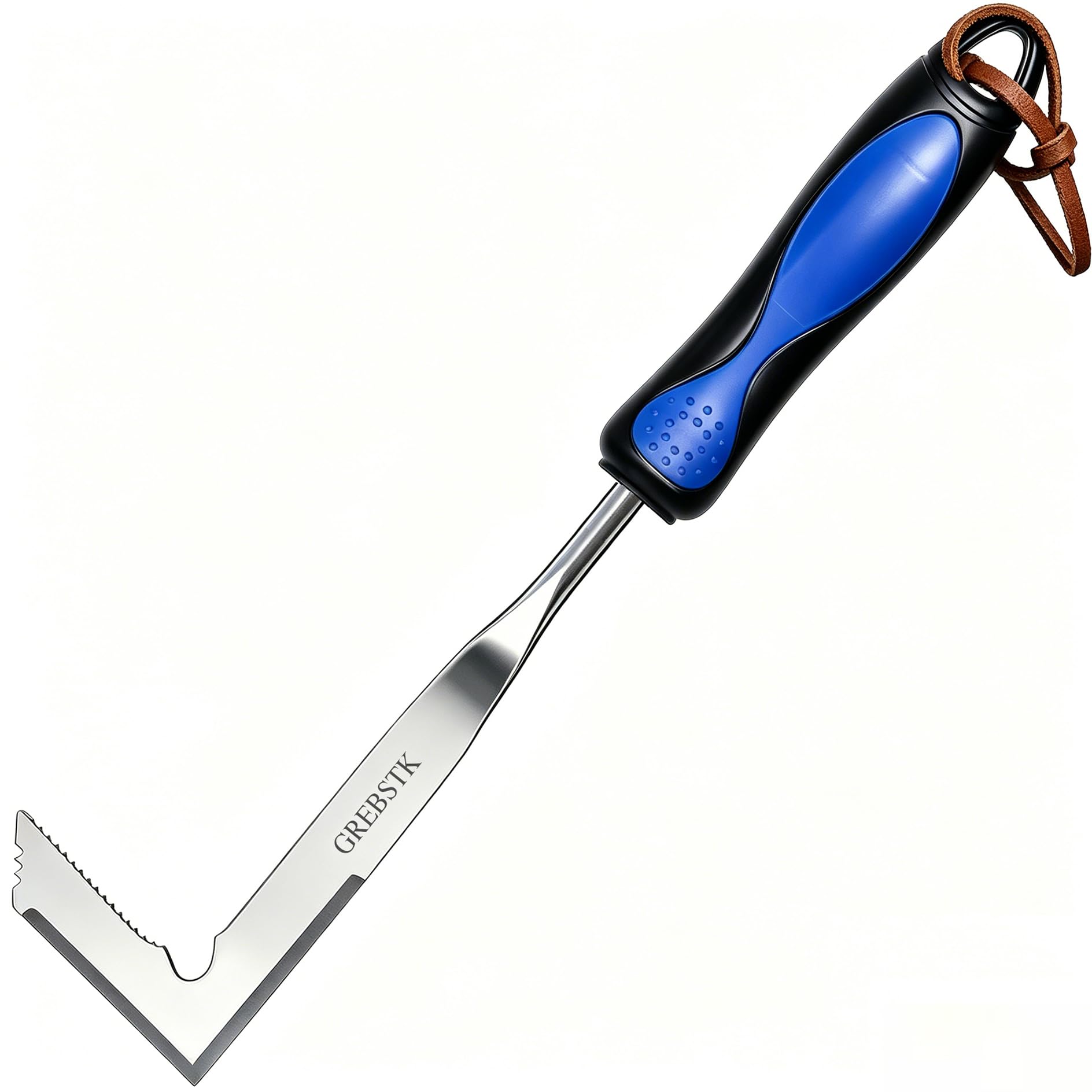
A weed in a paver joint is a different problem from a weed in a bed. There is no soil to push a fork into, just a half-inch gap and a root running under the stone, and the tool that fixes it is a flat blade thin enough to follow the joint.

The GREBSTK is an L-shaped stainless blade with edges on both sides, about 13 inches overall and 5.6 ounces, with an anti-slip handle and a hang hole. You work it back and forth in the gap: the blade scrapes the joint clean and drags the weed out with it, and because the motion is a pull rather than a dig you are not fighting the paving or lifting the stones.

In this set it is the specialist, and its place is a bucket by the patio rather than a spot in the border. It is also the tool whose edge varies most out of the box — some of these cut a joint clean on the first pass and some need a stroke or two with a file before they do. What it will not do is lift a taproot out of a lawn. That is a fork's job, and no amount of scraping changes it.

Bottom line: For grass and moss in paver joints, this thin L-shaped blade is faster than any fork — a patio tool, not a border tool.

How We Tested Hand Weeders

I started with a long list of hand weeders and filtered it by blade shape, handle length, grip material, size, and price. The shortlist included narrow-blade weeders, notched hooks, and small forks, all chosen because they could be used one-handed while kneeling, which is how most people actually pull weeds. We ended up with 14 tools and used them for six months.

Testing happened in real garden beds, not on a bench. I worked each weeder into wet spring soil, dry summer clay, sidewalk cracks, and a rocky patch, sinking the tip beside dandelions and plantain and levering upward to see whether the root came out whole or snapped off. To check sturdiness, I pried and twisted in compacted ground, then looked for bending at the neck, wobble where the handle met the metal, and cracks in the grip. I also used each one with gloves and bare hands, noting whether the handle slipped, dug into my palm, or forced my wrist into an awkward angle.

After each session, I knocked off the soil, wiped the handles, and checked for rust, loosening, and general wear. We compared how each head worked in loose versus heavy soil, how much effort it took to clear a patch of weeds, and whether the tool still felt solid after repeated use. Value was part of the score, but a low price did not rescue a weeder that snapped roots or felt flimsy; it had to earn its spot in the bucket.

How to Choose Hand Weeders

The head does the work

Three shapes cover almost everything. A two-pronged fork straddles a taproot and grips it, which is the right approach for dandelions and thistles in open soil. A curved steel blade slices underneath the crown instead, and it keeps working when the ground is compacted or threaded with roots. An L-shaped scraper is a different animal: it drags weeds out of joints by friction rather than gripping them.

Match the head to the weed you hate most, not to the one in the product photo. A lawn full of dandelions calls for a fork; a border of mixed weeds in hard soil calls for a blade.

Weed the surface, not just the plant

In a bed, a fork or blade has soil to push into and plants you want to leave alone, so a narrow head matters. In a lawn you want the root lifted with as little turf damage as possible. Gravel is the trap: stones shift instead of giving the prongs purchase, so a tool that is excellent in a bed can be close to useless there. On pavers there is no soil at all, which is scraper territory.

Buy for the surface you have most of, then add a second cheap specialist if you have both beds and paving.

Decide how much bending you will accept

Every hand weeder requires getting down to ground level; the difference is how far you reach. The tools here run from 11.5 to 15.63 inches, and the long ones buy a few inches of relief plus a little more leverage. Weight runs from under 2 ounces to a pound. A light tool is easier to carry around the yard and less tiring over an hour; a heavier one feels steadier when you are levering. Neither is wrong — just know which one you are buying.

Handles, grip and sore hands

A straight handle with a soft grip suits most people. If your hands are arthritic or your grip tires quickly, handle shape matters more than any blade feature: a curved handle keeps the wrist neutral, and a molded thermoplastic grip spreads pressure across the palm. Wood is worth considering for shock absorption, though it needs drying before storage.

The trade-off with a fixed curved grip is a single hold. If you shift your grip constantly through a session, a straight handle with several grip positions will suit you better.

What the money buys

Price in this group tracks material and finish more than size. Forged and hardened steel heads cost more than cast aluminum, take a keener edge, and can be refreshed with a file. Aluminum will not rust but will not hold a fine edge either. Warranties split the same way, with Fiskars and Radius both covering their tools for life.

A hand weeder is a decade-long purchase for most gardeners, so the gap between a budget tool and a premium one works out to very little per season.

Frequently Asked Questions

Final Verdict

For most gardens the CobraHead is the one to buy. Its curved steel blade gets under a taproot and then loosens soil for whatever you plant next, and at under two ounces it is the least tiring tool here to carry around a yard all afternoon.

If the price is the obstacle, the Fiskars Ergo does the same job in beds for a fraction of the money. If your hands are the obstacle, the Radius 102's curved grip is the kinder choice.