Garden Tools

Best Garden Trowel of 2026

A garden trowel is the hardest-working tool you own and the one you think about least — until the tip folds back against a root and the whole afternoon's planting list stalls. It digs, lifts, transplants, weeds, and scoops potting mix, often in the same hour, and it takes a beating doing all of it. A good one won't turn you into a better gardener, but it stops you fighting your tools mid-task: no wobbling handle, no bent tip, no mud packed into a seam too narrow to reach with a rag.

I snapped a trowel on one stubborn root last spring, and the replacement I grabbed from a hardware bin lasted three weeks before its handle worked loose. So over the past four months, my team and I ran 14 trowels through a full stretch of planting season, from cool spring sowings to the July heat. The lesson most first-time buyers learn the hard way is that the join between blade and handle is where a trowel lives or dies. Below are the ones that came out of that season still worth reaching for.

1

Fiskars Ergo Garden Trowel

Top Pick
Fiskars Ergo Garden Trowel

Beds and pots

Our Score 9.6/10
Check Price

Worth Noting

  • Aluminum head bends if levered against rock
Weight
6.4 oz
Warranty
Full lifetime
Dimensions
12.25 x 2.75 x 1.5 inches
Blade Material
Cast aluminum
Read the full review

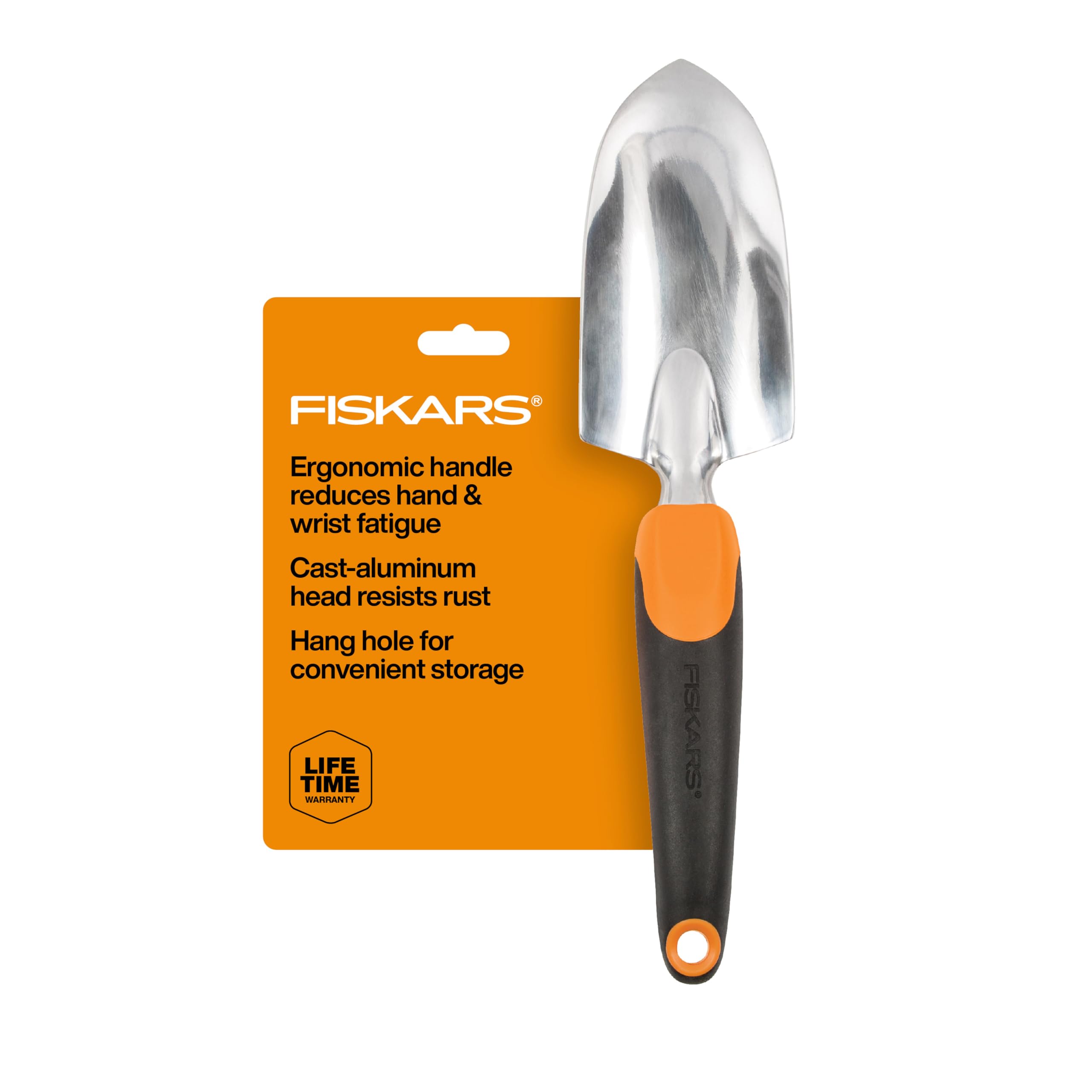
At 6.4 ounces, the Fiskars Ergo is one of the lightest trowels in this group, and the weight is the whole argument. Planting a flat of annuals is a few hundred small lifts and turns, and a light tool is what keeps the last fifty from feeling like work. The cast-aluminum head is broad enough to shift a decent scoop and narrow enough to drop into a four-inch pot, which is the range most of us actually garden in.

The handle explains the rest. It is molded rather than round, so it stays oriented in your hand instead of rolling between grips, and it does not punish a bare palm the way a plain metal shaft does. Head and handle are cast as a single piece with no weld at the neck — the joint that fails first on cheap trowels — and the aluminum does not rust, so a night forgotten in the rain costs you nothing.

For most gardeners this is the trowel to buy. It handles bed work and pot work without complaint, the full lifetime warranty covers a genuine defect rather than just sounding generous, and it sits in the same bracket as the other budget picks here. Nothing else in this group is this easy to pick up and use for an hour straight.

The habits it rewards are careless ones. Ours lives in a bucket by the back door, gets hosed off with the pots and goes away wet, and the aluminum has never spotted. The hang hole in the handle means it can go on a nail, which sounds trivial until you have lost a trowel in the compost heap twice in one season.

Bottom line: We recommend the Ergo to almost anyone: it is light, comfortable and rust-proof, and it handles beds and four-inch pots without complaint.

2

Edward Tools Bend-Proof Trowel

Edward Tools Bend-Proof Trowel

Clay and rock

Our Score 9.6/10
Check Price

Worth Noting

  • Oversized head is awkward in small pots
Weight
7.04 oz
Warranty
Lifetime
Head Build
One-piece
Blade Material
Stainless steel
Read the full review

The blade and shank of this Edward Tools trowel are a single piece of stainless steel: no ferrule, no weld, no rivet — the three places a hand trowel normally gives up. The head is noticeably bigger than a standard one too, so a single push shifts soil that takes a narrow blade two or three.

That is why it is our pick for clay and rock. Stony ground is where a trowel either earns its place or dies, and the one-piece build is what makes the difference: there is no joint to spread under load and no thin neck to fold over. The extra width helps in the same conditions, because you are moving more soil per push in ground that is fighting back.

The grip is contoured, with a palm swell and finger grooves, and it stayed comfortable through a long session of lifting and resetting. At 7.04 ounces it is heavier than the aluminum picks, which you notice at the end of an afternoon and not during a single hole. The lifetime warranty matches the best here, and the price sits in the same bracket as the Fiskars.

Bottom line: For heavy clay and rocky ground, this is the trowel we trust: one piece of stainless steel, no joint to fail, and a head that moves soil fast.

3

Kemaier Heavy Duty Trowel

Kemaier Heavy Duty Trowel

Roots and edging

Our Score 9.6/10
Check Price

Worth Noting

  • Narrow blade is a poor scoop
Head Build
Fully welded
Blade Length
6.3 inches
Blade Material
Carbon steel
Blade Thickness
2.5 mm
Read the full review

Six and a third inches of 2.5 mm carbon steel, ground to a sharpened V and welded into the handle as one smooth, seamless piece: the Kemaier is the closest thing here to a knife with a grip on top. That is exactly why we rate it for roots and borders. It slices a clean line along a lawn edge and goes through a mat of fine roots where an aluminum trowel simply bounces off.

The blade is thick enough to take a push from the heel of your hand without folding, and the tip is sharp enough that you feel it bite on the first stroke. It is also narrower than most of the trowels here, which is the trade: a fine cutting tool and a mediocre scoop, so you move less soil per lift than you do with the Edward Tools or the Garden Weasel.

Carbon steel asks for thirty seconds of care — rinse it, dry it, hang it — and a muddy blade left in a bucket will spot before the week is out. Do that much and it is a trowel that should keep its edge through several seasons of border work, with a few light passes of a fine file when it starts to drag.

Bottom line: A sharpened carbon-steel blade for gardeners who cut roots and edge borders more than they scoop; ours has kept its bite all season.

4

Garden Weasel Transplanter Trowel

Garden Weasel Transplanter Trowel

Potting and scooping

Our Score 9.6/10
Check Price

Worth Noting

  • Narrow bowl is slow for moving bulk soil
Edge
Serrated
Dimensions
3 x 3 x 13 inches
Blade Length
6 inches
Handle Material
Thermoplastic rubber
Read the full review

The bowl of the Garden Weasel transplanter is deep rather than wide — a narrow, cupped scoop six inches long — and that shape is why it is the trowel we reach for when we are potting. It holds a real mouthful of mix, drops it where you aimed it, and the pointed tip slides under a nursery plant without taking half the root ball with it.

As a scoop for containers and transplants it is the best of these, and it is the one that never makes it back to the shed. The serrated edges cut small roots and slice through the mat that comes with a badly pot-bound plant, which is a job the flat blades here make a mess of.

The trade is that it is a scoop, not a shovel. At three inches across it is slow going if you are moving a heap of soil or backfilling a long trench, and the wide-headed Edward Tools covers that ground faster. The straight, deep bowl also takes a little getting used to if you learned to dig with a flat blade.

Bottom line: The best scoop of the group for potting and transplanting, and the one that stays out on our potting bench all season.

5

Garden Guru Hand-E Trowel

Garden Guru Hand-E Trowel

Large hands

Our Score 9.6/10
Check Price

Worth Noting

  • 9-ounce weight is tiring over long sessions
  • Handle is a stretch for small hands
Weight
9 oz
Warranty
Lifetime
Blade Length
5.5 inches
Blade Material
Stainless steel
Read the full review

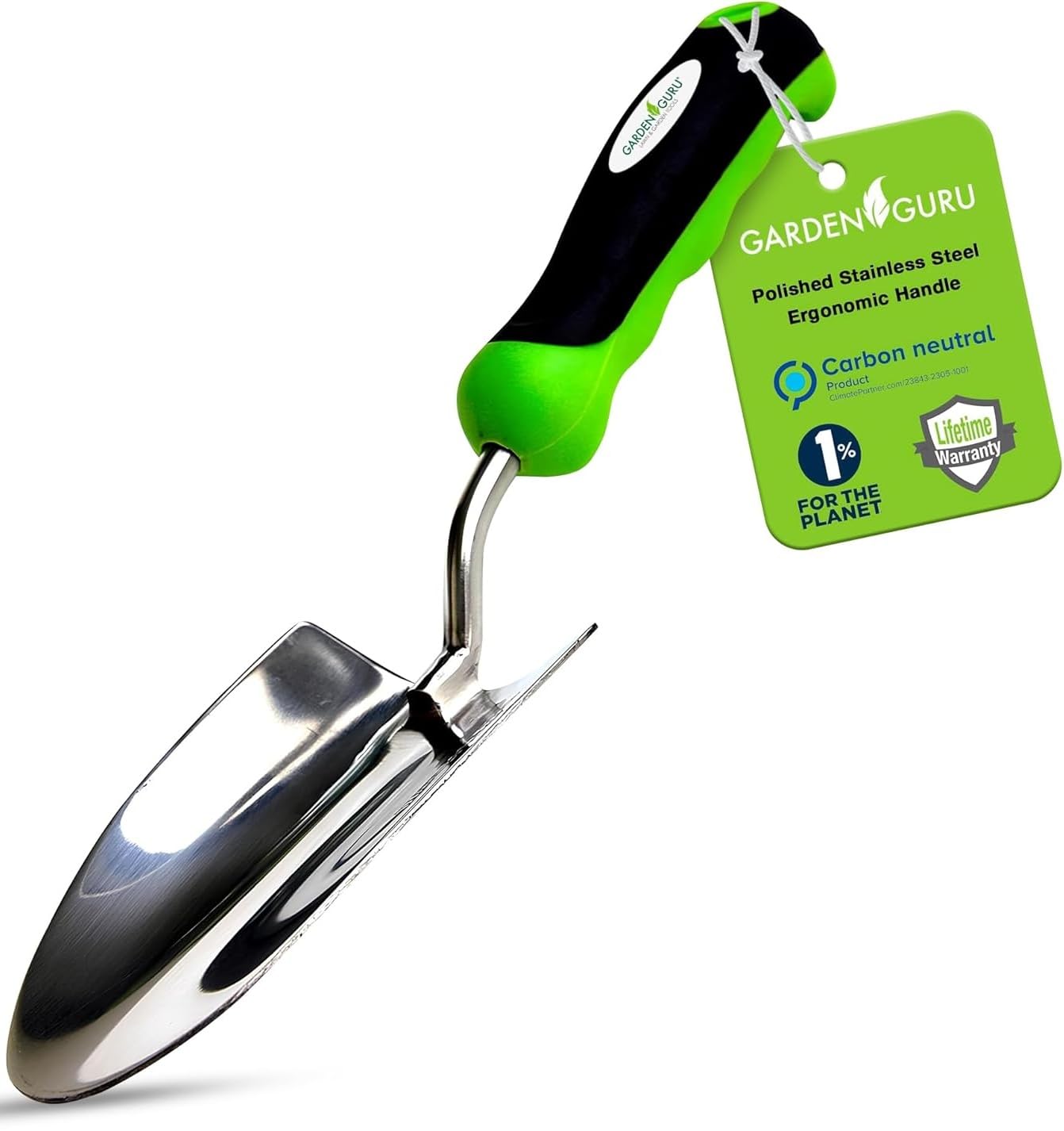
If your hands are large, or your grip is not what it was, start here. The Garden Guru's handle is the most generous in this group — thick, with a thumb rest on top and finger grooves underneath — and it is the one trowel here that a big hand can hold without curling the fingers into a fist. The stainless blade is thick, polished, 5.5 inches long and dished for scooping.

The rest is standard-issue good: a rust-resistant blade that rinses clean, a hang hole, and a lifetime warranty. Two things come attached to that big handle, though. A small hand will find it a stretch, and the trowel runs to 9 ounces, which you feel over a long session of pricking out seedlings.

Bottom line: Large hands and sore wrists get the most from this one — nothing else here has a handle this generous.

6

WORKPRO 11-Inch Hand Trowel

WORKPRO 11-Inch Hand Trowel

Traditional feel

Our Score 9.6/10
Check Price

Worth Noting

  • Two-year warranty is the shortest here
Weight
8.8 oz
Warranty
2 year
Blade Material
Polished stainless steel
Handle Material
Wood
Read the full review

Most of the trowels here have rubber or molded grips; the WORKPRO has wood — a smooth hardwood handle on a slim 11-inch frame that feels like the hand tools people inherit and never throw away. It is a texture thing as much as anything, since wood does not go slick in the same way a wet rubber grip can, and it warms up in your hand on a cold morning.

The blade is polished stainless steel with a sharpened point and edges that cut through turf and fine roots without much persuasion. It is the slimmest blade among the full-size picks here, which makes it precise in a planting hole and slow if you are shifting bulk soil. There is a lanyard and a hang hole, so it can live on a hook rather than in a drawer.

Where it earns a place is feel and length. Eleven inches is short enough to sit in a tool tote and long enough to keep your hand out of the mud, and the wood handle makes this the pick for anyone who finds a rubber grip clammy. The two-year warranty is the shortest in this group, which is worth knowing if long coverage is part of why you are buying.

Bottom line: A wooden handle and a sharp stainless blade for gardeners who dislike the feel of rubber grips, on a slim 11-inch frame that suits a tote.

7

Root Slayer 16011 Trowel

Root Slayer 16011 Trowel

Root-bound beds

Our Score 9.4/10
Check Price

Worth Noting

  • Heaviest trowel here at 340 grams
  • Thick woody roots still stop it
Edge
Ripsaw serrations
Weight
12 oz
Warranty
Lifetime
Blade Material
Powder-coated carbon steel
Read the full review

There is a particular frustration that comes from trying to open a planting hole in a mat of grass roots with a flat trowel. The Root Slayer answers it with teeth: dozens of ripsaw serrations down both edges and an inverted V tip, so you work the blade back and forth and saw your way under the root instead of stabbing at it and losing.

The blade is powder-coated carbon steel, stiff enough that you can lean on it, and the handle uses a natural-radius grip around a polypropylene core — the shape a hand falls into without being told. It feels like a serious tool the moment you pick it up, and it looks like one too, which is not nothing for something hanging in a shed.

At 12.75 inches it is the longest trowel here, and the length does real work: it keeps your knuckles out of the dirt when you are digging deep, and it gives you a second hand position when you need leverage. The powder coating sheds mud, and the lifetime warranty is the same coverage the Fiskars and Edward Tools carry.

For a neglected border, a bed of ground cover or a shrub that has sat in the same spot for a decade, this is the trowel we want in hand, and its price is the only reason it is not the obvious first buy. For a dozen annuals in soft, screened soil the teeth are simply unnecessary — you are paying for capability you will not use.

Bottom line: Root-choked beds are where this earns its price; the ripsaw teeth get under growth that stops every flat trowel here.

8

Fiskars 4-in-1 Seed Trowel

Fiskars 4-in-1 Seed Trowel

Seed starting

Our Score 9.2/10
Check Price

Worth Noting

  • Plastic handle can snap under load
  • Not for digging in garden soil
Weight
1.92 oz
Warranty
Full lifetime
Dimensions
0.88 x 2 x 11 inches
Blade Material
FiberComp
Read the full review

This is not really a digging trowel, and it is worth saying so up front. The Fiskars 4-in-1 is a seed tool: a narrow FiberComp trowel forms one half, and a detachable widger with a pointed stylus forms the other, with English and metric depth markings debossed along both so they do not wear off in the wash.

For sowing and pricking out, that combination is genuinely useful. The widger lifts a seedling out of a tray with its root ball more or less intact, the stylus dibs a hole the right size for it, and the markings take the guesswork out of how deep the next one goes. At 1.92 ounces it disappears into a pocket, which is where a seed tool belongs.

What it will not do is dig. The blade is plastic, so it is for potting mix and soft, screened soil, not for opening a hole in a bed or levering out a dandelion. The handle is the part that gives way when someone leans on it, which is the risk you run with any plastic trowel pushed past its job.

Buy it as a companion to a real trowel rather than a replacement for one: a seed-starting tool that also handles potting up, for the kind of money that makes it an easy addition to a seed box. If you are buying one tool this season, one of the steel or aluminum picks above will serve you far better.

Bottom line: Buy it as a seed-starting companion rather than your only trowel — the widger and depth markings do work no digging blade here can.

How We Tested These Garden Trowels

We built the shortlist from manufacturer spec sheets and from reviews that mention failures rather than first impressions, then narrowed it by blade material, handle shape, and how the blade attaches to the handle — full tang, welded socket, or a stamped blade pressed into a ferrule. We deliberately included wide scoop-style trowels, narrow transplanting models, and one-piece all-metal designs so the field covered the jobs people actually buy a trowel for.

Fourteen trowels went through four months of real planting. They dug holes in clay-loam raised beds, pried dandelions out of a gravelly border, scooped potting mix at the bench, and divided perennials in containers on a balcony. Every week we jammed each blade under a root and levered it sideways, which is the fastest way to find out whether a tip folds or a handle twists, and we dropped each one onto a patio slab to see if the handle cracked or the ferrule shifted.

Cleaning got its own attention, because wet clay is the real test. We let soil dry on each blade, then rinsed and wiped them and noted where grit hid: in the open seam of a socket, around rivets, in the grain of a wooden handle. Along the way we compared what each trowel gave you for its price — steel thickness, handle material, stamped versus printed depth markings — and watched whether the connection stayed tight after a month of levering.

How to Choose the Right Garden Trowel

Start with the blade, not the handle

The blade decides whether a trowel survives your soil. Cast aluminum is light, inexpensive and rust-proof, and it is perfectly good for loam, compost and containers — but it is soft, and a blade forced sideways against a stone will bend and stay bent. One-piece stainless steel is the toughest construction at this kind of money: no weld at the neck and no ferrule to work loose. Carbon steel takes the keenest edge of the three and cuts roots best, at the cost of needing a wipe-down after every wet session.

If your beds are clay, stony or full of buried rubble, pay for steel. If you garden in raised beds with bought-in mix and mostly plant pots, aluminum is not a compromise — it is the lighter, easier tool.

Match the bowl to the job you do most

A deep, cupped bowl moves soil fast when you are filling a planter or backfilling a hole; a narrow blade is more precise for setting out seedlings and gets into corners a scoop cannot reach. Serrated and V-shaped edges are a third thing again — they saw through roots and slice a clean line along a border, and they make poor scoops.

The trap is buying one trowel for everything. A big scoop is clumsy in a four-inch pot, and a slim transplanter takes three times as long to fill a half-barrel. Buy for the job you do weekly, not the one you do once a spring.

Weight and handle: what your wrist notices

Trowels in this group run from under 2 ounces to 12, and the difference shows up at the end of a session rather than the start. Light tools suit repetitive work — pricking out, planting plugs, potting up — while heavier ones carry more momentum into hard ground and are less tiring when the soil is fighting back.

Handle shape matters just as much. A large, contoured grip with a thumb rest is easier on a big hand or an arthritic one; a slim molded handle keeps a smaller hand in control. Buy the grip that fits your hand, then accept the blade that comes with it.

Care, storage and how long it lasts

Rust is the slow killer. Aluminum and composite trowels can be left out in the rain; stainless will pit if it goes away muddy; carbon steel will spot within the week. The habit that saves all three is thirty seconds with a rag and a bucket — rinse, wipe, hang. A hang hole matters more than it sounds if your tools live on a nail by the shed door.

Sharpened edges come back with a few light passes of a fine file along the existing bevel. File the bevel, not the flat face, and stop before the edge gets thin enough to fold.

Frequently Asked Questions

Final Verdict

The Fiskars Ergo is the trowel we recommend to almost everyone: light enough for a morning of potting, tough enough for ordinary beds, rust-proof if you forget it outside, and covered for life. Buy the Edward Tools instead if your ground is clay or studded with stone — its one-piece stainless blade is the one that comes back straight. And if roots are the problem rather than the soil, the Root Slayer's teeth do work no flat blade here can match.