Fencing & Farm Structures

Best Greenhouses of 2026

A greenhouse makes a simple promise: tomatoes into October, seedlings that don't stretch toward a windowsill, and a place to pot up on a cold morning. What the category doesn't tell you is that it runs on a tradeoff. The taller and roomier the frame, the more sail area it hands the wind, and the lighter the cover, the sooner you're out there with repair tape. The right one holds warmth overnight, stays put in a gust, and lets you open the door one-handed with an armful of trays.

I've kept a zip-up greenhouse in a gusty corner of my yard for years, and the zipper always failed before the frame did — the kind of thing you only learn by living with one. We spent eight months with 12 greenhouses, from pop-up tents to walk-in polycarbonate houses, using them through spring starts, summer overflow, and the first frosts. A few earned their footprint; a few were a fight from the first windy night. The ones worth buying share a handful of traits, and they're all below.

1

EAGLE PEAK 8x6 Pop-Up Greenhouse

Top Pick
EAGLE PEAK 8x6 Pop-Up Greenhouse

All-round backyard growing

Our Score 8.8/10
Check Price

Worth Noting

  • Included stakes and tie-downs are minimal
Cover
Water-resistant PE, UV-resistant
Frame
Powder-coated alloy steel
Weight
37.3 lb
Footprint
98.4"L x 70.9"W x 91.7"H
Read the full review

The reason to start here is the frame. EAGLE PEAK's center lock lets you stand inside, push the roof up and lock the whole thing into shape on your own, and we put ours up without waiting for a second pair of hands. Every other walk-in on this list goes faster with someone holding the opposite corner.

At 98.4 by 70.9 by 91.7 inches it is a genuine 8x6 walk-in with just under eight feet of headroom, which is the point where a greenhouse stops being a tent you crouch in. Two narrow staging tables down the long sides leave a walkway wide enough to water from, and the roll-up door plus two mesh vents give the heat somewhere to go on a bright morning.

The cover is a water-resistant, UV-resistant PE film, and it does what film does well: it holds warmth and humidity and it keeps the wind off. Ours runs wet with condensation by mid-morning, which is normal for a sealed tent — open the vents and the door and it clears. What film does not do is insulate the way a rigid panel does, so treat the cover as a wear item rather than part of the building.

Wind is the thing we planned for first. The powder-coated steel frame is heavier than most at 37.3 pounds and stiff once locked, but a wall of clear film catches everything, so the extra guy lines and the weights went on before the plants did. Set it out of the prevailing wind, drive the stakes, and it behaves.

That done, this is the walk-in we point most people toward: room to work, room for a season of plants, and a setup you can do alone in spring and reverse in autumn. If your site is wide open, or you want a structure that stays up all year rather than coming down each season, the panel kit below is the better conversation.

Bottom line: The walk-in we recommend to most backyard growers: roomy enough for staging tables and light enough for one person to raise and take down alone.

2

KOKSRY 56x55x78 Walk-In Greenhouse

KOKSRY 56x55x78 Walk-In Greenhouse

Budget walk-in

Our Score 8.8/10
Check Price

Worth Noting

  • Shelves flex under heavy, wet pots
  • Door zippers are the weak hardware
Cover
PE with two mesh windows
Frame
16mm steel tube
Shelves
8 shelves across 3 tiers
Footprint
56"L x 56"W x 78"H
Read the full review

When the budget decides, this is the walk-in we point to. KOKSRY's 56 by 56 by 78-inch house has a full-height door and eight shelves hung off the frame, and it does the tray-and-pot job — seed flats, herbs, small perennials through the winter — for a fraction of what our top pick costs.

The build is simple: labelled parts, push-fit connectors, 16mm steel tube, two mesh side windows and a roll-up door. Everything looks alike, so lay the parts out in order before you start; skip that and you will rebuild a side. Once it is square it feels more solid than the money suggests, and the stakes and ropes in the box are enough on level soil.

Where it earns its place is growing surface per square foot of patio. Three tiers a side gives you roughly the shelf area of a potting bench, and the frame is light enough for two people to shift across a yard when the season turns. On a deck, use sandbags or water containers instead of the stakes, which need soil to do anything.

Bottom line: The budget walk-in we send people to for seed trays and small pots: full height, eight shelves, and space for a season of starts.

3

Ohuhu 4-Tier Mini Greenhouse

Ohuhu 4-Tier Mini Greenhouse

Indoor seed starting

Our Score 8.8/10
Check Price

Worth Noting

  • Cover hardens and cracks after a season outside
Cover
PE, UV-resistant
Frame
Rust-proof iron
Tiers
4 shelves, 22 lb each
Footprint
27"L x 19"W x 62"H
Read the full review

Four tiers, 27 by 19 inches of floor and 62 inches tall — this is the one that turns the corner of a porch into a seed-starting station. Assembly is push-fit and tool-free, each shelf is rated to 22 pounds, and the whole thing weighs about as much as a bag of potting mix, so it goes out in March and comes back in when the trays are done. For the space it takes, nothing else here gives you as much growing surface.

The PE cover is UV-resistant and does the humidity-dome job well; a clear cover and a bright porch are enough to germinate almost anything. The wire shelves sit on plastic clips that let them slide, so a handful of zip ties, fitted on day one, is the difference between a rack that feels solid and one that rattles. The door also needs two hands when the cover is cold, which is a small thing until February.

Bottom line: Our pick for a porch or a bright room where seedlings need somewhere to go: four tiers of growing space that fold away when the trays are done.

4

JESLED Indoor Greenhouse with Grow Light

JESLED Indoor Greenhouse with Grow Light

Lit indoor growing

Our Score 8.8/10
Check Price

Worth Noting

  • Indoor use only
  • 13.8-inch depth limits pot size
Cover
EVA tent
Tiers
5 adjustable heights
Lights
8 T8 full-spectrum LEDs
Footprint
35.4"L x 13.8"W x 70"H
Read the full review

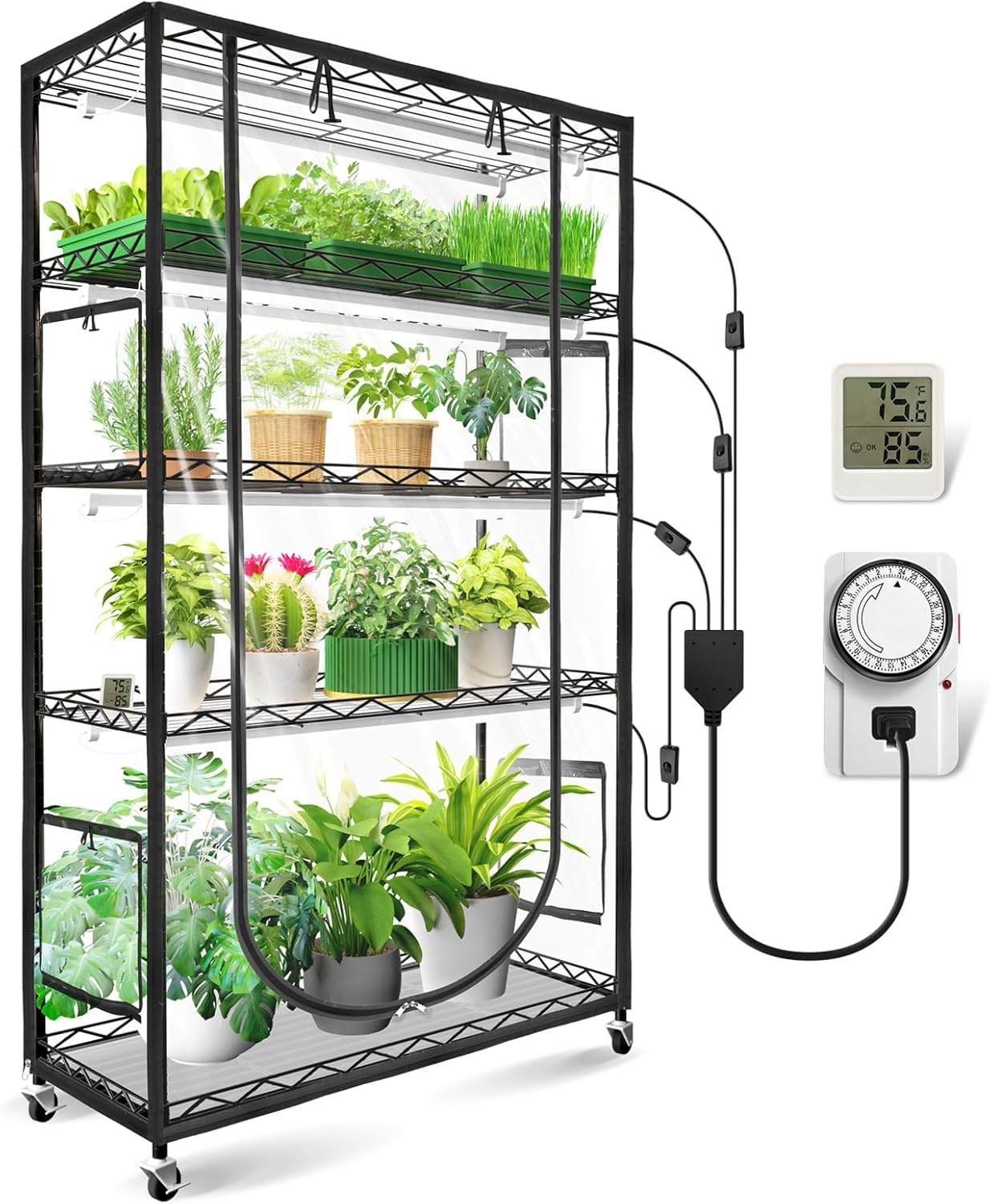
It is the only pick here that brings its own light. Eight T8 full-spectrum LED bars hang inside an EVA tent on a metal stand, each tier on its own switch, with a timer and a small thermo-hygrometer — which makes this the one greenhouse on the list that does not need a sunny window.

The proportions tell you what it is for: 35.4 inches long, 13.8 inches deep, 70 inches tall, with five adjustable shelf heights so a tier can drop as the plants grow. Lockable casters let you roll it to the sink for watering and back to the wall after, and it goes together without tools.

We ran ours zipped up and the plants stayed compact rather than stretching, and the per-tier switches mean you can run one shelf of cuttings while the rest stay dark. Check every bar when it arrives — with eight of them, a dead one is easy to miss until a tray goes pale.

For an apartment, a basement or a spare room, this makes year-round growing possible without a greenhouse in the yard, and it is the only thing here that works in December. It costs more than the racks on this list, but it is a complete, tidy system: stand, lights, cover and timer together, with the tent holding the humidity seedlings want.

Bottom line: For an apartment or a basement, this is the pick that makes year-round growing possible without a garden: lights, timer and tent in one unit.

5

Sylviera 6x8 Polycarbonate Greenhouse

Sylviera 6x8 Polycarbonate Greenhouse

Permanent backyard kit

Our Score 8.6/10
Check Price

Worth Noting

  • Assembly takes two people and most of a day
Vent
1 adjustable roof vent
Frame
Aluminum alloy
Panels
4mm double-wall polycarbonate
Footprint
88"L x 67"W x 77"H
Read the full review

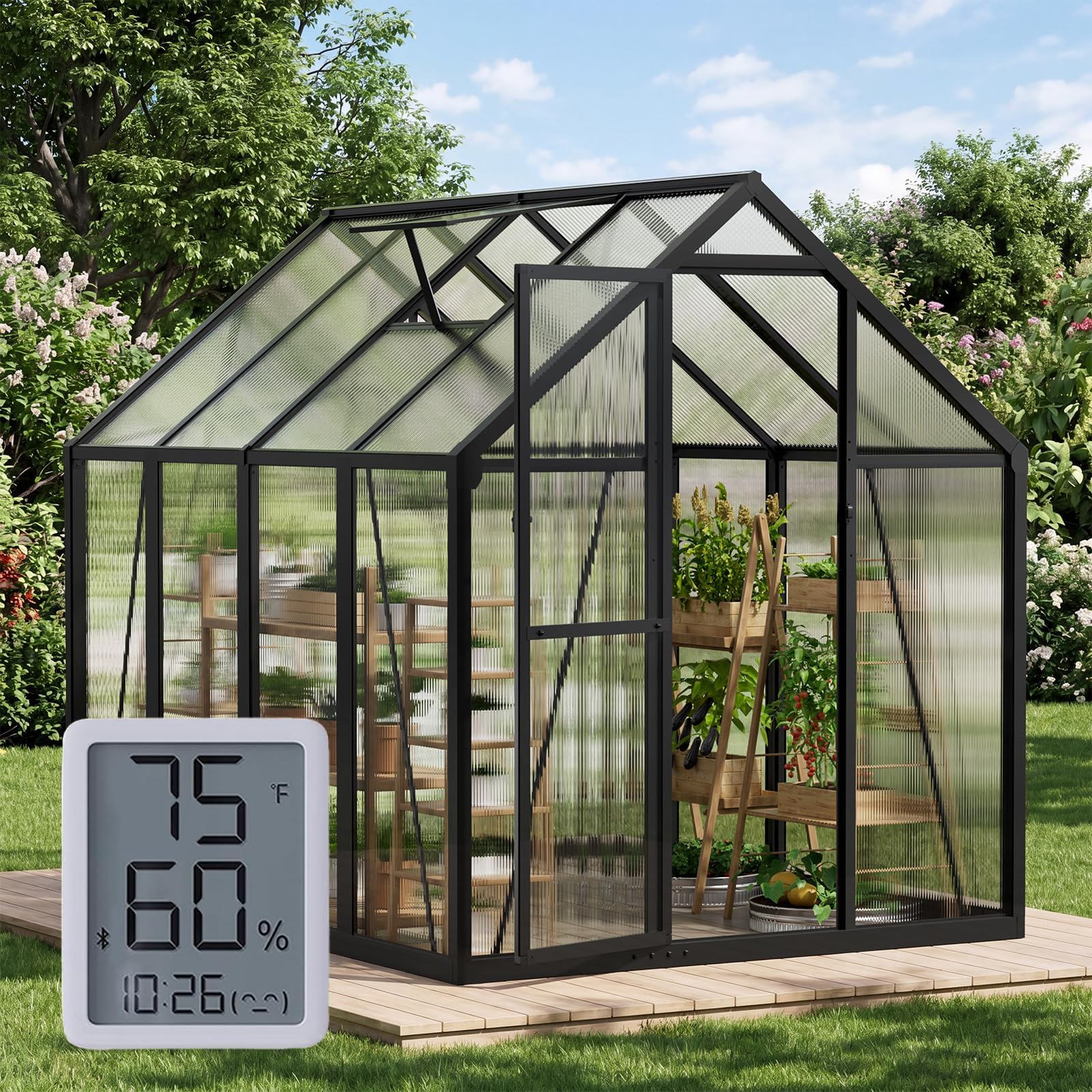
Panels rather than film are the whole argument here. This is a 6x8 kit built from 4mm double-wall polycarbonate in an aluminum frame: rigid walls that keep their shape, light that arrives diffused rather than concentrated, and a good deal more warmth on a cold night than a single layer of PE can hold.

For anyone who wants a greenhouse still standing in five years rather than a tent to re-cover, this is the pick. We think it is the most house-like thing in the group, it reads as garden architecture instead of a marquee, and the lockable door and adjustable roof vent make it usable in July as well as March.

The roof vent and the hygrometer that comes with it are what separate a greenhouse you use from one you bake in — crack the vent by mid-morning and the humidity settles where seedlings want it. In a hard freeze it still needs fleece over the plants or a small heater; panels hold warmth, they do not make it.

Bottom line: The pick for a permanent, year-round greenhouse: rigid twin-wall panels and an aluminum frame that shrug off weather a film tent cannot.

6

KING BIRD 25x10 Tunnel Greenhouse

KING BIRD 25x10 Tunnel Greenhouse

Large gardens

Our Score 8.6/10
Check Price

Worth Noting

  • Door zippers fail before the rest does
  • PE cover has a shorter life than the frame
Cover
150 GSM PE, UVI 6
Frame
Galvanized steel with crossbars
Vents
10 roll-up screen windows
Footprint
295.2"L x 118.1"W x 79.2"H
Read the full review

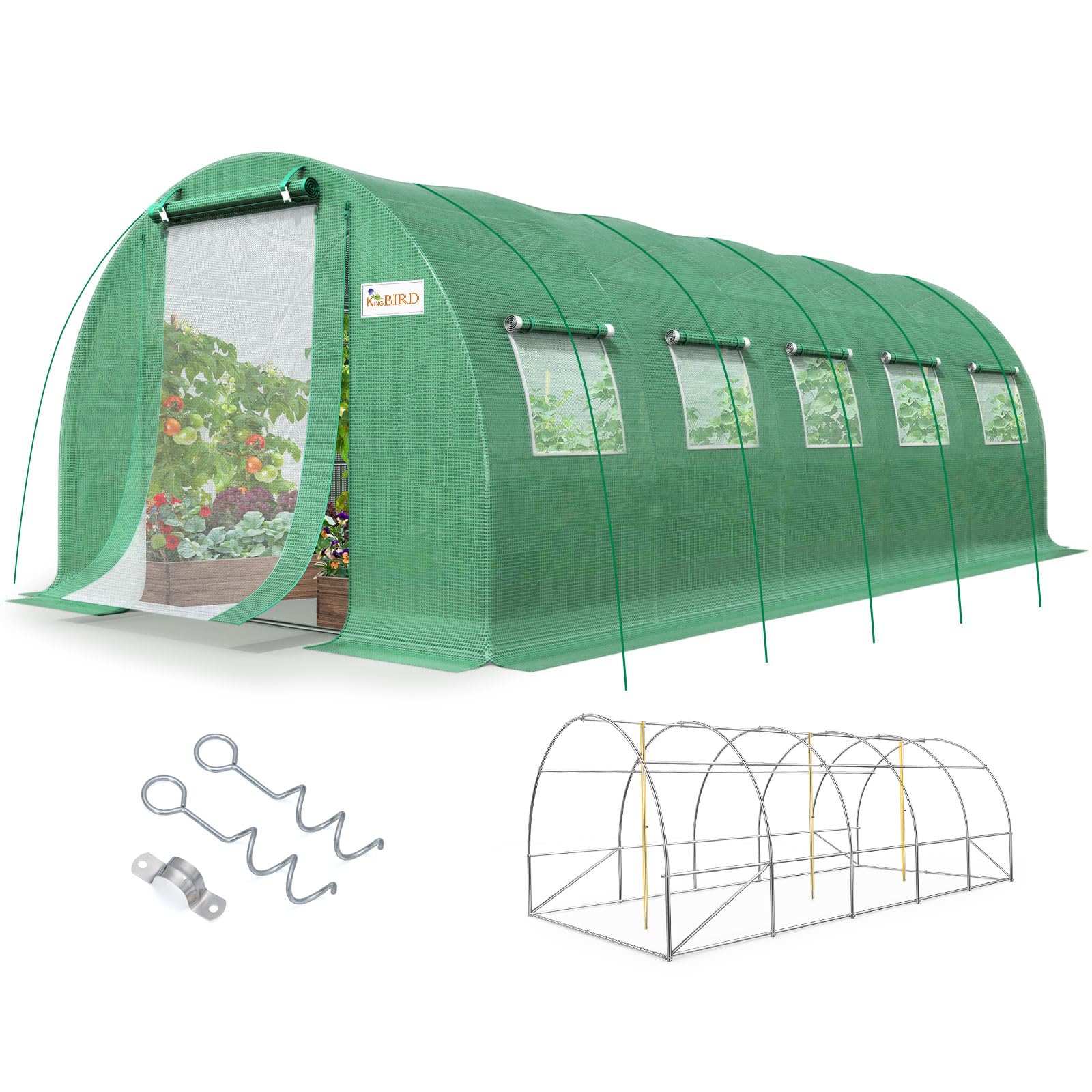
Twenty-five feet long, ten wide and 6.6 feet to the ridge, this is not a bigger version of the tents above — it is a different scale of growing. At 242 square feet it covers roughly seven times the floor area of our top pick, which is the gap between somewhere to overwinter pots and growing a whole tomato rotation under cover.

The frame is what justifies the money: galvanized steel with extra top crossbars, diagonal bracing and two stiffeners, wrapped in 150 GSM PE with UVI 6 protection. Ten roll-up screen windows and mesh-panel doors at both ends let you pull air through the length of it, which is how a tunnel avoids becoming an oven by mid-morning.

We rate it for a serious plot. It is the only structure here that will hold a season of row crops, and a two-person build across an afternoon or two is a fair trade for that. Set it where a hedge, fence or shed breaks the prevailing wind, drive every stake, and add guy lines at the ends — a 25-foot sail takes anchoring seriously.

If your growing is containers and a couple of raised beds, the walk-ins above do the job with far less fuss and no second builder. If you are planting in rows, or selling at the end of the season, nothing else in this group comes close to the space.

Bottom line: The one for a plot you plant in rows: 242 square feet under one roof, with the caveat that it wants two builders and firm anchoring.

7

Bamworld 3-Tier Wooden Greenhouse

Bamworld 3-Tier Wooden Greenhouse

Balcony display

Our Score 8.4/10
Check Price

Worth Noting

  • Wood frame wants a covered spot
  • 15.8 inches of clearance per shelf
Cover
Clear PE
Frame
Wood, push-fit
Shelves
3 tiers, 15.8" clearance
Footprint
22.8"L x 16.7"W x 54.1"H
Read the full review

Most of the greenhouses here look like greenhouses. This one looks like a plant stand that happens to wear a cover: a 54-inch wooden frame, three shelves, and a 22.8 by 16.7-inch footprint that fits a balcony or the corner of a sunroom without an argument about the view.

It is push-fit wood, tapped together by hand with no tools, and the maker's estimate of fifteen minutes is about right once the parts are sorted. The shelf boards are thin, so load them with pots rather than bags of compost, and tap the connectors home properly — a loose joint on a light frame is what makes these feel wobblier than they are.

The clear PE cover rolls up on a zippered door and traps enough heat to start seeds four to six weeks early, and the whole thing is light enough to move around a balcony to chase the sun. It blocks wind and light frost; a hard freeze will still find your plants, so it is a season extender rather than a winter house.

We were struck by how much it looks like furniture and how little it looks like a tent, which is exactly why it works indoors: a sunroom shelf with a cover on is a propagator you do not have to hide when guests arrive. As a display shelf that doubles as a seed starter, it is the best-looking option in the group.

Bottom line: The best-looking option here, and the easiest to live with indoors — a wooden shelf that doubles as a propagator rather than a tent in the yard.

8

Quictent Tabletop Mini Greenhouse

Quictent Tabletop Mini Greenhouse

Patio tabletop growing

Our Score 8.2/10
Check Price

Worth Noting

  • Film cover needs replacing before the frame
Cover
Clear PVC film
Doors
2 zippered doors
Frame
Metal poles and connectors
Footprint
71" x 36" x 36"
Read the full review

The cover is what you are really buying here, and it decides how many seasons you get. Quictent uses a clear PVC film rather than the green PE most of these tents are made from, and the difference is light: the maker quotes 95 to 98 percent transmission against under 80 for a green cover, which is why seedlings under it stay stocky instead of stretching for the window.

At 71 by 36 by 36 inches it sits over a bench, a balcony rail or a raised bed, with zippered doors at both ends and a removable top cover for watering days. For a first greenhouse, a rented patio or a school project, this is the one we hand over — it goes together in minutes without tools and packs flat for storage.

What it is not is permanent. Weight the base, tie it to a railing, and take the cover off before a storm rather than after — that routine is the difference between two seasons and four. Quictent backs the connectors and stakes with a lifetime replacement offer, which tells you where they expect the wear to happen.

Bottom line: The easiest first greenhouse we tested: a bench-top tent that goes up without tools and does a season of seedlings without asking for much.

9

Ohuhu 6.6x2.5 Lean-To Greenhouse

Ohuhu 6.6x2.5 Lean-To Greenhouse

Narrow side yards

Our Score 8.0/10
Check Price

Worth Noting

  • Needs a sheltered wall to stay put
  • Plastic connectors work loose over time
Door
1 roll-up zippered door
Cover
Translucent PE
Frame
Plastic
Footprint
78.7"L x 30"W x 66.9"H
Read the full review

Some gardens do not have room for a walk-in; they have a strip. At 78.7 inches long, 30 inches deep and 66.9 inches tall, this lean-to is built for the wall of a house, the side of a shed or a fence line, where the structure borrows the wall for shelter and you can still stand a tomato plant upright.

Inside there is a single run of floor space behind a roll-up zippered door, with translucent PE stretched over a plastic frame — that is the budget decision right there, and it is why this one sits near the mini greenhouses on price rather than the walk-ins. Stakes and windproof ropes come in the box, and they need to go in deep, with the whole thing set against a wall rather than out on the lawn.

Against a sheltered wall it is the most space-efficient thing in this group: two and a half feet of depth gives you tomatoes, herbs or a cucumber vine without eating the lawn. It suits a courtyard, a side return or a patio wall — anywhere you want height without footprint. We treat the wall as part of the design, not a suggestion.

Bottom line: The sensible answer for a side return or a courtyard wall, where two and a half feet of depth buys you a season of tall plants.

How We Picked and Tested These Greenhouses

We started with spec sheets rather than photos: footprint, peak height, frame material and thickness, cover fabric weight, whether a replacement cover is sold separately, and price per square foot of floor space. Anything that couldn't be anchored down, or that didn't list its frame dimensions anywhere, got cut before we ordered it.

Assembly is where these things live or die, so we built each one solo with a stopwatch running and noted the first step where we genuinely needed a second person. Then we used them like a gardener does — trays of seedlings in March, hardening off in April, overflow tomatoes in July, and a scramble to cover peppers the night of the first frost.

Once they were up, we anchored each one the way its manual specified and left it out in the weather. After every windy stretch we walked the frames looking for bent joints, popped connectors, and covers rubbed thin where they meet the pipe. Doors and zippers got opened and closed dozens of times a day, and we noted which ones snagged on the flap, split at the pull, or seized shut after a cold night. To judge how well each held heat, we set a thermometer at soil level and read it at dawn against the outside temperature. Value came down to cost per square foot and whether the cover alone could be replaced in a couple of years without buying a whole new house.

How to Choose Greenhouses

Start With the Site, Not the Square Footage

Measure the ground and the headroom before anything else. A walk-in needs a flat, level patch and enough clearance at the door for you plus a watering can; a rack or tabletop tent needs a bench, a porch or a bright room. Remember that portable means it comes apart for storage, not that you will move it every week — a loaded 8x6 with pots in it is a two-person job.

Mark the footprint with stakes, walk around it, and check the door swing and the path you will carry water along. The strip beside a wall is the exception worth planning for: a lean-to turns two and a half feet of dead space into growing room, but only where the wall itself is sheltered.

Wind Is What Ends a Greenhouse's Life

Frames bend and covers shred in the same weather across this whole category, and what separates a tent that lasts from one that does not is usually siting and anchoring. Put the structure where a fence, hedge or wall breaks the prevailing wind rather than in the middle of an open lawn.

Stakes need soil to bite into; on a patio or deck, use sandbags, water containers or weights on the base frame instead. If the anchors in the box are short and thin, replace them before the first blowy week — that is the cheapest insurance you will buy for any of these.

Film or Twin-Wall Panels

A PE or PVC film cover is cheap, light and easy to replace, and it holds warmth and humidity well; in strong sun, expect to change it every season or two. Twin-wall polycarbonate panels cost more, insulate better, resist wind and last years, but they need a rigid frame and a proper, level build.

Let the routine decide. If the greenhouse comes down each autumn and lives in the shed over winter, buy film. If it stays up through wind and frost in an exposed garden, buy panels and budget a full day with a helper to build it.

Doors, Vents and Zippers

Zippers are the first thing to wear on almost every greenhouse here, so look at how many openings one zip is being asked to serve. A single door and two mesh windows are enough for a small walk-in; a long tunnel needs windows along both sides to pull air through the length of it.

Open a zip square rather than dragging it round a corner, and never force one that has jumped its track. Before you buy, check that replacement covers are sold for the model — a sound frame with an unavailable cover is a frame you throw away.

Shelves, Clearance and What You're Growing

Shelf ratings and the gap between tiers decide what you can actually raise. A rack rated to 22 pounds per shelf holds trays and small pots, not wet bags of compost. Around 16 inches of clearance suits seedlings and houseplants; tomatoes and peppers want floor-to-ridge height, not a shelf.

Count what you are overwintering and match the floor area; count trays and match the shelf area. Buying one size up from your first instinct is usually the better error, as long as the site still takes it.

Frequently Asked Questions

Final Verdict

For most gardeners, the EAGLE PEAK is the greenhouse to buy: a real walk-in that one person can raise, shift and take down, with room for staging tables and a season of plants. It is the pick that removes the excuse.

Change one requirement and the answer changes with it. An exposed site that wants a permanent structure calls for the Sylviera panel kit, a row-cropping plot needs the KING BIRD tunnel, and a porch, balcony or spare room is better served by the Ohuhu rack, the Bamworld shelf or the lit JESLED unit.