Fencing & Farm Structures

Best Greenhouse Ventilation Fans of 2026

The first hot week of July is when a greenhouse stops being an asset and starts being an oven. I walked out one afternoon to find my tomatoes curled and the thermometer at 104°F, a brick propping the door open doing precisely nothing. A vent fan pushes that hot air out, pulls cooler air in through the louvres, and keeps humidity from turning the house into a sauna. We've spent 10 months with 12 of them, and the gap between a good one and a frustrating one comes down to noise, honest airflow, and a thermostat that does what the dial promises.

The CFM number on the box is measured in open air, not through a vent opening with a bug screen over it, so a generously sized fan can still underwhelm. Power is the other snag — you need an outlet or a cable run at the gable end. Everything below earned its spot by cooling the far corner, holding a steady temperature instead of cycling on and off, and staying quiet enough to forget. Small hobby house or full polytunnel, your match is in here.

1

AC Infinity AIRLIFT T14

Top Pick
AC Infinity AIRLIFT T14

Humidity control

Our Score 9.2/10
Check Price

Worth Noting

  • Loudest of the group at 68 dB
Noise
68 dB
Airflow
1513 CFM
Blade Size
14 inches
Controller
Temperature and humidity, WiFi
Read the full review

Humidity is the half of greenhouse ventilation that gets forgotten until the mold appears. This is the only fan in the group that switches on a humidity set point as well as a temperature one, and it will push an alarm to your phone when either crosses the line you set. At 1,513 CFM from a 14-inch opening, one unit covers a mid-size hobby house with room to spare.

The controller is where the money goes, and it earns it if you use it: schedules, alarms, speed ramps, and a climate history you can scroll back through to see what happened on the worst day in July. The app's logic takes an evening to sink in — you have to build an automation before the variable-speed function behaves the way you expect — but once it's built the house runs itself, and you have a record of it.

It's the priciest fan here by a wide margin, and the humidity trigger is the only honest reason to pay it. If your greenhouse problems are all heat, the Amico does that job for much less and you'll never miss the app. If your summers come with damp, still mornings and closed vents, this is the one that turns a reaction into a rule.

Bottom line: We recommend it where humidity, not just heat, is the problem — and where you'll actually use the app.

2

iLiving 12" Shutter Fan

iLiving 12" Shutter Fan

Set-and-forget

Our Score 9.2/10
Check Price

Worth Noting

  • A one-year parts warranty only
  • Durability is the weak spot in all-summer duty
Noise
Under 65 dB
Airflow
960 CFM
Control
Thermostat and variable speed
Coverage
Up to 1400 sq ft
Read the full review

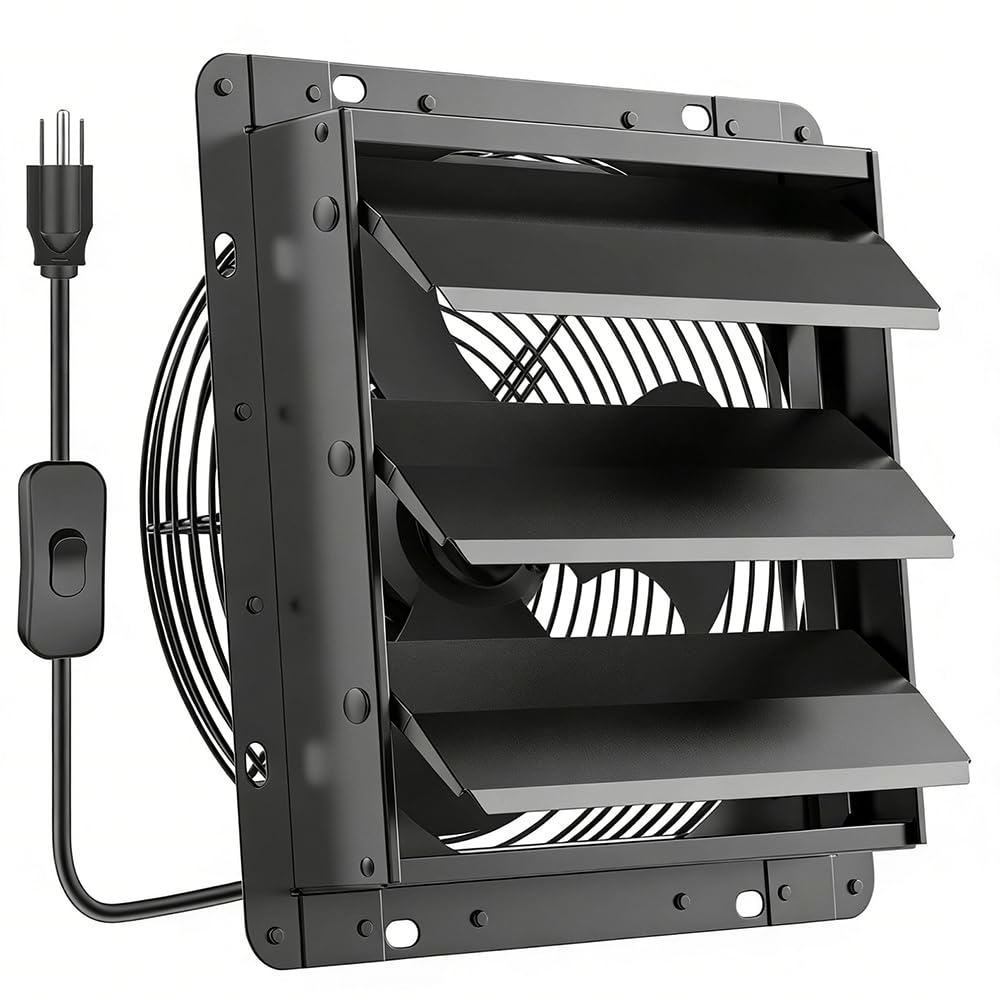
One carton, one job. The fan, the automatic shutter, a Thermospeed controller that handles both temperature and stepless speed, and a cord with a standard plug all arrive together — no separate thermostat to buy, no wiring to arrange, and the whole thing is UL and cUL listed. Listed airflow is 960 CFM with coverage up to 1,400 square feet. For a first greenhouse fan, that completeness is worth more than a bigger number on the box.

Two things to know. The first is noise: 65 dB is a real figure, and this is a fan you'll hear from the far end of the garden when it's on high. The second is the thermostat, whose set point and the actual temperature at plant height don't always agree — treat the dial as a starting position, put a thermometer in the beds for the first week, and adjust from there.

It's the fan we suggest to anyone who wants the whole job solved in an afternoon, and it's priced accordingly against the Amico, which gives you more airflow, more speeds, and a longer warranty for about the same money. Where the iLiving wins is simplicity: the controller is a knob and a dial, there's nothing to program, and anyone in the household can work it without a phone.

Bottom line: Our pick for a plug-and-play install: thermostat, speed control, and a cord in the box, with a UL listing behind it.

3

HG Power 10" Shutter Fan

HG Power 10" Shutter Fan

Small greenhouses

Our Score 9.2/10
Check Price

Worth Noting

  • Plastic louver pivots are the wear point
Noise
52 dB
Screen
Built-in mesh
Airflow
647 CFM
Control
Stepless speed controller
Read the full review

A mesh screen sounds like a small detail until you've cleared a shutter fan of milkweed fluff and cabbage moths. This 10-inch unit has one behind the louvers, so the blades stay clear and whatever is drifting around the garden stays outside. The rest suits a small house: 647 CFM, a 10.6-inch louver that seals shut when the fan stops, 52 dB, and a stepless speed controller so you can run it gently.

We pick this over the plain 10-inch HG Power for the speed control and the screen, and over the budget VEVOR for the same reasons plus a cord. Where it gives ground is the build: the clips the louvers pivot on are plastic, and that's the part that wears. In a windy spot where the shutters flutter all day, that's what to keep an eye on.

At 52 dB it's quiet enough for a shed wall next to a seating area, and 647 CFM is right for a 6-by-8 or 8-by-10 house, or a potting shed you want to keep from cooking. It installs entirely from the inside, which is a real kindness in February, and the 12.36-inch frame drops between studs without re-framing.

Bottom line: Our small-greenhouse pick: 647 CFM, an insect screen, and a speed dial in a fan quiet enough to live with.

4

VEVOR 10" Shutter Fan

VEVOR 10" Shutter Fan

Tight budgets

Our Score 9.0/10
Check Price

Worth Noting

  • Single speed with no thermostat
Noise
50 dB
Speeds
Single
Airflow
820 CFM
Blade Size
10 inches
Read the full review

This is the cheapest fan here by a clear margin, and the numbers don't look like a budget unit: 820 CFM from a 10-inch blade at 1,650 rpm, a galvanized steel frame with aluminum shutter and blades, and a listed 50 dB. On paper it moves more air than the 12-inch iLiving.

What isn't in the box is the cord. You get the fan and the shutter, and the wiring is yours to sort — either hardwired into a switched circuit or finished with a plug by someone competent to do it. That's not unusual for a permanently installed exhaust fan, and it's part of how the price stays where it is, but it turns a Saturday job into a weekend one.

The rest of the install is straightforward. It arrives assembled, the frame is 12.8 inches square with enough bolt holes to find a stud, and the shutter swings open as the fan spins up. The materials are the ones the dearer fans use, and the motor is fully enclosed — worth knowing in a greenhouse, where damp air and dust get into everything.

Where it makes sense is a working greenhouse, coop, or workshop that already has a switched circuit and a thermostat planned. Do that and you have a system that does what an all-in-one does for less. In a hobby house with one outdoor socket and no appetite for wiring, it's the wrong first buy.

Bottom line: We recommend it only where the wiring is already there: 820 CFM, the cheapest fan in the group, no cord in the box.

5

Amico 12" Shutter Exhaust Fan

Amico 12" Shutter Exhaust Fan

Most greenhouses

Our Score 8.8/10
Check Price

Worth Noting

  • Controller takes some learning to program
Motor
25W brushless DC
Noise
50 dB
Speeds
8 plus thermostat
Airflow
1282 CFM
Read the full review

Twelve hundred and eighty-two cubic feet per minute is more air than most hobby greenhouses need in one go, and that headroom is exactly why we like it. The working figure for summer ventilation is one full air change a minute: a 10-by-12-foot house with an 8-foot ridge holds around 960 cubic feet, so a fan this size clears it and then settles onto one of its eight lower speeds. You get the reserve for the worst afternoon in July without running a single-speed fan that sounds like it's about to leave the wall.

The thermostat is what turns a fan into a system. A probe on a three-foot lead switches the fan on at your set temperature and off again, so the house isn't sitting open to the wind all morning. Three feet is short, though, so plan the mounting around it — get the probe into shade at plant height rather than against a sun-warmed wall, or the fan will keep running long after the house has cooled down.

The rest of the package is unusually sensible for the money. The 25-watt DC motor draws a fraction of what the AC fans here pull, the listed 50 dB is the quietest of the 12-inch units we cover, and the three-year warranty is the longest in this group — which matters, because the thing that actually kills greenhouse fans is running every hot day for three summers.

Expect to spend a few minutes with the manual. The controller steps between speed and temperature modes with two buttons, and the first afternoon is a bit of a puzzle; after that you set it in June and don't touch it again until the nights get cold. That's the whole pitch, really: a greenhouse that looks after itself while you're at work.

Bottom line: For most hobby greenhouses this is the fan we recommend: 1282 CFM, eight speeds, a real thermostat, and a three-year warranty.

6

KEN BROWN 20" Shutter Fan

KEN BROWN 20" Shutter Fan

Large greenhouses

Our Score 8.8/10
Check Price

Worth Noting

  • Single speed with no thermostat
  • Heavy enough to want two people
Speeds
Single
Weight
19.7 lb
Airflow
3500 CFM
Blade Size
20 inches
Read the full review

A 20-inch shutter fan is a different class of object from everything else here. It's 19.7 pounds of aluminum with five blades, a 5.4-foot cord already fitted with a plug, and a 1,309 rpm motor pulling 130 watts. The payoff is 3,500 CFM — several times what the 10- and 12-inch fans in this group move.

That volume belongs on a working greenhouse, a polytunnel, or a barn you're trying to keep below oven temperature. On a small hobby house it's simply too much: it will clear the air in under a minute and then you're paying to move air out of a door. Match it to a house of a few thousand cubic feet and it earns its keep on the worst afternoons of the year.

The case for it is scale and simplicity: big blades turning relatively slowly, one moving part, and a plug on the end of the cord. That simplicity is also its limit — this fan doesn't think, so a separate thermostat does the switching, which is the setup we prefer for something this size. Check the shutter and blade clearance when it arrives; the assembly is the part to look over, and it's easier to sort out on the ground than up a wall.

Bottom line: We keep this one for large houses: the most airflow here by a wide margin, one speed, and a plug already fitted.

7

iLiving 12" DC Shutter Fan

iLiving 12" DC Shutter Fan

Mid-price humidity

Our Score 8.8/10
Check Price

Worth Noting

  • No app, remote, or climate logging
Motor
45W EC
Noise
53 dB
Airflow
960 CFM
Control
Temperature and humidity, 12 speeds
Read the full review

Think of this as the smart fan's idea at a smaller price: a 12-inch shutter fan with a digital controller that triggers on temperature and humidity, twelve speeds, a 45-watt EC motor, 960 CFM, and a 5.6-foot cord. It's ETL listed, it arrives assembled, and at 53 dB it's the quieter of the two iLiving fans here by a distance.

The controller is a box on the end of a lead, and you set it by hand — no app, no logging, no remote. In a greenhouse a hundred feet from the house that's a walk rather than a dealbreaker, and it's the difference between this and the smart fan.

We like it for the grower who wants humidity triggering without a phone in the loop: set the trip points once, glance at the display on the way past, and the damp mornings look after themselves. The caveat is history — this is a newer design with far less of a service record behind it, which is why it sits here rather than among the runners-up.

Bottom line: We like it as the middle path to humidity control: temperature and humidity triggers, twelve speeds, and a quiet EC motor, no app.

How We Tested Greenhouse Ventilation Fans

We started by pulling together every greenhouse fan sold to home growers, then filtered by blade and shutter size, CFM rating, mounting style, and whether the controls lived on the unit itself or on a remote thermostat. That left 12 fans, which we ran for 10 months — from the first warm days of late spring through the cold nights of October, when a thermostat suddenly matters more than airflow.

Each fan went into one of two test greenhouses: an 8-by-12 hobby house with louvred side vents, and a polytunnel with far more cubic feet to move. We mounted them at the gable, timed how long a solo install took with a drill and a stepladder, and noted what each one needed for power — a nearby outlet, a longer extension run, or a hardwired connection that meant calling an electrician.

Then we let the weather do the work. On the first hot mornings we tracked how quickly the temperature fell at the far gable compared with the intake vent, using a thermometer set at plant height. We stood three feet outside the door with a decibel meter during peak afternoon running, then repeated it from the potting bench inside, because a fan that's tolerable in the garden can be a drone at close range. We watched how each thermostat handled a 20-degree swing — easing on and off or slamming between full blast and nothing — and cycled the speed settings and manual controls daily to see how the switches felt after a few hundred uses.

By August, a few units had developed a rattle. By October, we knew which housings had yellowed, which shutters no longer sealed flush, and which motors still started cleanly on a cold morning. We judged cooling performance on the plants as much as the numbers: a fan that holds the house near 78°F at midday keeps tomatoes setting fruit, and one that lets it spike doesn't, whatever the spec sheet says.

How to Choose Greenhouse Ventilation Fans

Size the fan to the air, not the footprint

Greenhouse ventilation is usually specified in air changes, and the working figure for summer is one full exchange a minute. Multiply length by width by average height: a 10-by-12 house with an 8-foot ridge holds about 960 cubic feet, so a 1,000 CFM fan is the starting point rather than an extravagance.

The trap is that CFM is a free-air figure. Shutters, insect mesh, and a short run through a wall all cost you airflow, so if the fan has to pull through a screen or the house is mostly glazing, go one size up and let the thermostat run it less often.

Decide how much of it should run itself

A thermostat is the difference between a ventilated greenhouse and one that's ventilated when you happen to be home. Set the trip point a couple of degrees above your target and let the fan cycle instead of running flat out.

We put heat control first for a first fan because it's the problem you can feel, then add humidity triggering once the house gets closed up — cool, still, damp mornings are what fungal trouble likes. Watch the probe: a sensor against a sun-warmed wall reads hot all afternoon, so hang it in shade at plant height if the lead reaches.

One speed or a dial

A single-speed fan is either off or emptying the house, which in a small greenhouse means a blast every few minutes instead of a steady exchange. A stepless or multi-speed controller lets you run the fan slowly for hours: gentler on seedlings, quieter at the boundary, and better at holding humidity down without dropping the temperature.

It's worth paying for in a house with tender plants. For a shed, a coop, or a barn, one speed and a thermostat do the same job with less to go wrong.

Power, cutout, and the hole in the wall

Three things to check before you order: whether a cord and plug are included, what size opening the fan needs, and where the nearest power is. The number in the name is the blade, not the cutout — a 10-inch fan wants roughly a 12.8-inch square opening, and a 12-inch wants 14 to 15 inches.

One of the picks here arrives with no cord at all, so budget for an electrician or for fitting a plug yourself, and site the fan within reach of the supply rather than running an extension lead through a wet house.

Noise, and the long summer

Decibels are measured in free air at a set distance, so read them as a comparison between fans rather than a promise about your wall. Low 50s disappears into garden noise; mid 60s is a fan you notice from the end of the path; a 20-inch unit at 60 dB is a working fan, not a background one.

Then think about the fifth summer rather than the first. These run in hot, damp air for months at a stretch, and the warranty length is the clearest statement a maker makes about how long it expects the thing to last.

Frequently Asked Questions

Final Verdict

If we were buying one fan for a hobby greenhouse this week, it would be the Amico 12-inch. It moves more air than anything else in its size class here, gives you eight speeds and a thermostat to run them, sips power on a DC motor, and backs the whole thing with a three-year warranty — the least fussy route to a greenhouse that ventilates itself.

Two things change the answer. If your problem is damp, still mornings rather than raw heat, the AC Infinity's humidity trigger is worth the premium. If you're ventilating a barn-sized house, skip the 12-inch class entirely and put the 20-inch KEN BROWN on a thermostat.