Garden Tools

Best Grass Shears of 2026

A string trimmer has no idea where your flower bed starts. That's why the last few inches around fence posts, stepping stones, and the mailbox almost always get cut by hand, usually on your knees. Grass shears are built for exactly that strip: no cord, no gas, no noise, just two blades and your grip. The wrong pair makes the job miserable, with blades that tear at the grass instead of slicing it, a spring that sticks halfway through a stroke, and a lock that pops open in your hand.

What I've learned is that price tells you surprisingly little here. A cheap pair with tight, well-aligned blades will outcut an expensive pair with sloppy ones. Sharpness gets all the attention, but the spring and the grip are what decide whether you can finish a border without your hand cramping. My team and I spent four months with 14 pairs, edging beds and cleaning up around obstacles, and the differences showed up fast. The ones worth your money are below.

1

Kings County KC8807-11

Top Pick
Kings County KC8807-11

Long borders

Our Score 9.4/10
Check Price

Worth Noting

  • Longer and heavier than the small pairs here
Handle
Rubberized grips
Blade Type
Bypass
Blade Length
6 inches
Overall Length
13.5 inches
Read the full review

Six inches of blade is the whole argument for the Kings County KC8807-11, and it is a good one. The longer bypass blade takes a bigger bite of grass per squeeze, so a long border takes noticeably fewer cuts, and it is the pair we reach for when an edge has been let go for a few weeks and the grass is long and lying over itself.

The action is the next thing you notice. The spring returns the handle cleanly and the blades meet along their whole length, so you are not sawing at a stem caught near the tip. Coated handles with rubberized grips kept it comfortable through a full bed, and the steel has the solid, no-rattle feel that the cheapest pairs here do not.

The trade is size. This is a longer tool than the Fiskars at 13.5 inches overall, and heavier in the hand, so around small plants you will place it more carefully than a short pair. On open borders and clumps of ornamental grass the extra reach pays for itself.

Bottom line: For long borders and clumps of ornamental grass, this is the cleanest-cutting pair here, with a smooth spring and grips that do not punish your hands.

2

CRAFTSMAN V20 2-in-1

CRAFTSMAN V20 2-in-1

Mixed cleanup

Our Score 9.2/10
Check Price

Worth Noting

  • No blade covers for storage
Battery
1.5 Ah lithium-ion
Voltage
20 volts
Hedge Blade
8 inches
Grass Shear Blade
4 inches
Read the full review

The CRAFTSMAN V20 is the only battery tool that earned a place here, and it is doing a different job from the rest. What the money buys is a 4-inch grass shear blade, an 8-inch hedge blade, a 20-volt 1.5 Ah battery and a charger — one tool for the bed edging and the small shrubs beside it, with a blade change you can do by hand.

We think it justifies its price if you have a lot of edge and hands that would rather hold a trigger than work a spring. It is light enough to run one-handed, compact enough to get between shrubs, and quieter than a string trimmer, which matters if your only free hour is early on a Saturday.

Two things to plan around. The blade covers are not included, so the shear blade lives loose in a shed drawer unless you make it a sheath or a box. And the power fades before the battery dies, so the cut gets rougher as the charge drops — start on a full charge and keep a second battery if your border is long. On a small lawn with a few yards of edging, a manual pair is cheaper, quieter and never needs charging.

Bottom line: If you want a trigger instead of a squeeze, and you have hedges as well as edges, this cordless 2-in-1 is the one worth the money.

3

Gardena Comfort Grass Shears

Gardena Comfort Grass Shears

Long sessions

Our Score 9.2/10
Check Price

Worth Noting

  • No swivel head for awkward spots
  • Priciest of the manual shears here
Handle
Ergonomic, ambidextrous
Blade Edge
Serrated
Blade Type
Bypass
Item Weight
10.4 oz
Read the full review

The part of the Gardena Comfort you cannot see in a product photo is the blade bearing, and it is why this pair is worth a look at its price. A good bearing keeps the two blades pressed together along their whole length as they close, so the cut stays strong near the tip instead of fading into a crush at the end of a thick tuft.

The blades are serrated, which suits grass — the teeth catch a blade before it can slide out of the jaws. The handles are ambidextrous and shaped to sit in the hand rather than across the fingers, and at 296 grams the whole tool is light enough to carry with a bucket in the other hand.

Gardena lists spare parts for the tool for ten years in Europe, which is the kind of support that makes a premium manual tool easier to justify than a premium powered one — a shear with a worn part can be brought back rather than replaced.

Where it fits is a long session on tidy borders: the shaped handle keeps your wrist in a natural line and the bearing means you are not fighting the tool for the last inch of every cut. If your edging is an hour on a Saturday rather than five minutes with a bucket, the extra money buys something real.

Bottom line: The pair we point to for long edging sessions: a shaped handle and a blade bearing that keeps the cut strong along the whole edge.

4

Fiskars Shear Ease Grass Shears

Fiskars Shear Ease Grass Shears

Everyday edging

Our Score 9.0/10
Check Price

Worth Noting

  • Takes small handfuls, not big clumps
Warranty
Full lifetime
Item Weight
8 oz
Blade Length
5 inches
Blade Swivel
360 degrees
Read the full review

Every yard has an edge the mower cannot reach and a string trimmer ruins: the strip along a fence, the grass creeping over a flower bed, the tuft around a mailbox post. Hand shears are the right tool for that strip, and the Fiskars Shear Ease is the pair we hand most people first. Its five-inch bypass blades swivel a full 360 degrees, so you turn the cutting head to meet the grass instead of kneeling sideways to meet it.

Weight is why it sits at the top of this list. At 8 ounces it is one of the lightest full-featured pairs here, and the handles are ambidextrous, so a left-handed gardener gets the same grip as a right-handed one. The swivel is the part we kept coming back to: at the base of a rose bush or under a downspout, you rotate the head a quarter turn and your wrist stays neutral instead of contorting.

What it will not do is bulk. The blades are happiest taking a few stems at a time; grab a fistful of wet, overgrown grass and they balk, and you will need three bites where the Corona takes one. Shear Ease is the name for the blade geometry that keeps sap and clippings from gumming the cut, and it does help the blades keep moving in damp grass.

A full lifetime warranty on one of the least expensive pairs here is a good deal, and the easy-open lock is a thumb flick rather than a two-handed wrestling match at the end of a session. For an ordinary border, that combination is hard to argue with.

Bottom line: Most yards need exactly one pair of shears, and this is it: light for an hour of edging, ambidextrous, with a 360-degree head that reaches where a fixed blade cannot.

5

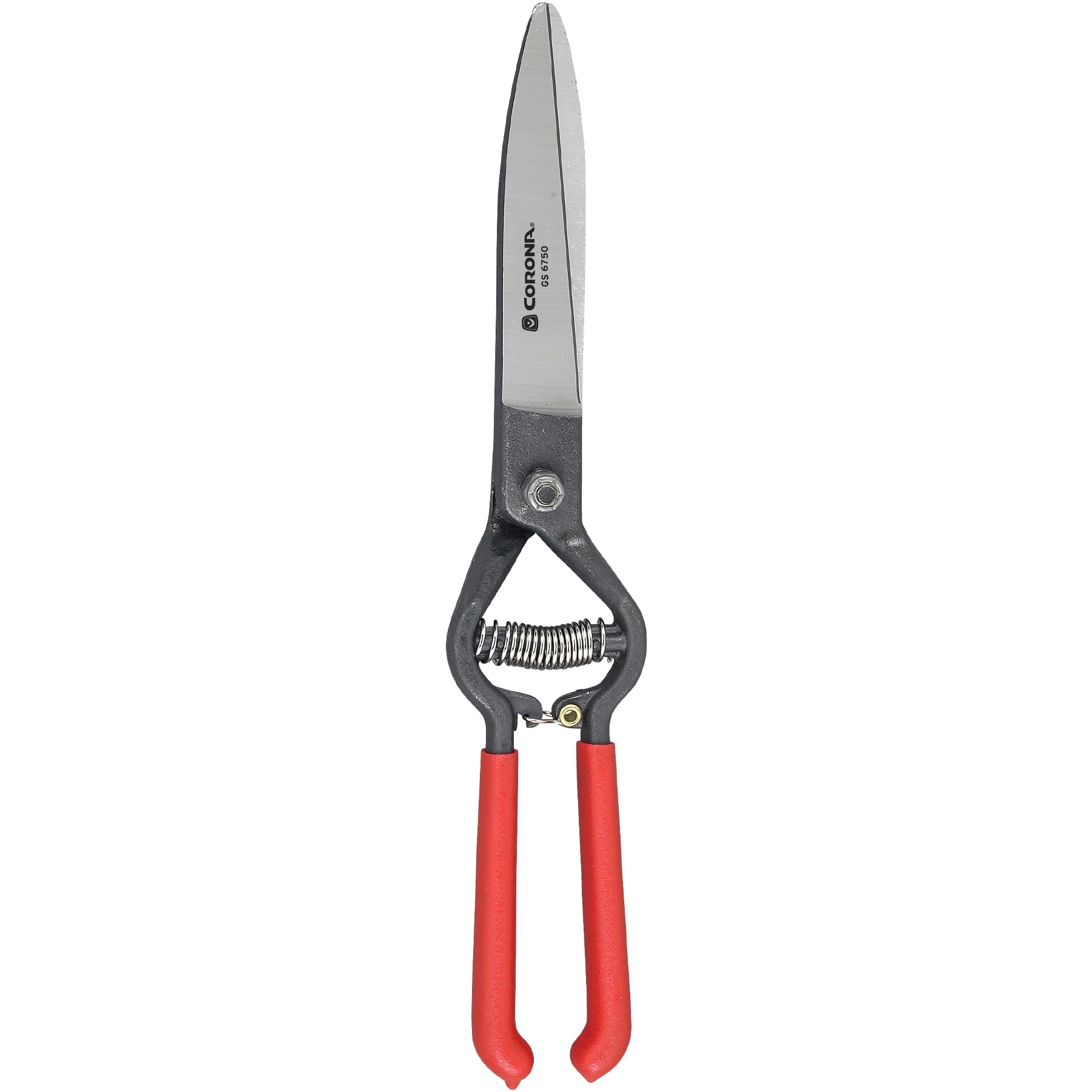
Corona GS 6750D ClassicCUT

Corona GS 6750D ClassicCUT

Overgrown edges

Our Score 9.0/10
Check Price

Worth Noting

  • Handles tire some hands on long sessions
Blade Edge
Straight
Cutting Width
4.5 inches
Blade Material
Alloy steel
Overall Length
14.5 inches
Read the full review

The Corona ClassicCUT has a habit worth knowing about before you buy: the blades can stick shut mid-cut, and you will find yourself pulling them apart with your fingers before the next snip. The pivot takes adjustment, so keep it snug and wipe the blades after a wet session, and the sticking largely stops.

What you get in exchange is cutting power. The 4.5-inch blades go through thick, wet, heavy grass that stalls the lighter pairs on this page — this is the tool for the strip behind the shed that the mower gave up on. The steel takes a fresh edge easily, which matters more on a shear than on almost anything else in the shed, and the build feels heavier-duty than the price suggests.

We rate it for overgrown edges and weed patches, not for fiddly work around flowers: the blades are short, the action is deliberate, and it wants room. If your trimming is maintenance on tidy borders, the Fiskars is the easier tool; if it is reclaiming an edge that has gone wild, this is the one.

Bottom line: Buy this one when the edge has gone wild: it keeps cutting through thick, wet grass that stalls the lighter shears.

6

Jardineer Grass Shears

Jardineer Grass Shears

Small yards

Our Score 8.8/10
Check Price

Worth Noting

  • Not for twigs or woody stems
Safety Lock
Yes
Blade Coating
Non-stick
Blade Material
Carbon steel
Overall Length
12.2 inches
Read the full review

One of the cheapest pairs here is also one of the easiest to live with. The Jardineer is a plain, light hand shear with a heat-treated carbon steel blade and a non-stick coating, and for trimming grass along a walk and cleaning up around flowers it does the job without ceremony.

The coating earns its keep in damp grass: clippings slide off the blade instead of balling up under the top edge. There is a safety lock for storage, and the handles have an anti-slip grip that is fine for the short sessions this tool is built for.

The boundaries are worth taking seriously. Jardineer says this one is for grass, leaves and decorative clippings rather than shrub twigs or branches, and that is exactly right — push it into anything woody and the blade will complain. Check the pivot screw now and then, too; it is the part that loosens with use, and a quarter turn keeps the blades meeting properly.

Where it makes sense is a small lawn, a courtyard, or the front border you tidy twice a month. It will not outlast a forged pair and it will not beat the Kings County in a cutting contest, but it costs a fraction of either and leaves a clean edge.

Bottom line: A sensible first pair for a small lawn: coated carbon steel, a safety lock, and very little money.

7

Q-yard QY-741F

Q-yard QY-741F

Weak grip

Our Score 8.8/10
Check Price

Worth Noting

  • Stiff safety latch needs a firm thumb
  • Return spring is the part to watch
Blade Edge
Serrated
Item Weight
8.32 oz
Blade Length
5 inches
Cutting Mechanism
Compound lever
Read the full review

The Q-yard's party trick is a compound lever — two pivots instead of one, turning your squeeze into up to twice the cutting force of a single-pivot pair. If the reason you are reading about grass shears at all is that your hands cannot manage the squeeze on the old pair, that is the feature that matters more than blade length or brand.

The five-inch blade is serrated and PTFE-coated, a good combination for grass: the teeth hold fine blades so they do not slip out of the cut, and the coating stops wet clippings from sticking. At just over half a pound it is a light tool, and the grips are shaped to fill your palm rather than dig into it.

Where it makes sense is thick stems and long grass along a fence, where a single-pivot pair makes you work. Around delicate plants the wide jaws are clumsy — the serrated edge wants something to grip, and a single blade of grass leaning over a seedling gets lost between them. That is the trade: efficiency on volume, less finesse up close.

Bottom line: If hand strength is what stops you keeping a clean edge, these compound-lever shears do most of the squeezing for you.

8

Byhagern Grass Shears

Byhagern Grass Shears

Spare pair

Our Score 8.8/10
Check Price

Worth Noting

  • Short handles cramp larger hands
Weight
Under 1 pound
Blade Length
6.7 inches
Blade Material
High carbon steel
Overall Length
12.2 inches
Read the full review

A pair of gardening gloves comes in the box with the Byhagern shears — a small thing, but you remember it when you are on your knees and your own gloves are in the shed. The shears underneath are the least expensive pair here, weigh under a pound, and arrive sharp enough to trim fine grass cleanly.

What it gets right is the basics: a high carbon steel blade with a straight edge, light plastic handles, and a compact 12-inch body that is easy to keep with the bucket and hand trowel. Trimming around downspouts and the rocks at the edge of a bed is exactly the work this shape is good at, and being under a pound means you do not set it down between jobs.

The compromises are the usual ones at this price. The pivot screw works loose and needs an occasional turn, and a quarter turn with a screwdriver keeps the blades meeting properly; wipe the steel down after a wet session and it stays clean. Treat it as the second pair you keep in the shed, or the first pair for a small yard, and it is good value.

Bottom line: The cheapest way into a decent pair of hand shears: light, sharp, good enough for a small yard, and there are gloves in the box.

How We Tested Grass Shears

We started by gathering every pair with a real following, hand shears and cordless models alike, then narrowed the field by blade length, handle material, and whether the spring could be swapped out. That left us with 14 pairs, which we used from early spring through midsummer, the stretch when edges need cutting most.

Most of the work happened on ordinary Saturdays: trimming along a concrete walk, working around six fence posts, cleaning up the strip between lawn and mulch bed, and reaching under shrubs where a string trimmer can't go. For each pair we cut the same measured 10-foot stretch of overgrown fescue and counted the strokes it took, then looked at the cut ends to see whether the grass was sliced clean or torn and bruised. The cordless models ran a 60-foot fence line without stopping so we could see how far one charge really went.

Between cuts we watched the things that decide whether a tool gets picked up again. We opened and closed every pair a few hundred times to see if the spring still snapped back, hosed them off and left them out to check for rust and loosened pivots, and worked bare-handed and gloved, noting hot spots after 20 minutes. The locking mechanism got tried one-handed, mid-job, with gloves on, the way you'd actually do it. At the end of four months we set what each pair cost against how it looked and cut, which is where a few of the cheaper ones earned their keep.

How to Choose Grass Shears

Manual first, battery when volume wins

A manual shear costs less, never needs charging, and gives the crispest line along a walk. A cordless 2-in-1 earns its place when you also have small hedges, or when the growth is too much for hand pressure — the CRAFTSMAN here swaps a 4-inch grass blade for an 8-inch hedge blade in seconds.

The trap is assuming a powered unit gives the same finish. A powered shear blade cuts grass well, but the tight, vertical line along a pavement edge comes from a bypass blade closing against itself, which is why we still reach for a manual pair on a visible border. A couple of beds and a fence line is manual territory; a quarter acre of edges is not.

Blade length: what 4 to 6 inches changes

Short blades of 4 to 5 inches are easier to aim between flowers and around rocks. A 6-inch blade, like the Kings County's, takes more grass per squeeze and suits long, straight borders and clumps of ornamental grass — but it is more tool to hold and harder to place beside a small plant.

The edge matters as much as the length. Serrated blades grip fine, floppy grass so it cannot slide out of the jaws; a straight edge slices cleanly through thicker stems. Match the blade to what is actually growing on your edge, not to the biggest number on the package.

Leverage, and what it costs your hand

Compound-lever shears use two pivots to multiply your squeeze, which is genuinely useful if grip strength is the limit — it is the whole reason the Q-yard is on this list. The trade is a wider, heavier mechanism that is clumsy around delicate plants.

Leverage also cannot rescue a dull blade. If your shears crush rather than cut, sharpen them before you blame your hands. For most people a light single-pivot pair used for twenty minutes beats a powerful one used until the hand gives out.

Handles, weight, and whether you need a swivel

Most of the pairs here weigh under a pound, and that is the number to care about if you trim for more than a few minutes: half a pound more in the hand is the difference between finishing a border and stopping halfway. Ambidextrous handles matter if two people in the house share the job.

A 360-degree swivel head lets you keep your wrist straight along a fence or under a shrub, and the Fiskars is the only pair here with one. It is worth paying for on an edge full of obstacles, and easy to ignore on a straight one.

The parts that decide how long they last

Two failures end most pairs: blades that stop closing properly, and blades that rust. Keep the pivot snug so the blades meet along their full length, wipe them down after a wet session, and a coated or stainless blade stays smooth far longer than a plain carbon one left damp in a shed.

Check the lock before you commit, too. A lock that engages mid-cut, or one that will not release under a tired thumb, is the most irritating fault in this category — and it shows up in the first squeeze, not the fiftieth.

Frequently Asked Questions

Final Verdict

The Fiskars Shear Ease is the pair we point most people to. It is light enough to use for an hour, ambidextrous, one of the least expensive pairs here, and the 360-degree head does the work a fixed blade cannot when you are edging around a shrub or a downspout. For an ordinary border it is all the tool you need.

If your edges have gone wild, the Corona's short, heavy blades will cut through grass the Fiskars balks at. And if you would rather pull a trigger than squeeze a handle — or you have small hedges alongside the edging — the CRAFTSMAN is the one worth the money.