Watering & Irrigation

Best Garden Hoses of 2026

A garden hose has to be two contradictory things at once — light enough to drag around the yard without a second thought, and tough enough not to fold in half the moment it rounds a corner. I've spent too many Saturday mornings hauling a stiff coil across the lawn, stopping every ten feet to wring out a twist, to trust the words kink-free on a label. A hose that behaves is the difference between watering the beds in ten unhurried minutes and turning a simple chore into a tug-of-war with a rubber snake.

Over the past seven months, my team and I ran 12 hoses through a full growing season, from spring planting to the first cold snap, and the ones that held up shared a few things. Here's what nobody tells a first-time buyer: the couplings usually give out before the hose body does, so how the fittings are attached matters as much as the rubber itself. Below are the ones I'd happily leave coiled by the spigot all summer.

1

Briggs & Stratton 8BS50

Top Pick
Briggs & Stratton 8BS50

Long-term durability

Our Score 9.2/10
Check Price

Worth Noting

  • About ten pounds for 50 feet
  • 50 feet only, short for a large lot
Length
50 feet
Weight
9.7 lb
Material
Rubber
Couplings
Nickel-plated brass
Read the full review

Pick up the Briggs & Stratton and the weight is the first thing you notice: about ten pounds of hose for 50 feet, which is more than most of us want to carry. Then look at the ends. Nickel-plated brass, crush-proof, with a rubber washer already seated and a coupling that does not flex when you tighten it down. That is the trade this hose makes, and it is why it is our pick: the parts that fail first on a cheap hose are the parts Briggs overbuilt.

The rubber earns its keep in use. It stays supple when the weather turns, so the coil you left out in October still unrolls in November, and it does not take a permanent set the way lighter hoses do. It will kink if you drop a loop on the ground and pull hard — we will not pretend otherwise — but straighten the loop and the flow comes back with no memory fighting you.

Fifty feet is the real limit. On a typical lot that is one side of the house, so plan on moving the sprinkler or joining a second hose at the far end. If your spigot sits at the back corner and the beds are at the front, the 100-foot Flexzilla is the better buy and you trade some of this build for a much lighter hose. If your reach is modest and you want the last hose you buy for a while, this is the one.

Bottom line: The hose we recommend to anyone who wants to buy once and forget it: brass ends, real rubber, and a 50-foot reach that suits a normal yard.

2

Unywarse Steel 50 ft

Unywarse Steel 50 ft

Budget metal hose

Our Score 8.8/10
Check Price

Worth Noting

  • 50 feet only, so big lots need two
Length
50 feet
Nozzle
10 functions
Weight
5.8 lb
Maximum Pressure
150 psi
Read the full review

Of the steel hoses here, the Unywarse is the one we hand to someone who wants the kink-free life without paying for it. It is the least expensive hose on this list, and it arrives with a ten-pattern nozzle, a lockable trigger clip, and oversized aluminium collars that are easier to grip than the standard crimped ends.

The sleeve does what a sleeve should. It slides across concrete, shrugs off a dog's teeth, and never remembers being coiled. Over a season of dragging it around beds and along the driveway we never had to walk back and untwist it, and at 5.8 pounds it is light enough to carry in one hand while you water with the other. That combination — no kinks, no weight — is what makes it a value pick rather than just a cheap one.

Setup is where you spend your five minutes. The extended collars give you something to turn, but a dry washer will weep, so seat the rubber gasket squarely and stop at hand-tight plus a quarter turn. Drain it before a freeze, as the maker asks, and this is the hose that makes the case for steel without the steel-hose price.

Bottom line: The budget pick we actually recommend: a kink-free steel hose with a ten-pattern nozzle, provided you seat the washer properly on day one.

3

Bionic Steel 75 ft

Bionic Steel 75 ft

Long metal reach

Our Score 8.8/10
Check Price

Worth Noting

  • Joints cannot be repaired once they leak
Length
75 feet
Weight
3 lb
Material
304 stainless steel
Maximum Pressure
500 psi
Read the full review

Drag a Bionic Steel across a patio and you hear it: a dry sliding sound rather than the rubbery grab of vinyl. That is the 304 stainless sleeve doing its job, and it is why this 75-footer does not snag on bed edging, rounds a corner without a fight, and shrugs off abrasion that would scuff a rubber hose.

At 3 pounds it is the lightest way here to cover 75 feet — well under half the weight of the 50-foot rubber Briggs — and light enough to carry the whole coil on one arm. The 5/8-inch interior keeps a full stream rather than the pencil-thin output of an expandable, and the 500 psi burst rating is generous headroom for a household tap.

Our reservation is at the joints. A steel hose fails at the crimp or the inner tube rather than the sleeve, and once it goes you cannot cut and re-clamp it the way you can a rubber hose. So we treat ours gently: lift it rather than haul it, drain it before frost, hang it in a loose loop. Do that and the light weight and the no-kink behavior are worth the care.

Bottom line: Seventy-five feet that weighs under three pounds and does not kink — buy it for reach and ease, and keep an eye on the joints.

4

Flexzilla 100 ft

Flexzilla 100 ft

Large yards

Our Score 8.6/10
Check Price

Worth Noting

  • Kinks when dragged in tight loops
  • Premium price against the metal hoses
Length
100 feet
Weight
6.8 lb
Material
Hybrid polymer
Warranty
Limited lifetime
Read the full review

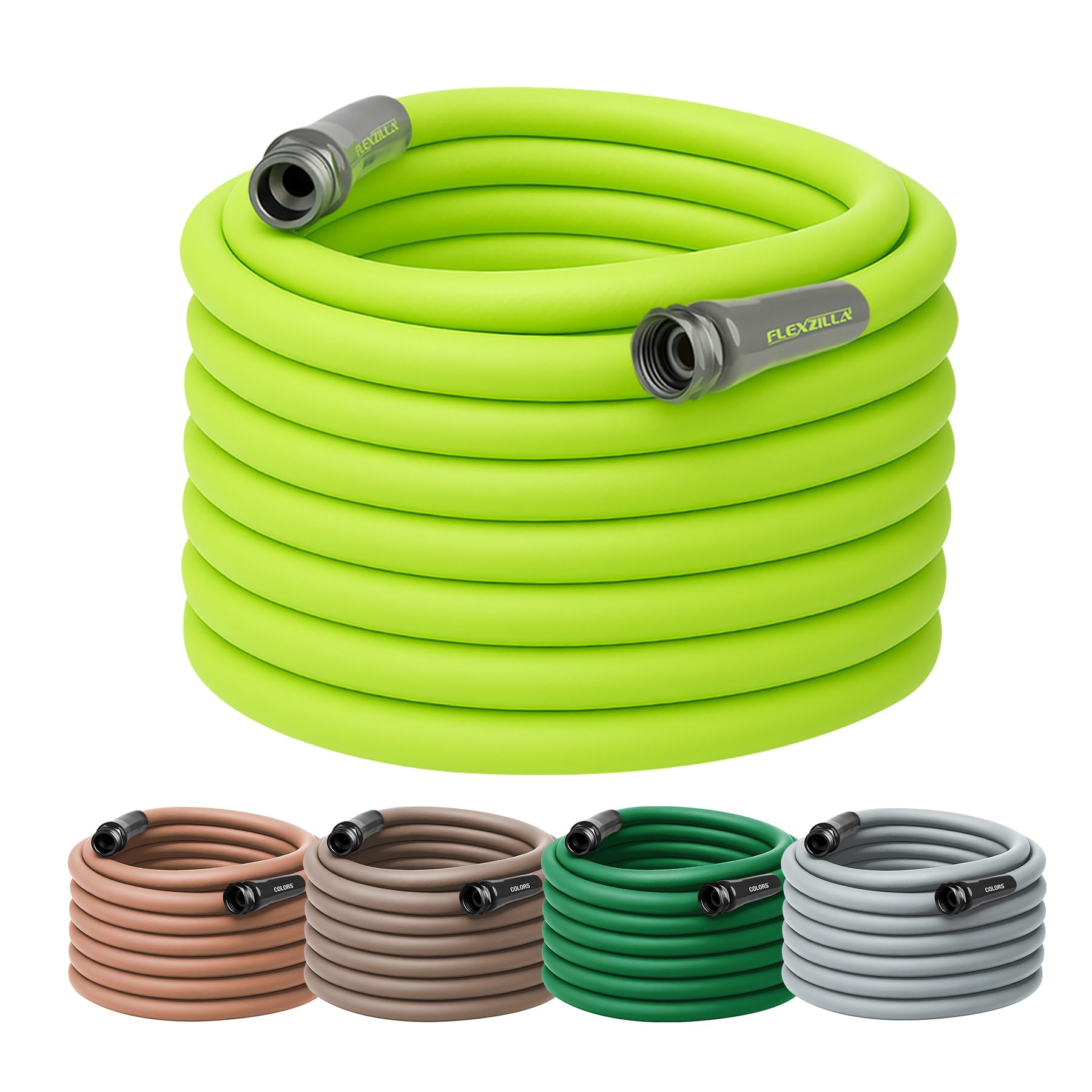
Chartreuse is not a subtle color for a garden hose, and after a season of walking past it we are sold: you can see this thing from the back step, so you do not trip over it and you do not leave it lying in the grass. It is also the lightest way here to move water 100 feet — 6.8 pounds for the whole run, light enough to lift with one hand while you carry a watering can in the other.

Hybrid polymer is why. It lays flat straight out of the coil, it does not take a set, and it stays soft when the temperature drops, which is more than the vinyl hoses manage. Against the rubber Briggs it is a far easier hose to live with day to day: you give up some of that tank-like build and get a hose you will drag to the far bed without thinking about it.

The 150 psi rating is generous for a household tap, and the limited lifetime warranty is the longest coverage in this group. Ours lives on a hanger and gets coiled loosely, which is where a soft hose behaves best. The fittings are aluminium rather than brass, so lift the coil and carry it to the spigot instead of hauling a full hose by the nozzle — that one habit is the difference between a hose that lasts and one that does not.

Bottom line: The long hose we hand to anyone with a big yard: 100 feet you can lift with one hand, as long as you treat the ends kindly.

5

Teknor Apex Zero-G

Teknor Apex Zero-G

Pots and patios

Our Score 8.6/10
Check Price

Worth Noting

  • Fifty feet only, so it is a pots-and-patio hose
Length
50 feet
Weight
4.3 lb
Water Use
Drinking-water safe
Maximum Pressure
600 psi
Read the full review

The Zero-G is the hose we reach for when we are watering pots rather than a lawn. It weighs 4.3 pounds, it coils small enough to hang on a hook by the back door, and it does not fight you when you pull it around a corner. That is why it stays on the spigot instead of going back in the shed.

Teknor's kink-free design earns its keep in the ordinary cases — a loop dropped on the patio, a pass around a rose bush — and it recovers faster than the rubber hoses here. The 600 psi rating is far more than a household tap will ask of it, the couplings are crush-resistant brass rather than crimped aluminium, and it is rated drinking-water safe, which is rare enough in this group to be worth naming.

The five-year warranty is the second-longest coverage here, behind only the Flexzilla's lifetime term. The maintenance that matters is at the tap: a spent washer has this hose dripping down the wall by midsummer, so keep a few spares and swap them each spring. Do that and it earns its place by being the hose you do not mind carrying.

Bottom line: For pots, patios, and a hose you want to leave out, we take the Zero-G: light, kink-resistant, and safe to drink from.

6

KETTOYA 100 ft

KETTOYA 100 ft

Light 100-footer

Our Score 8.6/10
Check Price

Worth Noting

  • Thin inner tube can split with rough handling
Length
100 feet
Nozzle
10 patterns
Fittings
3/4-inch swivel
Included
Hose, nozzle, storage strap, sealing rings, thread tape
Read the full review

The box is the first clue that KETTOYA thought about the fiddly parts: a ten-pattern thumb-control nozzle, a velcro storage strap, spare sealing rings, and a roll of thread tape all come with the hose. For a first hose, that is most of a starter kit.

The hose itself is a fabric-covered, non-expanding 100-footer that weighs a fraction of a rubber hose of the same length — light enough that hauling the coil across a yard is not a chore. The swivel connectors at both ends do real work too: the hose hangs straight instead of twisting itself into a rope.

Where we are cautious is longevity. The inner tube is thin — that is how you get this much length at this weight — and thin tubes are the ones that split. Ours has been fine kept on its strap, off the ground, and drained after use; that routine is the price of the light weight. This is a hose for a careful owner with a long reach to cover, not for dragging around a corner on concrete every day.

Bottom line: A lot of light reach for the money, and a sensible first hose — as long as you store it off the ground and skip the concrete drags.

7

Giraffe Tools 100 ft

Giraffe Tools 100 ft

Big flat yards

Our Score 8.6/10
Check Price

Worth Noting

  • 14.7 pounds before the water goes in
  • Twists and kinks when coiled by hand
Length
100 feet
Weight
14.7 lb
Warranty
2-year limited
Maximum Pressure
150 psi
Read the full review

Giraffe puts a swivel grip at each end, and it is the detail we appreciated most at setup: you can spin the collar onto a spigot by hand without the hose twisting behind you. The polymer jacket resists abrasion and UV, and the hose is rated to 150 psi with a two-year warranty behind it.

At 100 feet it covers a big lot, and the 5/8-inch bore keeps a usable stream at the far end. It is a hybrid, so it stays soft when the temperature drops — a hose left out in October still bends in November instead of going stiff.

The weight is the catch. Giraffe lists 14.7 pounds, more than twice the 100-foot Flexzilla and over three times the 50-foot Zero-G, and you feel every bit of it when the hose is full and you are pulling it around a corner. It also twists on itself when you coil it by hand, so the end of the day takes longer than it should.

Why include it, then? Because a 100-foot hybrid with swivel ends and a UV-resistant jacket is a sensible thing to leave on a reel at the side of a large, flat yard, and at this price it covers ground the lighter hoses cannot reach in one run. Buy it for the coverage, set it up on a reel from day one, and the weight stops being a daily argument.

Bottom line: A hundred feet of soft, UV-resistant hose for a big flat yard — plan on a reel, because it is heavy once the water is in it.

8

YAMATIC 75 ft

YAMATIC 75 ft

Mid-size yards

Our Score 8.6/10
Check Price

Worth Noting

  • Twists and fights the coil at day's end
Length
75 feet
Fittings
Brass 3/4-inch
Maximum Pressure
600 psi
Temperature Range
25° to 140°F
Read the full review

The temperature range on the YAMATIC — 25 to 140 degrees Fahrenheit — means nothing until you are outside in a cold drizzle. The hybrid polymer stays workable at the low end, which is more than the vinyl hoses manage when they have been left out overnight.

It is a 75-footer with solid brass 3/4-inch fittings, a 600 psi burst rating, and a bright orange jacket you can spot in long grass. Seventy-five feet is an awkward length to shop for and, for a lot of yards, exactly right: enough to reach the back fence without 25 feet of hose coiled at your feet.

Handling is where our enthusiasm cools a little. Pulled out straight it is soft and light and delivers a strong stream; coiled by hand at the end of the day it has a mind of its own and takes a couple of tries before it lies flat again. A reel solves most of that.

None of it is disqualifying. If your spigot sits roughly seventy feet from where you water, this lands between the 50-foot hoses and the 100-foot ones without the weight of either, and brass fittings plus a cold-weather polymer are the right ingredients for a hose that stays out all year. Give it a reel and it is a quiet, useful buy.

Bottom line: A sensible 75 feet for a mid-size yard, with brass fittings and a polymer that shrugs off cold mornings — best kept on a reel.

How We Chose and Tested These Garden Hoses

We started with the hoses that come up again and again in customer reviews and on garden center shelves — standard vinyl, rubber, and hybrid constructions in the common lengths and diameters — then filtered by coupling material, warranty, and price so we weren't comparing a 25-foot lightweight hose against a 100-foot contractor model. That left 12, which we ran through a full growing season of roughly seven months, from the first planting weekend to the first freeze.

Each hose lived on a real spigot rather than a test bench. We dragged them around the corners of the house and across a gravel path, watered raised beds and hanging baskets, filled a kid's pool, and rinsed off the driveway after a muddy weekend. We weighed every hose dry and then again full of water, since one that feels featherlight on the shelf can turn into dead weight by the time you've hauled it 40 feet.

To judge kinking honestly, we didn't just yank — we walked each hose around the same sharp corner and noted whether it folded, kinked, or sprang back once the water was shut off. We checked every connection at the spigot and at the nozzle after pressurizing, watching for drips on the threads and around the collar. Several hoses stayed out in full sun for weeks so we could see how fast the color chalked or faded, and at the end of the season we coiled each one cold to see which went back neatly and which fought back, which is usually where value reveals itself.

How to Choose Garden Hoses

Buy the shortest hose that reaches

Every extra foot is more weight to drag and more friction between the tap and the nozzle, so the right length is the shortest one that reaches your furthest bed with a little slack. Walk the route rather than estimating it: spigot to back fence, around the shed, plus a few feet for the sprinkler. A 50-foot hose like the Briggs & Stratton suits a small, fenced yard; a 100-footer like the Flexzilla only earns its length if you actually water that far. A hose that is too long gets coiled at your feet, and that loose pile is exactly where it kinks.

Weight decides how often you water

Water is heavy, and a hose gets heavier as it fills. The spread here is wide: 4.3 pounds for the 50-foot Zero-G, 6.8 for the 100-foot Flexzilla, and about ten pounds for the 50-foot rubber Briggs. Rubber and hybrid hoses feel different in the hand as well — a stiff hose drags at the shoulder where a soft one follows. If you carry the coil around the house, weight comes first and a light hybrid or steel hose earns its place. If the hose lives on a reel, buy for durability instead, because you are not lifting it.

What kink-free really means

No hose here is kink-proof. What varies is memory: a hybrid or a steel-sleeved hose lays flat out of the coil and does not hold a bend, while rubber stays supple but keeps the shape you leave it in. Most kinks come from storage rather than use — a tight loop on a hook puts a permanent bend in the same spot, and that is where the flow stops. Coil it loose and wide, use a reel, and pick a steel sleeve if you drag around tight corners all season.

Fittings and washers cause most leaks

A drip at the spigot is usually a washer problem, not a dead hose. Rubber washers flatten over a season, and a collar cranked down with a wrench deforms the very seal it is meant to protect. Brass and nickel-plated couplings survive being dropped and cross-threaded; aluminium is lighter and softer; plastic eventually cracks. Seat the washer square, tighten by hand plus a quarter turn, and keep spares in the shed. On a metal hose, check the crimp at both ends each spring — that joint, not the sleeve, is what fails.

Winter, sun, and getting more than a season

Most hoses do not wear out, they get killed. Water left in the tube through a freeze expands and splits it, and a hose left pressurized in summer sun suffers in the same way. Coil it, drain it, hang it out of direct sun, and disconnect it from the spigot before the first hard frost. Cold flexibility matters if you water late in the year: the hoses here rated for it, from the Flexzilla's soft compound to the YAMATIC's 25-degree low end, still unroll in November. The stiff ones need to come indoors.

Frequently Asked Questions

Final Verdict

After a season of dragging hoses around, the Briggs & Stratton is the one we recommend without hedging: brass ends, real rubber, and the only durability story in this group that comes out positive. If 50 feet will not reach your back beds, the Flexzilla gives you twice the length at about two-thirds the weight, and if the budget is tight, the Unywarse is the steel hose to start with.

Buy for your longest run rather than for the shelf. A hose that reaches everything and weighs nothing does not exist, so pick the compromise you can live with every time you turn the tap.