Watering & Irrigation

Best Garden Hose Connectors of 2026

There's a specific frustration that shows up on the first warm Saturday of the season: you screw on the sprayer, turn the spigot, walk twenty feet of hose, and feel cold water hit your ankles a half-second before you hear the pop. The fitting let go. A garden hose connector is a cheap, unglamorous part that decides whether watering is pleasant or a soaking — and when the bore is too narrow or the threads don't seat, it quietly strangles your water pressure too. Get the right one and you stop thinking about it: no drip at the joint, no wrestling match when you swap nozzles, no surprise shower.

The thing most first-time buyers miss is that "universal" usually means "fits most 3/4-inch outdoor threads," and quick-connect fittings only play nicely with their own family, so a mixed drawer of them will fight you. My team and I spent five months with 16 connectors on spigots, sprinklers, and wands, and the ones that lasted share a few unglamorous traits. Whether one suits you comes down to a permanent brass fitting or a quick-swap system — both are below.

1

RAINPOINT 2-Way Splitter

Top Pick
RAINPOINT 2-Way Splitter

Two-hose spigots

Our Score 9.4/10
Check Price

Worth Noting

  • Priciest splitter in this group
  • Bulkier at the spigot than a plain Y
Valve
Stainless steel ball
Thread
3/4" GHT Thread
Handles
1.9 in metal
Pressure Rating
200 PSI
Read the full review

Handles are what sold us. At 1.9 inches, the levers on this splitter are roughly twice the length of the stubs on a cheap Y, and the arc shape lets you push with the flat of your hand instead of pinching. On a spigot down behind the shrubs, that is the difference between a two-second job and a wrestling match — and in gloves, it is the difference between shutting off one line and giving up and shutting off both. Under the handles sits a full-port stainless ball valve, so two sprinklers still run at the pressure they get from a single connection.

The body is metal wrapped in TPR rubber, 0.8 lb in the hand, and the chunky casting gives you something to hold when you snug the inlet down on the spigot. The outlet threads are cut to lock the hose end against twisting, which matters more than it sounds when you drag a full hose around a corner. Ours went on without tape and stayed dry through a full watering season.

The catch is price: this is the most expensive splitter in the group by a clear margin, and if you are splitting one spigot for a season, that is hard to justify when the Morvat does the basic job in brass for less. It is also a bigger lump at the faucet than a plain Y, which matters if your spigot sits close to a wall or under a low cover. For the spigot you use every day, the handles and the sealing are worth the premium.

Bottom line: We recommend the RAINPOINT for anyone tired of fighting stiff levers on a wet spigot: long metal handles, full-port flow and the cleanest sealing record of the splitters here.
2

Hourleey Hose Coupler

Hourleey Hose Coupler

Joining hose ends

Our Score 9.4/10
Check Price

Worth Noting

  • Drips once the washer wears
Pack
2 couplers, 4 washers
Thread
3/4 in GHT, female both ends
Material
Solid brass
Read the full review

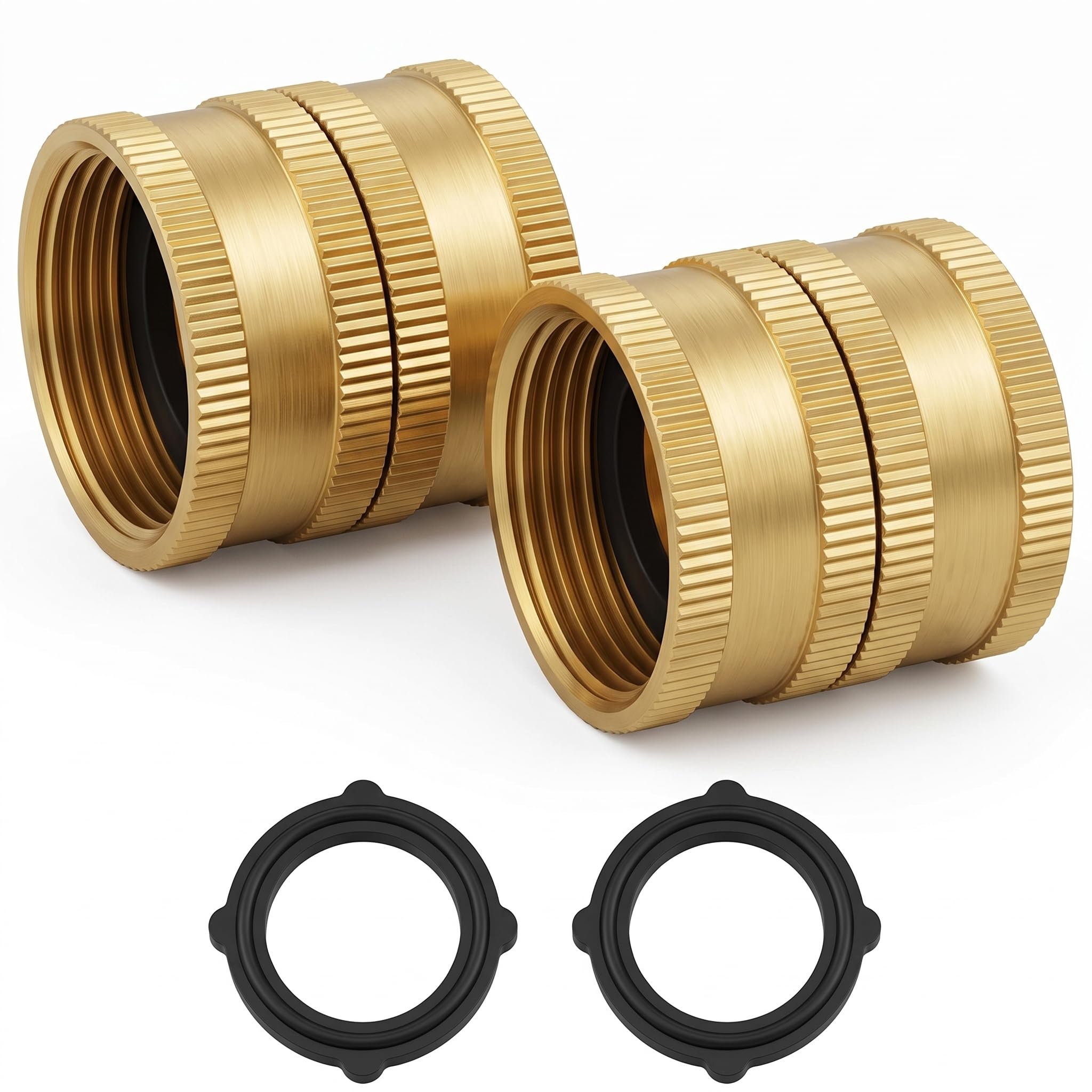
Hose reels are the usual culprit. The leader on a reel often ends in a male thread, and so does the hose you want to attach, and no amount of twisting gets you anywhere. A double-female coupler is the whole answer: 3/4-inch female thread on both ends, solid brass, and small enough to leave on the hose when you coil it.

What we appreciated most is that each end rotates independently. That sounds like a detail until you are joining two stiff hoses that both want to lie their own way — the collars let each half find its thread without the hose coiling against you. The brass is solid and machined cleanly, the opposite of the gold-tinted fittings that strip on the first tighten, and the pack carries four spare washers for the part that gives out first.

The joint is only as good as the hose end you give it. A clean, square cut seats reliably; a ragged, swollen end from a hose left out all summer will find the thread and still weep. Two in the pack is the right count — one to use, one for the drawer — and the brass is the reason to keep them rather than replace the hose.

Bottom line: Buy this when two male hose ends will not meet: solid brass, two in the pack with spare washers, and the simplest fix for a reel that will not reach.

3

M MINGLE Adapter 4-Pack

M MINGLE Adapter 4-Pack

Mixed hose repairs

Our Score 9.2/10
Check Price

Worth Noting

  • Short male ends need a clean, square hose cut
  • Female couplers weep if the washer sits crooked
Pack
4 adapters, 4 washers
Thread
3/4 in GHT
Material
Solid brass
Configuration
2 male-male, 2 female-female
Read the full review

Two male and two female couplers in one bag is the right way to buy a spare. You cannot predict which end you will be short of — a stripped male thread on a reel, an accessory with a female inlet, a hose that needs extending from the wrong side — and this pack covers both directions without a second order. We reached for the male-male first; the swivel females are what make the pack worth keeping.

Brass throughout, 3/4-inch GHT, with four extra washers in the bag. The female couplers swivel, so they thread onto a hose end without the hose fighting back, and the threads are cut cleanly enough that they start by hand. Weight is reassuring without being clumsy at the end of a hose.

For a household with two or three hoses and a reel, this is the pack to buy before the day it is needed. If you already know exactly which adapter is missing, buy that one instead — the value of a four-pack is in covering the join you have not hit yet.

Bottom line: The pack we keep in the shed: two male and two female couplers solve a hose join in either direction, so the mismatch that stops watering never becomes a trip to the store.

4

HQMPC Quick-Connect Set

HQMPC Quick-Connect Set

Frequent swapping

Our Score 9.2/10
Check Price

Worth Noting

  • Hard to justify for one hose and nozzle
Material
Solid brass
Warranty
3 years
Configuration
6 male, 6 female
Pressure Rating
200 PSI
Read the full review

Six matched pairs is what you are buying here: six male nipples, six female couplers, four spare washers and a three-year warranty. That is enough to put a nipple on every nozzle, sprinkler and hose end you own, with a coupler on the spigot and one left in the drawer.

What quick-connects change is the order of operations. Instead of threading a wet nozzle onto a wet hose end with the water running, you snap one off and the next one on with a single hand. We found the collar is what decides whether that stays easy, and brass is the material that does not seize the way aluminum does after a couple of seasons of wet handling. The 200 PSI rating sits well above household pressure.

If you have one hose and one nozzle, this set is more than you need, and the aluminum Twinkle Star set below covers that job for less. Where it earns its money is a shed with several hoses, a pressure washer and a pair of sprinklers all swapping on the same spigot. The sleeve and its O-ring are the parts that wear; when one pair starts to weep, swap it for another from the set rather than wrenching it tighter.

Bottom line: The set to buy if you swap nozzles and sprinklers all season: six brass pairs that click on and off, in a metal that does not stiffen the way aluminum does.

5

Morvat Brass Splitter

Morvat Brass Splitter

Budget brass splitter

Our Score 9.2/10
Check Price

Worth Noting

  • Valves are stiff for the first few uses
Thread
US standard NH 3/4 in
Valves
2 independent shut-offs
Material
Brass
Warranty
1 year
Read the full review

Everything the RAINPOINT charges a premium for, the Morvat gives you in brass for less: a Y body, two separately controlled ball valves, a hexagonal top connection that takes a wrench when the swivel sticks, and a one-year warranty. Eight ounces of metal, which we found hangs off a spigot without sagging.

The valves are the difference you notice daily. They shut off cleanly and independently, so one line keeps running while you work on the other, and the 360-degree swivel on the inlet lets the whole splitter settle square to the wall instead of fighting the hose. The seal at the inlet wants a firm hand rather than a gentle one; the tape in the box is there for a spigot with worn threads.

The bigger caveat is longevity, and it is why this sits below our top pick. The inlet thread is where these split when they do, so treat the swivel as the fragile end and do not let a full hose hang off it.

Bottom line: Full brass and two independently controlled outlets for less than our top pick — the splitter we point people to when the budget is real but plastic is not an option.

6

Xiny Tool Shut-Off Valve

Xiny Tool Shut-Off Valve

Hose-end shutoff

Our Score 9.2/10
Check Price

Worth Noting

  • Narrows flow, so no good ahead of a sprinkler
Extras
4 spare washers
Thread
3/4 in
Material
Brass body, plastic handle
Configuration
4 shut-off valves
Read the full review

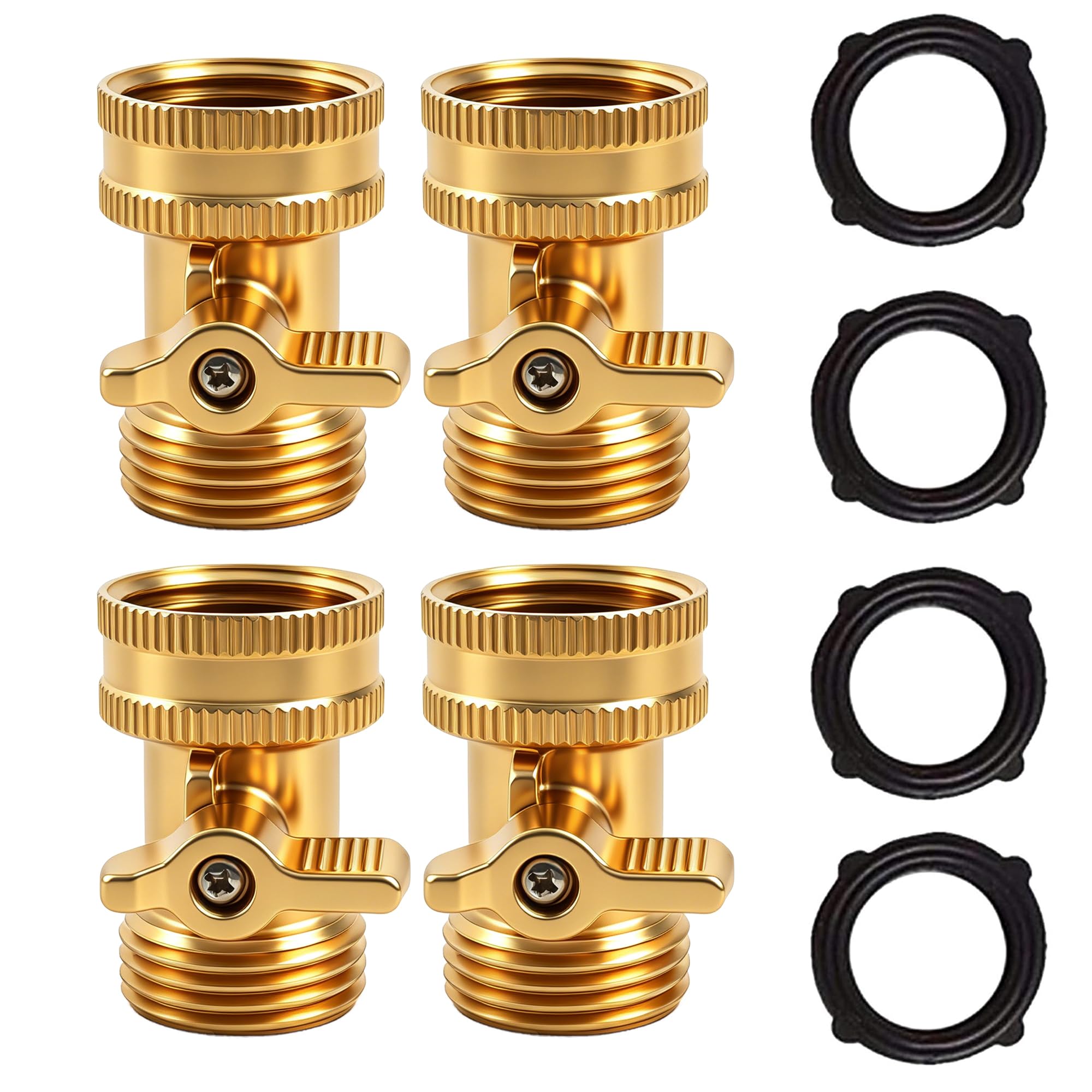
The point of a hose-end valve is to stop walking. Screwed on between the hose and the nozzle, one of these kills the water at your feet, lets you swap the nozzle for a brush, and opens again — no trip back to the spigot, no wet trail through the bed.

Four valves in the pack, brass bodies, a washer in each and four spares besides, so a two-hose garden and an RV line all get one. The lever is a wide plastic paddle rather than a small brass ball handle, which is comfortable on wet hands and easy to find by feel when you are crouched under a shrub. The body is compact enough to hang off a hose end without dragging it down.

Where we reach for these is the end of a hose feeding a hand nozzle, a brush or a mister, and on both ends of a run you do not want to walk twice. There is nothing delicate about them; they are the fitting you leave on and forget. Buying four means one on every hose, which beats a single good valve you keep moving from hose to hose.

Bottom line: A four-pack of brass shut-offs that puts the tap where you are standing, so you stop walking back to the spigot every time you switch attachments.

7

Twinkle Star Quick Connect

Twinkle Star Quick Connect

Light-duty setups

Our Score 9.0/10
Check Price

Worth Noting

  • Release sleeve is stiff when new
Pack
4 pairs, 4 washers
Fitting
3/4 in quick connect
Material
Aluminum
Read the full review

Aluminum, not brass, and that is the trade this set makes. The first thing we noticed is how little they weigh on the end of a hose, which is genuinely pleasant; the second is that aluminum is the material that corrodes and stiffens at the collar after a season or two of wet handling. The price reflects both.

What you get is four female couplers, four male nipples and four spare washers — enough to convert a hose and a few accessories, or two hoses at a push. Push, click, done. Swapping a sprinkler for a spray nozzle takes a second and one hand, which is the entire argument for quick-connects over threads.

Two things to know before you buy. These are not valves, so water flows the moment you disconnect — shut off at the spigot first unless you fancy a soaking. And the seal lives on the rubber washer, so keep the spares with the fittings instead of in a drawer, because a missing washer turns a click-fit into a fountain.

For a first set on a couple of hoses, this does the job at a price that makes trying them painless. If your fittings live outdoors all year and you hate replacing them, put the money into the brass set instead.

Bottom line: The cheapest route to one-hand nozzle swaps: four aluminum pairs that click on and off, best for a couple of hoses and light use.

How We Tested the Best Garden Hose Connectors

We narrowed the field to 16 connectors — brass, composite, and plastic, quick-connect and threaded — after sorting through spec sheets and customer reviews to find the models that kept coming up as leak-free and the ones that kept coming up as cracked by August. Anything that wouldn't fit a standard 3/4-inch outdoor thread got cut, and we passed on decorative options that cost more without adding metal.

Testing ran from May through September, across a vegetable bed, two lawn sprinklers, and a driveway that gets washed more often than it needs to. Each connector went onto a spigot and a 50-foot hose, and we ran full pressure for ten minutes with a dry paper towel wrapped around the joint — any dark patch counted as a leak. We timed hookups with wet hands, then dragged the hose around a corner and dropped each fitting on the concrete to see what happened to the collar and the O-ring.

For water flow, we filled a five-gallon bucket through each connector and compared it against the bare hose, so a narrow bore showed up as a slower fill rather than a guess. Disconnection got tested the way it actually happens: end of the day, one hand, hose still pressurized, nozzle in the other. Because these live outdoors, we left the survivors attached through rain and heat and checked monthly for stiffness, green crust, and anything gone brittle. Value came last, with each price weighed against what the fitting looked like in September — the only honest way to judge a five-dollar part.

How to Choose Garden Hose Connectors

Match the thread before anything else

Nearly all US garden hoses and spigots use 3/4-inch garden hose thread, printed as GHT or NH. The trap is that a plumbing-aisle 3/4-inch fitting is usually national pipe thread — the same diameter, a different pitch — and it will start on a hose end and then weep no matter how hard you lean on it. Look for GHT or NH on the label, not just the number.

If your spigot is not a standard hose thread, buy one adapter for it and leave that adapter on permanently, so everything else you own stays standard.

Brass, aluminum or plastic

Brass is the material that lasts. It does not seize at the collar, it shrugs off sun and frost better than the alternatives, and a brass Y is the fitting you stop thinking about; it is also heavier and more expensive, which is why both of our splitter picks are brass or metal-bodied. Aluminum is lighter and cheaper and perfectly adequate for a couple of hoses you bring in each winter, but it is the metal that corrodes and stiffens where it is handled wet.

Plastic is a stopgap. A UV-exposed plastic splitter or valve eventually cracks, usually right at the thread where you cannot see it starting.

The washer does the sealing

Every fitting here seals on a flat rubber washer, not on the threads, so the condition of that washer is the difference between a dry joint and a drip. Check that it sits square in its recess before you tighten anything, and replace any washer that has gone hard, split or doubled up — two washers seal worse than one, not better.

Buy packs that include spares, since several here ship with four. Hand-tight plus a quarter turn is enough; forcing a fitting to stop a leak usually distorts the washer and makes the drip worse.

Match the fitting to the job

A coupler joins two hose ends and is only needed when both ends are the same gender. A splitter turns one spigot into two controlled outlets. A quick-connect set replaces threading with a click. A shut-off valve puts the tap at your feet. None of them is a universal upgrade — buy the one that matches the annoyance you actually have.

Watch the bore on anything with a valve in it. A ball valve the width of a pencil will strangle a sprinkler or a soaker line even when it is fully open, though it is perfectly fine feeding a hand nozzle.

Frost and sun finish more fittings than wear does

Water left inside a fitting expands when it freezes, and brass splits at its thinnest section, usually the inlet thread. If your spigot is frost-free, disconnect everything for the winter; if it is not, do it before the first hard frost. Sun is the slower problem: it hardens rubber washers and makes plastic brittle.

A minute with a wrench in October is cheaper than a new splitter in May.

Frequently Asked Questions

Final Verdict

If we were buying one fitting this weekend, it is the RAINPOINT. The long handles and the full-port valve are the two things you feel every time you water, and it has the most consistent record on sealing of anything here. Where it does not fit is a tight budget or a spigot shoehorned under a bush: the Morvat gives you brass and two independent valves for less, and the Hourleey coupler solves the narrower problem of joining two hose ends.

Start with the job you actually have, and put the money into brass anywhere the fitting stays outdoors all year.