Tree & Forestry Care

Best Forestry Helmets of 2026

Forestry work has a way of reminding you that safety gear is not decorative. A limb under tension, a saw that kicks back, a branch that drops faster than you expected—the helmet is the one piece of kit that has to work the first time, every time. But a helmet that fights your head, fogs up, or leaves your ears ringing after an hour is a helmet you'll stop wearing.

That's the balance we went looking for: real protection, a fit you can forget about, and build quality that survives more than one season. Over the past eight months, I've put a dozen forestry helmets through storm cleanup, firewood cutting, and trail maintenance on a wooded property—not just in a workshop. The best ones share a simple trait: the suspension, ear muffs, and face shield all feel like one system, not three parts bolted together. Below are the ones that earned a spot on the hook by the door.

1

Pfanner Protos Integral Arborist Helmet

Top Pick
Pfanner Protos Integral Arborist Helmet

Full-time climbers

Our Score 9.6/10
Check Price

Worth Noting

  • Heaviest helmet in this group at 3.9 pounds
Vents
Adjustable, open or closed
Weight
3.9 lb
Coverage
Top, side and rear
Certification
EN 397 and EN 12492
Read the full review

Side and rear coverage is the phrase that separates this helmet from everything else on this list. A chainsaw helmet is built to take something falling on the crown; the Protos is shaped to shrug off a hit from the side as well, which is where a limb swings when you're up in the tree and where ordinary hard-hat protection is thinnest.

The whole system runs off two fingers, which stops being a small thing the first time you're 40 feet up with gloves on. The ear muffs click out and swing back inside the shell so they don't snag on brush, the vents open and close for airflow, and the swept-back profile keeps your upward view clear when you're sizing up the next branch.

The adjustment is the learning curve. It's a fiddly system the first afternoon — plan a session with it on the ground rather than on the job — and after that we didn't touch it again. Every part is replaceable, including the muffs and the visor, which is what you want from a helmet that's meant to be worn every day.

For a climber or a full-time arborist, that's a fair trade for the coverage. For a homeowner cutting firewood twice a year, it's a lot of money for protection you're unlikely to need. And if you work to a US site requirement, confirm the European rating satisfies it before you spend — the hard-hat certification here is EN, not Z89.1.

Bottom line: The helmet we point climbers to: side and rear coverage, two-finger operation with gloves, and a fit that disappears once it's dialed.
2

Green Devil 4-in-1 Forestry Helmet

Green Devil 4-in-1 Forestry Helmet

Glasses wearers

Our Score 9.4/10
Check Price

Worth Noting

  • Instructions are thin for first assembly
Included
Helmet liner and drawstring bag
Suspension
6-point adjustable
Certification
ANSI certified
Face Protection
Metal mesh shield plus built-in retractable eyewear
Read the full review

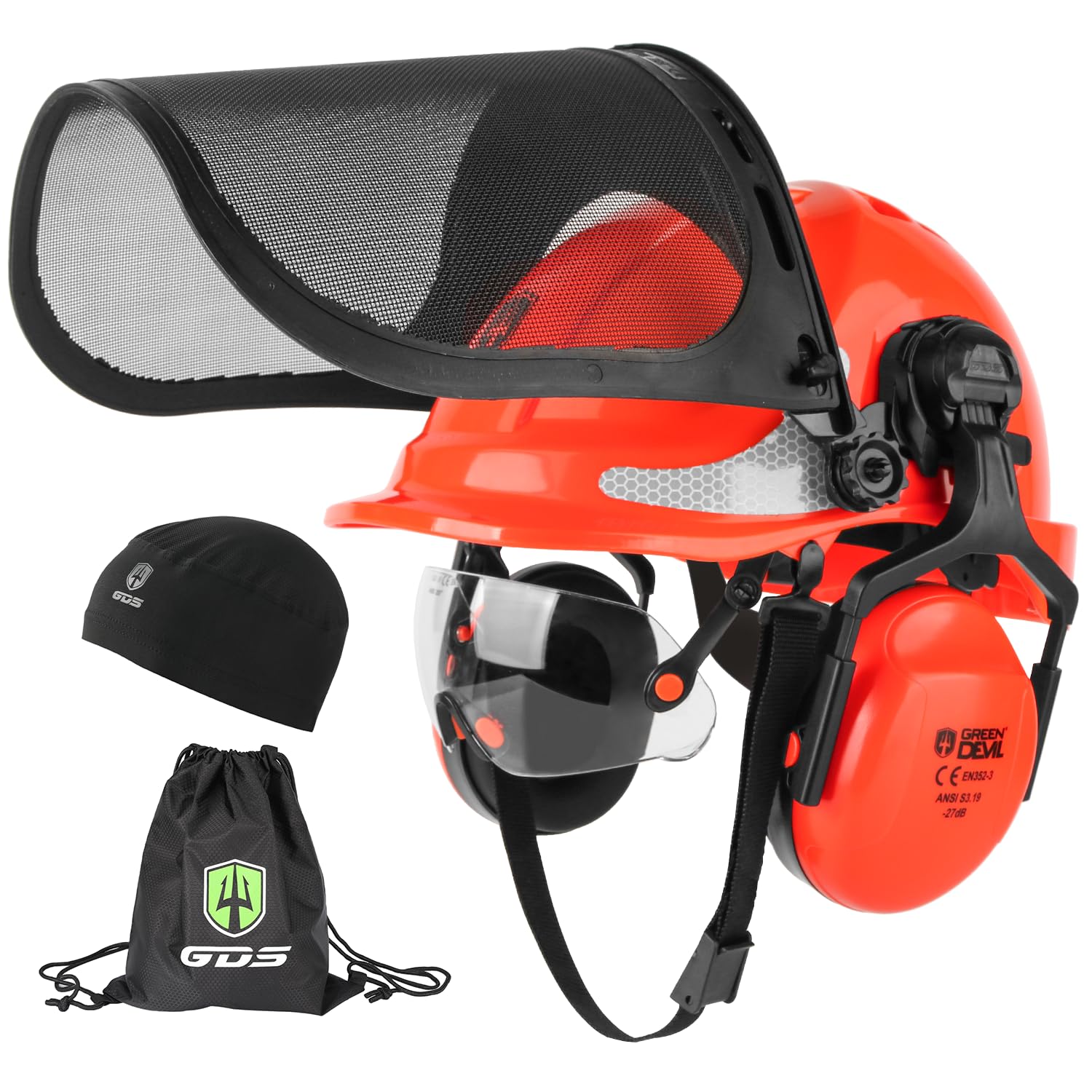
Built-in safety glasses sound like a gimmick until you've spent ten minutes patting your pockets for the pair you set down somewhere in the brush. This shell carries its own retractable eyewear behind the mesh visor, so eye protection is there every time you pull the helmet on — and the set lifts out entirely if you wear prescription glasses and would rather use those. That single detail is why we hand this one to anyone who spends the day with something on their face.

The rest of the kit holds up to that standard: six-point suspension with a rear knob, ear muffs that sweep back against the shell instead of dangling by your jaw, a washable liner that keeps the sweatband from going slick, and a drawstring bag so the mesh doesn't get crushed in a truck bed. Instructions are the weak spot — thin enough that the first build takes longer than it should, with the pivot tabs needing a firm push before they seat.

Bottom line: Our pick for anyone who wears glasses: the retractable built-in eyewear means eye protection lives on the helmet, not in a pocket.

3

NoCry 6-in-1 Forestry Helmet

NoCry 6-in-1 Forestry Helmet

Chainsaw work

Our Score 9.2/10
Check Price

Worth Noting

  • Chin strap needs two hands and a steady pull
Warranty
Limited lifetime
Suspension
6-point with rear ratchet dial
Face Shields
Metal mesh and clear polycarbonate
Certification
ANSI Z89.1 hard hat, S3.19 ear muffs, Z87.1 eye protection
Read the full review

Two shields in one box is the reason this kit covers more of the year than anything else here. The metal mesh doesn't fog and doesn't scratch, and it stops the chips that come off a chain at speed; the clear polycarbonate shield is the one for rain, fine grit, and the spray a string trimmer throws sideways. They swap rather than stack — you fit the one you plan to use that day — and the rest of the kit is certified on all three fronts that matter: head to ANSI Z89.1, eyes to Z87.1, hearing to S3.19.

Six configurations sounds like a brochure line until you're mid-job and want the muffs swung back against the shell to hear someone, or the visor pushed up to sight a notch. The rear dial turns easily with gloves on, the visor carriage adjusts for distance from your face, and the six-point harness spreads the load across the crown instead of laying a band over your forehead. Set it once and it stays where you put it.

What makes it our default is that nothing in the set feels like an afterthought — the shield pivots have firm detents rather than drooping into your eyeline, the muff seals actually close, and the shell is comfortable through a long afternoon. The one part that doesn't match the rest of the build is the chin strap.

The mesh is finer than most, which matters more than the size of the window: the small chips that slip through coarser screens stop here instead of landing on your eyelashes. It's also backed by a limited lifetime warranty, where the shortest coverage in this group is 90 days.

Bottom line: We recommend it as the default forestry helmet for most buyers: three certifications in one kit, a mesh and a clear shield, and a fit that stays put.

4

Oregon Chainsaw Safety Helmet

Oregon Chainsaw Safety Helmet

Occasional cutting

Our Score 9.2/10
Check Price

Worth Noting

  • Vented Class C shell, so no electrical rating
Weight
2 lb
Face Shield
Flip-up mesh visor
Ventilation
6 vent holes
Certification
ANSI Z89.1-2009 Type I, Class C
Read the full review

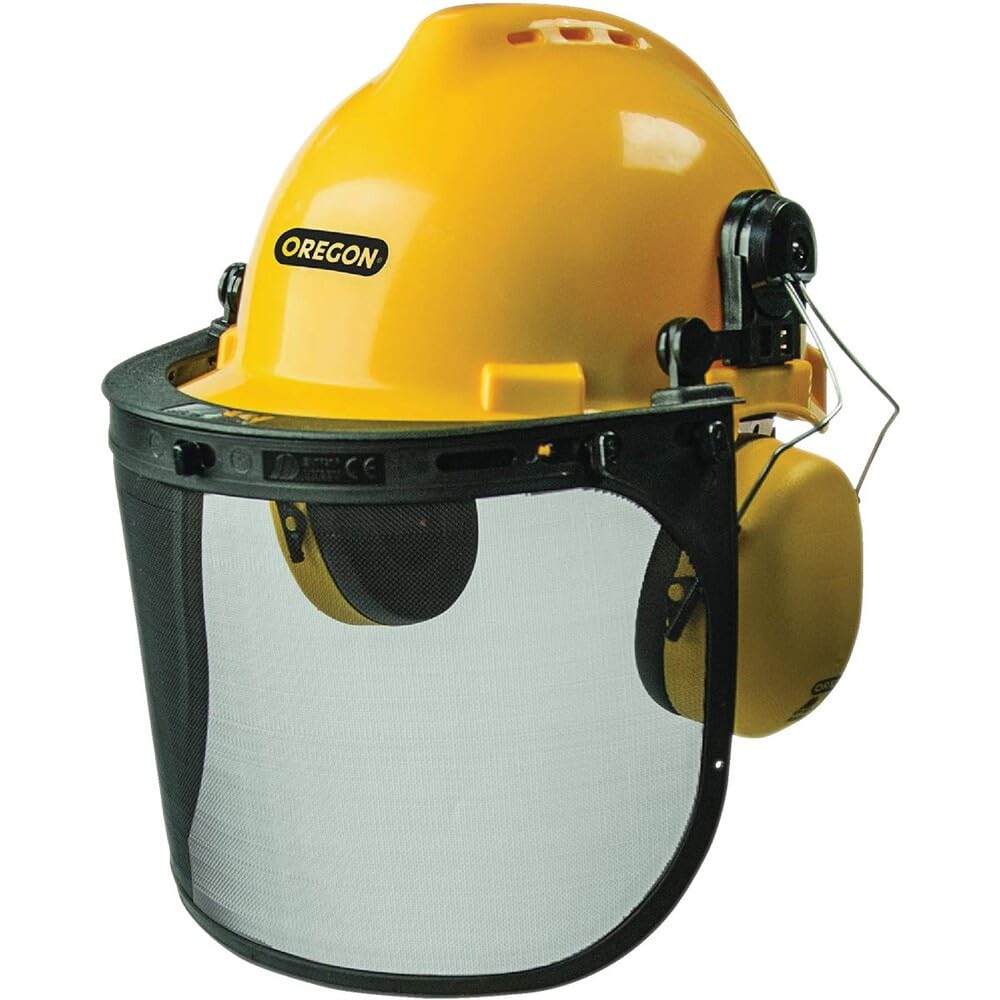
The least expensive helmet here is also the lightest full kit at 2 pounds, and that pairing is exactly why we keep recommending it to homeowners and weekend cutters. You get an ANSI Z89.1-2009 Type I Class C shell, a wide flip-up mesh visor, and cap-mounted ear cups that articulate out of the way — the three pieces of a forestry helmet, for less than anything else on this page.

The visor is the part we rate highest. It's a wide mesh screen that doesn't fog and doesn't scratch, and it has positive stops, so it stays parked where you put it instead of creeping down into your eyeline mid-cut. Six vents across the crown keep air moving, the sun peak comes off if you don't want it, and the headband ratchets out far enough for genuinely large heads.

What you give up is refinement. The plastic harness works but doesn't feel as planted as the six-point systems on the pricier helmets, and there's no clear shield in the box if you want one for grit and spray. For firewood, storm cleanup, and trimmer work, none of that reaches you.

Bottom line: The one to buy if you cut a few times a year: a certified shell, a flip-up mesh visor, and 2 pounds on your head for the lowest outlay here.

5

UltraMaxx 6-in-1 Chainsaw Helmet

UltraMaxx 6-in-1 Chainsaw Helmet

Complete starter kit

Our Score 9.0/10
Check Price

Worth Noting

  • Face shield is light and flexes easily
Weight
2.73 lb
Included
Mesh shield, goggles, liner, bag
Certification
ANSI Z89.1
Ear Muff Rating
31 dB SNR
Read the full review

Nothing else here arrives with as much in the box: the helmet, a metal mesh shield, a pair of anti-fog goggles, ear muffs rated 31 dB SNR, a cooling liner, and a drawstring bag. For a first forestry helmet, or for equipping a helper without a second shopping trip, that completeness is the whole pitch.

The shell has vents across the crown and a face shield that slides as well as flips, so you can set it at a height that blocks chips without cutting into your view of the cut. The rear tension knob is the quick-adjust type, and at a listed 1.24 kg the whole thing sits between the 2-pound Oregon and the 3.9-pound Pfanner on your neck.

The face guard is where it gives ground — light, and it flexes more than the shields on our top pick. For trimmer work and the occasional tree that's fine; push through heavy brush every day and the stiffer shields here will outlast it. For a complete, certified kit with a liner and a bag at this price, we think that's a trade most people should take.

Bottom line: The most complete kit here — helmet, muffs, mesh, goggles, liner, and bag — at a price that makes it an easy first forestry helmet.

6

Green Devil Bluetooth Forestry Helmet

Green Devil Bluetooth Forestry Helmet

Crew communication

Our Score 9.0/10
Check Price

Worth Noting

  • Ear cups can pop out of their sockets
Weight
3.5 lb
Ear Muffs
Bluetooth 5.3 with passthrough
Certification
ANSI certified
Face Protection
Built-in visor plus mesh shield
Read the full review

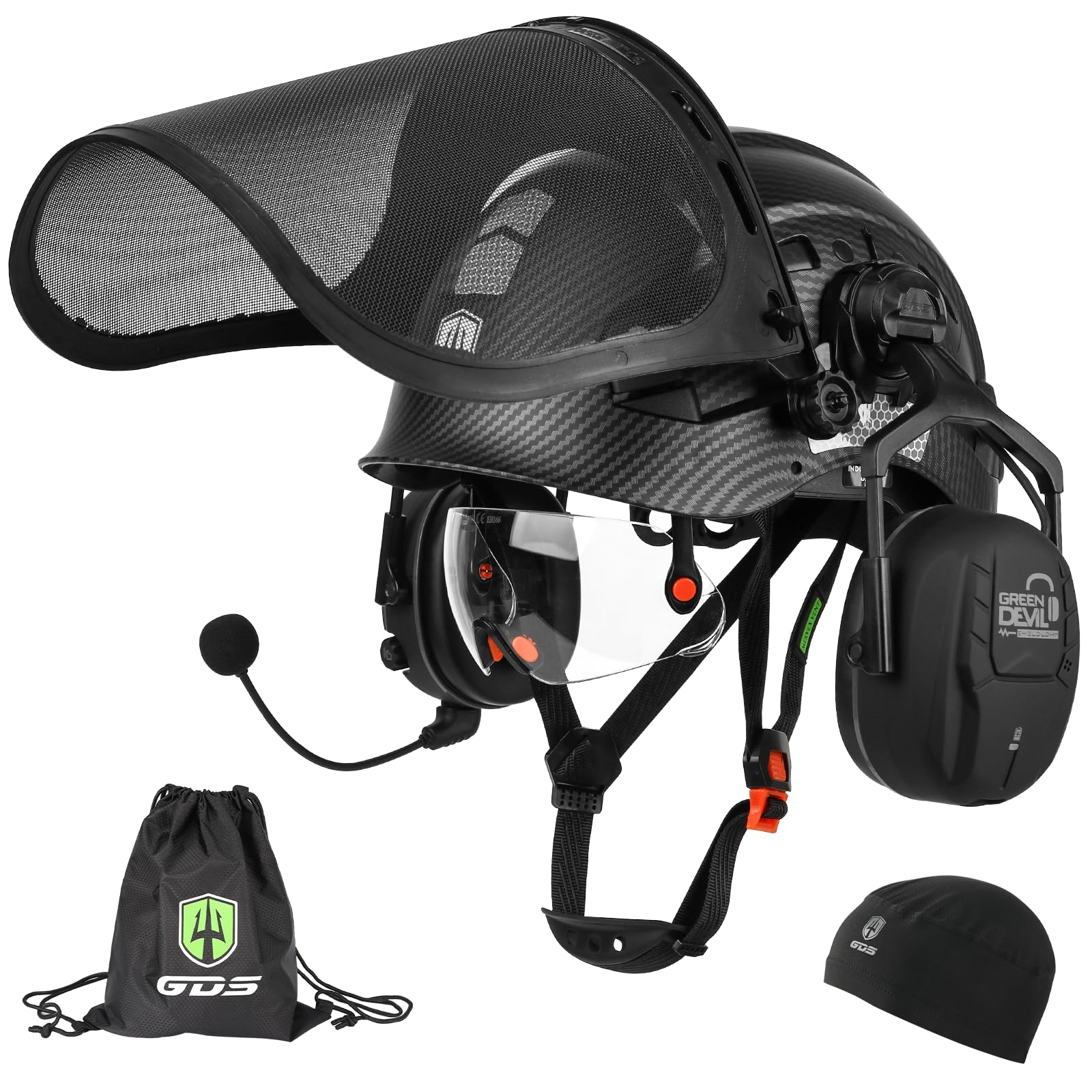
The passthrough is what sold us: the muffs stay sealed over your ears while a microphone feeds voices in, so you can catch a shout or a change in a machine's note without lifting a cup. Add music or a podcast and a long day of cutting gets considerably more bearable. Pairing is Bluetooth 5.3, and it holds the connection while you move around.

The muffs are the weak point. They sit on sockets rather than a fixed yoke, and they can pop out of those sockets when you pull the helmet on or off — the noise reduction is genuinely good once they're seated, but you'll be pressing them back in more often than you want to. At 3.5 pounds it's also the second-heaviest helmet here.

This is a specialist's purchase, and it's priced in premium territory. If you run a crew and communication is the bottleneck — no more walking to the far end of the landing to shout — it earns its keep. If you just want your head, eyes, and ears covered, the top pick does that for a fraction of the outlay.

Bottom line: For crews who need to talk more than they need the lightest helmet: passthrough audio, music, and full protection in one shell.

7

Tooliom 5-in-1 Chainsaw Helmet

Tooliom 5-in-1 Chainsaw Helmet

Adjustable sizing

Our Score 8.8/10
Check Price

Worth Noting

  • Plastic shield brackets crack if it's dropped
Weight
2.98 lb
Included
Clear shield, mesh visor, goggles
Head Size
52-64cm Adjustable
Certification
ANSI Z87.1
Read the full review

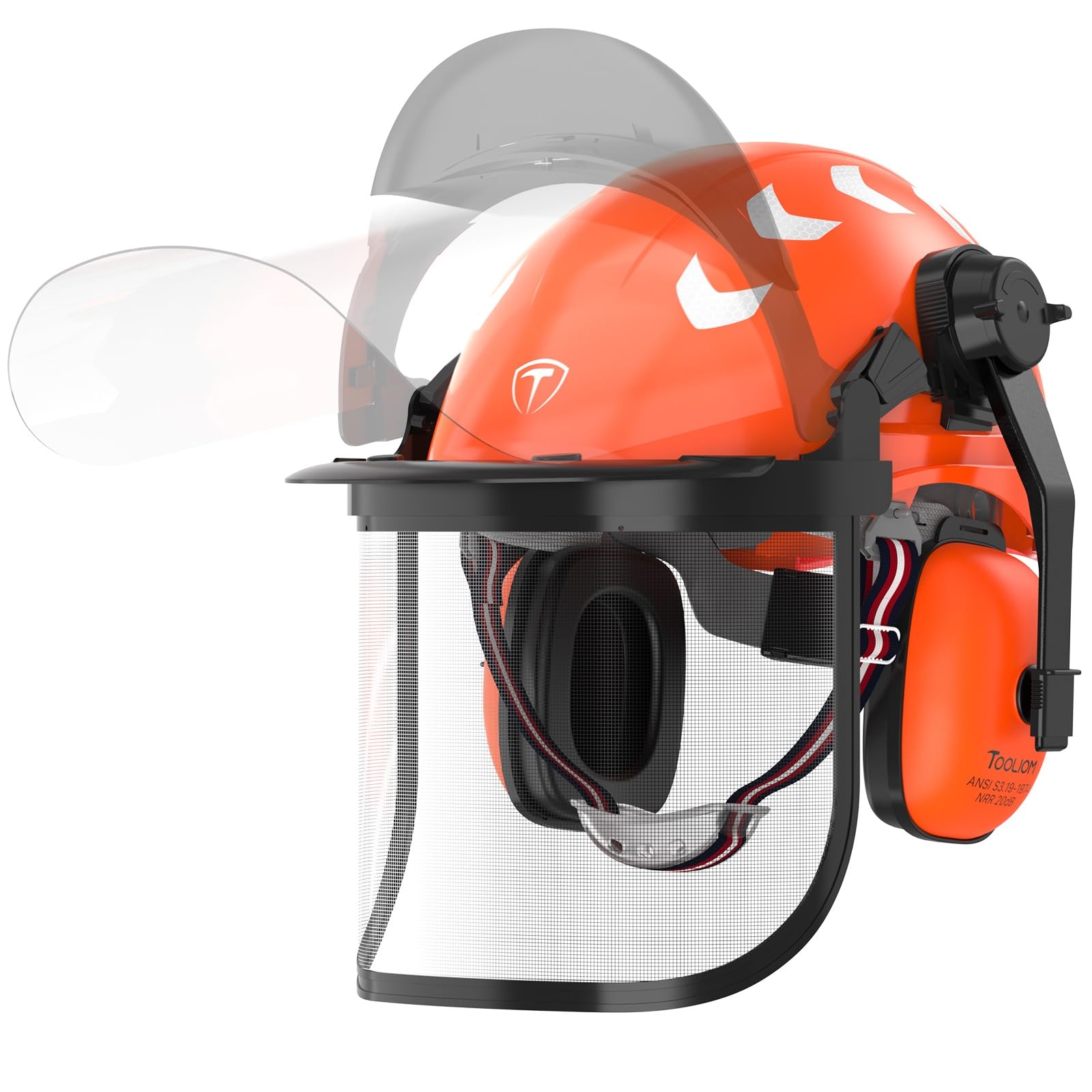
52 to 64 centimeters is the only stated head range in this group, and for anyone who has ordered a one-size helmet and found out otherwise, that's a genuinely useful number. Measure around your head just above the ears, compare, and you know before you order rather than after.

The kit is a five-piece set: helmet, muffs, a metal mesh visor, a clear shield, and a separate pair of goggles, plus a chin strap. Both shields rotate through 90 degrees, so you can park one up and out of the way instead of unclipping it, and the six-point harness with the rear dial is the same arrangement as the rest of the group.

The goggles are the odd extra. They duplicate what the clear shield already does, and we haven't found a job where we reached for them instead — they live in the bag, which is fine, because that's where the spare shield goes too.

Treated as a light-duty kit for trimmer work and the odd limb, it's adjustable, complete, and the easiest helmet here to size correctly. Just know what you're buying: the certification named for this helmet is ANSI Z87.1, which covers the eyewear rather than the shell, so check the hard hat itself for a Z89.1 marking before you count on it for head protection.

Bottom line: A light-duty kit worth considering if sizing is your worry: it's the only helmet here that states a head range before you order.

8

Husqvarna Chainsaw Helmet

Husqvarna Chainsaw Helmet

Electrical hazard work

Our Score 0.0/10
Check Price

Worth Noting

  • Ear-cup mounts can break away from the shell
Weight
2 lb
Suspension
6-point textile, 3 depth settings
Certification
ISEA/ANSI Z89.1-2014 Type I, Class E
Ear Muff Rating
24 dB NRR
Read the full review

Class E is the reason to look at this one. The Oregon here is a vented Class C shell with no electrical rating; the Husqvarna's hard hat is ISEA/ANSI Z89.1-2014 Type I Class E, which is the class that insulates. If your work puts you anywhere near a conductor, that difference decides the purchase before anything else on this page matters.

For everything else it's a quietly competent helmet. The 24 dB NRR muffs adjust vertically and sideways and lock off so you can hold a conversation without taking the shell off, the six-point textile harness has three depth settings, and the cotton sweatband is the detail we appreciated most — it absorbs instead of going slick the way a foam pad does.

Fitting the visor is the annoyance. It has to be forced onto its frame, and the printed guidance is thin enough that it's worth watching someone do it first rather than working it out in the truck. Do that job on a bench before the season starts and the rest of the helmet behaves.

Bottom line: Buy it for the Class E shell: the only helmet here with an electrical rating, plus muffs that lock off so you can talk.

How We Tested Forestry Helmets

We built our shortlist from helmets designed for arborists, loggers, and homeowners running a chainsaw, then narrowed it to 12 models that had replaceable parts and clear safety markings. Over eight months, we wore them during storm cleanup, firewood cutting, and trail maintenance on a wooded property—often for two-hour stretches in heat, sawdust, and light rain.

Fit got the same attention as protection. We adjusted each helmet to three head sizes on our team, timed how long the suspension took to dial in while wearing work gloves, and noted where pressure points showed up after a long session. We checked that the chinstrap stayed put when we looked up or bent over, that the face shield covered the full face without leaving a gap at the chin, and that the earmuffs sealed without pinching. We also watched whether the visor stayed up when we were just walking the property.

After each session, we wiped the helmets down and inspected the pivot points, clips, and suspension straps for cracking or stretching. A couple spent hot afternoons in a truck cab to see how the plastic and foam held up to heat. We compared what each helmet included—earmuffs, face shield, ventilation, replacement parts—against what it cost, because value here is less about the sticker and more about how many seasons it will last.

How to Choose Forestry Helmets

Read the certification, not the sticker count

Every helmet here carries a hard-hat standard, but the class tells you where it can be worn. ANSI Z89.1 Type I covers impact on the crown. Class C shells are vented and carry no electrical rating, while Class E shells insulate — the Husqvarna is the only one here rated that way. A vented helmet is more comfortable in July and the wrong tool anywhere near a conductor.

Helmets built to EN 397 and EN 12492, like the Pfanner, are certified to European standards. That's fine for your own land, but confirm it satisfies a US site requirement before you spend. Eye protection is a separate rating: look for Z87.1 on a clear shield or goggles.

Fit is decided by the harness, not the shell

Nearly every forestry helmet in this category is sold as one size, so the six-point suspension and the rear dial do all the work. A ratchet knob adjusts one-handed with gloves on; a textile harness takes two hands and tends to hold its setting longer.

The trap is reading 'one size' as a fit guarantee. Measure around your head just above the ears and compare against any published range — the Tooliom is the only helmet here that gives one, 52 to 64 cm. If you sit at either end of the bell curve, that number is worth more than any feature list.

Mesh, clear, or both

Mesh is the right default for saw work: it never fogs, it doesn't scratch, and it stops chips at speed. A clear shield earns its place for fine grit, spray, and dust, but polycarbonate fogs when you're working hard in the cold, and a fogged shield gets pushed up out of the way — worse than no shield at all.

If your year is mostly wood, buy mesh and don't pay for the rest. If you also trim, spray, and clear brush, a kit with both shields, like the NoCry, is the one that covers the calendar.

Compare hearing ratings on the same scale

Ear muffs get quoted as either NRR or SNR, and the two numbers aren't interchangeable — an SNR figure reads higher for the same real-world protection, so 31 dB SNR isn't automatically quieter than 24 dB NRR. Don't line the numbers up across those two scales.

What matters more day to day is whether the cups retract against the shell so they don't snag on brush, and whether they lock off so you can hold a conversation without taking the helmet off. The Husqvarna's muffs do that; so do the Pfanner's.

Weight, vents, and the twenty minutes nobody budgets for

A full kit runs from about 2 pounds to nearly 4, and that difference shows up in your neck at hour six rather than hour one. Vents that open and close let a single helmet work in January and in July.

Budget twenty minutes for assembly before you actually need the thing: the visor goes onto its frame with more force than you expect on several of these, and the pivot tabs need a firm push to seat. Check that the visor and muff mounts are replaceable, because those are the parts that fail first.

Frequently Asked Questions

Final Verdict

The NoCry 6-in-1 is the helmet we point most people to. It's certified for head, eyes, and ears, it comes with both a mesh and a clear shield, and the harness holds its setting — which is more than several helmets here manage.

If you cut a few times a year, the Oregon does the same job for the least money. Climbing all day, spend on the Pfanner; working near conductors, the Husqvarna is the only one here with an electrical class rating.