Pest & Weed Control

Best Fly Traps of 2026

A single fly in the kitchen is a curiosity; a second one means you're hosting. One August, a bowl of peaches turned my counter into a landing strip, and the old coiled strip over the sink caught more hair than flies. A good trap pulls flies in, holds onto them, and lets you toss the whole mess without touching it. The best ones are easy to set, bright enough to notice, and cheap enough to replace without wincing.

Over the past three months, my team and I tested 16 fly traps—sticky ribbons, window stickers, UV plug-ins, and bait cups—in the places flies actually gather: a fruit bowl, the back-door sill, a garage corner, and the compost bucket. We counted what each one caught, watched how fast the sticky surface loaded up, and noted which bait cups turned rank before they filled. The loudest trap rarely won; the cheapest often cost more in refills. The picks below are the ones that earned their spot, whether you're chasing one stray fly or a full summer invasion.

1

RESCUE! Outdoor Disposable Fly Trap

Top Pick
RESCUE! Outdoor Disposable Fly Trap

Yard and patio

Our Score 9.4/10
Check Price

Worth Noting

  • Outdoor only; the bait smell rules out porches
Use
Outdoors
Type
Water-activated bait bag
Disposal
Single-use
Traps Per Pack
8
Read the full review

Eight bags sounds like more than anyone needs until you watch one fill. Hang a RESCUE! bag where the flies are thick and it can go from a pouch of powder and water to a heavy, dark sack in a matter of days, so a single trap rarely lasts a season. The eight-pack is the version we recommend: one for the spring wave, one for the August surge, and a spare for the corner by the bins that always needs its own.

Setup takes a minute — tear the top, add water to the line, hook it on a fence or a branch. The bait then does the work by smelling about as bad as it needs to. That is not a flaw anyone can engineer out; the scent is the trap. Which is why placement matters more here than anywhere else on this list: the far edge of the property, downwind of the patio, well clear of doors and windows you open.

The bag is the weak point. It is thin plastic holding a few pounds of water and dead flies, and a seam that lets go makes a foul job much worse. Hang it clear of anything it can swing against, and treat a full bag as a two-handed lift from the base. Nothing else about this trap asks anything of you.

Bottom line: If you have flies in a yard, a barn, or around the bins, buy the eight-pack and hang one at the far edge — it fills fast and you throw it away full.

2

LFSYS Window Fly Traps

LFSYS Window Fly Traps

Whole-house windows

Our Score 9.4/10
Check Price

Worth Noting

  • Catches only what lands on it
  • A used strip is unpleasant up close
Use
Indoors
Type
Clear adhesive strip
Traps Per Pack
100
Peel-off Residue
None
Read the full review

A hundred strips is not a trap, it is a supply. That changes how you use them: instead of saving one for the worst window, you put one on every pane where you have seen a fly and stop thinking about it. For a big house, a glass sunroom, or a rental with old windows, that is the right math.

The strips are clear, thin, and sticky on one face, and they come off the glass clean, with no residue to scrub. There is no scent and no chemical, so there is nothing to explain to a child or a pet beyond not touching the sticky side.

Placement decides everything with these, and it is the reason we prefer a big box to a small one: you can afford to put a strip on every window and find out which panes the flies actually use. Flies gather at light, so the bright window by the door fills while the shaded interior wall catches almost nothing and convinces people the product is useless.

Bottom line: Best value on this list for covering a whole house of windows, as long as you put the strips where flies actually land.

3

Kensizer Window Fly Traps

Kensizer Window Fly Traps

Windows and doors

Our Score 9.2/10
Check Price

Worth Noting

  • Only catches flies that land on it
  • Looks grim once flies accumulate
Use
Indoors
Type
Clear adhesive strip
Traps Per Pack
30
Peel-off Residue
None
Read the full review

No bait, no light, no fan: a Kensizer strip is a clear adhesive rectangle you press onto glass and forget. That is the whole mechanism. A fly that lands on the window it is trying to escape through stays there, which makes this the least aggressive trap in this guide — and the easiest to live with in a kitchen where you do not want another appliance or another smell.

Thirty strips in a pack is the reason we keep these around instead of treating them as a one-off. Put one on the inside of a patio door and one on the kitchen window and you will know within a day whether flies are using that route; if they are, the strip darkens and another comes out of the box. No setup, no upkeep, no decision beyond keeping the box stocked.

The limits are real. A strip catches nothing it does not touch, so a pane with no sun and no fly traffic stays stubbornly empty, and a working strip is not pretty once it is covered. Clear helps it disappear from across the room; up close, a full one is exactly as grim as it sounds.

Bottom line: For flies that gather on windows and glass doors, we recommend these: clear, odorless, and they peel off without a fight.

4

RESCUE! Reusable Fly Trap

RESCUE! Reusable Fly Trap

Long outdoor season

Our Score 9.0/10
Check Price

Worth Noting

  • Emptying a full jar is genuinely unpleasant
  • Refill packets are an extra cost
Use
Outdoors
Bait
Refill packets
Type
Reusable bait jar
Traps Per Pack
3
Read the full review

Every disposable bait bag ends up as a sack of dead flies in the trash, and if that bothers you, the reusable RESCUE! is the answer. Three jars, screw-on lids, and bait packets you mix with water: when a jar fills, you empty it, rinse it, drop in fresh bait, and the body goes back out for the next round.

The jar is a better object than a bag at the awkward moment. A screw lid opens and closes without anything slapping or splashing, the base sits flat while you fill it, and there is a rim to hold when it is heavy. That is what makes a set worth storing between seasons rather than buying fresh bags every spring.

Where it gives ground is the job nobody wants. Emptying a jar of drowned flies is a genuinely unpleasant few minutes, and the refill packets are a cost the disposable bags roll into the purchase price. It is outdoor-only and smells like it. What you are buying is a body that survives seasons, not a nicer experience on emptying day.

Bottom line: Worth the unpleasant emptying if you want one trap body for years instead of a bag per wave — best for a yard with steady fly pressure.

5

BugBane Outdoor Fly Trap

BugBane Outdoor Fly Trap

Small yards

Our Score 8.8/10
Check Price

Worth Noting

  • One trap per pack
  • Smell builds once it starts catching
Use
Outdoors
Bait
Fish, egg and bran
Includes
1 trap, 2 bait refills
Hanging Chain
Included
Read the full review

This is the cheapest way to find out whether a hanging bait trap suits you: one trap, two bait charges, and the chain in the box. It works the same way the big outdoor kits do — scent lure, water, drown — without committing to a season of plastic before you know how bad the problem is.

The bait is fish, egg, and bran, which is about as harmless as this category gets, and the blue body adds a visual cue to the scent so the mix does not have to be quite so foul to work. Hang it 20 feet from the house and the catch builds within days, mostly house flies and other filth flies; horse flies and deer flies are a harder sell for it.

One trap means one location, so a large yard needs a second or a third to make a real dent. And once it is working, the smell sits at the back of the yard every time you walk past. That is the trade: cheap entry, one problem area covered well.

Bottom line: A cheap, honest way to test whether bait trapping works in your yard before you buy a season's supply.

6

Landisun Yellow Sticky Traps

Landisun Yellow Sticky Traps

Houseplants

Our Score 8.8/10
Check Price

Worth Noting

  • Film is fiddly to peel off
  • Thin cards tear in stiff soil
Use
Indoors and outdoors
Type
Double-sided yellow card
Shapes
Butterfly and sunflower
Traps Per Pack
48
Read the full review

Fungus gnats do not cross a room. They hover a few inches above the soil of the plant they hatched in, which is why a window strip on the far side of the kitchen does nothing about them, and why these little yellow shapes exist.

You push a butterfly or a sunflower into the pot and the color does the attracting. Double-sided means both faces work, and because the card sits in the soil, the gnats meet it at the height they actually fly. There is no chemical and no smell, which matters in a room where you also grow herbs you intend to eat.

The cards double as a diagnostic. A week after you cut back on watering, the new card tells you whether the population is falling — one glance at the yellow and you know whether to keep going or change something else.

Two things to know before buying a box of 48: the protective film is fiddly to peel, especially on the first one, and the cards are thin enough to tear if you force them into stiff soil. For houseplants, this is the one we reach for before anything with a scent, and a box this size lasts most people a year.

Bottom line: The right trap for fungus gnats in houseplants, and the only thing here that works at soil level.

7

Safer Home Plug-In Fly Trap

Safer Home Plug-In Fly Trap

Kitchen fruit flies

Our Score 8.4/10
Check Price

Worth Noting

  • House flies often ignore the light
  • Needs an outlet near the problem
Plug
Rotating
Type
Plug-in UV LED
Coverage
400 sq ft
Includes
1 trap, 2 glue cards
Read the full review

Where you plug a light trap in matters more than which light trap you buy. The SH502 has a rotating body, so a horizontal outlet above a counter works as well as a vertical one behind the fruit bowl — and since these devices only catch what comes close, getting it to the source is most of the battle.

The rest is simple: a UV LED pulls small flying insects toward a glue card tucked behind the front slats, out of sight. The card holds them, the unit stays silent, and after dark the light doubles as a night light, which takes the edge off having a bug trap in the kitchen.

It is the plug-in we recommend first, mostly on value. Two glue cards come in the box and the coverage claim is 400 square feet, so one unit handles a kitchen or a small living room without a second purchase. What it will not do is house flies. Gnats, fruit flies, and moths vanish; a big fly can circle the light and leave, which is the honest pattern with every plug-in here.

Bottom line: The plug-in we point people to first: cheap to start, silent in the kitchen, and it does its best work on gnats and fruit flies.

8

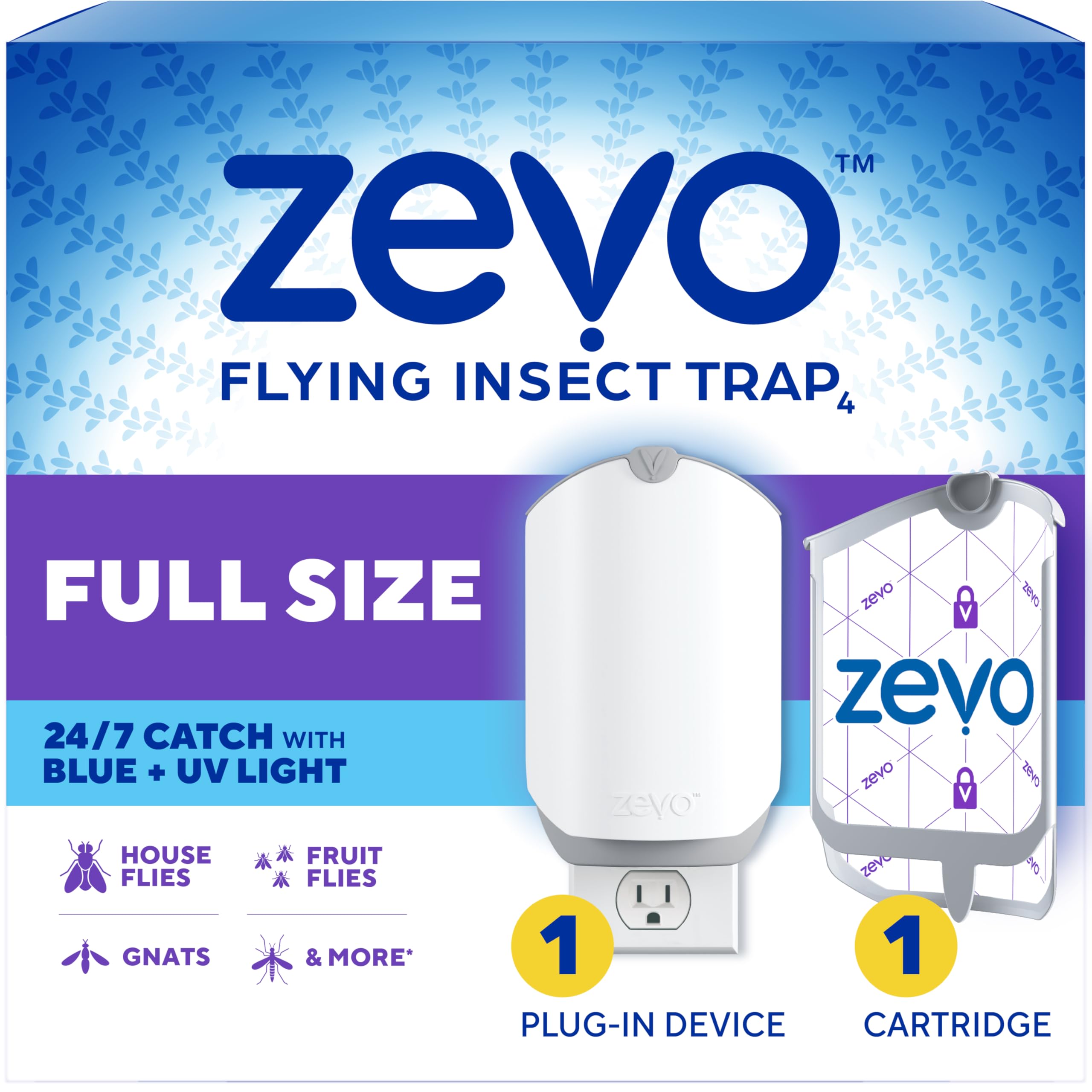
Zevo Plug-In Fly Trap

Zevo Plug-In Fly Trap

Dim indoor rooms

Our Score 8.4/10
Check Price

Worth Noting

  • Cartridges are a recurring cost
  • Results vary a lot by room
Type
Plug-in UV light
Power
Standard wall outlet
Includes
1 device, 1 cartridge
Cartridge Check
Every six weeks
Read the full review

Zevo hides the evidence. The glue cartridge clips in behind a slatted front with the sticky face turned toward the wall, so from across the room you see a small white box with a blue glow — no corpses, no zap, no smell.

That blue and UV light runs around the clock, which is why it earns its keep in a dark hallway, a downstairs bathroom, or a kitchen after the lights go out, and why it does much less beside a bright window. Plenty of them end up doubling as night lights in spare rooms.

The economics are the part to think about. One cartridge comes in the box, the device blinks to remind you to check it every six weeks, and replacements are a standing cost for as long as you keep using it. That is fine if it is catching and irritating if it is not.

And catching is the variable. It is the best-known plug-in here and still the one we are least sure about: in some rooms the cartridge fills with gnats and fruit flies within a week, in others the light burns and nothing lands. Buy it for a dim room near a known source, not as a whole-house fix.

Bottom line: Hidden catch, quiet running, no zap and no smell — worth one socket in a dark room, less convincing anywhere bright.

How We Tested the Fly Traps

We started by rounding up the trap styles people actually buy—sticky ribbons, window stickers, UV light traps, and bait cups—and narrowing the field by size, refill availability, and whether the trap could be set up without scissors or a bait mix. We bought every unit ourselves at hardware stores and online, then tested 16 of them over three months in the same handful of spots: a kitchen counter near the fruit bowl, a back-door window, a garage corner, and beside the compost bucket. Each trap stayed in place for a full week before we swapped in the next one.

At setup, I timed how long each trap took to unbox, mount, and place without help, and noted whether glue ended up on my fingers or the trap folded onto itself. Every morning we counted the flies stuck to each surface—and for UV traps, how many landed on the bright panel versus the wall around it. We also checked how quickly sticky pads filled up, whether bait cups soaked up moisture and turned soupy, and if any trap gave off an odor strong enough to notice from the next room.

Value came down to more than the sticker on the shelf. We tracked how many days each trap stayed useful before it needed replacing, whether refills were easy to find, and if a cheap trap ended up costing more in refills than a slightly pricier one. The traps that scored best caught flies consistently without a mess, stayed bright and inviting for weeks, and didn't make me dread picking them up.

How to Choose Fly Traps

Outdoor bait traps: the smell is the engine

Mixing bait with water starts a fermentation that flies can smell from a long way off. The worse it reeks, the better it works, and no amount of clever design removes that. So placement does the heavy lifting: at the edge of the property, downwind, well away from doors, patios, and windows you open.

Buy for the size of the problem — one bag or jar per trouble spot, and a multipack if your fly season runs long. The classic mistake is hanging a bait trap beside the grill and then wondering why dinner tastes like the trap.

Window strips: no smell, no bait, no miracles

Sticky strips catch by accident. Nothing lures the fly in; you are intercepting one that happens to land on the glass. That makes placement the whole game — a bright window near a door fills, a shaded interior wall stays empty for a month.

Clear strips disappear better, yellow ones pull more of the small stuff around plants. Check that a strip peels off clean, because a trap that leaves glue on the pane is a chore you will only repeat once.

Plug-in light traps: built for small flies

UV and blue light pull gnats, fruit flies, and moths. House flies are bigger, stronger, and much less interested, which is the single most common reason people call a plug-in useless.

Put one close to the source — the fruit bowl, the bin, the houseplants — and in a room that goes dark, because daylight drowns out the light. Factor in cartridges: the device is the cheap part and refills are the cost that keeps coming. Choose a rotating plug so the outlet you have is the outlet it fits.

Disposable, reusable, or refillable

There are four ways to pay for the same job. Disposable bags cost more up front and nothing after. Reusable jars cost less per fly but ask you to empty them. Strip packs are the cheapest way to cover a lot of glass, and plug-in cartridges recur every few weeks.

We favor the reusable route for a farm, a kennel, or anywhere the trap runs all season, where the refill price and the plastic saved both add up. If you want the whole mess gone in one motion, disposable is worth the premium.

Frequently Asked Questions

Final Verdict

For most yards, the RESCUE! eight-pack is the trap to start with: hang one bag where the flies are worst, keep it away from the house, and replace it when it gets heavy. If the flies are indoors on the glass, skip bait entirely and put up Kensizer strips — no smell, no outlet, no noise. And when the problem is fruit flies around the sink rather than house flies at the door, the Safer Home plug-in is the one worth a socket.