Tree & Forestry Care

Best Firewood Carts of 2026

A firewood cart looks like a simple thing: a box, four wheels, a handle. Then you fill it with a week's worth of split oak and drag it across a gravel driveway, and the difference shows up fast — wheels that splay, an axle that bends, a handle that rattles loose by the second trip. What a good one fixes is repetition. It turns three armloads, three sets of bark crumbs on the floor, and three trips through the cold into one loaded run from the stack to the stove.

My team and I spent eight months with eleven carts, and the pattern was clear: the ones that held up had a solid axle, real wheels, and a bed that didn't flex when it was full. Measure your doorway and the step up to your porch before you order — a cart that carries a face cord but won't roll through the door is a very expensive log holder. The picks below span different loads, terrains, and budgets.

1

VEVOR Log Cart

Top Pick
VEVOR Log Cart

All-round hauling

Our Score 9.2/10
Check Price

Worth Noting

  • Inflatable tires need occasional pressure checks
Wheels
10.5-inch inflatable rubber
Cart Weight
17.4 lb
Load Capacity
250 lb
Footprint (D X W X H)
26.4"D x 20.5"W x 43.3"H
Read the full review

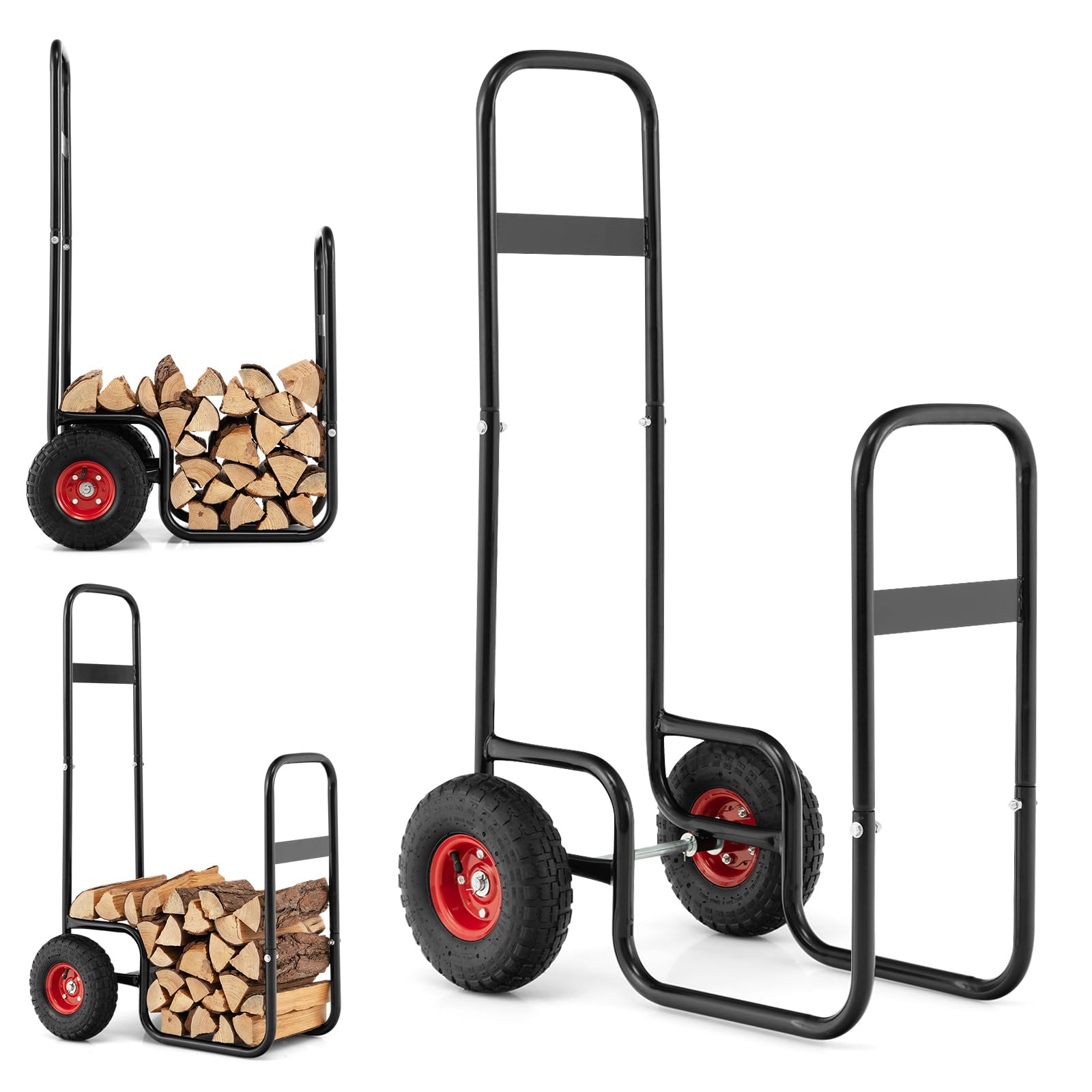
A 250-pound rating, a 26-inch-deep basket and a 17.4-pound frame is a combination nothing else here puts together. The cart weight is the number you feel: a cart that weighs less than a tenth of its own rated load tips back onto two wheels with one hand, so moving a heaped basket from the stack to the door stops being something you have to psych yourself up for.

The wheels are why it takes the top spot. Inflatable rubber, 10.5 inches across, rolls over gravel and lawn and lifts across a door threshold where a small hard caster stops dead. On a flat path it tracks straight and feels nearly weightless; on rutted, uneven ground it takes genuine effort, which is the honest trade for tires that absorb a bump instead of transmitting it.

The basket has an elevated rail that lets you heap split wood above the frame without it sliding off on the move, and a mesh panel across the bottom catches bark and the small pieces that drop between logs. That panel is the detail we appreciate most after a winter of hauling, because it means one sweep at the end of the week rather than one after every load.

Assembly is a twenty-minute job with the hardware in the box, and the bolts are the one corner cut: they are soft enough to strip if you torque one down before the rest are started. Thread everything finger-tight first, snug in a cross pattern, and the frame pulls square. What that leaves is the only cart here pairing a 250-pound rating with air tires.

Bottom line: Our pick for most wood burners: 250 pounds of split wood on air-filled wheels that cross gravel and take a threshold without a fight.

2

Tangkula Firewood Log Cart

Tangkula Firewood Log Cart

Gravel without flats

Our Score 9.2/10
Check Price

Worth Noting

  • 220-pound rating trails the 250-pound carts here
Frame
Powder-coated steel
Wheels
10.5-inch rubber
Load Capacity
220 lb
Footprint (D X W X H)
26"D x 20"W x 44"H
Read the full review

Set the Tangkula beside our top pick and the frames are near twins: 26 inches deep, 20 wide, 44 tall, a 220-pound rating and the same arched basket shape. What you feel through your hands is the wheel. Tangkula fits solid rubber where the VEVOR fits air.

For a driveway with nails, wire and broken concrete in it, we prefer the solid tire. There is no valve to check and no slow leak that turns a loaded basket into a plough halfway to the house. The cost is shock: over pavers or a concrete sill the cart thumps, and a heaped load rattles where an air tire would float it. Neither wheel wins in the abstract; rough yard and you want solid, rutted path and you want air.

The frame arches back at the top so stacked split wood stays put on the move, and the black powder coat is clean enough that the cart does not read as garden equipment parked in the living room. It is 44 inches tall with a load aboard, so measure the gap beside the stove before you commit. Long splits ride fine across the top rail; big rounds pile above it and need a hand on the way through a doorway.

Bottom line: The cart to pick if you never want to think about tire pressure: solid rubber wheels, a 220-pound basket, and a frame tidy enough to keep indoors.

3

Fire Beauty Firewood Log Cart

Fire Beauty Firewood Log Cart

Tight hearth spots

Our Score 9.0/10
Check Price

Worth Noting

  • No published load rating to plan around
  • Small basket means more trips
Frame
Solid iron
Wheels
Solid rubber
Cart Weight
19.8 lb
Footprint (D X W X H)
18.5"D x 17"W x 40.75"H
Read the full review

Seventeen inches wide and 18.5 deep, this is the narrowest full-height cart here, and that is the whole reason it earns a place: it drops into the slot between a stove and a wall where the wider carts simply will not go, and then it rolls back out of it. We like it best as a standing rack that happens to have wheels.

The frame does both jobs without a conversion. The curved bracket at the back holds split logs stacked as a rack indoors, and the same basket rolls out to the pile as a dolly when it is time to restock. Solid rubber tires mean no flats, the 19.8-pound frame pulls up a step without a second person, and the curve keeps the pile from sliding off on the move.

One gap worth knowing: there is no published load rating, which is unusual among these carts. Load it by feel rather than to a number, and stop when the frame starts to bow. Give the axle mounts a look before the first load, since on a cart this light the welds decide how long it lasts, and keep the basket to split, seasoned wood.

Bottom line: The pick for a tight hearth and a short carry: narrow, light, and happy to stand in place as a rack between loads.

4

YQBRAO Rolling Firewood Rack

YQBRAO Rolling Firewood Rack

Hearth-side storage

Our Score 9.0/10
Check Price

Worth Noting

  • Won't cross gravel or climb a loaded step
  • Low rail means lifting each split over the side
Frame
Powder-coated steel
Wheels
4 casters, 2 locking
Carrier
Removable liner bag
Footprint (D X W X H)
11"D x 32.2"W x 17.68"H
Read the full review

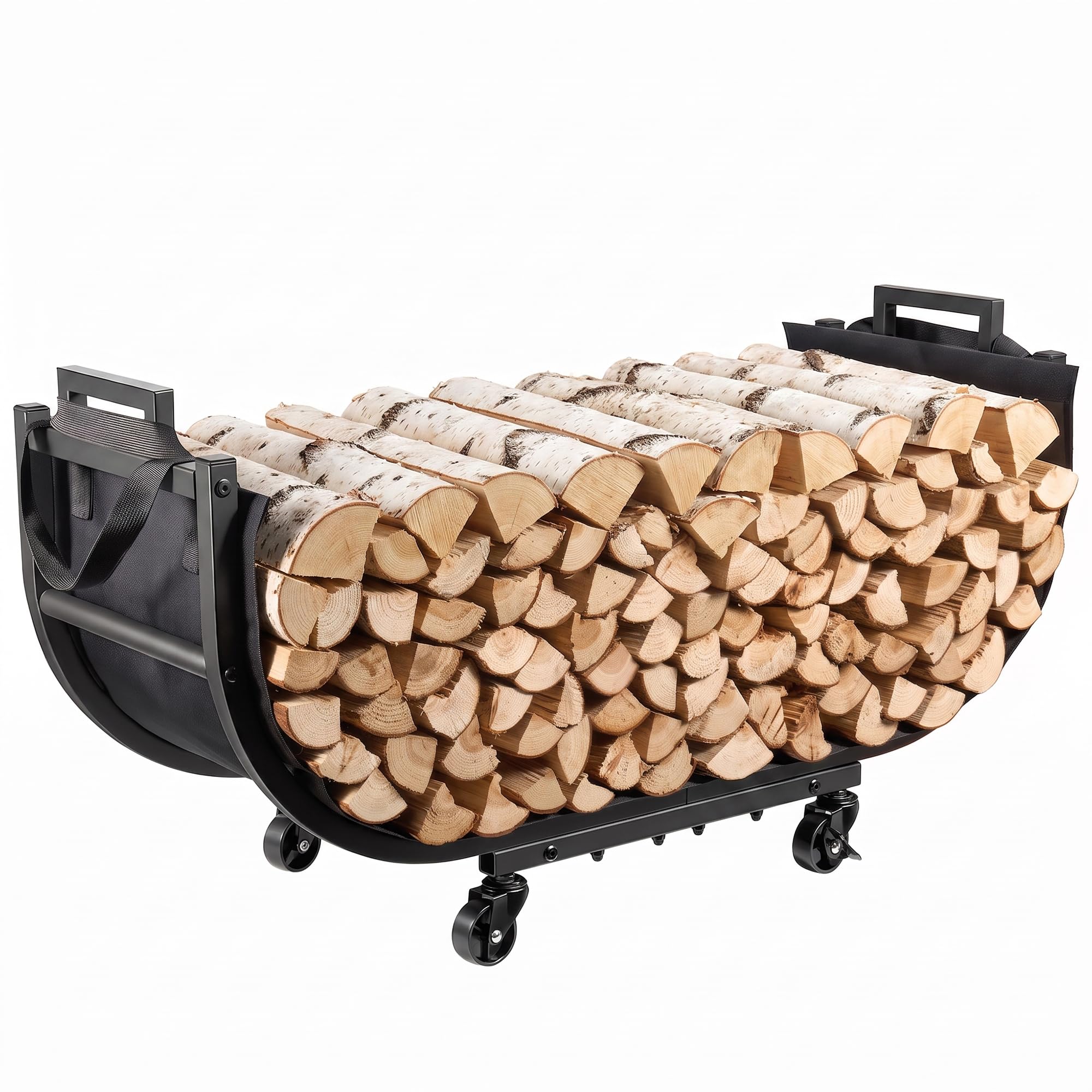
This is not a cart for a gravel path, and it does not pretend to be. It is a 32-inch rack on four casters with a liner bag inside, and we like it for the job it actually does: holding two or three days of split wood beside the fireplace and rolling the whole stack to the door when it is time to refill.

The liner is the good idea. It hooks over the frame, catches bark and chips so they do not snow across the floor, and lifts out as a carrier when you want to shuttle wood in from the porch. Two of the four casters lock, so the rack stays put while you stack into it. At 17.68 inches tall it is low, meaning you lift each split over the rail rather than dropping it in, but you can also see over it, which matters in a small room.

Worth knowing before you buy: those casters are for hard floors and a patio slab, not a lawn, and this will not climb a step with a load on it. Treat it as the indoor half of a two-part system, a real hauler outside and this rack inside, and it does its job tidily.

Bottom line: Buy it for the hearth end of the job: a wide rack that keeps firewood tidy and rolls to the door, on hard floors only.

5

Goplus Firewood Cart

Goplus Firewood Cart

Quick setup

Our Score 8.8/10
Check Price

Worth Noting

  • 220-pound rating, below the 250-pound carts here
Wheels
10.5-inch pneumatic rubber
Assembly
Four steps, tools included
Load Capacity
220 lb
Footprint (D X W X H)
26"D x 20"W x 44"H
Read the full review

Handles, frame, wheels, and you are done. Goplus builds its cart in four steps with the tools in the box and a sheet of instructions short enough to read standing up, and of the carts here it is the one we hand to someone who dreads flat-pack assembly. There is no trick to it and nothing to line up by eye.

What you get at the end is a 26 by 20 inch basket on 220 pounds of rated capacity, rolling on the same 10.5-inch inflatable tires as our top pick. That is a meaningful match: the air tires walk up a low entry step and across a doorstep without unloading first, and they take the jolt out of a gravel path. In the hand it feels a touch lighter than the top pick and steers the same way.

Check one thing while the wrench is out: the cotter pin holes on the axle. Make sure all four pins seat before the first load, because it is a five-minute check that is miserable to discover with a basket of oak aboard. Past that, the Goplus is the unglamorous choice, and a good one: the cart for a back door and a short path.

Bottom line: Buy it if you want air tires without an assembly ordeal: the four-step build and 10.5-inch wheels make it the easiest cart here to live with from day one.

6

Sunnydaze Firewood Log Cart

Sunnydaze Firewood Log Cart

Big daily loads

Our Score 8.8/10
Check Price

Worth Noting

  • Rust shows early at welds and wheel mounts
  • Heaviest full-height cart here at 21 pounds
Wheels
10-inch rubber
Load Capacity
250 lb
Wood Capacity
About 1/8 face cord
Footprint (D X W X H)
26"D x 21.5"W x 43"H
Read the full review

Allow for the assembly before anything else. The Sunnydaze frame is sound, but the holes in it do not always agree with the brackets: bolts that should slip through need a nudge from a drill, and the instructions will not rescue you. If you have a cordless drill and a free evening, read on, because the cart underneath is worth the trouble.

What you get is the biggest single haul here. The basket is rated to 250 pounds and holds about an eighth of a face cord, which is a day's wood for a stove run hard, so the trip count drops to one instead of five armloads. The 10-inch wheels take a step with a load on, and the frame is tall enough to stack against rather than drop into.

The reason it stays on the list is that capacity per trip: fill it once in the morning and you are done handling wood until tomorrow. Expect to go around the frame with a wrench after the first month as the joints settle and the whole thing can develop a wobble; ten minutes of re-tightening keeps it tracking straight.

Bottom line: Buy it for the largest single load in this group, an eighth of a face cord per trip, as long as there is a drill handy for the frame bolts.

7

VIVOHOME Firewood Log Cart

VIVOHOME Firewood Log Cart

Light and rigid

Our Score 8.6/10
Check Price

Worth Noting

  • Tube joints have play under a full load
Wheels
10-inch rubber
Load Capacity
250 lb
Wood Capacity
About 1/8 cord
Footprint (D X W X H)
20.2"D x 22.2"W x 41.5"H
Read the full review

An eighth of a cord is the number VIVOHOME puts on its basket, with a 250-pound rating behind it. In practice that is an evening's wood for a stove run hard, or a couple of days of casual fires, enough that the trip count drops without the basket getting so heavy you cannot tip it back.

The tube frame is the best-finished thing about it: 1-inch carbon steel with a wall thick enough that the cart does not flex when a full basket rolls over a lumpy path. We rate the frame well above the floor that sits in it. That 600D Oxford panel is what catches the bark, and it is also the first thing to give when a sharp split goes in point-first.

So line it. Two flat splits laid across the cloth before the rest go in solves that for the life of the cart, and it is the kind of fix the assembly sheet never mentions, which is vague about the cloth as well, so fit it before you tighten the frame down. At 22.2 inches wide it is the broadest of the tall carts here, so measure the door before you commit.

Bottom line: A light, stiff cart with one flaw you can fix on day one: line the cloth floor with flat splits and it hauls 250 pounds without complaint.

How We Tested Firewood Carts Through Eight Months of Real Fires

To build the shortlist, I started with roughly 40 carts sold by hardware brands, wagon makers, and fireplace retailers, then filtered by load rating, wheel size and type, footprint, and price. That cut it down to eleven covering the main formats: steel utility carts with fixed sides, canvas-sided wagons, and a couple of wooden handcarts. Each arrived flat and got assembled solo, with only the tools in the box and a stopwatch running, because a cart that takes two people and an afternoon is one most shoppers send back.

Assembly told us a lot. I noted whether the pre-drilled holes actually lined up, whether the hardware came labeled and bagged by step, whether the axle was one solid rod or two stub axles bolted to the frame, and whether the handle met the bed in a weld or a bolted bracket. Those details predicted almost everything that came later — the carts that went together in under 25 minutes were the ones that never loosened up.

Then came the firewood. Every cart made the same run: loaded from the pile beside the house, wheeled over gravel, grass, and a wooden deck, up a threshold, and parked next to the stove or fire pit. I counted how many armloads each one replaced, then pushed past the rated capacity to see whether the side panels bowed, the axle flexed, or the wheels splayed under load. I measured each footprint against a 32-inch doorway and watched how a full cart handled a turn, since a loaded cart that won't clear the door is furniture. Two of the cheaper models sat outside through rain and snow all winter, which settled the value question for me: rust is what you actually pay to avoid.

How to Choose Firewood Carts

A tall dolly or a low rolling rack?

Firewood carts split into two shapes that solve different problems. The tall two-wheel dolly, which is the VEVOR, Tangkula, Goplus, Sunnydaze and Fire Beauty pattern, is built to move a heavy load a real distance: from a stack at the side of the house, across gravel, over a sill and through a door. The low castered rack, like the YQBRAO, is built to keep wood tidy in one room and move it a few feet.

The trap is choosing with your eyes. The rack looks better in a living room, so people buy it for a woodpile forty feet away and then carry by hand all winter. If your wood sits more than a garden's length from the fire, buy the tall cart and park it where it is least in the way.

Wheels decide more than the rating does

Two carts rated at 250 pounds feel nothing alike once you leave concrete. Inflatable rubber tires, 10.5 inches across on the VEVOR and Goplus, absorb roots and gravel and ride over a threshold; the trade is a valve to check and the chance of a slow leak. Solid rubber, as on the Tangkula and Sunnydaze, cannot flat and shrugs off nails and wire in a driveway, but it thumps over pavers and sends every bump into a full basket.

We put wheel material ahead of every other specification here, because it is the one thing you cannot change later. Diameter matters too: anything under eight inches catches on door sills and step nosings, and no load rating rescues a cart you have to lift over the threshold.

Measure capacity in trips, not pounds

Ratings in this group run from 220 to 250 pounds, and the practical gap between them is small. What changes your evening is how much of the basket you can fill and still tip back: a 26-inch-deep basket swallows a day's wood, an 18-inch one means a second trip. Look at the basket floor as well, because an open frame dribbles bark and small splits the whole way to the house while a mesh or cloth panel catches them.

Where a cord fraction is stated, treat it as the useful number. An eighth of a cord is several days of steady burning for a stove, which is roughly the point at which a heaped basket stops being something you want to tip back onto two wheels.

Assembly is where these carts are won

Every cart here arrives flat and most go together in minutes; the variable is the hardware. Powder coat left in a bolt hole, a bracket welded a little off, or a thread cut too fine turns a twenty-minute build into an afternoon. Two habits help: start every bolt finger-tight and only snug them once the frame is square, and dry-fit the axle before you load anything.

The Sunnydaze's hole alignment and the soft bolts on the VEVOR are the two places in this group where a drill or a handful of your own hardware earns its keep. Neither is a reason to walk away; both are things to know before the box is open on the patio.

Living with it indoors

Wood is dirty and the cart lives where you do, so what the basket does with debris matters more day to day than an extra 20 pounds of rating. A floor that holds bark, whether mesh on the VEVOR, cloth on the VIVOHOME or a liner bag on the YQBRAO, saves a sweep every night.

Think about the slot it will occupy between loads. A full-height cart is 41 to 44 inches tall and 17 to 22 inches wide, which is furniture-sized in a small room. And powder coat is not a rust guarantee: touch up chips at the wheel mounts before winter rather than after.

Frequently Asked Questions

Final Verdict

Most people should buy the VEVOR. It carries 250 pounds, it is the only cart here with that rating on air-filled tires, and its 17.4-pound frame and 20.5-inch width let you tip, steer and park it without thinking. Thread the bolts carefully and it is the cart that quietly ends the armload shuffle.

Two alternatives change the answer. If your drive is full of nails, wire and broken concrete, take the Tangkula and its solid rubber wheels. If you burn daily and want the largest single load here, the Sunnydaze holds about an eighth of a face cord, provided there is a drill in the house for the frame bolts.