Fencing & Farm Structures

Best Electric Poultry Netting of 2026

The first time you walk out at dawn and find a scatter of feathers where the flock should be, the math changes fast. A fixed run stops working the day the grass runs out, and it does nothing about the hawk that's been circling since Tuesday. Electric poultry netting handles both jobs at once: a moveable perimeter that keeps hens where you put them and puts a jolt into anything sniffing around the outside. The trouble is that nets look identical in listing photos and behave nothing alike in wet grass.

I've strung nets across dewy spring pasture and dry August stubble, and over the past eight months my team and I have lived with 10 of them. What separated the good ones had less to do with the energizer's spec sheet than with how a net behaves at 6 a.m. when you're alone in the rain, moving birds to fresh ground. Below are the ones that earned their spot, plus the things I'd check before spending a dime.

1

Premier 1 PoultryNet Plus 100 ft

Top Pick
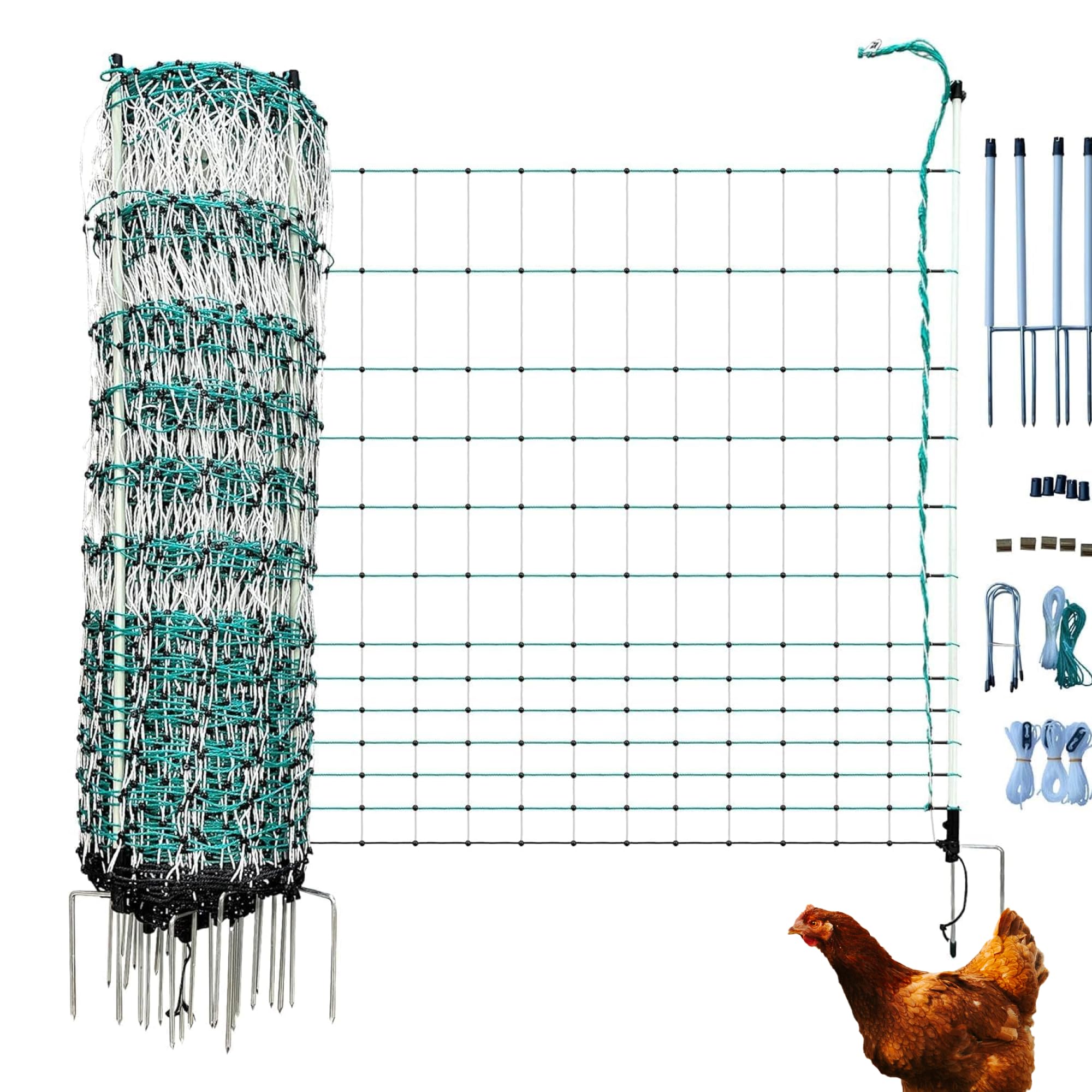
Premier 1 PoultryNet Plus 100 ft

Backyard flocks

Our Score 9.4/10
Check Price

Worth Noting

  • Energizer sold separately
  • 100-foot roll caps the size of one pen
Weight
23 lb
Net Height
48 in
Roll Length
100 ft
Post Spacing
6.8 ft
Read the full review

Posts every 6.8 feet: that's the figure that put this net at the top of our list. The rolls here that state a spacing run 10 to 12 feet between supports, and the gap is where electric netting quietly fails. The mesh bellies down between posts, touches grass, grounds out, and stops delivering a shock at the height a predator meets it.

PoultryNet Plus is the denser version of Premier's standard roll, and the difference is exactly that post set plus double spikes on every stake. Setup is unroll, drive, connect, with no assembly and no tools, and at 23 pounds the roll rides under one arm from the shed to the fence line. The plastic struts threaded between posts do their bit too, holding the mesh in shape instead of letting it hang in scallops.

Where it gives ground is size. A hundred feet makes a square pen about 25 feet a side, a genuine backyard run and about half the enclosure the 164- and 168-foot rolls here give you. Fence a paddock rather than a corner of the lawn and you're buying two rolls, which costs more than one of the long ones. Measure the perimeter you actually want, because joining two nets adds corners to brace.

The extra posts earn their keep on rotation. In a fixed run on flat ground, most of these nets will hold; it's when you pull stakes and re-set the fence every week or two that sag turns quick work into a chore. Moving several rolls on the same afternoon, this was the one that needed the least fiddling.

Bottom line: Posts every 6.8 feet keep this fence taut and live where longer rolls sag, which is why it's the net we recommend first for a backyard flock.

2

Premier 1 PoultryNet Plus Kit

Premier 1 PoultryNet Plus Kit

First-time buyers

Our Score 9.2/10
Check Price

Worth Noting

  • Premium outlay for a single 100-foot run
  • Solar output depends on sun and panel placement
Energizer
SolarStop 80 included
Net Height
48 in
Roll Length
100 ft
Support Posts
4 FiberTuff posts
Read the full review

One order, one box, and nothing left to match. The kit pairs the same 100-foot PoultryNet Plus netting we recommend above with four FiberTuff support posts, a SolarStop 80 energizer, a ground rod, a wiring harness and a digital tester. That's the whole parts list that usually sends a first-time buyer back for a second round of research, and it's the reason this kit earns a spot.

You pay a premium for the convenience, and the honest question is whether the pieces are worth it. They are. The energizer is rated for this net, the tester is the tool you'll actually use, and the four support posts hold corners and curves upright without guy lines. Bought bare, the same netting still needs all of it; here you're just skipping the assembly of the order.

Solar is the part to watch. A panel in shade, a run of gray days or a fence line left in tall grass all leave the net underpowered, and weak voltage is the difference between a fence that turns a raccoon and one it walks through. Use the tester at the far end of the run rather than beside the energizer, and chase the sun with the panel if your yard makes that hard.

Bottom line: If you don't own an energizer, start here: the net, solar unit, tester and ground rod arrive together and are rated for each other.

3

Starkline 164 ft

Starkline 164 ft

Long runs

Our Score 9.2/10
Check Price

Worth Noting

  • Heaviest roll in this set at 29.6 lb
Weight
29.6 lb
Post Type
Double-spiked fiberglass
Net Height
48 in
Roll Length
164 ft
Read the full review

Nearly the same money as our top pick buys 64 more feet of net here, at the same 48-inch height and with double-spiked fiberglass posts instead of Premier's plastic struts. If a hundred feet won't close your run, this is the shortest path to a bigger one.

The trade is support. There's no stated post spacing, so plan on walking the line and adding stakes at corners and grade changes rather than trusting the roll to hold its shape on its own. On soft ground the fiberglass stakes drive cleanly and stay where you put them; on stony ground they're the part to watch.

What it doesn't have is a chick-tight bottom or the post density that made the Plus our top pick. For adult birds in a run over 100 feet, though, it does the job without fuss, and it's the roll to choose when the size of the enclosure is the priority and the birds are grown.

Bottom line: A straightforward way to fence a bigger run: 164 feet of 48-inch net at our top pick's height, with the weight to show for it.

4

Starkline 82 ft

Starkline 82 ft

Small yards

Our Score 8.6/10
Check Price

Worth Noting

  • 82-foot perimeter suits only a small pen
Weight
15 lb
Post Type
Double-spiked fiberglass
Net Height
48 in
Roll Length
82 ft
Read the full review

Fifteen pounds is the whole argument. This is the lightest full-height roll in the set: 48-inch net, fiberglass posts with double spikes, 82 feet end to end. It's the one we carry to a garden bed at the far end of the property without thinking about it.

Eighty-two feet makes a pen roughly 20 feet square, which is a small flock or a serious vegetable garden. The net unfolds without the wrestling match electric fencing is famous for, the double spikes drive and pull cleanly, and one person can move the whole thing in a single trip. As a first net, or a second one for rotating a garden bed, that size is a feature: shorter runs go up faster and get moved more often.

The weak point is the ground, not the net. On hard-packed or stony soil, fiberglass stakes can bend at the tip before they bite, so start each hole with a metal stake or a spade rather than forcing it into dry clay.

Bottom line: The small-yard pick: 82 feet and 15 pounds, light enough to move alone and short enough to fit a garden bed or a modest run.

5

Pet & Livestock HQ 164 ft

Pet & Livestock HQ 164 ft

Chicks and bantams

Our Score 8.4/10
Check Price

Worth Noting

  • 164-foot perimeter is a lot for a small yard
Posts
19 double-spiked
Net Height
48 in
Roll Length
164 ft
Bottom Strand Spacing
2 in on 6 strands
Read the full review

Chicks are the reason to look at this one. Standard poultry netting carries its lowest strands far enough apart that a young pullet walks straight through, and this net tightens the bottom six strands to 2 inches apart, the closest base in this set, then graduates the spacing upward through 14 horizontal strands, 12 of them conductive.

Nineteen double-spiked posts across 164 feet works out to one roughly every 8.6 feet, between our top pick's 6.8 and the wider spacing on the long rolls, and it shows in how the net hangs. We set it on a gentle slope and it stayed taut enough that we weren't chasing sag or re-driving stakes. For a flock with bantams or a hen raising chicks, that combination is why it's the one we recommend first to a friend with small birds.

One thing it doesn't buy is height. At 48 inches it matches every other full-size roll here, so it's a deterrent for ground predators rather than a fence for a determined dog. What it does buy is the confidence to put chicks out earlier, in the same pen as the flock, without a second layer of hardware cloth around the bottom.

Bottom line: For a flock with chicks or bantams, buy this one: the 2-inch bottom spacing is the tightest here, and 19 posts keep 164 feet of net standing.

6

RentACoop 168 ft

RentACoop 168 ft

Largest pen

Our Score 8.4/10
Check Price

Worth Noting

  • Twelve-foot post spacing is the widest here
Weight
28 lb
Net Height
48 in
Roll Length
168 ft
Post Spacing
12 ft
Read the full review

Containment is the least of your worries once this one is up and powered. RentACoop's 168-footer is rated for birds from four weeks old through adult, it keeps hens in and ground predators out on level ground, and it's the longest single roll here, over 1,700 square feet with the full roll laid out.

What we appreciate beyond the size is how it moves. One person can pull the stakes, drag the roll and re-stake it without a second set of hands, and the box includes the mini posts, metal stakes and corner guy lines that some rolls make you source yourself. That hardware matters more than it sounds: every bend in a run is where a fence leans and where slack begins.

The catch is the post spacing. Twelve feet between posts is the widest here, and on a grade the mesh between them droops, touches grass and grounds out, which is the most common way an electric net quietly stops working. Plan the run with the slope in mind and put the mini posts on every grade change. For a big single enclosure and a flock that follows the grass, that trade is worth making.

It's also the only roll here that states an age range, four weeks and up, so a batch of birds can move out of the brooder straight into it rather than waiting for a second, sturdier fence.

Bottom line: The longest single roll in this set, and one person can pull it up and re-stake it; buy it when one big enclosure matters more than tight spacing.

7

FMFenceTrix 2-Roll

FMFenceTrix 2-Roll

Flighty birds

Our Score 8.4/10
Check Price

Worth Noting

  • 41.3-inch net is shorter than the 48-inch rolls
  • Riser rope needs tensioning to be useful
Weight
29.9 lb
Net Height
41.3 in
Roll Lengths
98.5 ft and 65.6 ft
Overall Height
60 in with spikes
Read the full review

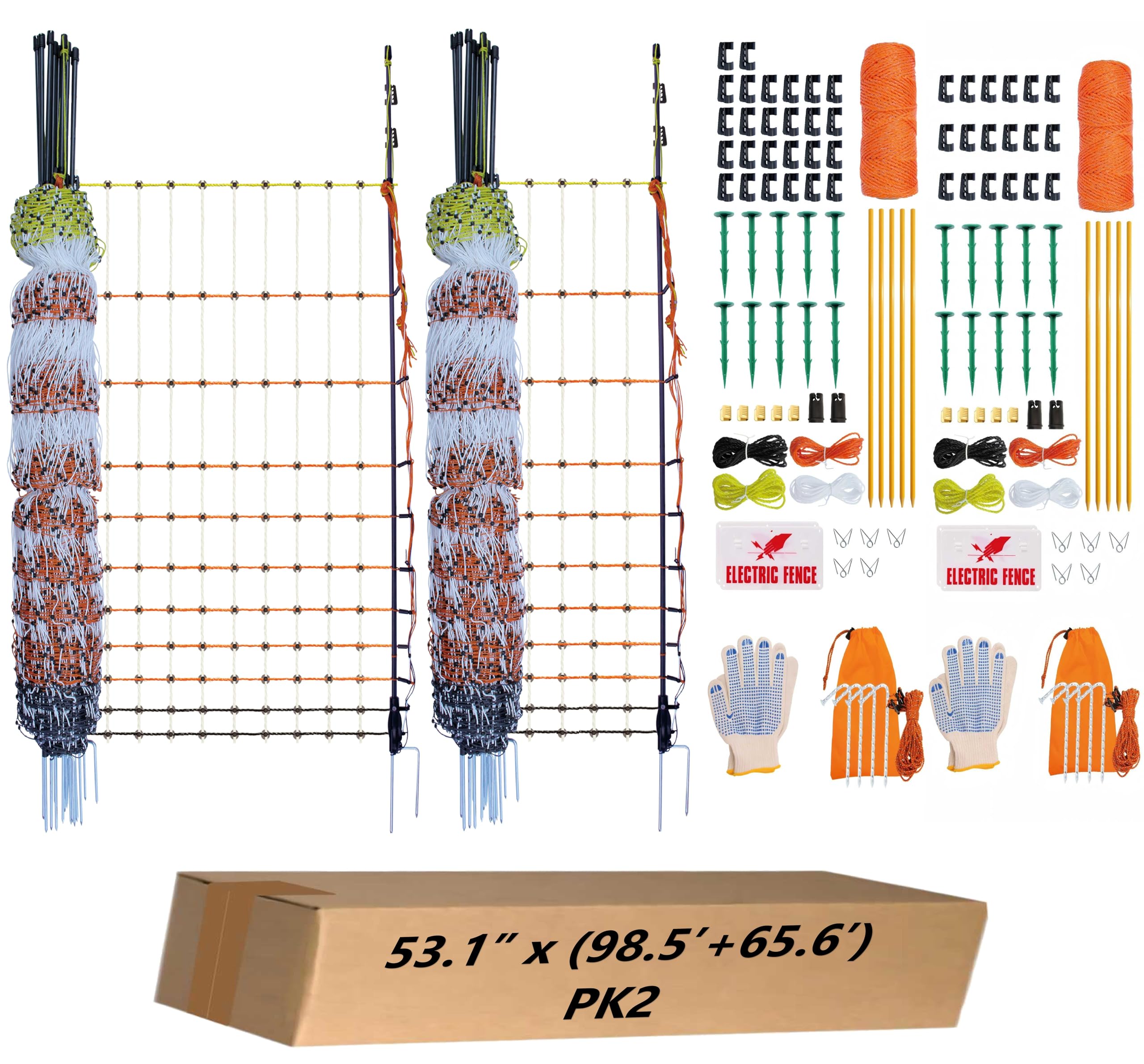
Two rolls instead of one: 98.5 feet and 65.6 feet, so you can run a long side and a short side, or fence two separate pens without cutting anything. That flexibility is why this kit is on the list.

The net itself stands 41.3 inches, shorter than the 48-inch rolls, but the frame reaches 60 inches with the spikes, and the kit ships 328 feet of energized rope you clip above the net to take the whole fence to about 59 inches for birds that fly. Ten mini posts come along to hold the rope where you want it, which is the difference between a riser that works and one that sags into the net.

Setup is the easy part. Two rolls unspool, the double spikes go in by hand, and the 11 strands are graduated from bottom to top, with the two lowest non-conductive. If you're counting on the base of the fence to do the work on small birds, that's worth knowing before you order.

The shorter net is the catch. Without the rope, 41 inches is a speed bump for a determined hen, and the rope only earns its place if you string it taut and keep it tensioned through the season. Treat this as a system you set up on purpose for a flock that flies, not a roll you throw out and forget.

Bottom line: Two shorter rolls plus a riser rope make this the flexible choice for a flighty flock, provided you set it up deliberately.

How We Chose and Tested the Best Electric Poultry Netting

We began with 26 nets sold to U.S. backyard flocks and cut that to 10 by comparing mesh height, strand count, post spacing, joule output, and price per foot of fence. Every net was bought at retail, and every one went onto the same working property with a 24-hen laying flock, rotating through the same paddocks for eight months so no net got easier ground than another.

Setup was timed solo, from unrolling the spool to hearing the energizer tick, and we noted how many posts needed a second shove to sit plumb. Once birds were inside, we watched containment the way you actually do — hens probing the bottom wire at dusk, a young rooster launching at the top — and measured the gap between posts at ground level a week in to see which nets had gone slack. A neighbor's dog and my own two walked the outside line, and we noted which of them respected it after one correction.

Charging performance got checked with a fence tester after rain, at the far end of the run rather than at the terminal. A line of thunderstorms in month three told us which posts were actually sturdy, and we tracked the slower stuff too: whether mesh held its shape through a summer of UV, how the gate still lined up after daily use, whether a net went back into its bag with cold hands, and what a broken strand cost to fix. Value came down to cost per foot measured against how long a net stayed upright without fuss.

How to Choose the Right Electric Poultry Netting

Post spacing comes first

Electric netting fails quietly. The mesh bellies down between supports, touches wet grass or a fallen branch, and the current leaks to ground; the fence still looks right and stops discouraging anything. That's why we weight post spacing above almost every other figure here. The rolls that state one run from 6.8 feet apart on our top pick to about 8.6 feet on the Pet and Livestock HQ net and 12 feet on the RentACoop.

Double spikes matter for the same reason: a post you can drive with your boot stays upright in wind that lays a single spike flat. Count posts per roll, not just feet of net.

Length is perimeter, not area

A 100-foot roll doesn't fence 100 square feet. It fences a shape whose sides add up to 100 feet, about 25 feet a side as a square, roughly 625 square feet inside. The 164- and 168-foot rolls get you nearer 40 feet a side, which is a paddock rather than a pen.

Sit with that before ordering, because two short rolls joined cost more than one long roll, and every join adds a corner to brace. Small flock and tight yard: buy short and move it often. Big rotation: buy the length once.

Budget for an energizer

Most rolls arrive as net and posts only. You need a low-impedance energizer rated for the length of net you're powering plus a ground rod, and the rating has to cover the total, so two rolls need roughly double the capacity of one. Solar units go anywhere the panel gets sun but run weaker through gray spells; mains units need an outlet at the fence line.

If matching parts sounds like a chore, a kit does the matching for you, and the tester that comes with one is the tool you'll use every week after.

Grass, corners and the weekly walk

Two habits keep a net hot. Keep the bottom wire clear: mow or trim a strip along the fence line, and don't let mulch or tall weeds bridge the mesh to the ground. Brace the corners, which is where a fence leans and where slack starts.

Plan on moving the net every week or two if you're rotating birds; netting left in one spot for seasons is where mesh and posts wear out first. A two-minute walk with a tester tells you more about a fence than staring at the energizer.

Frequently Asked Questions

Final Verdict

The net we recommend for a normal backyard flock is the Premier 1 PoultryNet Plus at 48 inches by 100 feet. Posts every 6.8 feet are what earn it: the mesh stays taut, the fence keeps its voltage, and moving it is quick work instead of a fight.

Measure your run before you order. Over 100 feet, look at the Pet and Livestock HQ 164-footer, which also tightens the bottom strands for chicks. If you don't own an energizer and don't want to match one, the Premier kit puts the whole system in a single box.