Fencing & Farm Structures

Best Electric Fence Insulators of 2026

The cheapest part of an electric fence is also the one that decides whether the whole thing works. An insulator is a small block of plastic or ceramic, but it has one job: hold the wire off the post so the charge goes where it is supposed to instead of leaking into wood or steel. Buy the wrong one and you get sagging wire, cracked collars, or a fence that reads weak on the tester after the first hard rain. The right one disappears into the job—easy to install, snug on the post, and tough enough to keep tension through mud, sun, and the occasional clumsy boot.

Over the past five months, my team and I tested 14 types of electric fence insulators on wooden corner posts, steel T-posts, and a garden deer fence. We installed them with drills and hammers, ran both polywire and aluminum wire, and checked voltage at the far end after wet weather. Price mattered, but only after an insulator passed the basics: a clean fit, secure wire, and hardware that did not strip or bend on the first try. The picks below are the ones I would buy again for my own paddock—and the ones I would hand to a neighbor who just wants the fence to stay hot.

1

Pushglossy 200-Piece Wood Post Insulators

Top Pick
Pushglossy 200-Piece Wood Post Insulators

Tidy wood-post runs

Our Score 9.6/10
Check Price

Worth Noting

  • Black body is harder to spot than yellow
Fits
Wooden posts
Material
Non-conductive plastic
Pack Size
200 insulators and 400 screws
Insulator Size
3.35 in long, 1.57 in wide
Read the full review

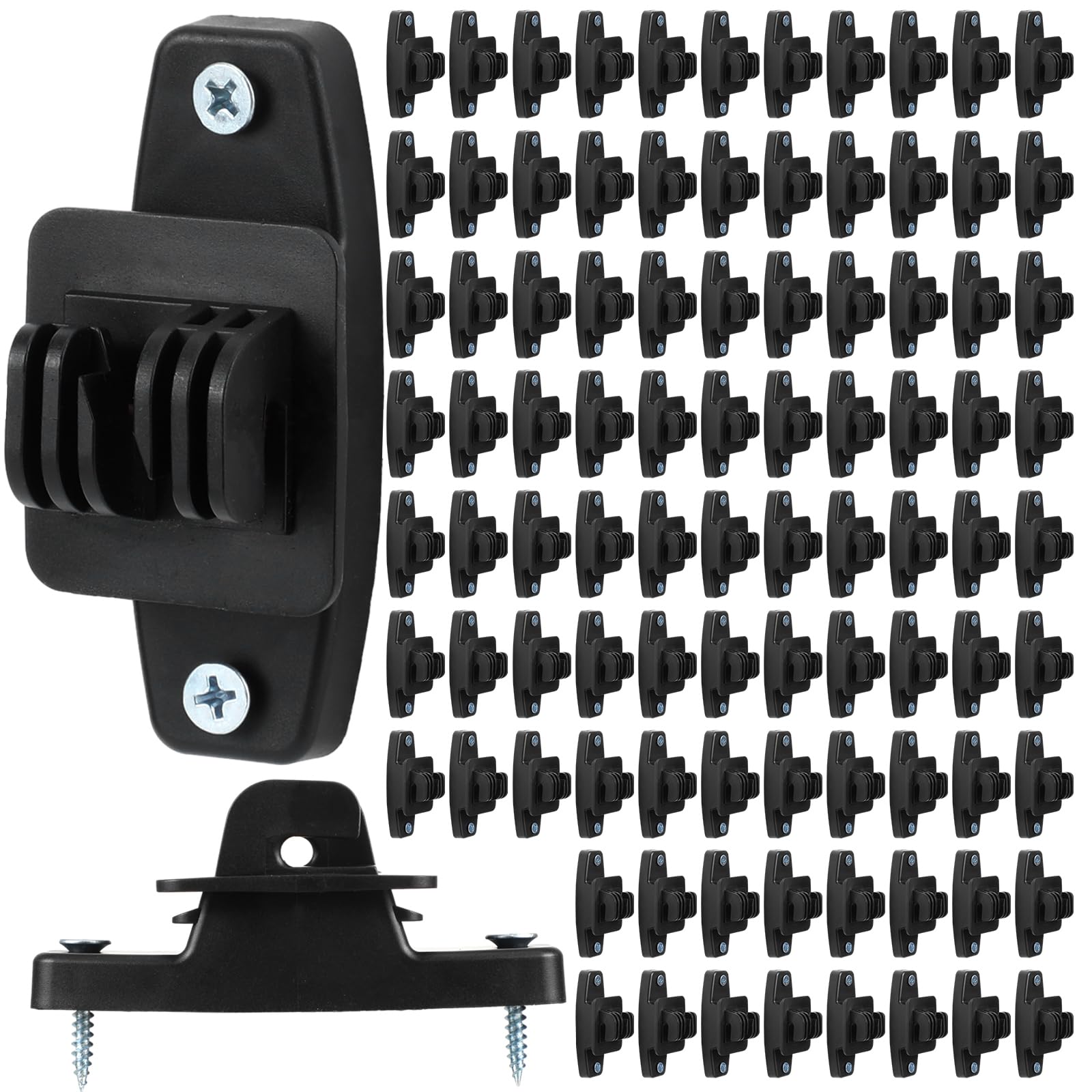
Two screws come with every insulator in this box, which tells you how it is meant to go on: the claw body is fixed at both ends rather than pivoting around a single screw the way a ring does. That is a slower install than a screw-in ring, and a flatter, more stable fixing. On a post that has dried and checked, two points of contact is not a bad idea.

The body is 3.35 inches long and 1.57 inches wide, molded in a non-conductive plastic with a claw that wraps the conductor rather than pinning it under a slot. That is a more positive grip than a small ring gives you, and it is the reason this box is worth a look despite the price.

Because the price is the sticking point. At 200 pieces with 400 screws, this works out to the highest cost per insulator of any wood-post box in this guide, noticeably more than the Sweetude box for the same count. We have not found the extra money buying anything that shows up at the energizer, so our recommendation is conditional: choose it if the two-screw fixing suits the fence you are building, and take the cheaper box if all you need is rings in timber.

Bottom line: Two screws for every insulator and a claw body that wraps the wire: a sturdier fixing than a single-screw ring, sold in a 200-piece box.

2

Zareba Standard T-Post Insulators

Zareba Standard T-Post Insulators

Standard T-post lines

Our Score 9.4/10
Check Price

Worth Noting

  • Fits only 1-1/4 and 1.33 in studded T-posts
  • No holder for poly tape
Fits
1-1/4 or 1.33 in studded T-posts
Material
Polyethylene
Mounting
Wrap-around with no hardware
Pack Size
25 insulators
Read the full review

No tools, no hardware, no thinking: the Zareba wrap-around is the insulator we point people to when the fence line runs on steel T-posts. It presses over a standard 1-1/4 or 1.33-inch studded post, the stud seats in the molded channel, and the wire drops into the slot on the face. At the lowest cost per insulator in this guide, that simplicity is the whole argument. A long fence line needs dozens of these, and the ones that go on fastest are the ones that actually get replaced when they crack.

The first couple take a second of fumbling while you work out which way the channel faces; after that they go on as fast as you can walk. We threaded both steel wire and polywire through the slot without the body twisting on the post, and the wrap-around shape holds its place when you pull a run taut. Yellow matters more than it sounds like it should: after a storm, you want to spot the broken one from the truck.

The plastic is thin, and that is the trade. Press one onto a post that is rusted or slightly oversized and the collar can split, and a bag left in the sun for a few seasons gets brittle enough to crack at the stud. Because they cost so little, the practical answer is to buy a bag more than the run needs and keep it in the barn. A cracked insulator leaks charge into the post every minute it stays up, and swapping it is a thirty-second job.

Where the design runs out of road is a corner, or a post driven off-angle. The slot faces one way, so a wire pulling sideways does not sit as cleanly, and that is the moment to reach for a multi-position head like the Lock Jawz. On a straight run of standard posts, nothing here is faster to hang or cheaper to replace.

Bottom line: The cheapest insulator here, and the one we keep coming back to: it snaps onto a standard T-post and holds wire without a single tool.

3

Sweetude 200-Piece Screw-In Insulators

Sweetude 200-Piece Screw-In Insulators

Wood post value

Our Score 9.4/10
Check Price

Worth Noting

Fits
Wooden posts
Material
PP body with galvanized steel screw
Mounting
Self-tapping screw-in
Pack Size
200 insulators and 1 socket tool
Read the full review

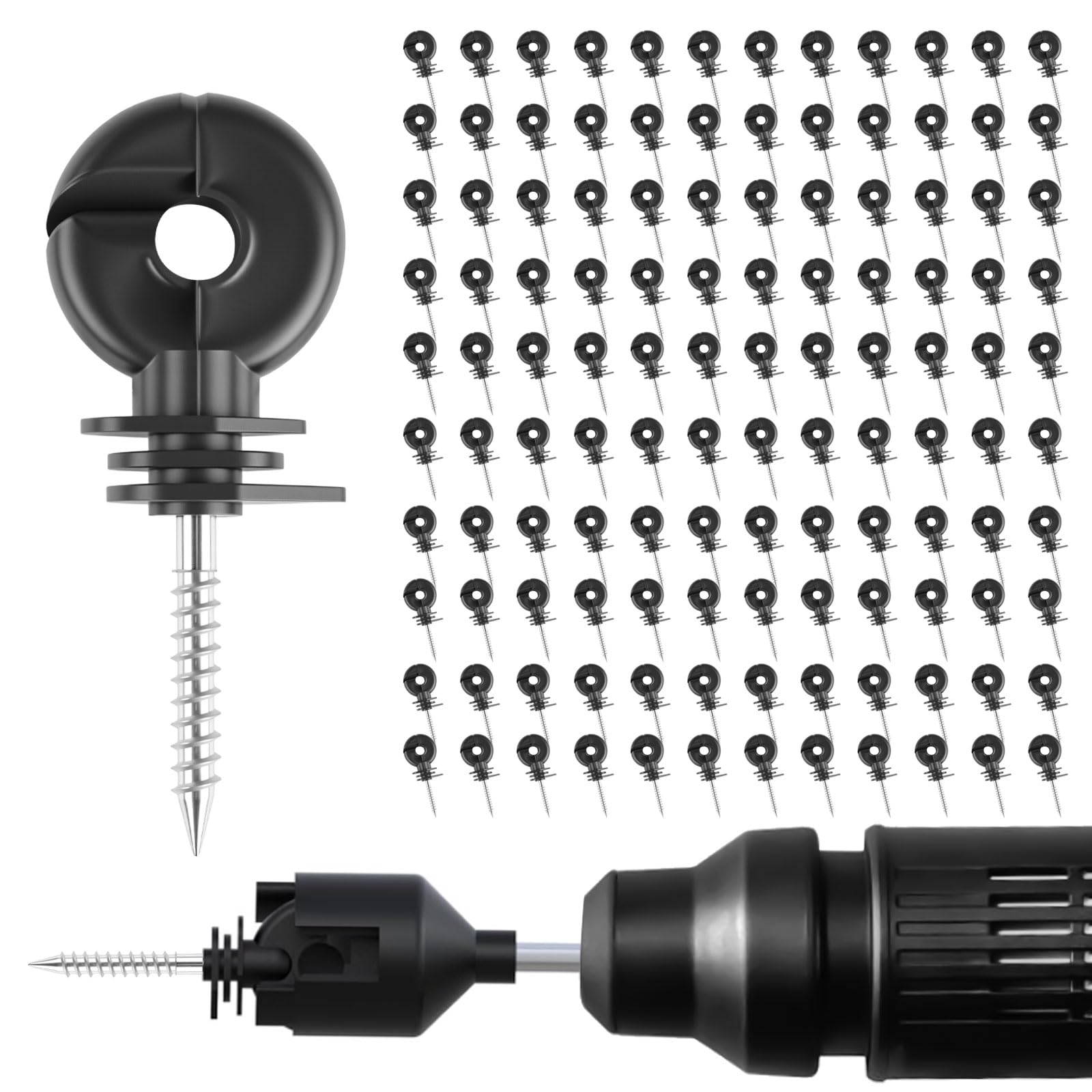
Everything else here assumes a steel T-post. The moment your fence line is timber, the hardware changes completely: a ring screws into the wood, holds the conductor clear of a face that stays damp for days after rain, and takes a few seconds with a drill. No nail to line up, no stud to match, no fighting a snap-on fitting that was molded for a different post.

Of the screw-in boxes in this guide, this is the one we recommend first for most timber fences. Two hundred rings and a socket tool that chucks into a battery drill, at roughly the same money per insulator as the big bulk kit without making you buy three hundred of them. The screw is galvanized steel through a polypropylene body, the thread is coarse enough to bite without a pilot hole, and the durability on this box is the strongest of the wood-post picks here.

The one thing to know is that these are effectively single-use. Back one out of a seasoned post and the thread has torn its own hole, so it will not bite a second time. Mark your heights, plan the run, and drill once. At this count, one bad post will not leave you short.

Bottom line: For timber posts, this is the screw-in box we recommend first: 200 rings, a drill socket, and a thread that bites without a pilot hole.

4

Zareba Slant Nail Insulator

Zareba Slant Nail Insulator

Wooden post runs

Our Score 9.2/10
Check Price

Worth Noting

  • Nails ship loose and bags can run short
  • Plastic is the weak link over time
Fits
Wooden posts
Standoff
2.5 in from the post
Pack Size
25 insulators with nails
Conductors
Steel, aluminum, polywire, polyrope to 1/4 in
Read the full review

Two and a half inches is the number that matters here: the slant nail holds the wire that far off a wooden post. Clearance is the whole job on timber, because a wire that sags back against damp wood grounds the run and the energizer spends its charge leaking into the post instead of into the fence. One nail sets it, the angled body carries the wire past the face, and you are walking to the next post. That is why this is our pick for wooden fences.

The conductor range covers anything you would string on a timber line: 9 to 22 gauge high-tensile steel, aluminum wire, every grade of polywire, and polyrope up to a quarter inch. The nails come in the bag, so there is no second trip to the hardware store, and the slant means you can hang a wire along rough-sawn posts without it resting on the wood between insulators. In a wet spring, that clearance is the difference between a fence that bites and one that ticks.

The open slot is the other quiet advantage. You can lift a strand out to open a gap for a gate or a vehicle and drop it back without undoing the run, which is more useful than it sounds on a place where stock moves between paddocks every few weeks. Line the nail up square and drive it clean; on a narrow post, a crooked nail is the only thing here that will give you trouble.

Bottom line: If your fence hangs on timber, this is the simplest hardware for the job: one nail, two and a half inches of standoff, and wire that stays off the post.

5

NQN 300-Piece Screw-In Kit

NQN 300-Piece Screw-In Kit

Large timber builds

Our Score 9.2/10
Check Price

Worth Noting

  • Screw shank can break through 2x lumber
Fits
Timber posts
Screw
13-lap self-tapping
Pack Size
300 insulators and 2 socket tools
Conductors
8 to 30 gauge high-tensile wire
Read the full review

The box arrives at close to eleven pounds, which is the first honest signal about what this is: a bulk kit for a fence you mean to finish rather than patch. Three hundred black rings and two socket tools that chuck into a drill, so one driver can live in the truck and one in the shop, and you stop rationing hardware halfway through the job.

For throughput, this is the kit we hand someone who is building rather than repairing. The self-tapping screws are coarse enough to start by hand and to drive with a drill, the slot takes anything from 8 to 30 gauge high-tensile wire, and two drivers mean you are not swapping chucks every ten posts. Against the smaller screw-in boxes, you are paying for volume and the second tool, not for a better insulator.

The plastic is the caution. Drive a ring into hard, dry timber without a pilot hole and it can split at the shoulder; set the clutch light, let the thread cut its own way, and you will break far fewer. Predrilling a few hundred holes sounds like a chore until you have spent an afternoon backing out snapped rings, and at this quantity that afternoon is time you get back.

Bottom line: A box of 300 rings and two drill drivers, built for a fence you intend to finish in one go rather than patch a section at a time.

6

HXSEMAYIG 120-Piece Screw-In Insulators

HXSEMAYIG 120-Piece Screw-In Insulators

Garden-sized fences

Our Score 9.2/10
Check Price

Worth Noting

  • Included drill adapter fits the ring loosely
Fits
Wooden posts
Pack Size
120 insulators and 1 socket tool
Conductors
8 to 30 gauge high-tensile wire
Read the full review

A hundred and twenty insulators is an odd number until you have built a garden fence. It is roughly three strands around forty posts with a few left over, and it is not so many that the box becomes clutter. That is the job this kit suits: a deer fence around vegetables, a small paddock, a run of timber posts nobody is going to pay a contractor to do.

The rings are polypropylene and polyethylene over a sharp, hardened thread, and they take high-tensile wire from 8 to 30 gauge. They will thread into timber by hand, and that is genuinely true, though nobody does a hundred of these by hand twice. A drill makes the difference between an afternoon and a weekend.

Black plastic in hard sun is the long-term question. A ring that has gone chalky will crack as you drive it, so keep the spares in the shed rather than on the dash of the truck, and walk the run in spring looking for the ones that have gone pale. That single habit will save you more insulators than the difference between one box and another.

Where this kit earns its place is the middle of the range. It is enough hardware for a real garden fence without committing to three hundred pieces, and it costs less than the bulk boxes do for someone who does not need them. If your fence is one strand on a dozen posts, take the small Zareba bag instead; if it is half a mile of timber, go bigger.

Bottom line: For a garden-scale timber fence, 120 rings and a drill adapter is about the right size: enough to finish the job without a box of spares in the shed.

7

GGTYHAO 110-Piece Insulator Kit

GGTYHAO 110-Piece Insulator Kit

Mixed conductor lines

Our Score 9.2/10
Check Price

Worth Noting

  • Costs more per ring than the bulk boxes
Fits
Timber posts
Length
3.54 in
Pack Size
110 insulators, socket tool, gloves
Conductors
Wire, polywire, rope, tape
Read the full review

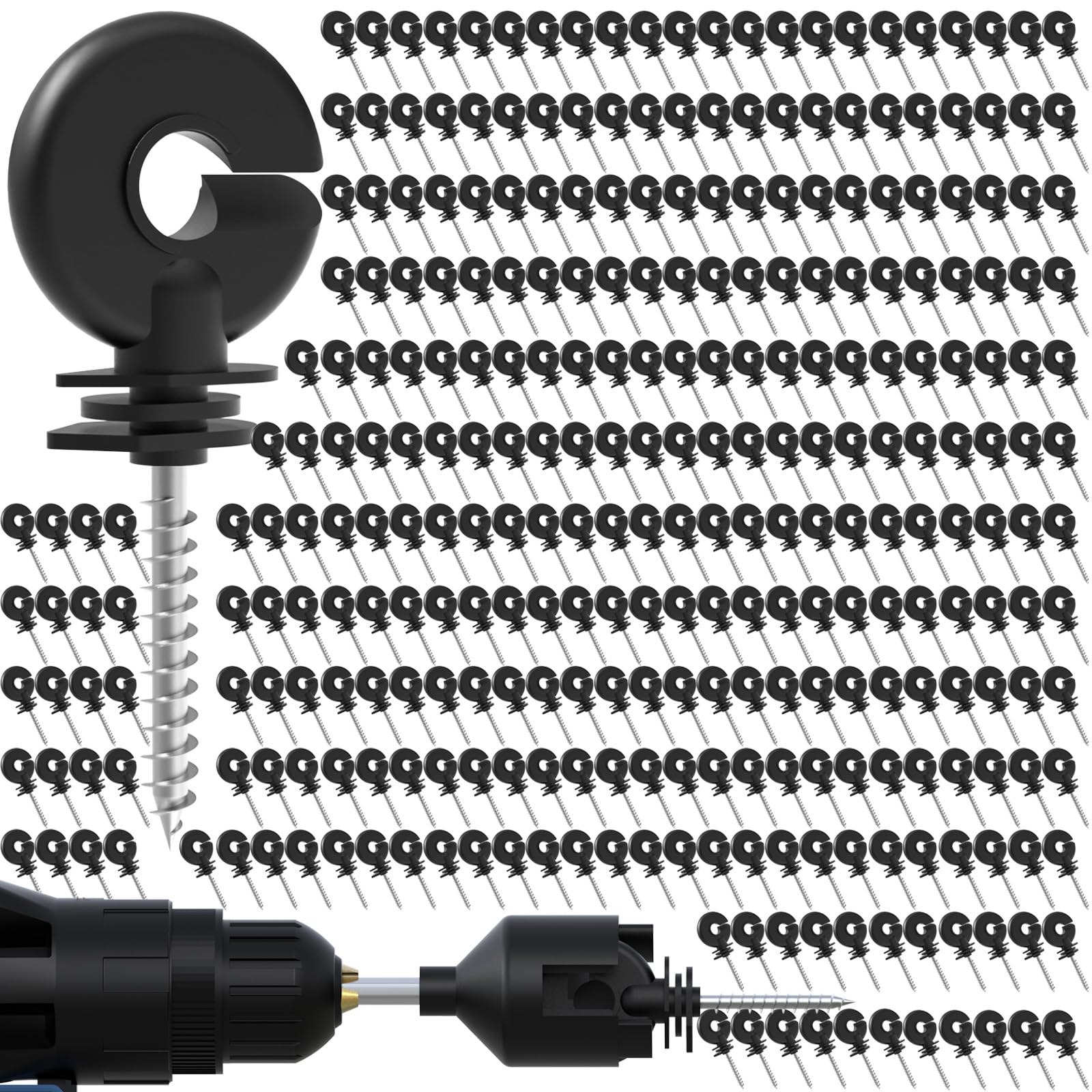
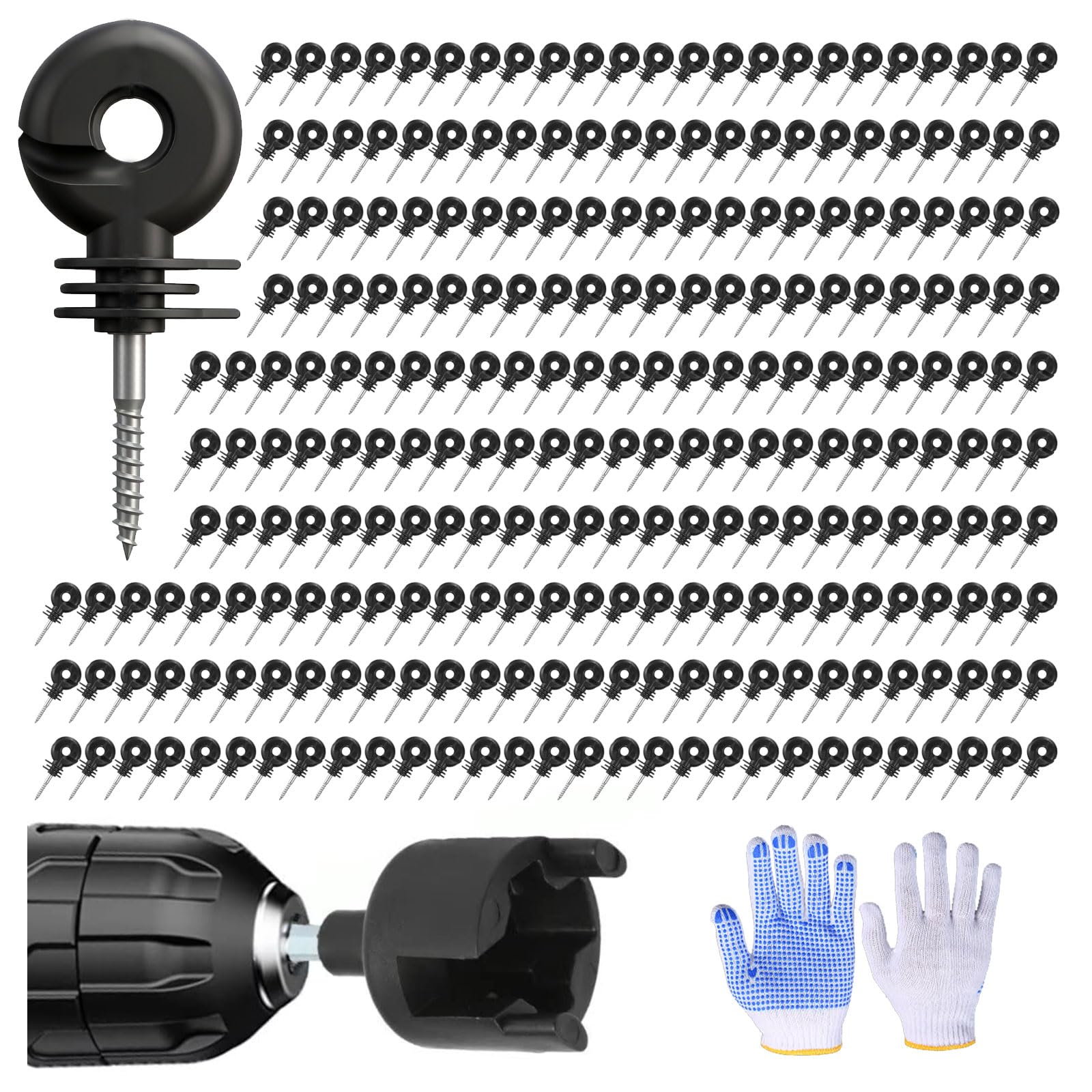
The gloves are the giveaway that someone who has screwed in a few hundred of these packed the box: 110 black rings, a socket adapter for a drill, and a pair of work gloves. It is a small thing, and it is the sort of small thing that means you can open the box and start on the fence instead of hunting for a driver.

These rings take wire, polywire, rope, and electric fence tape, and they are sold for the start, end, and corner of a run as well as the straight sections. That last part is the useful bit: the angled slot takes a conductor on the turn, so a corner does not need a different fitting.

Installation is the usual screw-in routine. Start the point square, keep the pressure light, and let the coarse thread cut rather than forcing it. The ring measures 3.54 inches overall and 1.57 inches wide, a workable size for a hand drive as well as a drill, and 110 of them is a weekend on a smallholding or a garden perimeter rather than a season on a ranch.

Where this kit beats the other small boxes here is versatility. The same ring covers four kinds of conductor and corner duty, so a mixed fence, say a strand of polywire for the sheep and tape along the road frontage, does not need three kinds of hardware in the shed. If your line is one conductor on straight runs, a plain ring box costs less per piece. If it is not, this is the tidy answer.

Bottom line: 110 rings, a drill adapter, and a pair of work gloves: a sensible small-batch kit for mixed wire, rope, and tape on timber posts.

8

Lock Jawz T-360 Insulator

Lock Jawz T-360 Insulator

Awkward T-post runs

Our Score 9.0/10
Check Price

Worth Noting

  • Body can crack at the post channel
Fits
Standard T-posts, 1.25 to 1.33 lb
Pack Size
100 insulators
Positions
6 around the post
Conductors
Polyrope, polywire, steel, aluminum, barbed wire
Read the full review

A T-post never ends up exactly where you drew it on the plan. It gets driven at an angle, the studs face away from the wire, or the fence turns a corner and the insulator that worked for two hundred feet suddenly points at nothing. The T-360 answers that with a head that indexes into six positions around the post, so the wire slot lands wherever the run is actually going.

The wire weaves into the slot rather than being trapped under a flap that snaps shut, which means you can add or drop a strand later without cutting the run. The same body takes a single strand or a pair, and it handles polyrope, polywire, steel, aluminum, and barbed wire. No pins to lose, either, which sounds like a small thing until you have dropped a bag of them in the grass at dusk.

This is the insulator we reach for when a line is irregular, meaning a paddock with gates, corners, and a change in grade, and it earns its higher cost per piece exactly there, where a fixed-direction insulator forces you to compromise on where the wire pulls. One caution: a smooth poly conductor can slide through the slot when you crank the tension on, so tension at the end posts and let the line insulators do nothing but carry the wire.

For a straight half-mile, a plain yellow wrap-around is cheaper and just as good. The T-360 pays for itself in the awkward ten percent of a fence: the corners, the gate posts, the place where the ground drops away and the wire has to follow it down.

Bottom line: When a post is driven crooked or the line turns, this head aims the wire where it needs to go, with six positions around a standard T-post and no pins to lose.

How We Tested Electric Fence Insulators

We started by pulling together the insulator styles that show up in real fence plans: screw-in corner insulators, nail-on wood-post insulators, T-post clips, ring insulators, and replacement collars for temporary polywire. I filtered the shortlist by post type, wire gauge compatibility, whether the hardware came in the pack, and cost per usable insulator rather than cost per bag. That left 14 types, which we used over five months on a half-acre goat paddock, a garden deer fence, and a few wooden corner posts that needed re-wiring.

Installation was the first real filter. I installed each type solo with a cordless drill or hammer and noted whether the screw bit into hard oak without stripping, whether the nail bent or mushroomed, and whether the insulator cracked when it was snugged down. On T-posts, I checked that the clip seated by hand and stayed put when I pushed the wire into the channel; on wood, I looked for a flush fit that did not wobble. Then I strung polywire and aluminum wire around the paddock, tensioned the line at the corners, and watched for sag, slippage, and wire that popped out after I bumped it with a boot.

Insulation and durability got the ugly-weather test. I left every insulator in place through spring rain and sun, checked voltage at the far end of the fence with a tester, and looked for cracks, chalky plastic, or collars that had stretched. At the end, I added up the hardware and compared price per post—some cheap packs lost their value fast when screws stripped or nails were missing. The ones that made the list were the ones that installed cleanly, held wire tight, and still read full voltage after months outdoors.

How to Choose Electric Fence Insulators

Match the fixing to the post

A T-post insulator wraps over the studs and holds on by tension; a wood-post insulator is nailed or screwed in. Those two are not interchangeable, and no amount of clever molding changes that. Check the stud size on your steel posts as well, because standard studded T-posts run 1-1/4 and 1.33 inches, and a wrap-around molded for one can fight the other.

We count post types before ordering rather than after, and that count has to include gate posts and corner braces, which are usually a different material from the run. A fence with steel line posts and wooden corners needs two kinds of insulator, and buying one box of each beats improvising at the last post in the rain.

Clearance and the conductor you are running

Insulators do two jobs: hold the conductor off the post and hold it in place. Standoff matters most on wood, where 2 1/2 inches clears a fence line and a longer extender earns its keep where wire has to pass a wide post or a branch line. The slot matters just as much. Most rings are built for 8 to 30 gauge high-tensile wire, polywire, and rope up to about a quarter inch.

Poly tape is the odd one out, because tape wants a holder that spreads it flat rather than gathering it into a ring. If your fence is tape along a road frontage, buy for the tape first and treat wire compatibility as a bonus, not the other way around.

Pack size, hardware, and what comes with it

Buy the box that matches the job rather than the largest one on the page. A 25-count bag suits repairs and short runs; a 200- or 300-count box is for a fence going up all at once, and it is money sitting in the shed if you only need a dozen. Then read what is included. A nail-on insulator without nails means a second trip, and a screw-in ring without a driver means sore fingers by the twentieth post.

We lean toward the kit that includes its driver, because that is the part you cannot improvise at the far end of a field. Check the screw length against your stock, too: a shank longer than the board is thick will show through the back of it.

What actually kills an insulator

Plastic insulators fail in two ways you can do something about. Ultraviolet light makes the plastic chalky and brittle until it cracks at the stud or the screw hole, and a fitting driven too hard onto a post that did not match splits at the collar. Both are manageable. Keep spares out of the sun, drill a pilot hole in hard timber, set the drill clutch light, and walk the fence once a year replacing anything cracked.

We keep a spare bag in the barn and expect to lose a handful a season. A cracked insulator is a small leak that quietly costs you voltage on the whole run, and swapping it takes less time than finding the fault did.

Frequently Asked Questions

Final Verdict

Insulators are the cheapest part of an electric fence and the part that decides whether the charge reaches the far gate. For a steel T-post line, the Zareba wrap-around is the default: no tools, the lowest cost per insulator here, and a spare bag on the shelf absorbs the occasional cracked one. On timber, move to the Zareba slant nail if you want a nailed fixing, or the Sweetude box if you want a drill and 200 rings at the same per-insulator money as the bulk kit.

Buy for the posts you have, not the ones you wish you had. That single decision settles more of this purchase than any other specification on the page.