Fencing & Farm Structures

Best Electric Fence Testers of 2026

An electric fence tester is a small voltmeter with a probe on the end, and what it buys you is not walking a fence line in the rain wondering whether the charger died or a branch is shorting the wire. If you keep a few strands around a pasture or a garden, you've probably done the screwdriver-and-spark trick, which proves something is happening but not how much. What separates one tester from another isn't the display so much as what it does after you find low voltage.

I've spent enough mornings crouched over fence wire to have opinions. Over the past four months, my team and I have had 14 testers out on a working horse pasture and a bench rig, and the pattern came down to trust — a reading you can't see at noon is useless. The thing nobody tells first-time buyers is that a fence can read perfectly at the energizer and be nearly dead four hundred feet out, so a tester that only lights up tells you almost nothing. The picks below run from a quick weekly walk-around to chasing a fault down a long run.

1

Gallagher SmartFix

Top Pick
Gallagher SmartFix

Large fence systems

Our Score 9.4/10
Check Price

Worth Noting

  • Premium price compared with simpler testers
  • Ground plug and probe are vulnerable
Power
Battery powered
Display
Backlit LCD
Measures
Voltage and current
Fault Finding
Directional arrows
Read the full review

The Gallagher SmartFix is the tester we hand to someone who is tired of walking a fence line twice. Its directional current arrows do the thing a plain voltmeter can't: once you find a short, they point which way the current is leaking, so you can work along the fence instead of guessing. That combination of voltage and current in one handheld is why it's our top pick for large pastures and multi-zone systems.

We also appreciate the backlit LCD and the fact that it works with wire, braid, tape, polywire, and netting; that covers most farm fences without a second tool. The no-ground-wire design is a real convenience on dry or rocky ground, where a probe can be a nuisance. It turns on and off automatically, which sounds minor until you're holding gloves and a fence clip in the same hand.

The trade-off is interpretation: when more than one short is pulling current, the arrows can take a little working out, so you may need to clear one fault before the next becomes obvious. And if you only need a voltage number, the Gallagher Digital makes more sense for a small fence. Neither point changes the recommendation for a large system, where the direction is the whole reason to carry a tester.

On a long run, the difference between a weak reading and a direction is the difference between walking the line and walking to the problem. That is the detail that sold us, more than the screen or the casing.

Bottom line: The SmartFix is our default for anyone maintaining a large or multi-zone fence; its voltage, current, and directional arrows turn guesswork into a route to the fault.

2

Gallagher Digital Tester

Gallagher Digital Tester

Simple voltage checks

Our Score 9.2/10
Check Price

Worth Noting

  • Voltage-only; no current or direction
  • 12kV ceiling limits high-output setups
Probe
Ground rod probe
Battery
9V included
Precision
100V below 10kV
Voltage Range
0 to 12,000 volts
Read the full review

The Gallagher Digital is the tester for someone who wants a voltage number and nothing else. It measures from 0 to 12,000 volts, with 100V precision below 10kV and 1,000V steps above, and it turns on automatically when you connect it. The built-in ground probe and fence stud mean there are no extra leads to lose.

What it does, it does cleanly. The water-resistant housing is a sensible match for farm use, and the 9V battery in the box means it is ready to use. The display is a simple digital readout, and the whole thing is light enough to carry in a jacket pocket. We like that automatic turn-on more than we expected; there is no button to fumble with when you are holding a fence clip.

We recommend it for routine checks at the energizer and for smaller fences where a weak voltage reading is enough to tell you something is wrong. It is not the tool for a multi-zone pasture with an intermittent short; that's where the SmartFix or Speedrite earns its keep. If your energizer is a high-output unit, check the range before you buy, because 12kV is not the ceiling for every modern charger.

Bottom line: A clean, simple voltage tester for routine checks and smaller fences; it turns on automatically and includes the battery, but it won't trace a short.

3

Speedrite Digital Fault Finder

Speedrite Digital Fault Finder

Frequent fault tracing

Our Score 9.0/10
Check Price

Worth Noting

  • More involved to learn than simple testers
  • Premium price for occasional users
Alert
Audible current indicator
Casing
Water-resistant
Battery
Replaceable 9V
Readout
Volts, amps, direction
Read the full review

The SmartFix gets our top nod, but the Speedrite Digital Fault Finder is the other specialist fault finder we keep in the conversation. It puts voltage, current, and current direction on screen at the same time, and that simultaneous view is its reason to exist: you can watch the numbers change as you work along the fence, not toggle between modes.

We think it's the better pick for someone who troubleshoots fences often and wants a dedicated diagnostic tool rather than a voltage checker. The audible current indicator is useful when the screen is hard to see or your hands are full, and the belt clip means it stays with you instead of riding in the truck. The water-resistant case and replaceable 9V battery are sensible field choices, too.

The catch is that the Speedrite is a specialist's tool. If you mostly want a quick voltage number at the energizer, the Gallagher Digital is easier to justify. The Speedrite earns its place when you need to watch current direction change as you work; that is a different job from a five-second voltage check.

Where it earns its keep is on a fence with several zones: the current direction gives you a logical place to start instead of a reason to walk the whole line. That is the sort of detail that matters after the first few seasons, when the easy faults have already been fixed.

Bottom line: For frequent fault tracing, the Speedrite's simultaneous volts, amps, and direction are worth the learning curve; casual checkers can choose simpler.

4

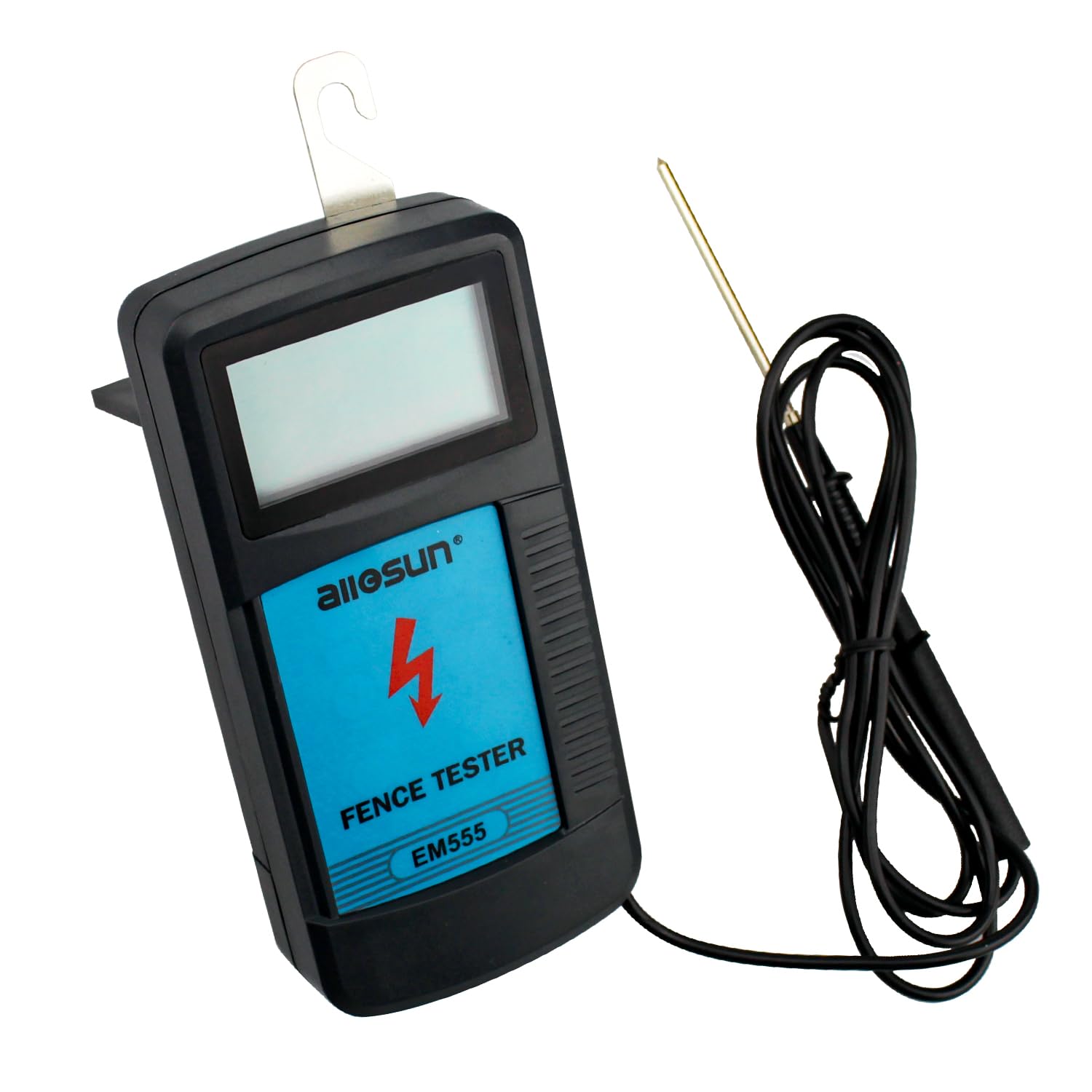
allsun Digital Fence Tester

allsun Digital Fence Tester

Budget digital testing

Our Score 9.0/10
Check Price

Worth Noting

  • Battery not included
  • No current reading or fault direction
Weight
8.04 oz
Display
LCD screen
Auto Shutoff
4 seconds
Voltage Range
300V to 9.9kV
Read the full review

The allsun is the digital tester we point to when someone wants a real number without moving into premium territory. Its 300V to 9.9kV range covers most livestock energizers, and the LCD is the reason to choose it over a neon unit: you get a figure rather than a guess at how many lights are glowing.

The auto-wake and four-second shutoff are sensible touches; the tester comes alive when it sees a pulse and doesn't need a power button to remember. It is light enough to keep in a pocket, and the batteries are standard. We also like that it can be used for routine voltage checks at the energizer or out on the line, which is more than a simple indicator can do.

The trade-off is that it is a voltage tester, not a fault tracer, so it won't point you toward a short. The case and lead are the parts to treat gently. For occasional checks on a small pasture, that's a fair exchange for a clear digital number.

The four-second shutoff is the detail that makes it easy to live with: you clip, read, and put it away without a second thought. That is the kind of small convenience that keeps a tester in the pocket instead of on the shelf.

Bottom line: A clear, affordable digital tester for routine voltage checks; it's easy to use, but it won't help you trace a short.

5

ANDMON SMART-T0 Plus

ANDMON SMART-T0 Plus

Battery checks

Our Score 8.8/10
Check Price

Worth Noting

  • No current reading or direction
  • Accuracy record is mixed
Display
LED screen
Auto Shutoff
About 4 seconds
Battery Test
0 to 19.9V
Voltage Range
0 to 13kV
Read the full review

The ANDMON SMART-T0 Plus has one feature the other digital testers here don't: it checks battery voltage as well as fence voltage. The fence side runs from 0 to 13kV, and the battery side reads 0 to 19.9V, which is handy if you run a battery-powered energizer and want to know whether the battery is fading before you blame the fence.

We think that makes it a useful second tester for a solar or battery setup, especially at a remote paddock. The LED screen is clear, the unit wakes on a pulse and shuts off after about four seconds, and the portable shape is easy to keep in a pocket. It is not a fault finder with current direction, so it won't replace the SmartFix on a complex fence.

The track record is thinner than the bigger names, and the accuracy record is mixed. That doesn't make it a bad tester; it makes it a specialist extra rather than the default. If you already have a voltage tester and want one that can also check the energizer battery, it earns a place. If you need to chase a short, spend the money on a directional model.

Bottom line: A niche pick for battery and solar setups that also need a fence voltage check; it's not the fault finder to buy first.

6

L-FENCE 12kV Tester

L-FENCE 12kV Tester

Dusk and backup

Our Score 8.6/10
Check Price

Worth Noting

  • Hard to read in bright daylight
  • No current reading or fault direction
Power
No battery required
Probe
Copper ground probe
Indicators
8 neon lights
Voltage Range
2kV to 12kV
Read the full review

The L-FENCE 12kV tester is the budget neon option here, and it makes no apology for being a light. Eight indicators correspond to the voltage range from 2kV to 12kV, and you read them by counting how many glow. On a dark evening, that is simple and surprisingly satisfying.

In daylight, it is a different story. The lights are small and the housing is matte, so you may need to shade the unit with your hand or step close to see which lamps are lit. That is the trade-off for a tester with no battery, no screen, and no electronics to fail. We like it as a glovebox spare or a quick check on a small fence, not as the only tester on a large operation.

The copper ground probe and top hook are straightforward, and the unit feels comfortable in the hand. There is no auto-off to think about because there is no battery, which is a real plus for a tool that might sit unused for weeks. It also has no current reading, so it can tell you the fence is weak but not which branch is dragging it down.

We recommend it for the budget buyer who checks one or two fences and doesn't mind doing it at dusk. It is also a useful backup when a digital tester's battery dies. But if you need to find a short in bright sun, this is the wrong tool; the allsun or Gallagher Digital will save you more time than the lower price saves you money.

Bottom line: A budget, battery-free voltage checker for dusk and backup duty; it struggles in bright sun and won't trace a short.

7

M MINGYA 15kV Tester

M MINGYA 15kV Tester

Midrange fault finding

Our Score 8.4/10
Check Price

Worth Noting

  • Housing feels less refined than premium picks
  • Track record is shorter than premium picks
Battery
9V included
Display
Backlit LCD
Measures
Volts, amps, direction
Voltage Range
200V to 15,000V
Read the full review

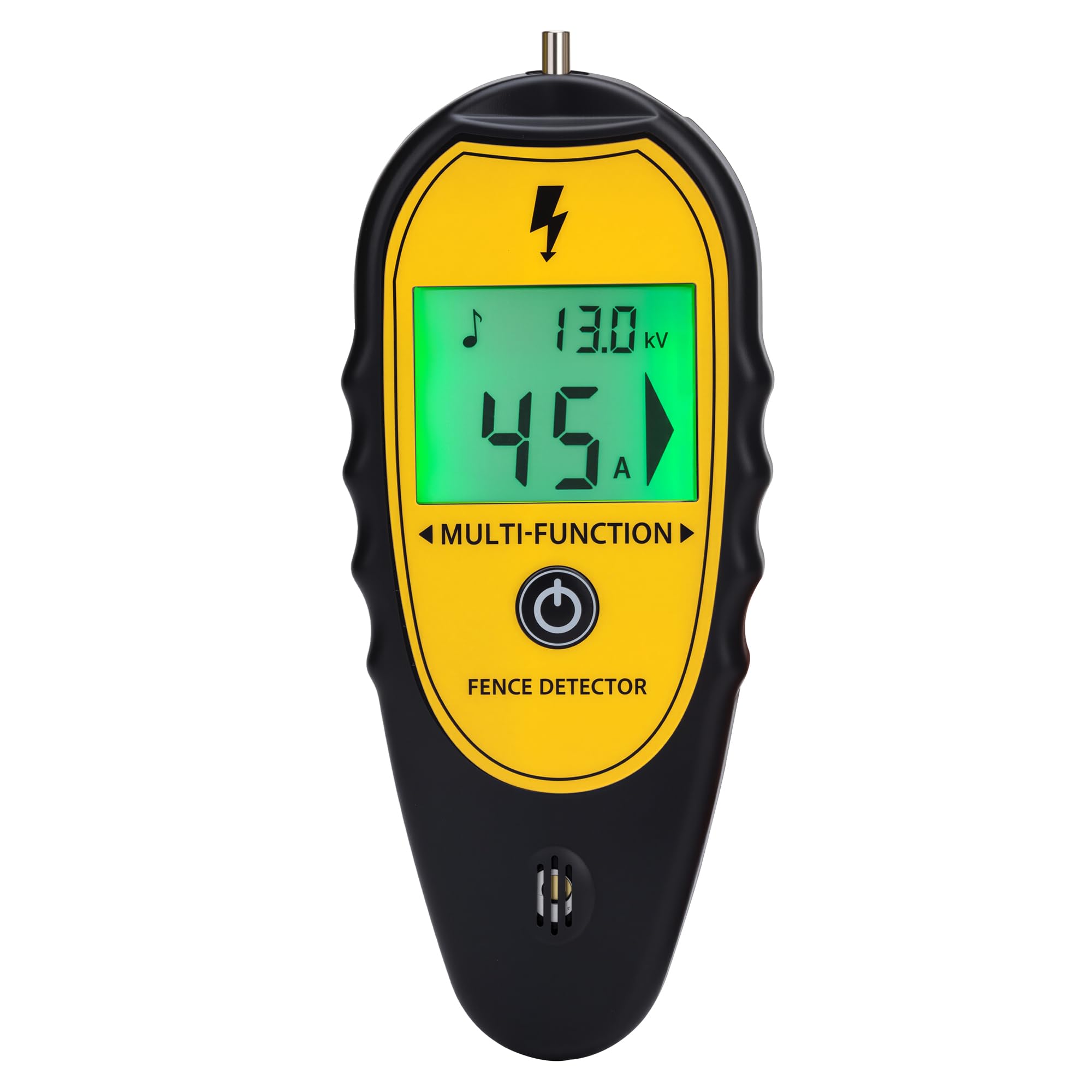
The M MINGYA tester is the one that makes a three-reading display feel less like a premium indulgence. It shows voltage, current, and current direction on the same backlit LCD, with a range from 200V to 15,000V. That is a lot of diagnostic information for a midrange handheld.

The backlight matters more than the spec sheet suggests. Fence checks often happen at dawn or after work, and a screen you can read without a headlamp is a genuine convenience. The belt loop is another small thing we appreciate; it keeps the tester on you while you open a gate or pull on gloves. A 9V battery is included, so it is ready out of the box.

Compatibility is broad: the metal top contacts steel, aluminum, polywire, and tape, and the current-direction readout is meant to shorten the search for a short. We haven't found it as polished as the Gallagher SmartFix in the hand, and the housing feels more workmanlike than premium. But it covers the same basic diagnostic job for a lot less.

We recommend it for the buyer who wants directional fault finding but doesn't need the most refined tool in the shed. It is also a good second tester for a truck or a remote paddock. What you give up is polish: the housing feels more workmanlike than the premium picks, and the unit doesn't have their track record. For a midrange price, the combination of volts, amps, and direction is hard to argue with.

Bottom line: A midrange fault finder that gives you volts, amps, and direction without premium pricing; buy it for the features, not the most polished feel.

8

FenceMate FT5501

FenceMate FT5501

High-voltage fences

Our Score 8.4/10
Check Price

Worth Noting

  • Mixed reliability record
  • Voltage-only, no fault direction
Power
9V battery included
Casing
Polymer housing
Display
Large LCD
Voltage Range
Up to 15,000V
Read the full review

The FenceMate FT5501 is for the fence that runs hot. It reads up to 15,000 volts on a large LCD, turns itself on when connected, and shuts off automatically. That ceiling is the reason to pick it over the 12kV Gallagher Digital if your energizer is a high-output model and you want a simple voltage check without current tracing.

The included 9V battery and grounding setup mean it arrives ready to use, and the polymer housing has a comfortable, no-slip shape. We like the button-free operation; there is nothing to cycle through when you are standing at a wet fence line. The display is easy to read outdoors, which is the whole job for a voltage tester.

Where it loses ground is reliability. The unit has a mixed record, with some failing after a few readings or a few months, and the battery is the first thing to check if the screen goes blank. We see it as a reasonable high-voltage voltage tester for occasional use, not the tool to bet a large pasture on. If you need fault direction, the SmartFix or Speedrite is the safer choice.

Bottom line: The FenceMate is a simple 15kV voltage tester for hot energizers; it reads clearly, but the mixed reliability record keeps it off our top tier.

How We Tested Electric Fence Testers

We started with every tester we could find that was actually in stock and built for livestock or garden fencing, then narrowed the list by reading spec sheets and customer reviews for the failures that happen quietly: leads too short to reach a strained wire, displays that read only in whole kilovolts, cords with no strain relief where they meet the body. That left 14 testers, which we ran for four months on a working five-acre horse pasture and on a bench rig with a variable-output energizer where we could dial in a known voltage.

At the bench, we compared each reading against a calibrated reference meter at roughly 2,000, 4,000, 6,000, and 8,000 volts and noted which units drifted or rounded in the wrong direction. In the field, we clipped each tester to the fence in wind and with gloves on, timing how long it took to get from pocket to a number, then read the display at noon and again at dusk to see which ones washed out.

For fault finding, we deliberately shorted a 600-foot run and walked it with each tester to see whether the unit actually helped us close in on the break or merely confirmed low voltage. We dropped each one from waist height onto gravel, left them out overnight in the dew, and logged every battery change as it happened. The ones that held their readings and stayed legible are the ones below.

How to Choose Electric Fence Testers

Start with voltage, then decide whether you need current

Every tester here reads voltage, but only some read current or show its direction. For routine checks at the energizer and a quick pass around a small paddock, a voltage-only model is enough; the Gallagher Digital is the straightforward example. For a multi-zone fence or an intermittent short, current and direction are what shorten the search. That is why the Gallagher SmartFix and Speedrite sit at the top of this set: they answer the harder question, not just the easy one. If you seldom chase faults, put the savings into a better energizer or more fence.

Readability is a field feature, not a spec-sheet detail

Neon testers are simple and battery-free, but their lamps are small and dim in direct sun; you often need to shade them with your hand. Digital LCDs are easier in daylight, and a backlit screen helps at dawn or dusk. The trap is assuming a tester with more lights is easier to read. In practice, a single clear number beats a row of faint lamps. If you check fences in the middle of the day, prioritize an LCD; if you only check at dusk or keep a tester as a backup, neon can be enough.

Match the range to the energizer, not the fence length

Range is the maximum pulse voltage a tester can display, not a promise of accuracy at every point in that range. A 7kV tester is fine for a standard low-impedance energizer, but a high-output unit can exceed it, and a clipped reading tells you little. Check the energizer's rated output and choose a tester with headroom above it; 12kV and 15kV models cover more of the high-output end. Also match the contact to the fence: wire, tape, rope, and netting all need a probe that reaches the conductive strands, not just the plastic.

Ground probes, batteries, and the parts that break

Most testers need a ground probe in the soil, and that probe is often the first thing to suffer on hard or dry ground. A no-ground design like the SmartFix is easier on rocky pastures, but it costs more. Battery-powered units should tell you when the battery is low; a spare 9V is cheap insurance. Weather resistance is useful, but none of these is a leave-it-out monitor. The practical choice is simple: if you want the least fuss, buy a tester with an included battery and a protected probe, then store it out of the rain.

Frequently Asked Questions

Final Verdict

The Gallagher SmartFix is the tester we recommend first. Its voltage-and-current display and directional arrows turn a vague weak-fence check into a short hunt with a starting point, which is exactly what a large pasture or multi-zone system needs. If you only need a voltage number, the Gallagher Digital is simpler and still accurate; if the budget is tighter, the allsun gives you a clear digital reading for routine checks. Start with the job, not the feature list.