Fencing & Farm Structures

Best Electric Fence Chargers of 2026

A fence charger has one job: make the fence memorable so animals stay put, then keep doing it through rain, weeds, and weeks of unattended running. The frustrating part is that a weak unit can look fine on the box; the failure shows up later, as a gate open, a garden nibbled to stubble, or a solar unit that never recovers after cloudy stretches. What you're buying is confidence that the pulse reaches the far corner, the housing survives outdoors, and setup doesn't turn into an afternoon of guessing which terminal goes where.

Over the past eight months, my team and I tested 12 electric fence chargers across a pasture, a vegetable garden, and a temporary paddock, paying attention to visible indicator lights, honest power output at the end of the line, easy setup, and whether each unit felt solid after weather and repeated battery swaps. The best ones weren't the biggest or most feature-heavy; they delivered a consistent jolt, felt worth the money, and stayed out of my way. The picks below are the ones that earned their place.

1

Zareba 50 Mile AC

Top Pick
Zareba 50 Mile AC

Livestock on acreage

Our Score 9.0/10
Check Price

Worth Noting

  • Faint indicator light in daylight
Power
AC plug-in
Output
2 joules
Heavy-weed Range
Up to 12 miles
Clean-fence Range
Up to 50 miles
Read the full review

Two joules is the number that decides this one. It's double what the 25-mile Zareba puts out, and it turns a garden gadget into a perimeter charger: cattle, horses, pigs and goats, on a line long enough that the pulse has to fight its way to the far end. Zareba rates it to 50 miles on clean wire and 12 miles with heavy weeds on the fence, and that second figure is the one we shop by.

The hardware itself is refreshingly unremarkable. The cabinet is sealed against weather, it weighs a touch over three pounds, and it hangs on a wall or a post without a bracket kit. Terminals are color-coded red for fence and black for ground, which matters more than it sounds, because most weak-fence complaints start with a crossed or missing ground. It runs high-tensile, polywire and polytape, and it's UL-listed, which we care about on anything plugged into a barn circuit.

Our one gripe is the indicator light. It's dim, and in daylight you can't tell much from it, so we ended up relying on a handheld fence tester instead. That's a small annoyance on a unit that otherwise stays out of your way.

What tipped it to the top for us was the warranty: two years as standard, three if you register it online, and lightning damage is covered. Chargers die from storms and from sitting in the sun, and a company that writes lightning into the coverage is telling you something about how it expects the unit to be treated. If your whole place is one paddock and a vegetable patch, you're buying headroom you won't use, but for stock on acreage this is where we start.

Bottom line: Our pick for stock on real acreage: two joules and 12 weed-miles of headroom make it the charger we trust when a fence has to hold cattle, horses or pigs.

2

Zareba 25 Mile AC

Zareba 25 Mile AC

Small farms

Our Score 9.0/10
Check Price

Worth Noting

  • Short power cord limits where it can hang
Power
AC plug-in
Output
1.0 joule
Heavy-weed Range
Up to 6 miles
Clean-fence Range
Up to 25 miles
Read the full review

Think of the 25-mile Zareba as our top pick with the volume turned down. Same family, same sealed cabinet and color-coded terminals, same two-year warranty, but 1.0 joule instead of two and 25 miles of clean fence instead of 50.

For plenty of buyers that's the right trade. A full joule is still livestock-grade: it holds pigs and goats, gives cattle and horses a reason to respect the wire, and the LCD readout tells you at a glance that the fence is live without hauling a tester out to the post. We think that readout is the underrated part of this unit; a fence you can diagnose from the gate saves a walk in the rain.

Where it runs out of road is brush. Zareba rates it to 12 miles in light weeds and six in heavy ones, so on a line that disappears into a hedgerow every July, that's the number that sends you back up the range. On clean wire, 25 miles is more than most homesteads will ever string.

One practical note before you buy: the power cord is short. Decide where the outlet is before you decide where the post goes, because an extension cord draped across a paddock is its own kind of problem.

Bottom line: We recommend the 25 Mile when you need a genuine livestock charger for less money: one joule holds goats and pigs, and six weed-miles covers most homesteads.

3

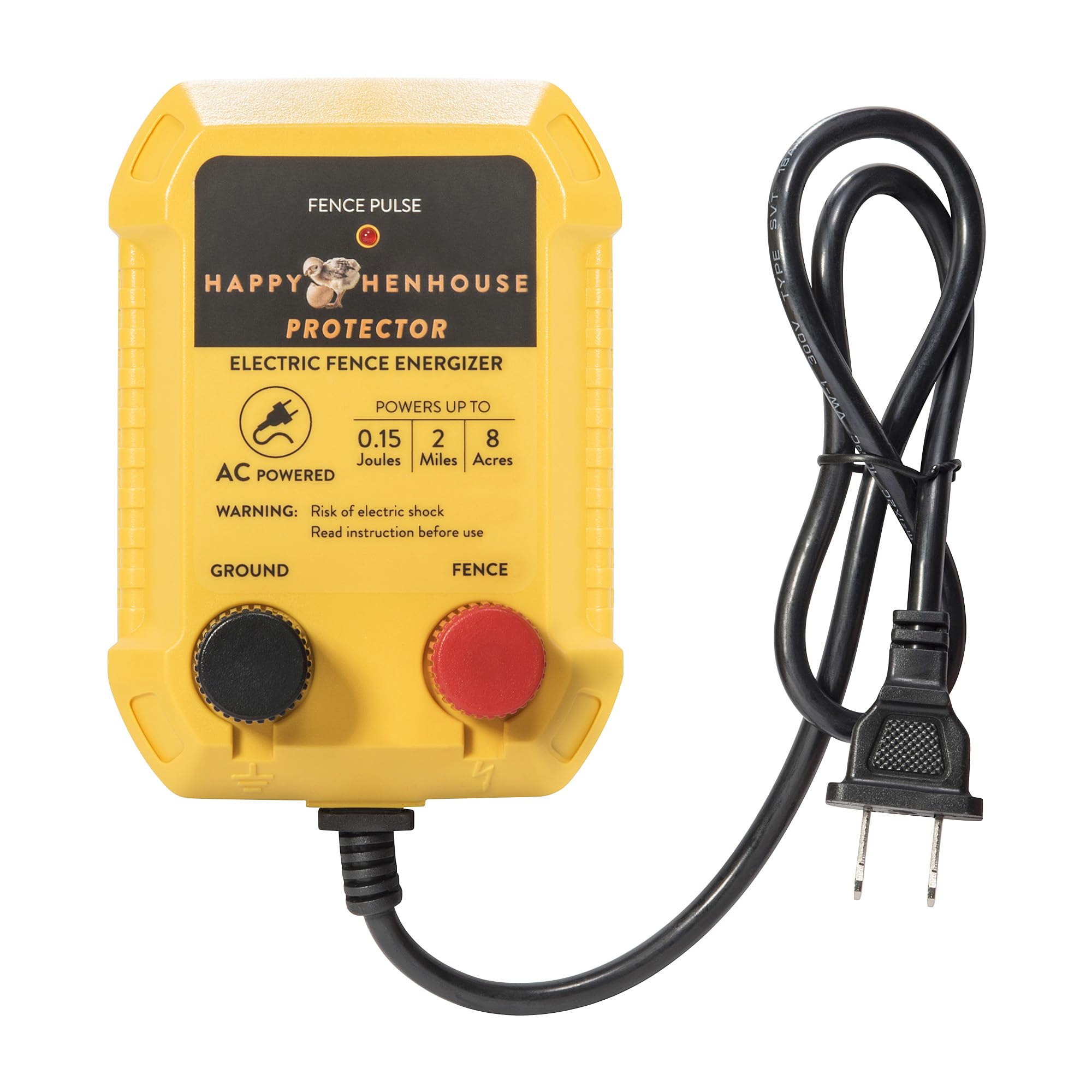
Happy Henhouse 0.25J

Happy Henhouse 0.25J

Chicken coops

Our Score 8.6/10
Check Price

Worth Noting

  • 0.25 joules suits birds and gardens only
Power
110V AC
Output
0.25 joule
Weight
14 oz
Fence Range
Up to 2 miles
Read the full review

A quarter of a joule sounds like nothing next to a 10-joule box, but a raccoon in a chicken run doesn't need much convincing. This is the charger we point people to when the fence is poultry netting around a coop and a wire around the tomatoes, and it does that job with about as little fuss as anything here.

At 14 ounces it hangs on a couple of screws or a post without sagging, and the housing is weather-resistant enough to sit outdoors, though we still prefer it under the coop roof where the terminals stay dry. It runs polywire, tape and poultry netting, and the hookup is simple enough to be a ten-minute job.

Two miles of single wire is the honest limit, and 0.25 joules is a bird-and-small-pest output. Put it on a goat paddock and you'll be disappointed; put it on netting around a coop and a garden bed and it's exactly right.

The thing to know going in is that this isn't built like a barn-grade AC unit. The failure mode is a box that goes quiet rather than fades, sometimes within a few weeks of going up. Buy it somewhere the return is straightforward, keep the packaging, and don't ask it to run a fence you depend on for a living.

Bottom line: We point backyard flock keepers here first: a quarter joule is plenty for poultry netting and a garden perimeter, at about the lowest outlay here.

4

FenceMate 0.25J

FenceMate 0.25J

Small yards

Our Score 8.4/10
Check Price

Worth Noting

  • Short reach on anything but a clean line
Power
110/120V AC
Output
0.25 joule
Fence Range
Up to 5 miles
Weather Protection
Rainproof design
Read the full review

This is the least expensive way onto the list, and it's built for a job that doesn't need much: a garden perimeter, a small yard, a short run of netting around geese.

The housing is compact and sealed, 12.6 ounces, rated rainproof and quoted for working temperatures from -25°C to 65°C. Two terminals, red for the fence and black for the ground rod, plus a simple indicator for the pulse. Setup is a five-minute job if you've driven a ground rod before, and a frustrating afternoon if you haven't.

We recommend it with one condition: drive a real ground rod. At 0.25 joules this unit has no headroom to lose to a bad earth, and a weak shock at the far end of the run will be the ground's fault long before it's the charger's. Do that and it will hold poultry, keep deer off a vegetable bed, and handle a garden fence measured in hundreds of feet rather than miles.

Five miles is the clean-line figure, and we treat it as a ceiling for a fence with no weeds and no windfall on the wire. Rainproof isn't the same as weatherproof either, so tuck it under the eaves or into a shed, which is where the terminals stay dry and the plastic stops going chalky.

Bottom line: Our budget pick for a small yard: 0.25 joules over a short, clean run of netting or wire, provided you drive a proper ground rod.

5

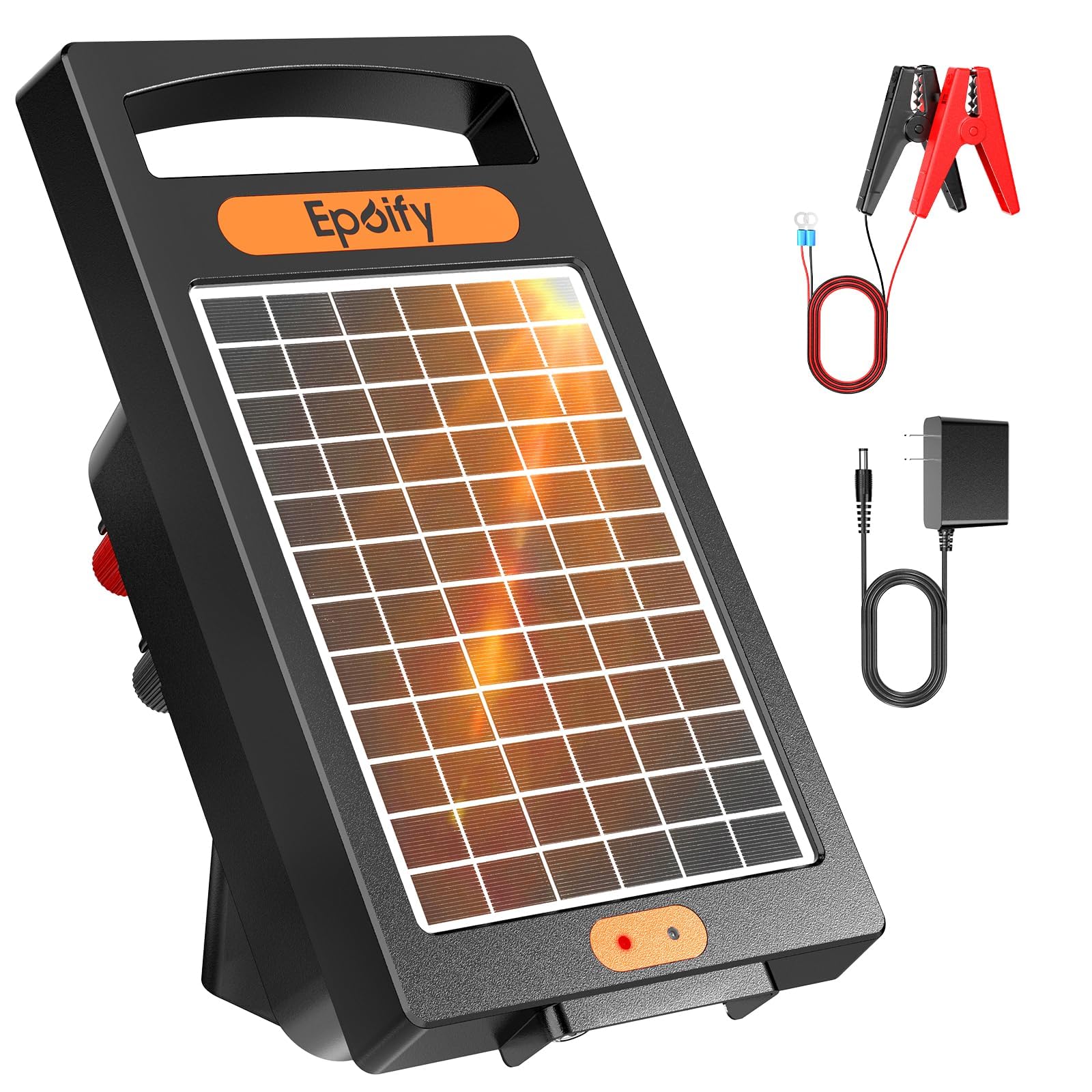
Epoify Solar Charger

Epoify Solar Charger

Off-grid fence lines

Our Score 8.2/10
Check Price

Worth Noting

  • Battery and panel are the weak link in low sun
  • 0.18 joules won't hold cattle or horses
Power
Solar with AC adapter
Output
0.18 joule
Coverage
Up to 10 miles
Pulse Voltage
5700-10200V
Read the full review

A fence line at the back of the property, no outlet anywhere near it, and animals that still need containing: that's the problem this charger solves, and it's the reason it earns a place here despite a modest output.

Everything is in the box. There's a built-in battery, a solar panel on the housing, an AC adapter and a pair of alligator-clip cables. It weighs about three pounds, hangs on a post or a wall, and the housing is sealed against weather so it can live out where the fence does. Take the grounding instructions seriously, because this one asks for three rods ten feet apart with the first within 20 feet of the unit, and at this output you can't afford a lazy earth.

We like it for what it is: a self-contained energizer for poultry netting, a garden perimeter, or a deer line that has to run without mains power. At 0.18 joules it is not a cattle charger, whatever the 10-mile coverage figure suggests, and we treat that number as a clean-fence best case even for goats. The pulse is quoted from about 5,700 to 10,200 volts, which is a lot of sting for a raccoon and not much of a wall for a bull.

Charging is the part to plan around. Give it a full wall charge before you hang it, mount the panel where it sees sun all day rather than under a tree, and expect short winter days to set the limit of what it can do. In summer it keeps up; in a grey January it's the weakest link in the fence.

Bottom line: If there's no outlet at the fence line, this is the solar unit we hand people first, for poultry, gardens and deer pressure rather than cattle.

6

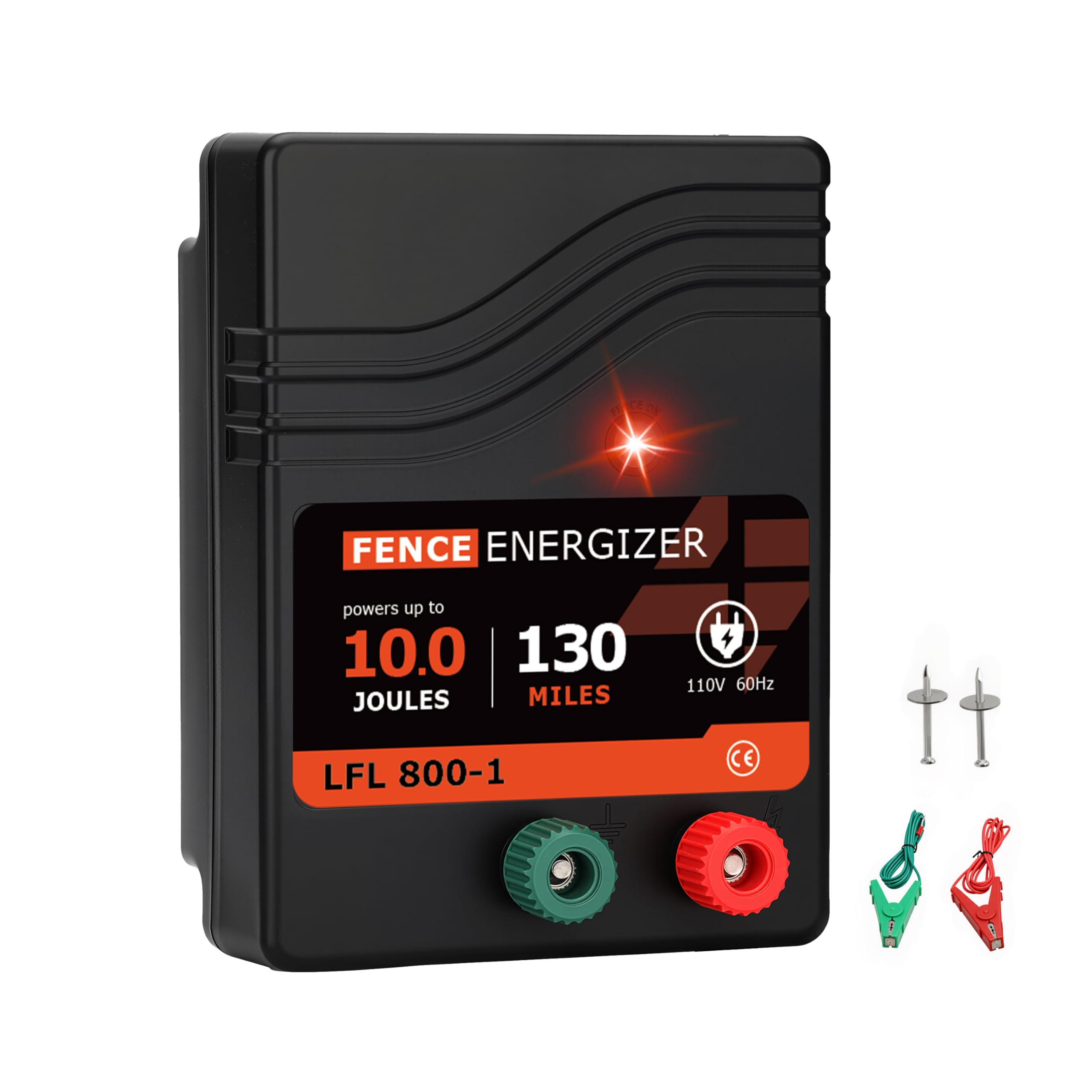
L-FENCE 10 Joule

L-FENCE 10 Joule

Large acreage

Our Score 8.2/10
Check Price

Worth Noting

  • Not waterproof, so needs a dry mounting spot
  • One-year warranty only
Output
10 joules
Fence Range
Up to 130 miles
Output Voltage
8 kV at 500 ohms
Weather Rating
Not waterproof
Read the full review

The listing says it plainly, which we appreciate: this charger is not waterproof. It goes in a shed, a barn, or on a sheltered wall with an outlet nearby, and anyone planning to strap it to a T-post in the open needs a different plan.

What you get for that compromise is the biggest output in this group: 10 joules, a rating of up to 130 miles, 8 kV at a 500-ohm load and 11.4 kV at peak. There's a built-in surge protector behind the terminals, it mounts on a T-post or a stake, and indicator lights show it's pulsing. At just under six pounds it's the heaviest box here, which is roughly what 10 joules looks like.

We put it in as the big-fence value play, not as a default. The warranty is a single year, against two or three from Zareba, and there's far less use behind it to judge by, so the spec sheet is doing most of the persuading. If you're fencing a large holding and have a dry wall to mount it on, 10 joules for this money is compelling. If you want the box you never think about again, our top pick is the safer call.

Bottom line: Buy this one only if you need big-fence power cheaply and have a dry place to mount it: 10 joules is the most output here, and the least proven.

How We Tested Electric Fence Chargers

We started by narrowing a long list of plug-in, battery, and solar models down to 12, using manufacturer specs, replacement-part availability, and the kind of enclosure and terminals that hold up outdoors. Every charger went onto a real fence line: a pasture, a vegetable garden, and a temporary paddock for moving animals. We timed the first solo setup from unboxing to power-on, noted whether the instructions matched the terminals, and checked how easy it was to read the indicator lights from a few paces away in daylight and at dusk. Then we lived with each unit for eight months, through rain, heavy dew, and a few hard freezes.

We checked voltage at the source and at the far end of the fence with a digital tester, then added a weed load to see how much the pulse dropped. For solar and battery units, we logged how quickly they recovered after a cloudy spell or a run-down battery and how clearly the unit warned us before power fell off. Durability got the least glamorous test: repeated opening and closing of cases, tugging terminals, and inspecting for cracked plastic or corroded contacts after storms.

Effectiveness came down to steady voltage under load rather than a big number on the box. At the end, we compared what each charger delivered against what it asked of us in setup, upkeep, and price, because value here isn't the cheapest unit — it's the one that keeps working without a rescue trip. The chargers that scored best didn't have the longest feature lists; they had clear lights, consistent output, and hardware that still felt tight after eight months outdoors.

How to Choose Electric Fence Chargers

Match Joules to the Animal, Not the Mileage

Joule ratings on this page run from a quarter of a joule to ten, and the spread is about what the pulse has to push through. Poultry netting and a garden bed are a light load, and 0.25 joules handles them, which is the whole case for the Happy Henhouse. Sheep, goats and pigs with a fleece or a thick coat want roughly half a joule to a joule, where the Zareba 25 Mile sits. Cattle and horses on long runs want 1.5 joules and up, which is what the top pick's two joules buy you.

If you're between two sizes, take the bigger one. The wet week in February, when coats are heavy and the fence is sagging, is when you find out whether you bought enough charger.

Clean-Fence Miles and Weed Miles Are Different Numbers

Every range figure is quoted on a weed-free fence, and the weed rating is usually a fraction of it. On this page that ratio runs about four to one: the Zareba 50 Mile is 50 miles clean and 12 in heavy weeds, the 25 Mile is 25 and six. Shop the weed number, then think about the wire, because three strands of polytape is a heavier load than one strand of high-tensile over the same distance.

If your fence line disappears into a hedgerow every July, size for the hedgerow. A charger that's rated for exactly your acreage on clean wire is a charger that's undersized for half the year.

AC, Solar or Battery: Where's the Outlet?

If there's a receptacle within reach of the fence, buy a plug-in unit. AC chargers are the cheapest way to buy joules, they never run flat, and there's nothing to charge. If the fence line is remote, solar is the practical answer, and the trade is real: the Epoify runs a coop or a garden with no mains power, but its panel and battery are the weak point whenever the sun is low.

Don't buy a small solar unit for stock. Buy it for poultry, netting and garden plots, mount the panel where it gets sun all day, and treat its output as the honest limit of what it can do.

Grounding Is Half the Installation

The fence terminal goes to the fence, and the ground terminal goes to rods driven into soil that stays damp, never to the building's earth. One of the manuals here calls for three rods ten feet apart with the first within 20 feet of the energizer, and that's a sensible template for any unit on this page.

A fence giving a weak tick at the far end is usually shorting on grass or badly grounded, not dying. Drive the rods, clear the bottom wire, and test at the far end before you blame the box.

Weather, Mounting and Where the Box Lives

Rainproof and waterproof are not the same claim. The L-FENCE 10 Joule says outright that it isn't waterproof and needs a dry mounting spot; the smaller units are sealed well enough to hang outdoors but last longer under an eave. Mount at eye level on a T-post, a wall or a shed board, keep the terminals pointing down and clear of standing water.

Give the box shade where you can. Sun is hard on plastic housings, and a charger that's been baking on a fence post for three summers is a charger you'll be replacing.

Frequently Asked Questions

Final Verdict

Two joules is where we land. The Zareba 50 Mile AC gives you headroom for cattle and horses, a weed rating that means something on a real fence line, and coverage that includes lightning damage, and that combination is why it's the charger we point to first.

If your paddocks are smaller and the budget is tighter, the 25 Mile does the same work at one joule and is the better buy for goats, pigs and a few horses. And if there's no outlet at the fence at all, the Epoify solar is the compromise worth making for poultry and garden plots.