Tree & Forestry Care

Best Electric Chainsaws of 2026

A chainsaw is one of those tools you don't think about until a storm drops half a maple across the driveway. I've been there, eyeing a tangle of wet limbs with a handsaw and a bad attitude. The right electric saw turns that afternoon into a twenty-minute cleanup—no gas can, no pull cord, no neighbor peeking over the fence. It also has to fire up every time you pick it up, which is where cheap models separate from keepers.

Over the past six months, I've cut with 12 electric chainsaws, corded and battery-powered, on everything from wrist-thick birch to a stubborn oak stump. Power and cutting speed are easy to feel in the first minute; the real tells were battery life under continuous load, whether the chain stayed sharp and tensioned after a few tanks of oil, and if the saw leaked bar oil on my shelf. I also cared about glove-friendly controls, a trustworthy chain brake, and value once you add a spare battery. The saws below are the ones that kept earning a spot in the truck.

1

EGO Power+ CS1613

Top Pick
EGO Power+ CS1613

All-around cordless

Our Score 9.4/10
Check Price

Worth Noting

  • Premium price for the battery kit
Weight
20.9 lb
Battery
56V 4.0Ah included
Bar Length
16 inches
Chain Speed
20 m/s
Read the full review

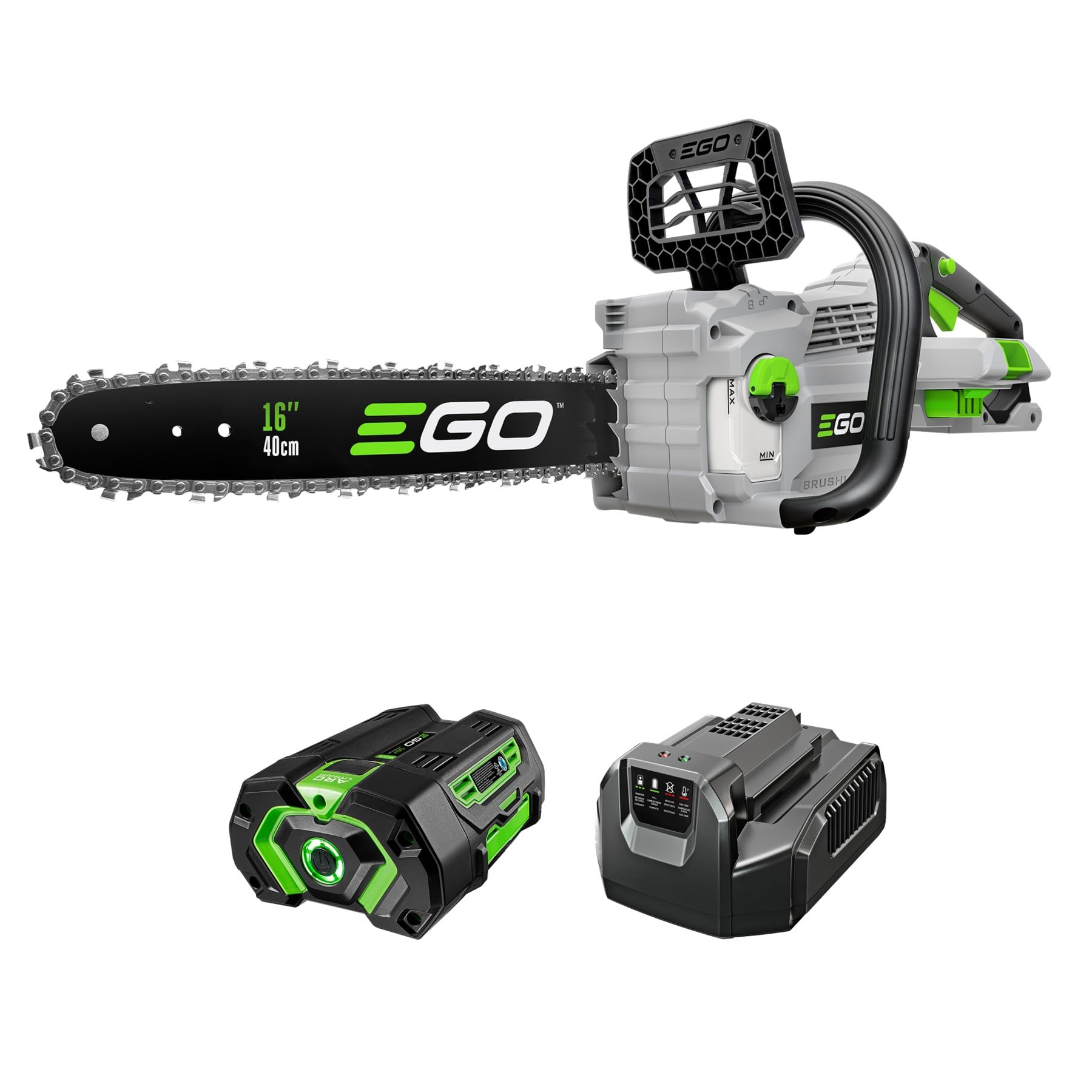
The EGO CS1613 pairs a 16-inch bar with a 56-volt battery, and that combination is why it is the saw we reach for when a job is too big for a compact 12-inch model but not worth a gas saw. Its brushless motor and 20 m/s chain speed put it in the same conversation as a 40cc gas saw, with the torque to keep the chain moving through a cut instead of stalling. That is why it is our top pick: it has the reach for storm limbs and small trunks without asking you to mix fuel or wrestle a starter cord.

The included 4.0Ah battery is the other half of the case. EGO rates it for up to 130 cuts through 4x4 with that pack, which is enough runtime for a morning of limbing and bucking rather than a few token cuts. The battery is shared with other EGO 56V tools, so the investment makes more sense if you are already on that platform. A standard charger comes in the kit, and the saw is compatible with the larger EGO ARC Lithium packs if you need more run time.

Tool-free chain tensioning is a dial rather than a wrench-and-screwdriver routine, and we appreciated being able to check tension between cuts without hunting for tools. The IPX4 rating is unusual for this group and gives the saw a measure of weather resistance for damp mornings. It is also quieter than a gas saw and starts instantly, which matters when you are making a handful of cuts rather than running a full-day operation.

The trade-off is heft: the listed 20.9 pounds is a lot to hold overhead, and the 4.0Ah pack is a big part of that. For ground-level bucking and storm cleanup, the balance and reach make the weight easier to live with. The 16-inch bar uses a 3/8-inch pitch, 0.043-inch gauge chain with 56 drive links, so replacement chain is straightforward to match.

Bottom line: For most homeowners, the EGO CS1613 is the electric chainsaw we recommend first: gas-like power, a 16-inch bar, and long battery runtime without a cord.

2

SEESII M16 Ace

SEESII M16 Ace

Mid-size cordless

Our Score 9.2/10
Check Price

Worth Noting

  • 10.3 pounds is heavy for overhead limbing
Motor
2000W brushless
Weight
10.3 lb
Batteries
Two 40V 4.0Ah
Bar Length
16 inches
Read the full review

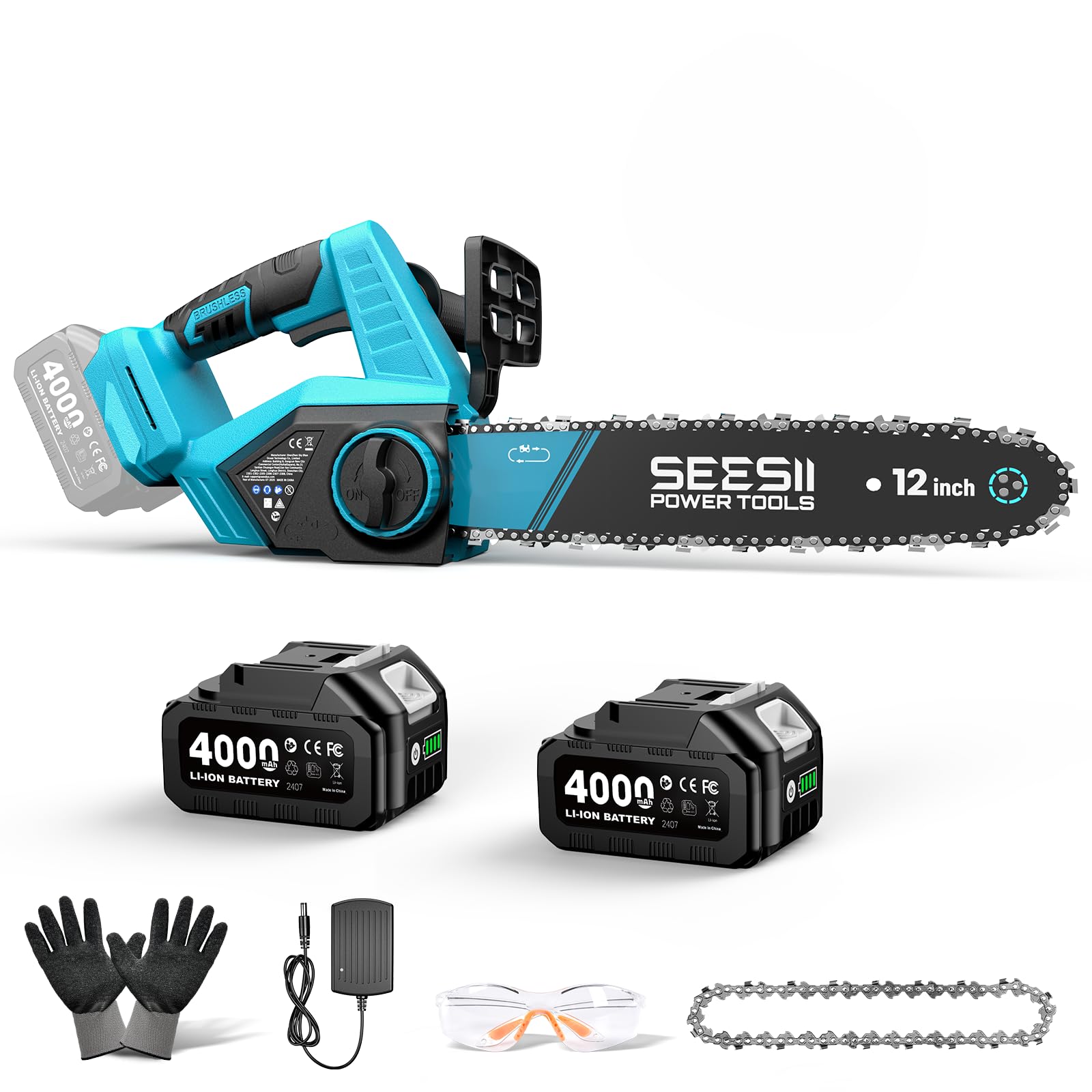
The SEESII M16 Ace takes the compact-cordless formula and stretches it to a 16-inch bar, a 2000-watt brushless motor, and two 40-volt 4.0Ah batteries. It sits between the compact 12-inch saws and the premium 18-inch machines, which is exactly where a lot of homeowners land. The 34.8 ft/s chain speed and 150 ml oil reservoir are the numbers to know.

The twin-battery setup is the practical part. Two 4.0Ah packs and a fast charger mean you can keep one battery on the charger while the other runs, and the saw is rated for up to 90 minutes of continuous runtime. That claim will depend on the wood and the cut, but the second battery is the buffer that makes it credible for a real cleanup rather than a quick trim.

The auto-oiler has a 150 ml reservoir, which gives you a useful buffer before a refill, and the tool-free tensioner is easy to reach. The 16-inch bar gives it more reach than the 12-inch SEESII, and the brushless motor has the torque to use it in softwood and smaller hardwood. It is a complete kit with batteries and charger, not a bare tool that needs a platform.

We think it makes the most sense for someone who wants one cordless saw for limbs and small-to-medium trunks and does not want to pay for the premium brands. The 16-inch bar is a good compromise between reach and control, and the two-battery kit removes the usual first-day anxiety about runtime. If the job is bigger than a 12-inch saw can handle but does not justify an 18-inch premium model, this is the gap it fills.

Bottom line: We see the SEESII M16 Ace as the sensible mid-size cordless kit: a 16-inch bar, two batteries, and enough power for limbs and small trunks.

3

SEESII M12 Studio

SEESII M12 Studio

Compact cordless

Our Score 9.0/10
Check Price

Worth Noting

  • 12-inch bar limits trunk work
Motor
1200W brushless
Batteries
Two 4.0Ah
Bar Length
12 inches
Chain Tension
Tool-free
Read the full review

Two 4.0Ah batteries, a 1200-watt brushless motor, and a 12-inch bar make the SEESII M12 Studio a complete compact kit rather than a bare tool. It is aimed at the homeowner who wants to clear branches, cut small limbs, and handle camp wood without dragging out a cord or a gas can. The two batteries are the difference between a toy and a tool: one can be charging while the other keeps the saw running.

We think that combination is the reason to choose it over the other compact saws here. The 12-inch bar is maneuverable in a tangle of branches, and the brushless motor has enough torque for 4x4 beams and limb-sized cuts without bogging down. It is light enough to use for a long cleanup, and the built-in battery indicator takes the guesswork out of when to swap packs.

The auto-oiling system and tool-free chain tensioner are the kind of details that make a small saw easier to live with, and the kit includes a charger for the two batteries. We also appreciated the safety guidance in the manual, which is more thorough than we expected on a saw at this level. The included charger is a standard unit, so you can top up the spare between sessions without special equipment.

Bottom line: We like the SEESII 12-inch kit for compact cordless work: two batteries, a brushless motor, and a light body make branch cleanup easy.

4

CRAFTSMAN CMECS600

CRAFTSMAN CMECS600

Budget corded

Our Score 8.8/10
Check Price

Worth Noting

  • Chain tension needs frequent checking
Motor
12 amps
Weight
6.2 lb
Bar Length
16 inches
Power Source
Corded electric
Read the full review

For the price of a decent hand tool, the CRAFTSMAN CMECS600 gives you a 16-inch bar, a 12-amp motor, and a 6.2-pound body. It is aimed at the homeowner who wants a real corded saw for storm cleanup, firewood, and overgrown fence lines without buying into a battery platform. The low-kickback bar and chain are sized sensibly for the motor, and the saw is light enough to carry from one side of the yard to the other.

We think it is the best budget corded pick here because the power is there when you need it. The 12-amp motor pulled through limb-sized branches and small trunks in our testing, and the 16-inch bar gives you more reach than the compact cordless saws. It starts instantly and runs without fumes, which is the whole appeal of a corded saw for a suburban yard. For a first chainsaw or a second saw for quick cleanup, it is an easy recommendation.

Auto-oiling with a visible oil window is a practical touch, and the saw does not need priming before you start. The 6.2-pound body is light for a corded 16-inch saw, so carrying it along a fence line is not a chore. The three-year limited warranty is longer than some premium saws offer, and that matters on a tool that will sit in the garage between storms.

Bottom line: We point budget-minded shoppers to the CRAFTSMAN CMECS600; it is a light 16-inch corded saw that cuts well for occasional yard work.

5

Oregon CS1500

Oregon CS1500

Self-sharpening corded

Our Score 8.8/10
Check Price

Worth Noting

  • Chain can loosen during use
Motor
15 amps
Weight
12.6 lb
Bar Length
18 inches
Sharpening
PowerSharp self-sharpening
Read the full review

The Oregon CS1500 puts a self-sharpening lever on the saw instead of a sharpening kit in your garage, and that is the feature that makes it worth considering. Pull the lever and the built-in PowerSharp system sharpens the chain in a few seconds, which turns a job most of us postpone into part of the routine. For a homeowner who wants one corded saw and no sharpening ritual, that is a real convenience.

The rest of the saw is built for steady corded work. A 15-amp motor and an 18-inch bar give it more reach than the 16-inch corded models, and the chain brake adds a layer of safety when you are moving between cuts. Automatic oiling keeps the bar and chain lubricated from the tank, and the tool-free tensioner is easy to reach when the chain needs a check. It arrives pre-assembled, so setup is mostly a matter of adding bar oil and plugging in an outdoor-rated extension cord.

The 18-inch bar is long enough for limbing and bucking firewood, but it is not a substitute for a gas saw on a big trunk. We also noted that the saw is heavy to hold overhead, which is the trade-off for the long bar and the strong motor. What keeps it in the roundup is the sharpener: it is the one corded saw here that takes the maintenance chore out of the routine.

Bottom line: If you hate sharpening a chain, the Oregon CS1500 is our corded pick; its built-in PowerSharp system keeps an 18-inch bar cutting with minimal fuss.

6

DeWalt DCCS621B

DeWalt DCCS621B

DeWalt 20V users

Our Score 8.8/10
Check Price

Worth Noting

  • Tool only; battery and charger not included
  • Can leak bar oil in storage
Motor
0.7 hp
Included
Tool only
Bar Length
12 inches
Power Source
20V MAX battery
Read the full review

The DeWalt DCCS621B is a 12-inch limbing saw with a 0.7-horsepower motor and a compact body that slips into the gaps between branches. It is the kind of saw you keep on the truck or in the shed for quick cleanup rather than a full-day woodcutting session. The 20V MAX battery slot means it runs on DeWalt's platform.

For its size, the saw has useful torque. It has enough power for 4-inch walnut and 8-inch poplar, and the 12-inch bar gives you reach for limbing without making the saw nose-heavy. The trigger and wrap-around handle are easy to manage with gloves, and the saw is light enough to carry along a fence line for an hour. The 12-inch bar is a good match for the motor, so the saw does not feel over-barred in a cut.

We think it is the best choice here for a DeWalt 20V household because it turns batteries you already own into a capable little chainsaw. It has the balance and torque of a good limbing saw, not a scaled-down toy. It is not a replacement for a 16- or 18-inch saw on big trunks, and it does not pretend to be; this is a saw for the smaller jobs that clutter a yard. The included sheath and compact footprint make it easy to store between jobs.

Bottom line: For someone already on DeWalt's 20V platform, the DCCS621B is our compact limbing pick; it is a capable little saw that uses batteries you own.

7

Husqvarna Power Axe 350i

Husqvarna Power Axe 350i

Large cordless cuts

Our Score 8.6/10
Check Price

Worth Noting

  • Battery life can fall short under heavy load
  • Premium price compared with the 16-inch pick
Boost
25% more power
Motor
1.9 hp brushless
Weight
7.7 lb
Bar Length
18 inches
Read the full review

If your cutting has outgrown a 16-inch saw, the Husqvarna Power Axe 350i answers with an 18-inch bar, a 1.9-horsepower brushless motor, and a boost mode that adds 25 percent more power. It is built for the homeowner who wants a battery saw that can handle larger trunks without a cord. The X-Cut chain and tool-less tensioning are part of the premium package.

The 7.7-pound body is light for an 18-inch saw, and that matters when you are working through a pile of rounds or clearing a fence line. The boost button is easy to reach with a gloved hand, and it gives the saw a noticeable extra pull in a hard cut. The battery and charger are included, so it is a complete kit rather than a bare tool.

We think it earns its place for someone who cuts bigger wood regularly and wants to stay cordless. The 18-inch bar gives it a reach advantage over the 16-inch EGO, and the brushless motor has the torque to use that bar in hardwood. It is not the saw for someone who mostly trims branches: the extra size is wasted there. The 18-inch bar is the difference between clearing a fallen limb and working up the trunk that dropped it.

Bottom line: The Husqvarna Power Axe 350i is our premium cordless choice for bigger cuts, with an 18-inch bar and a boost button that adds muscle in hard wood.

How We Tested the Best Electric Chainsaws

We started by pulling every electric chainsaw we could find from major retailers and specialty outdoor-tool brands—about 30 models—then narrowed the field by bar length, corded versus battery power, price band, and owner reviews that mentioned chain stretch, oil leaks, or dead packs. That left 12 saws, which we ran for six months.

Testing happened where these saws actually live: my backyard after a windstorm, a neighbor's fence line, and a stack of oak rounds that needed bucking before winter. I timed each saw through a series of 8-inch oak cuts until the battery died or the cord got in the way, and noted whether the motor bogged, whether the chain threw chips or dust, and how many clean cuts each charge delivered. Between sessions, I checked chain tension before and after every use, logged how often each saw needed tightening, and set each one on a clean piece of cardboard overnight to catch bar-oil drips.

We also paid attention to the unglamorous stuff: whether the controls worked with work gloves on, how easy the bar and chain were to swap, and whether the housing, handles, and battery latch showed wear after repeated weekends. To judge value, we compared what came in the box—battery, charger, wrench, case—against cut speed and cuts per charge. The saws that scored best kept cutting predictably, held tension, and stayed dry on the shelf.

How to Choose Electric Chainsaws

Start with the power source

Corded saws give you continuous power and no battery cost, but the cord limits where you work and adds a trip hazard. Battery saws cost more up front and need charging, yet they are the reason many homeowners finally use a chainsaw without dreading a pull-start. If your cutting is within reach of an outlet, a corded 16- or 18-inch saw is the simpler buy. If your limbs are at the back of the property, choose a battery platform you can share, as with the EGO 56V or DeWalt 20V systems.

Match the bar to the job

Bar length sets the maximum cut, not the saw's ambition. A 12-inch bar is ideal for limbs, storm cleanup, and camp wood; a 16-inch bar covers small trunks and firewood; an 18-inch bar gives more reach on bigger rounds but adds weight and cost. The trap is buying the longest bar you can afford and pairing it with a motor that cannot pull it. The SEESII 12-inch is a compact limb saw, while the Husqvarna 18-inch is built for larger cuts.

Treat chain tension as routine

Chain tension is the maintenance job that decides whether a saw feels reliable. A chain that loosens during a session can jump off the bar, so look for tool-free tensioning and check it before each use. Self-sharpening systems are a real convenience if you hate filing: the Oregon CS1500 sharpens in a few seconds. The trap is assuming an auto-tensioner means never checking; even a good system needs the chain seated and adjusted.

Weigh the saw with its battery

Battery saws get heavier when you add the pack, and that weight sits at the end of your arms. A 12-inch compact saw is easy to control overhead; a 16- or 18-inch saw with a large battery is better for ground-level bucking. Corded saws avoid battery weight but add cord drag. Pick the size you can hold comfortably for the cuts you do most, not the biggest bar in the lineup. The EGO's 20.9-pound listed weight is the clearest example of a big battery saw that rewards ground work.

Decide whether you need a kit

Bare tools look cheaper until you add batteries and a charger. If you are already on a platform, a bare tool is the smart buy: the DeWalt DCCS621B makes sense only if you own 20V packs. For everyone else, a kit with two batteries is the better value, because one pack can charge while the other runs. Check what comes in the box before comparing: the SEESII kits include two batteries, while the DeWalt is tool only.

Frequently Asked Questions

Final Verdict

We recommend the EGO CS1613 as the best all-around electric chainsaw here. It has the 16-inch reach, the battery runtime, and the gas-like power to handle most homeowner cleanup in one session, and the IPX4 rating adds useful weather resistance.

If you are already on DeWalt's 20V platform, the DCCS621B is the compact alternative. If you want an 18-inch corded saw with self-sharpening, choose the Oregon CS1500.