Watering & Irrigation

Best Drip Irrigation Kits for Raised Beds of 2026

There's a reason drip irrigation kits sell so well in spring: the pitch is a raised bed that waters itself, a spigot you turn on for twenty minutes, and vegetables that never see a dry spell. Then you open the box and find the weak link — a connector that pops off at full pressure, a length of tubing that kinks behind the tomatoes, or a timer that needs an adapter nobody included. A good kit fixes the real problem, which isn't watering, it's inconsistency: too much, too little, and all of it on your schedule.

I've been through that cycle enough times to be skeptical of any kit that calls itself complete. Over the past seven months, my team and I installed 12 kits on raised beds and watched how they held up through a full growing season. The ones that earned a permanent spot shared a few traits: connectors that clicked together without hose clamps, a parts list that matched what was actually in the box, and emitters that kept the far end of the bed as moist as the first. A kit lives or dies by its smallest fitting, not its emitter count. Below are the kits that held up through heat, harvest, and at least one forgotten timer setting — and the ones I'd install again.

1

Garden Grid 3x8

Top Pick
Garden Grid 3x8

One 3x8 bed

Our Score 9.4/10
Check Price

Worth Noting

  • One grid waters one 3x8 bed
  • The priciest route here per bed
Footprint
33.5 x 88 inches
Grid Squares
24
Maximum Pressure
70 psi
Streams Per Square
16
Read the full review

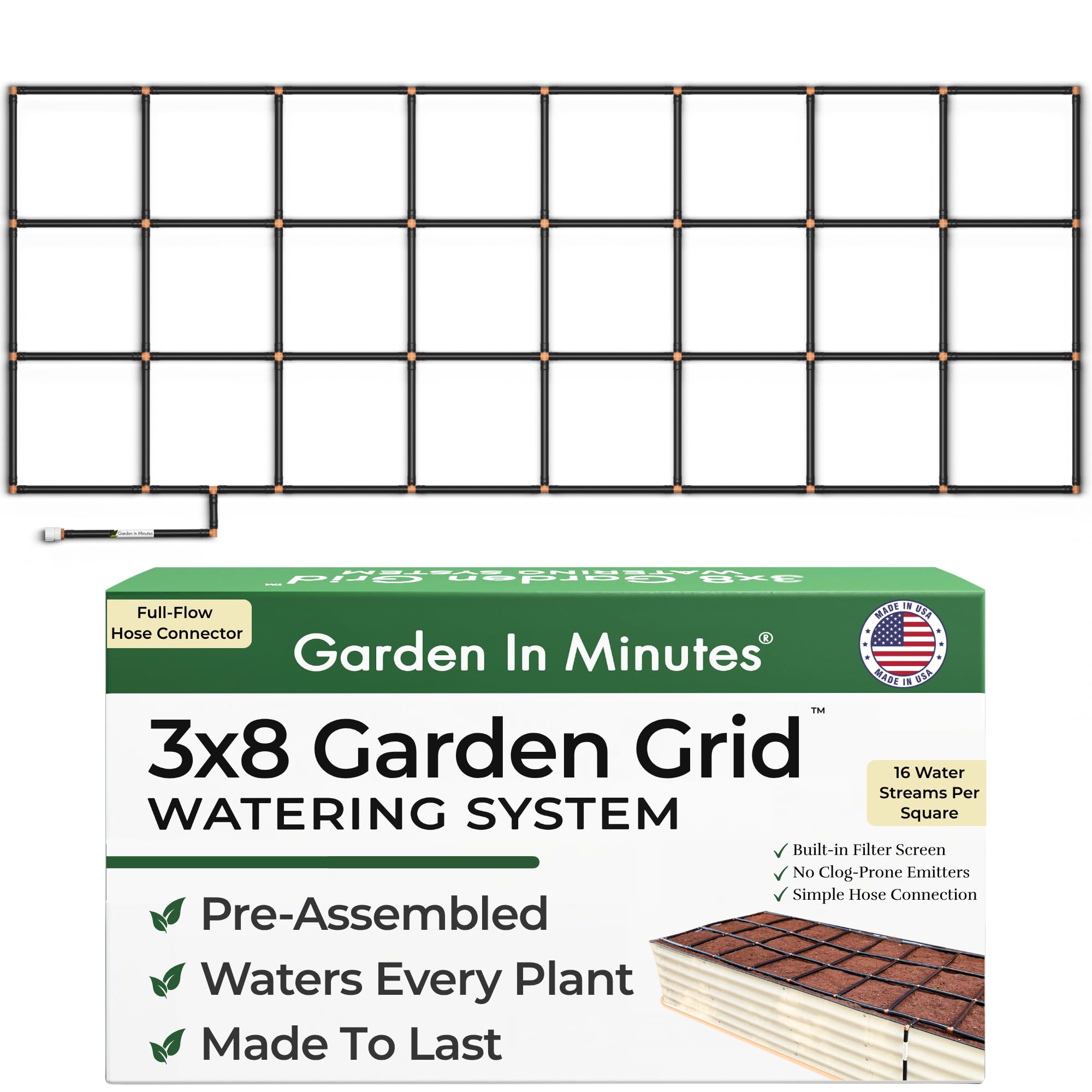
What struck us first is how little there is to do. Press the panels together, lay the grid on the soil, connect a garden hose, and the bed is being watered — closer to setting down a trellis than to plumbing.

Twenty-four squares, each throwing 16 streams at soil level. That is why a 3x8 bed under one comes up evenly instead of with a dry corner and a swamp, and why the leaves stay dry, which is worth something in a humid August. The squares also work as a square-foot planting guide, so the grid is still earning its place in April.

The details are sorted: a built-in filter, regulators on the flow, and adjustable nozzles that take you from a drip to a fuller spray depending on what your hose delivers. At 2.4 pounds it stays where it is laid once it is wet.

What it does not do is scale. A grid waters one 3x8 bed, and this is the most expensive way here to water a single bed; four beds means four grids, which is real money. Otherwise it stays out all season, and the only care it asks for is disconnecting before a hard freeze.

Bottom line: For a single 3x8 raised bed this is the easiest watering we have set up: press it together, hook up a hose, and stop thinking about it.

2

Rain Bird DripKitBag

Rain Bird DripKitBag

Repairs and expansion

Our Score 9.2/10
Check Price

Worth Noting

  • No faucet adapter or mainline, so not a first kit
  • No instructions included
Pieces
102
Tubing
100 ft of 1/4 inch tubing
Emitters
Pressure-compensating, self-piercing
Included Tool
Emitter insertion and removal tool
Read the full review

This is the one kit here that will not start a garden on its own: no faucet adapter, no mainline, just 100 feet of quarter-inch tubing and 102 small parts. It is also the bag we reach for when a line gets nicked or a bed needs one more branch.

The emitters are pressure-compensating and self-piercing, so you push one into the side of a charged line without punching a hole first, and the included insertion tool pulls them again without tearing the tubing. Couplings, tees, plugs and stakes live in their own bags inside, and the whole thing zips into a pouch that hangs on a shed hook.

There are no instructions in the bag. If you already run drip that hardly matters; if you do not, buy this alongside a starter kit and copy its layout. Either way, the pouch hangs on a hook in the shed and gets opened more often than the calendar suggests.

Bottom line: Not a starter kit — buy it once you already run drip, and the self-piercing emitters and included tool make a repair a five-minute job.

3

Thiswing 50 ft Kit

Thiswing 50 ft Kit

Small gardens

Our Score 9.0/10
Check Price

Worth Noting

  • Sixteen heads will not cover a large garden
Pieces
40
Tubing
50 ft of 5/16 inch tubing
Nozzles
16 bendable copper misting nozzles
Fittings
Quick connector
Read the full review

Sixteen nozzles with copper tips on bendable stems, 50 feet of 5/16-inch tubing and quick-connect tees. Thiswing's kit is small, and the parts that matter are better than the price suggests.

The copper is the difference. Plastic misting heads on cheap kits clog, split at the stem and stop aiming where you point them; these bend and hold, and can be re-aimed in July without pulling the line apart. We were pleasantly surprised by the tubing too — at 5/16 inch it is the size our top pick uses for its trunk, which is unusual at this scale.

Sixteen heads over 50 feet works out to roughly one every three feet, right for two beds or a line of pots and thin for a whole vegetable garden. The hose-bib connector is the shallowest piece in the box, so use a fresh washer and check it a week in. For a first system on a small plot that is a fair trade: an afternoon's work, and a line you can extend next spring with another length of tubing.

Bottom line: The small kit to hand a first-timer: everything pushes together by hand, the copper heads hold their aim, and 16 of them is enough for two beds.

4

Carpathen 100 ft Drip Kit

Carpathen 100 ft Drip Kit

Most raised beds

Our Score 8.8/10
Check Price

Worth Noting

  • 50 feet of mainline caps a long multi-bed run
Emitters
Adjustable spray on 7.5-inch stakes
Mainline
50 ft of 5/16 inch tubing
Branch Tubing
50 ft of 1/4 inch tubing
Maximum Pressure
45 psi
Read the full review

A hundred feet sounds generous until you look at how a kit divides it. Carpathen puts 50 feet into a 5/16-inch mainline and 50 into 1/4-inch branch tubing, and that split is the reason we recommend it over the all-thin-tube kits that crowd the cheap end of this category.

Mainline carries volume; branch line delivers it the last few feet to a plant. Skip the trunk and the far tomato on the run gets a trickle. With 58 pieces — tees, couplings, stakes and adjustable spray emitters on 7.5-inch stems — there is enough here to run a trunk along the back of two beds and drop a branch into each, and the heads twist to dial flow per plant, which matters in a bed holding both squash and lettuce.

Two things we noticed while putting it together. Barbed fittings go on far more easily after ten minutes in the sun, and forcing them cold is how couplers crack. Set the stakes before you pressurize, too — moving one afterward means digging around a wet plant.

The kit is rated to 45 psi, which is fine on plenty of outdoor taps and marginal on a hard-charging one; if your spigot delivers more than that, put a regulator between the faucet and the mainline before anything else. Do that and this is the kit we point most raised-bed gardeners toward: enough system to be useful, not so much that setup eats a weekend.

Bottom line: Buy this one if you want a system that is genuinely complete: a real mainline, adjustable heads, and fittings for two or three beds.

5

Rain Bird Landscape & Garden Kit

Rain Bird Landscape & Garden Kit

Mixed plantings

Our Score 8.8/10
Check Price

Worth Noting

  • Instructions assume you already know the layout
Pieces
108
Emitter Styles
Drippers, micro-bubblers, micro-sprays
Maximum Pressure
50 psi
Pressure Compensation
Yes
Read the full review

Rain Bird's 108-piece landscape kit carries three kinds of watering device: drippers, micro-bubblers and micro-sprays. A backflow preventer, a filter and the hose connection come in the box as well, so a whole bed can be laid out without a second order.

The pressure-compensating emitters are the part that earns the price. On an ordinary kit the tenth head on a run puts out less than the first, and you end up overwatering the near plants to reach the far ones. Compensation holds each head to the same output, so a dripper at every tomato and a micro-spray over the salad behave as though each were alone on the line.

We think that flexibility is worth paying for in a mixed raised bed and not worth paying for in a row of identical plants. Two things to know before you start: the diagram on the box is thinner than 108 pieces deserves, and five minutes with Rain Bird's published layout guide before you cut anything saves a lot of re-cutting. The faucet adapter also wants a firm, straight push and a check after the first week of pressure cycles.

Bottom line: Buy it for the head selection: drippers, bubblers and micro-sprays, all pressure-compensated, so a mixed bed waters evenly from first plant to last.

6

Landtouch 140 ft Kit

Landtouch 140 ft Kit

Budget systems

Our Score 8.8/10
Check Price

Worth Noting

  • No regulator or filter in the box
Emitters
10 vortex emitters, 10 spray emitters, 10 misting nozzles
Mainline
40 ft of 1/2 inch tubing
Branch Tubing
100 ft of 1/4 inch tubing
Maximum Pressure
80 psi
Read the full review

This is the least expensive way in this group to get a genuine half-inch mainline: 40 feet of it, plus 100 feet of quarter-inch branch tubing and 30 heads.

The 80 psi maximum pressure is the highest rating here, and that matters on a strong spigot — the Carpathen is rated to 45 psi and wants a regulator on the same tap. The 30 heads split evenly among vortex emitters, spray emitters and misting nozzles, which is enough variety to plant two beds quite differently.

What is missing is the cheap insurance. There is no pressure regulator and no filter in the box, and those are the two parts that keep grit out of emitters and stop a fitting splitting in July. We wished it came with both; add them to the order and the value story still holds, skip them and you are trusting your water supply and your spigot to behave.

The spigot end caps are the fiddly part — they do not spin freely, so thread them on before you pressurize rather than fighting them with water already in the line. For a first system on a budget, this one leaves the most room to add a bed next spring.

Bottom line: The value pick: 40 feet of half-inch mainline and 30 heads for less than the branded kits, as long as you add a regulator and filter.

7

MIXC 230 ft Kit

MIXC 230 ft Kit

Several beds

Our Score 8.6/10
Check Price

Worth Noting

  • Only 33 feet of mainline to work with
Pieces
73
Mainline
33 ft of 1/2 inch tubing
Branch Tubing
197 ft of 1/4 inch tubing
Emitter Styles
3 adjustable styles
Read the full review

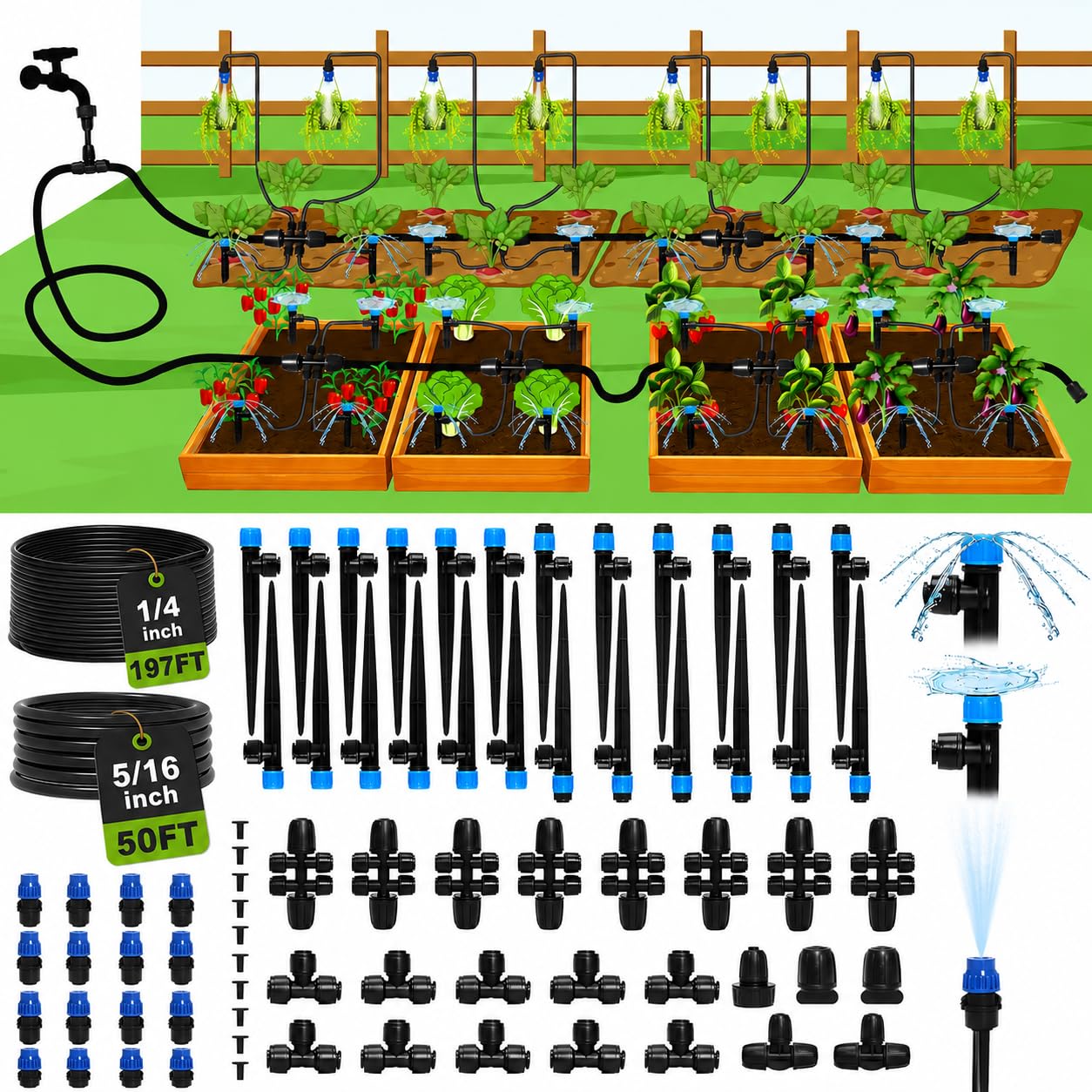
Two hundred thirty feet is the headline. Thirty-three of those feet are half-inch mainline and 197 are quarter-inch branch tubing, and that ratio is the whole personality of the kit: a short, fat trunk with a lot of thin branches coming off it.

For beds sitting within about 30 feet of the spigot, that is a sensible shape. The trunk carries volume, the branches fan out to each bed, and three emitter styles let you put a sprayer over greens and a dripper at each tomato. The quick-connect fittings push and twist into place and release again when you want to move a branch, which is the reason to choose this over a barbed kit.

We wondered whether 33 feet of trunk was enough, and for a compact plot it is; for a garden laid out end to end, order another roll of half-inch line at the same time. Trunk disappears fast once you route around raised beds and a path, and splicing later means a second order and another wait.

The multi-way splitter is where a kit like this takes the most stress, since it meets full spigot pressure before anything divides. Put a regulator ahead of it, check those joints after the first week, and the rest of it is undemanding.

Bottom line: Buy this when the beds cluster within about 30 feet of the tap and you want quick-connect fittings you can rearrange without any tools.

8

Bonviee 247 ft Kit

Bonviee 247 ft Kit

Dense planting

Our Score 8.6/10
Check Price

Worth Noting

  • No half-inch mainline, so the trunk stays short
Pieces
279
Emitters
12 vortex sprayers, 12 stream drippers, and 8 mist nozzles
Mainline
50 ft of 5/16 inch tubing
Branch Tubing
197 ft of 1/4 inch tubing
Read the full review

Thirty-two heads in one box — 12 vortex sprayers, 12 stream drippers and 8 mist nozzles — with 50 feet of 5/16-inch mainline and 197 feet of quarter-inch branch tubing behind them. Bonviee is selling variety and head count, and the box delivers both.

The three head types are the point. A vortex sprayer covers a square of bed, a stream dripper puts water at the base of a tomato without soaking the leaves, and the misters earn their keep over seedlings that a dripper would flatten. We appreciated the range: matching the head to the plant is the difference between a bed that is evenly damp and one that is soaked at the front and dry at the back.

Fifty feet of mainline is more trunk than the MIXC 230-foot kit gives you, and that buys reach past two or three beds before the first branch. It is not half-inch, though, so split the branches into two groups off the trunk rather than stringing all 32 heads along one line.

The mainline is the piece to protect: run it along the bed edge, stake it down and keep it out of the path of a hoe. Treated that way, this is the most generous box in this group for dense planting, and 279 pieces means spare tees and stakes rather than a mid-install trip to the hardware store.

Bottom line: The box to buy when you are planting thick: 32 heads you can match to each crop, and enough mainline to reach three beds.

How We Tested the Best Drip Irrigation Kits for Raised Beds

We started by pulling together kits sized for raised beds — those that promised enough tubing and emitters to cover a 4-by-8-foot bed without a second trip to the hardware store. We filtered out kits with vague parts lists or connectors that didn't match standard hose fittings, then ordered 12 to test over one seven-month growing season.

Each kit went onto a real bed, not a test bench. I timed how long it took one person to unroll the tubing, punch in emitters, and connect everything to an outdoor spigot, then checked the box against the parts list to see whether we finished with leftover pieces or a missing adapter. We noted whether the instructions matched the hardware, if the connectors snapped on securely or needed clamps, and how easy the kit was to rearrange when a plant outgrew its spot.

Once running, every kit stayed on a timer for the season, and we checked the bed edges and connector joints after each cycle for pooling water or popped fittings. We watched whether emitters clogged, whether tubing softened or cracked in the sun, and whether the kit connected cleanly to a standard faucet, a timer, and an extra length of hose. At the end of the season, we compared the cost per bed against the number of replacement parts each kit had already demanded.

What separated the top picks was rarely the number of emitters. It was whether the kit was genuinely complete — spare goof plugs, a pressure regulator, a filter — and whether a first-time installer could set it up without cursing. We also ran each kit through a week of daily use to judge how easily the timer and flow controls fit into a normal morning routine, because a kit that's fussy to adjust is one you stop using.

How to Choose Drip Irrigation Kits for Raised Beds

Start With the Mainline, Not the Footage

A kit's real capacity lives in its mainline, the half-inch or 5/16-inch tube that runs from the spigot, because that is what carries volume. Everything downstream is quarter-inch branch line, which delivers water beautifully over a few feet and starves a long run.

So read the split, not the total. The MIXC 230-foot kit puts 33 feet into a half-inch trunk and 197 into branch tubing; the Bonviee box gives 50 feet of 5/16-inch mainline with the same 197 of branch. If your beds sit more than 30 or 40 feet from the tap, plan to buy extra mainline in the same size on day one.

Match the Emitter to What's Growing

Drippers put water slowly at the base of a tomato, micro-bubblers flood a squash hill, micro-sprays cover a patch of salad, and a pre-set grid throws streams across a whole bed at once. Adjustable heads earn their price when one bed holds several crops.

Pressure compensation is worth having on any run longer than about 20 feet, since it keeps the tenth head putting out what the first one does — Rain Bird builds it into their landscape kit. For a bed of mixed vegetables, two or three head types beat sixteen identical ones.

Decide How Much Assembly You Want

Barbed fittings are cheap and secure, but they need a firm, square push and cold tubing fights back; leave it in the sun for ten minutes first. Quick-connect fittings cost more, go together in seconds, and release again when you want to move a branch — the MIXC and Thiswing kits are built around them.

At the far end of the scale is the Garden Grid, which is three panels pressed together with no cutting at all. Be honest about the afternoon you are signing up for: a 279-piece kit with 32 heads is a project, and a grid is not.

Size the Kit to the Beds, Not the Box

Raised beds are usually 4x4 or 3x8, which is 16 or 24 square feet, so a 100-foot kit comfortably covers two or three of them. The trap is assuming footage equals coverage: sixteen heads spread over 50 feet is roughly one every three feet, fine for a row of tomatoes and thin for a bed of greens.

Sketch the beds and count the plants you actually want watered, then buy on head count as much as on tubing length. A kit sized to the beds you have now is the right place to start.

Pressure, Timers and the End of the Season

These kits are water-pressure driven and rated to a stated ceiling — 45 psi on the Carpathen, 80 on the Landtouch, 70 on the Garden Grid — so check the tap before you connect. A regulator and a filter are cheap insurance against split fittings and grit-clogged emitters, and if the kit does not include them, order them with it.

Every kit here runs off a battery hose timer, which is the part that turns watering into something you stop doing by hand. Before the first hard freeze, pull the timer indoors, disconnect the line and drain it.

Frequently Asked Questions

Final Verdict

Most raised-bed gardens should start with the Carpathen kit. The 50-foot mainline and 50 feet of branch tubing give you a genuine trunk with enough heads for two or three beds, and the adjustable emitters mean you are not shopping for different heads next season.

Two situations change that. If your garden is a single 3x8 bed by the kitchen door, the Garden Grid costs more per bed but removes the entire assembly afternoon. If the beds are spread across a yard and reach is the problem, the MIXC 230-foot kit's quick-connect fittings make a long layout easier to change, provided the whole block sits within about 30 feet of the tap.