Watering & Irrigation

Best Drip Irrigation Emitters of 2026

A drip system is supposed to be the upgrade that takes watering off your to-do list. Then a head clogs, another dribbles, and the far end of a long run gets half the water of the first, and you're back out there with a wrench. The right emitter fixes that specific problem: it puts out the same volume at the first plant and the last, season after season, without turning into a weekly chore.

I've run drip lines through my own raised beds and patio pots for years, and this past spring my team put 16 emitters through a full growing season — same supply line, same pressure, same stubbornly hard water. What separates a good one from a frustrating one usually comes down to two things: how evenly it holds its flow after weeks of use, and how little fuss it takes to install, adjust, and reconnect when you move a line. A fancy flow rate on the box means nothing if the thing is glued shut with mineral scale by July. The picks below are the ones still earning their spot in my beds.

1

Rain Bird SW20-30PS

Top Pick
Rain Bird SW20-30PS

Mixed beds

Our Score 9.2/10
Check Price

Worth Noting

  • Flow can vary between individual heads
Flow Rate
2.0 GPH
Pack Size
30 emitters
Connection
Self-piercing; 1/4 in. or 1/2 in. tubing
Pressure Compensating
Yes
Read the full review

Pressure compensation is the feature that decides a long drip line, and the Rain Bird SW20-30PS is the emitter we start with because it holds a nominal 2 GPH from the first head to the last. The self-piercing tip is the second detail that earns its place: it pushes straight into 1/2-inch supply tubing or accepts 1/4-inch line, so adding a plant does not turn into a cutting-and-splicing project. For a bed that runs more than a few feet, that consistency is worth more than a fancy head.

For a mixed bed, 2 GPH is the useful middle of the range. It soaks a shrub without flooding a pot, and the 30-pack gives enough heads to cover a small bed or make a serious start on a larger one. We also like the UV- and chemical-resistant plastic for a part that sits in the sun and weather all season. This is not the head for someone who wants to dial each plant up or down; it is the head for someone who wants the line to behave.

The large passages and self-flushing action help with debris, but they do not make the emitter self-maintaining; a filter on the system is still the smart move. The 30-pack is also a reasonable size for a first order: enough to finish a small bed, not so many that you are storing a lifetime supply. For the money and coverage, this is the most broadly useful emitter here.

Bottom line: The Rain Bird SW20-30PS is our default for mixed beds: pressure-compensated 2 GPH flow and a self-piercing tip make it the easiest reliable choice here.

2

Rain Bird FE40-25S

Rain Bird FE40-25S

Thirsty shrubs

Our Score 9.2/10
Check Price

Worth Noting

  • Non-pressure-compensating; flow varies with pressure
Flow Rate
4 GPH
Pack Size
25 emitters
Connection
1/4 in. and 1/2 in. barbed
Pressure Compensating
No
Read the full review

Four gallons per hour is a lot for a drip emitter, and the Rain Bird FE40-25S is for the plants that need it: a mature shrub, a small tree, a big container that dries out fast. The flag top is the detail we appreciate most. Twist it off and you can clean the passage quickly instead of replacing the head.

This is the high-flow specialist in our group. The 4 GPH rate is roughly twice the 2 GPH heads, so it fills a root zone faster and is a better match for heavier soil or a plant that has outgrown a standard dripper. The dual barbed ends fit both 1/4-inch and 1/2-inch tubing, which makes it useful for retrofits. The 25-pack is enough for a small fruit-tree row or a mixed border of larger shrubs. It is not the head for a whole bed of small pots; the output is too much for that.

The flag is handy for cleaning, but it also makes the head a little easier to knock out of the main line. We treat these as heads for a few thirsty plants rather than a whole-zone solution, and we check them after a big rain or a hose drag. For a few thirsty plants, those are manageable compromises.

Bottom line: Thirsty shrubs and small trees get the Rain Bird FE40-25S: a 4 GPH flag dripper we keep for high-flow spots and quick cleaning.

3

Xloey 100-Pack

Xloey 100-Pack

Budget bulk

Our Score 9.0/10
Check Price

Worth Noting

  • Adjustment can drift over time
Pack Size
100 emitters
Connection
1/4 in. barb
Max Flow Rate
70 L/h
Spray Coverage
10 to 12 in. circle
Read the full review

The first number that matters with the Xloey 100-pack is the count: 100 adjustable emitters for about the price of a small pack elsewhere in this group. That changes the math for a big container collection or a nursery row, because you can keep spares without rationing them. It also means you can afford to experiment with placement before you commit a line.

The head is an 8-hole adjustable sprayer, not a point dripper. Fully open, it covers a circle of roughly 10 to 12 inches, which is useful for pots, raised beds, and seedlings that want a soft broadcast rather than a single soaking point. The 1/4-inch barb is standard, and the cap can be turned down to a trickle or shut off. The maximum listed flow is 70 liters per hour, so this is a gentle head rather than a high-flow soaker.

We think this is the budget bulk pick for someone who values flexibility over precision. The adjustment is not a laboratory valve, and low-flow settings are the fussiest part of the range. If you want a set-and-forget line, the pressure-compensated Rain Bird is the better call. The 100-count is the reason to choose it; the adjustment is the compromise.

Bottom line: For a drawer of adjustable heads on a budget, the Xloey 100-pack is the value pick we hand to container gardeners.

4

Raindrip PC8050B

Raindrip PC8050B

Larger plantings

Our Score 8.6/10
Check Price

Worth Noting

Flow Rate
2 GPH
Pack Size
50 emitters
Connection
1/4 in. feeder or 1/2 in. supply
Pressure Compensating
Yes
Read the full review

A 50-count box is the first thing that makes the Raindrip PC8050B a practical pick for a larger planting: enough emitters to run a bed, a border, or a row of containers without coming up short. The 2 GPH pressure-compensating design is the more important part. It holds the stated flow as pressure changes, and the turbulent-flow path is meant to flush sediment rather than let it settle. For a long line, that combination is what keeps the far end from turning into a trickle.

We see this as the bulk alternative to our top pick. The 50-pack stretches further, the self-cleaning design addresses the usual drip headache, and the emitter accepts 1/4-inch feeder line or punches into 1/2-inch supply tubing. Raindrip also backs it with a one-year satisfaction guarantee, which is a useful vote of confidence for a part that lives outdoors. It is a uniform line in a box, and that is the appeal.

The limitation is fixed output. There is no dial and no shutoff, so you cannot give one plant more than another without changing the emitter. That is not a flaw for a hedge or a uniform bed; it is a mismatch for a mixed container collection. Choose this when you want every plant on the line to get the same 2 GPH and you want a box of spares.

Bottom line: For a larger planting, the Raindrip PC8050B is the bulk buy we trust: 50 pressure-compensating 2 GPH heads with a self-cleaning flow path.

5

MIXC Quick-Connect

MIXC Quick-Connect

Tool-free retrofits

Our Score 8.6/10
Check Price

Worth Noting

  • Caps can pop off under pressure
  • Some heads arrive not flowing
Flow Rate
Up to 25 GPH
Pack Size
30 emitters
Connection
Push-to-fit 1/4 in.
Spray Diameter
Up to 10 ft.
Read the full review

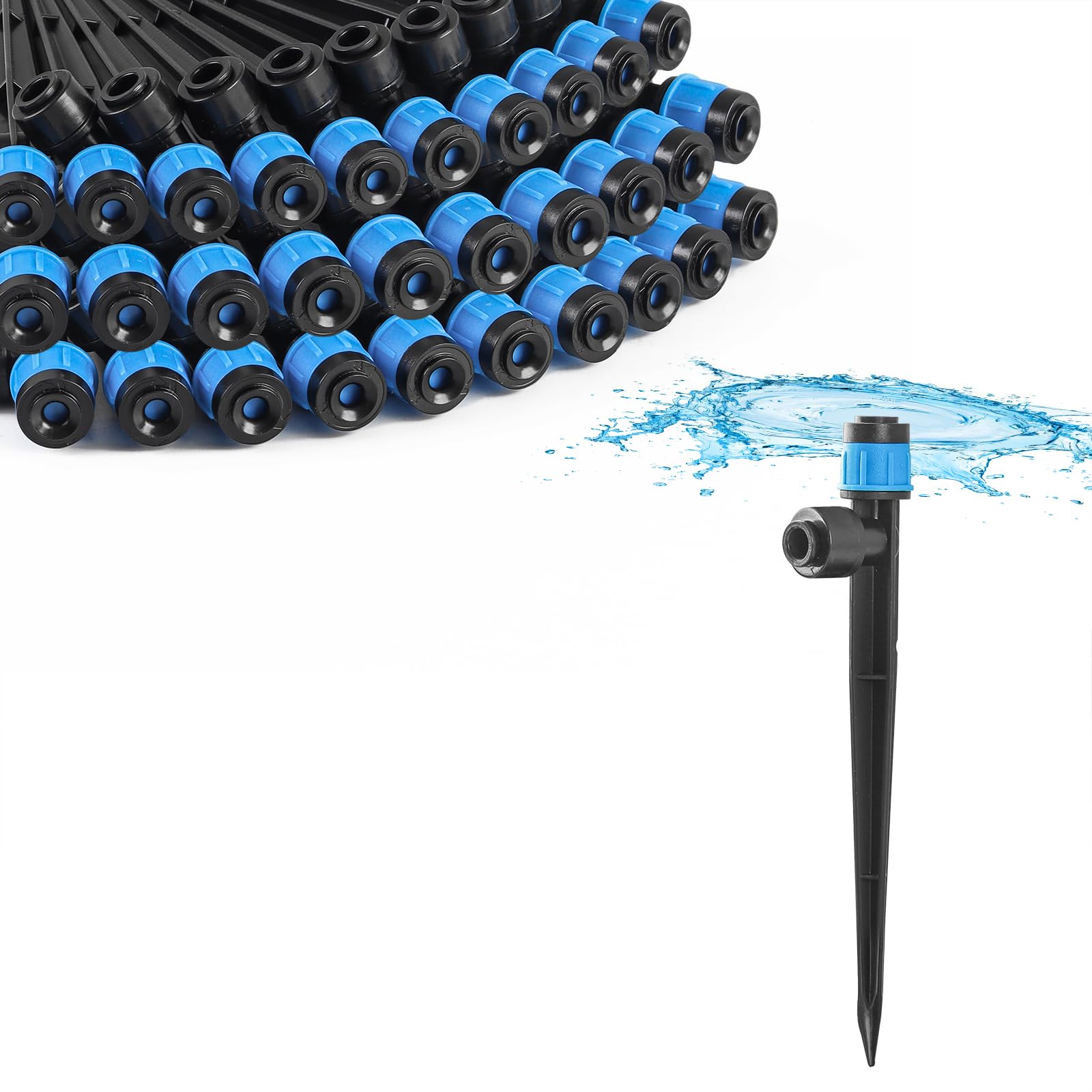
The push-to-fit connection is the reason to look at the MIXC Quick-Connect emitter: it presses onto compatible 1/4-inch tubing without heating the hose or adding a separate barb, and it pulls off just as cleanly when you move a plant. The vortex head adjusts from a fan spray to a full shutoff, which gives you one hand on the flow and the other on the plant. For a retrofit, that is a much more pleasant job than wrestling stiff tubing over a barb.

We like this for containers and small beds because the 5.2-inch stake holds the head where you want it and the head opens for rinsing. The output is much higher than a standard 2 GPH dripper, up to 25 GPH, so it is a sprayer for a small area rather than a precise root-zone drip. The 10-foot coverage claim assumes suitable pressure; on a low-pressure line, expect a smaller pattern. That is the trade for the quick connection and the wide adjustment range.

This is the one we hand people first when they are expanding a patio system and do not want to buy a punch tool or heat a kettle. The 30-pack is enough to rework a patio without adding a punch tool. For movable pots and a few seasonal beds, the convenience is worth it.

Bottom line: We pick the MIXC Quick-Connect for tool-free retrofits: push-to-fit tubing, a staked adjustable fan spray, and a shutoff at the head.

6

Spalolen Push-to-Fit

Spalolen Push-to-Fit

Movable pots

Our Score 8.6/10
Check Price

Worth Noting

  • Some units arrive non-functional
  • Narrow spray pattern
Mounting
Staked
Pack Size
30 emitters
Connection
Push-to-fit 1/4 in.
Spray Pattern
Adjustable 360° vortex
Read the full review

The Spalolen push-to-fit emitter is built around a simple convenience: the head slips onto 1/4-inch tubing without heat or tools, and the collar pulls off with one hand when you want to move it. That makes it a natural fit for pots and seasonal beds where placement changes.

The stake holds the head above the soil, and the vortex cap adjusts from a fine stream to a wider spray with a shutoff at the end. We like the serviceable head for rinsing; a clogged emitter is easier to fix when the top comes off. The 30-pack is enough for a patio of containers and a few beds.

We treat a 30-pack as a small project: test each head before you commit it to a line, and keep the ones that spray evenly as spares. The push-to-fit collar is the feature that makes the pack worth considering, especially if you move pots around. The stake is sturdy enough to stay put through a watering cycle.

This is not the emitter for a long, permanent row of thirsty shrubs; the output is better suited to local watering and the stake is the point. For a patio of containers and a few beds you rearrange, the tool-free connection is the advantage that matters. The 30-pack is enough to rework a patio without committing to a permanent line.

Bottom line: The Spalolen push-to-fit set is for movable pots and seasonal beds, and we like it because the tool-free collar makes repositioning a one-hand job.

7

Raindrip 157050B

Raindrip 157050B

Wide coverage

Our Score 8.6/10
Check Price

Worth Noting

  • Non-pressure-compensating; flow varies with line pressure
Flow Rate
0 to 11.7 GPH
Pack Size
50 bubblers
Connection
1/4 in. barbed inlet
Spray Radius
Up to 16 in.
Read the full review

The Raindrip 157050B is not a point dripper; it is an adjustable bubbler that throws eight streams in a full circle, which makes it the better choice for groundcover, decorative grasses, and a bed where you want a wider wetting pattern rather than a single soaked spot.

The dial turns the flow from off to 11.7 GPH and the spray radius up to 16 inches at 40 psi, so you can set a soft circle for a new planting or a stronger soak for established roots. The 1/4-inch barbed inlet punches into supply tubing, and the 50-pack gives you room to cover a bed. The eight streams also make it easier to see whether the head is working than a single drip point does.

We like it as a problem-solver for a patch that a standard dripper leaves dry in the middle. The 50-pack is enough to rework a bed, and the adjustable dial means one head can cover several small plants. It is not the head for a long, narrow row of individual plants; the circle is the point. For a small area that needs a wider soak, it earns its place.

Bottom line: The Raindrip 157050B is the bubbler we choose when a bed needs a wider soak than a point dripper can give.

How We Tested Drip Emitters Through a Full Growing Season

We began with a shortlist of roughly 40 emitters sold singly and in multipacks, then narrowed it by flow-rate options, connection style, and price per head. Anything that required a proprietary fitting we couldn't adapt to a standard half-inch line was cut, which left 16 emitters to test.

Each of the 16 went onto the same two 30-foot runs fed by one faucet and a pressure regulator, watering raised beds, five-gallon containers, and a row of hanging baskets. We installed every one ourselves and timed the install: punching the hole, pushing the barb in, and checking the connection for leaks.

From spring planting through the final fall harvest, we walked the lines once a week and compared the emitter at the tail end to the one at the head. We noted whether flow stayed even, whether the spray pattern held its shape or fanned out, and whether the emitter stayed seated when we dragged the hose or knocked it with a watering can. The system also ran on a timer through dozens of on/off cycles, and one bed with the hardest water was left alone to see which heads clogged first and how easily they cleared with a twist or a soak.

Adjustability got a separate pass: we turned each emitter from full flow to a trickle and back, then moved a few between bed and container to see how they handled reconnecting. At the end, we set what each one cost per head against how many a typical bed needs, since a bargain emitter that fails by midsummer isn't a bargain.

How to Choose Drip Irrigation Emitters

Decide How Even the Flow Must Be

The first choice is whether you need the same flow from every head. Pressure-compensating emitters such as the Rain Bird SW20-30PS and Raindrip PC8050B hold a nominal rate as pressure changes, which matters on long runs or a sloping yard. Non-compensating heads are simpler and often cheaper, but the far end of the line can run lighter. If your plants are similar and the line is long, pay for compensation. If you are watering a few pots close to the tap, a non-compensating adjustable head may be enough.

Match the Connection to Your Tubing

Emitter shopping starts with the tubing, not the plant. A 1/4-inch label is not a universal size: check the tubing's outside diameter and whether the emitter is barbed, self-piercing, or push-to-fit. Self-piercing heads like the Rain Bird SW20 punch into 1/2-inch supply line; push-to-fit heads like the MIXC and Spalolen need compatible 1/4-inch tubing. If the fit is tight, soften the tubing end in warm water rather than forcing the barb. Buy one pack, test the connection, then commit to the bed.

Choose Fixed, Adjustable, or High-Flow

Fixed emitters are the set-and-forget choice: a 2 GPH head for a similar bed, a 4 GPH head like the Rain Bird FE40 for a thirsty shrub. Adjustable heads give you a dial and often a shutoff, which is useful for containers and mixed plant sizes, but they can drift and need occasional resetting. High-flow does not mean better; it means faster. Match the rate to the root zone and soil, and group plants with similar needs on one line. If you mix rates, expect to check the line more often.

Plan for Clogs, Cleaning, and Placement

Drip emitters have small passages, so filtration and flushing matter more than any single feature. Self-flushing designs and removable caps help, but they do not replace a filter. Staked heads like the Spalolen and MIXC are easy to move; punch-in emitters are neater for a permanent bed. Wider patterns from a bubbler like the Raindrip 157050B suit groundcover and small beds, while a point dripper puts water exactly at the root zone. Walk the line after installation and adjust the placement before you bury it.

Frequently Asked Questions

Final Verdict

For most gardens, the Rain Bird SW20-30PS is the emitter we recommend first. Its pressure-compensated 2 GPH flow keeps a long line even, and the self-piercing tip makes expansion easy. If you are planting a larger bed and want a 50-pack of self-cleaning pressure-compensating heads, the Raindrip PC8050B is the better bulk buy. For a few thirsty shrubs, step up to the Rain Bird FE40-25S; for tool-free retrofits, the MIXC is the convenience pick.