Watering & Irrigation

Best Rain Barrel Connector Kits of 2026

A rain barrel is one of the few garden upgrades that pays you back — a decent downspout setup can pull hundreds of gallons off a single storm. Catching the water is the easy part. Getting it back out again, into a second barrel or down a soaker hose without a puddle spreading across the mulch, is where most setups fall apart. A good connector kit fixes exactly that: it joins downspout, barrel, and hose with fittings that actually match, so the only thing getting watered is the garden.

I plumbed two barrels in series behind my garage last spring and learned the hard way that thread size is the whole ballgame — an unlabeled kit will send you back to the hardware store twice before lunch. Over four months of real rain, we ran 14 kits through downspout diversions, barrel-to-barrel links, and long hose runs to the far beds, and the ones that held were the ones with thick washers and fittings you could snug down by hand. Below are the kits that stayed dry through a full season, not just the ones that looked promising in the box.

1

RAINPAL RBLSS5 Kit

Top Pick
RAINPAL RBLSS5 Kit

Close-set barrels

Our Score 9.6/10
Check Price

Worth Noting

  • 1/2-inch NPT fittings need matching ports
Hose Reach
5-7.5 in.
Thread Size
1/2 in. NPT
Required Hole
1-1/16 in.
Fitting Material
Stainless steel 304
Read the full review

The RBLSS5 asks you to keep your barrels close: its corrugated hose runs 5 inches and stretches to 7.5. If your drums already sit side by side, that short span is an advantage, because there is less hose to sag, kink, or snag on the way between them. The kit includes two bulkhead fittings and the hose, so the only extra you need is the drill and the right bit. That makes the pair look intentional rather than connected by a loop of slack hose.

Stainless steel 304 is the reason this small kit is worth the fuss. The bulkheads and hose resist rust, mouse damage, and the kinking that makes a flexible line annoying to route. The twist-and-turn hose is a small but useful detail: it can be angled without taking a permanent bend, which makes it easier to line up two barrels that are not perfectly parallel. Stainless is a sensible choice for an exposed setup that sees winter, too.

The fittings need a 1-1/16-inch hole, or a 1-inch saw opened with a file, so check your barrel wall before you drill. We like the metal-on-metal construction for a permanent installation; it feels like a permanent fitting rather than a temporary coupling. For a tight two-barrel stack, this is the neatest option here; for barrels several feet apart, it simply cannot reach.

Bottom line: The RBLSS5 is our pick when barrels sit inches apart and you want stainless fittings that resist kinks, rust, and mouse damage without a long hose in the way.

2

EarthMinded Connector Kit

EarthMinded Connector Kit

Most rain barrels

Our Score 9.4/10
Check Price

Worth Noting

  • Not recommended for metal drums
Included
Hole saw, seals, instructions
Hose Reach
6-31 in.
Hose Diameter
1.25 in.
Barrel Compatibility
Not for metal drums
Read the full review

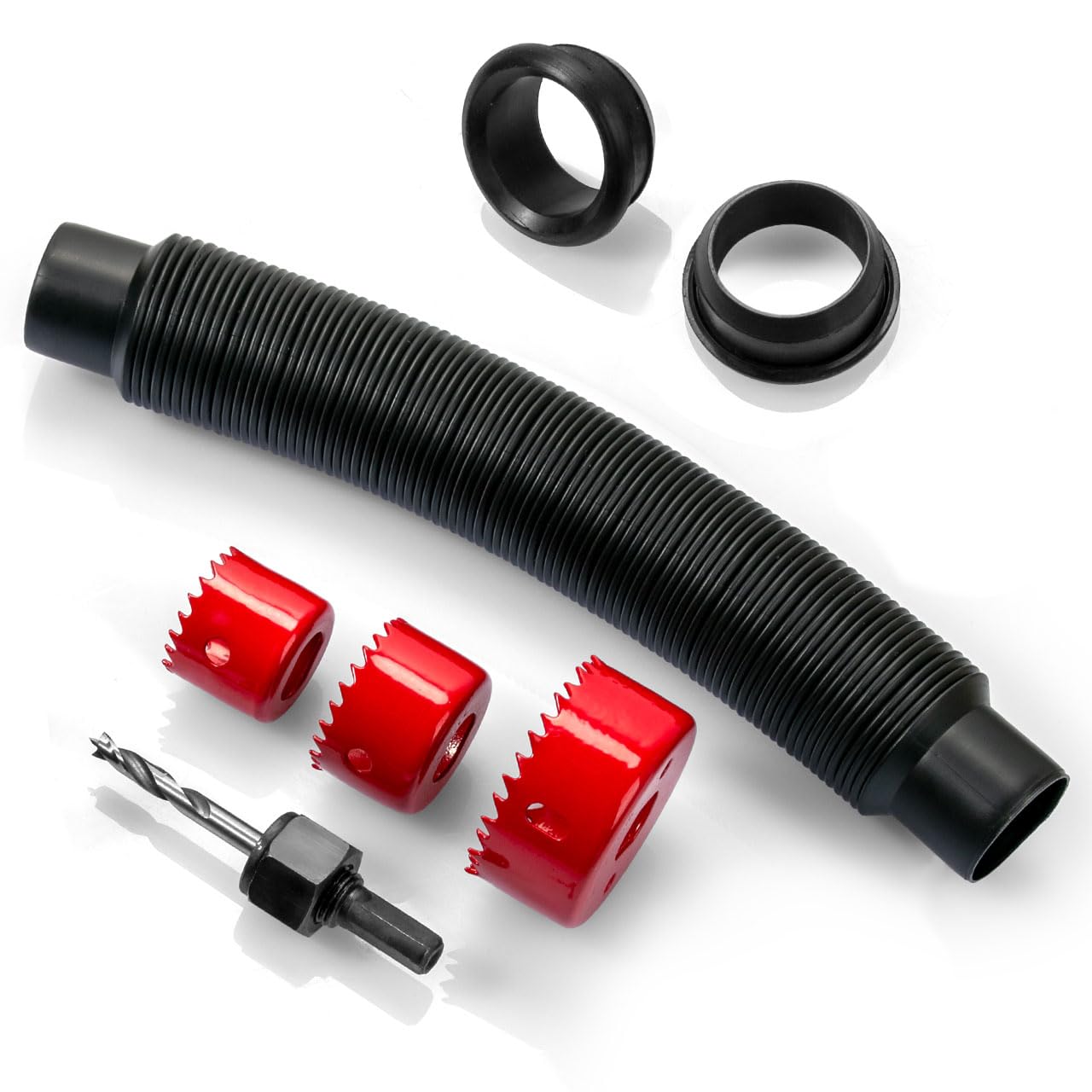
A 1.25-inch hose is the defining feature of the EarthMinded Connector Kit. It runs from 6 to 31 inches, so it can bridge barrels set close together or a few feet apart, and the wider bore gives water a less restrictive path between them. The kit also includes the hole saw, seals, and instructions, so you are not hunting for a specialty bit before you start.

We recommend it as the best default here because that combination covers the most common backyard setup: two plastic drums, a short gap, and a Saturday-morning install. We set it up between two drums and found the rim-to-rim layout easy to check; the hose sits above the waterline, so a slow seep shows up instead of hiding behind the barrel. The included saw cut cleanly and the seals seated without a fight. The layout also keeps the connection high on the barrels, which is handy when you want to inspect the seal without kneeling in wet mulch.

The rim-to-rim layout is also easy to live with. When the barrels are full, you can see the hose and fittings without moving anything, and the long run gives you room to position the second barrel where you want it. For a plastic-barrel system that needs to move water between two containers, the balance of reach and simplicity is hard to beat here.

Bottom line: For most two-barrel setups, this is the kit we point to first: the long 1.25-inch hose and included hole saw make the job easier to finish.

3

XCWT Linking Kit

XCWT Linking Kit

Budget linking

Our Score 9.2/10
Check Price

Worth Noting

  • Only one linking hose per kit
Included
Fill hose, 2 seals, hole saw kit
Hose Reach
9.5-31 in.
Hole Saw Sizes
2-1/8, 1-1/2 & 1-1/4 in.
Read the full review

The XCWT Linking Kit earns its place on completeness and price. You get the fill hose, two seals, and a three-piece hole saw set, so the same box can cut the link opening and give you sizes for a diverter or spigot later. For a first rain-barrel project, that is useful insurance against buying the wrong bit.

The hose stretches from 9.5 to 31 inches, which is close to what our top pick offers, and the kit has enough of a track record to feel like a known quantity rather than a gamble. We tested it on a pair of barrels with a gap of a couple of feet and found the hose reached without being stretched taut. The seals are thick enough to compress against a clean barrel wall, and the hose has a little give when you position the second drum. The extra saws are the detail we appreciated most; they turn a one-job kit into something you can reuse when you add a second connection.

It is a simple kit, and that is the point. There is nothing here you have to configure, and the parts go together with a drill and the supplied saws. If your goal is a low-cost two-barrel setup and you have a sheltered spot for the barrels, this is an easy recommendation.

Bottom line: We look to this budget kit when you want a complete linking set with extra hole saws and don't mind a shorter track record than our top pick.

4

RAINPAL RBL020 Kit

RAINPAL RBL020 Kit

Brass hose setups

Our Score 8.8/10
Check Price

Worth Noting

  • Crimped hose ends can fail at the connection
  • Hose can kink on tight bends
Required Hole
27 mm
Overall Length
9 in.
Wall Thickness
Up to 10 mm
Fitting Material
Brass
Read the full review

Brass is the draw here: the RBL020 gives you two bulky brass bulkheads with a 3/4-inch garden-hose thread on one side and 1/2-inch NPT on the other, plus a short 9-inch overall hose. If your barrels use standard hose connections, this is a familiar, repairable way to tie them together.

The fittings need a 27 mm hole, roughly 1-1/16 to 1-1/8 inches, and they clamp walls up to 10 mm thick. A 27 mm hole is close enough to common 1-1/16-inch saws that you can usually make it work with a file. We like that the brass bodies feel more substantial than a molded bulkhead, and the kit is simple enough to install with a drill and the right saw. The standard garden-hose thread is the practical win: you can add a valve, cap, or short leader without hunting for an adapter. That versatility is why this kit stays useful beyond the first connection.

The 9-inch overall length is the limiting factor; barrels need to sit close. For a pair already touching, that short run keeps the connection tidy, and the brass fittings do the real work. The thread and wall range cover a lot of homemade barrel setups, which is why this one stays useful even if it is not the longest kit here. If you need to span a walkway or a gap, choose a longer kit instead.

Bottom line: We keep this one for standard 3/4-inch garden-hose connections, with brass bulkheads that feel substantial, though the short hose demands close barrels.

5

WADEO Spigot Linking Kit

WADEO Spigot Linking Kit

Spigot plus link

Our Score 8.8/10
Check Price

Worth Noting

  • Costs more than basic linking kits
Spigot
3/4 in. GHT ball valve
Hose Length
13 in. each
Hose Quantity
2
Required Hole
1 in.
Read the full review

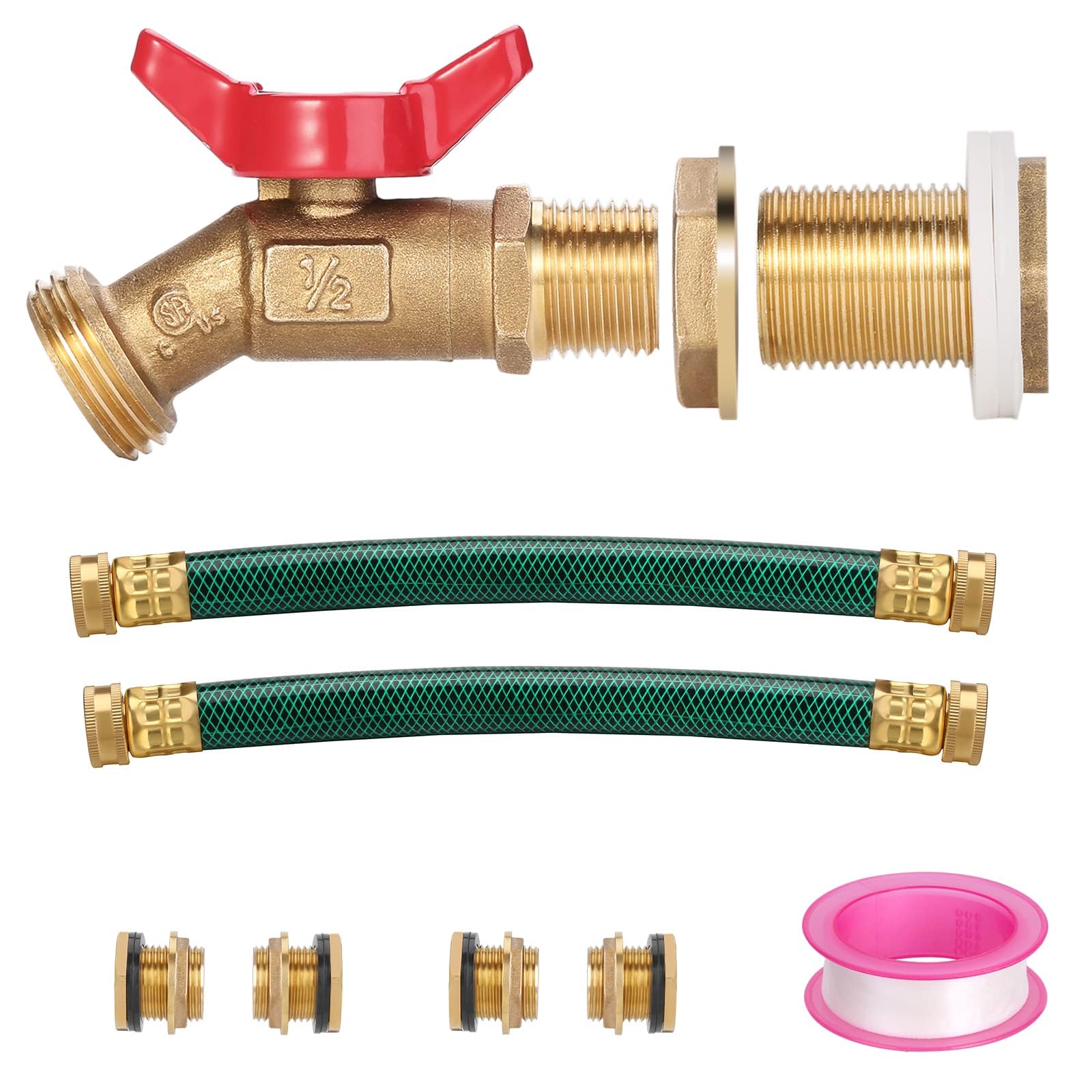
The WADEO Spigot Linking Kit is the one here that also replaces a spigot, and that is what we like about it. You get a 3/4-inch garden-hose-threaded quarter-turn ball valve, a brass bulkhead, two 13-inch hoses, and extra brass fittings, so one purchase can add a tap and link two barrels.

The brass construction is the appeal: the valve feels solid, the bulkhead uses a 1-inch hole, and the hoses end in standard garden-hose connections. The quarter-turn valve is the feature we value most; it gives you a positive shutoff without threading a cap on and off every time you fill a watering can. The package also includes two white washers and four male brass fittings, so you have spare connection parts on hand. The second hose gives you another run to route or keep as a spare.

The hoses are only 13 inches each, so this is a close-quarters kit; if your barrels are farther apart, you need a longer hose or a different layout. A 13-inch run is fine for barrels that nearly touch, not for a gap you can walk through. That is the main compromise, and it is easier to accept if you are already replacing a worn spigot and want one box to cover both jobs.

Bottom line: We recommend the WADEO kit when you need a new spigot and a link between barrels in one purchase, and you can live with a premium price and short hoses.

How We Tested Rain Barrel Connector Kits

We started with roughly 30 kits sold at garden centers and hardware stores, then narrowed to 14 based on what the packaging actually told us: thread type, material, and whether the fittings were brass or plastic. Anything that didn't state its thread size didn't make the cut, since a mismatched thread is the single most common reason a connector fails on day one.

Each kit went onto standard 55-gallon barrels in three real setups: a downspout diverter feeding a first barrel, a barrel-to-barrel link, and a spigot-to-hose run out to the beds. I installed every one solo, timing the job and noting whether it needed a wrench, thread tape, or a second trip to the store. Then we filled the barrels and wrapped every joint in a paper towel, checking after an hour and again the next morning — a dry towel counted, a damp one didn't.

Fit got its own round: we tried each kit against garden hose thread, pipe thread, and a plain 3/4-inch port, and noted which ones needed adapters that weren't in the box. We also ran 25 feet of soaker hose off each connector to watch how flow held up and whether the hose kinked at the barb when coiled. Durability was the slow part — the kits stayed outdoors through four months of sun, heat, and storms, and at the end we broke every connection back down to see which threads had stiffened, stripped, or cracked. Value came down to contents: washers, tape, and enough adapters to finish the job without another hardware run.

How to Choose Rain Barrel Connector Kits

Match the fittings before you drill

Start with the port and the thread, not the hose. A kit with a 3/4-inch garden-hose thread mates with standard spigots and hoses; a 1/2-inch NPT bulkhead needs a matching threaded port or adapter. The hole size matters too: 27 mm and 1-1/16 inches are close but not interchangeable, and an oversized hole can leave a bulkhead sitting loose. Measure the barrel wall and the opening you plan to use, then choose a kit whose fitting and wall range match. If the barrel is metal, check the kit's barrel compatibility before ordering.

Measure the gap, then pick the reach

A 5-inch hose and a 31-inch hose solve different problems. Short stainless or brass kits are neat when the barrels already touch, but they cannot be stretched across a path. Long accordion hoses are more forgiving, though the extra length needs support so it does not sag or kink. Measure from fitting to fitting, not barrel edge to barrel edge, and leave a little slack for movement when the barrels are full. A slightly longer hose is easier to live with than a perfect-length one that pulls tight every time the barrels shift.

Choose a material for your weather

Brass and stainless steel cost more than plastic, but they make sense where the connection will sit in sun, freeze, or be chewed by rodents. Stainless is the most resistant to rust and kinks, while brass gives you sturdy threads that can be taken apart and resealed. Plastic and rubber hoses are lighter and easier to route, but they are the parts most likely to stiffen or crack over time. Whichever you choose, keep the hose out of direct afternoon sun where you can, and inspect the crimps and seals at the start of each season. A sheltered install is kinder to every material here.

Decide whether you need more than a link

Most kits simply balance water between two barrels. If you also need a tap, an overflow path, or a way to fill a watering can, a combo kit can save a second purchase. The WADEO spigot kit adds a quarter-turn valve and two short hoses, while the RAINPAL RBL020 concentrates on brass bulkheads and standard hose threads. Buy the simpler kit when the barrels already have a spigot and you only need to connect them; pay for the combo when the valve is part of the job. Otherwise you are buying hardware you will not use.

Frequently Asked Questions

Final Verdict

For most gardeners, the EarthMinded Connector Kit is the one to buy: its 6- to 31-inch reach, 1.25-inch hose, and included hole saw cover the usual two-barrel setup without a second shopping trip.

If the barrels already sit close, the RAINPAL RBLSS5 Kit is the neater stainless choice. For the tightest budget, the XCWT Linking Kit gets you connected with extra saws in the box.