Watering & Irrigation

Best Drinking Water Safe Garden Hose of 2026

A garden hose is basically a straw, which is the part most people would rather not think about. Ordinary hoses can leach lead and other unwelcome things into the water sitting inside them, so a drinking-water-safe hose has been tested to a potable-water standard. That matters whether you're filling a kiddie pool, topping off a dog bowl, or drinking from the spigot at the far end of the yard.

Over the past six months, my team and I ran 14 drinking-water-safe hoses through a full growing season, and the differences went well past the label. Flexibility and kink resistance separated the good ones from the frustrating ones, and taste, genuinely, was the tiebreaker. Fittings that wept at the spigot and hoses that stiffened in the sun knocked several out of contention. Down below are the ones worth your money.

1

Camco TastePURE 50-Ft

Top Pick
Camco TastePURE 50-Ft

RV and garden

Our Score 9.2/10
Check Price

Worth Noting

  • Crimp connections can develop leaks
  • Kinks can still pinch flow
Length
50 ft
Material
PVC
Certification
NSF/ANSI 61; NSF/ANSI 372
Inside Diameter
5/8 in
Read the full review

NSF/ANSI 61 is the first thing we check on a hose that will fill a drinking-water tank, and the Camco TastePURE is the one here that names it alongside CSA lead-free certification to NSF/ANSI 372. That pairing is why it is our top pick: the hose is built and certified for potable water, not merely dyed blue and sold as food grade.

The 50-foot length and 5/8-inch inside diameter give it the reach for an RV hookup or a garden spigot, and the blue PVC body is reinforced for kink resistance. We also like that the water comes through clean; a strong plastic or rubber note is the quickest way to ruin a drinking-water hose, and this one avoids it in normal use.

What tempers our enthusiasm is handling. The PVC body is stiff, especially when the weather cools, so coiling it takes more patience than the hybrid hoses here. That is a fair trade for a hose that stays put on a reel or a hookup, but it is not the one we reach for when we need to pack up quickly.

Bottom line: We recommend the Camco TastePURE first for anyone filling an RV tank or drinking jug because its NSF/ANSI 61 and 372 credentials are the most complete here.

2

Kohree 50-Ft RV Hose

Kohree 50-Ft RV Hose

Full-length value

Our Score 9.2/10
Check Price

Worth Noting

  • Male-end coupling can fail under pressure
  • Can kink under a hard bend
Length
50 ft
Fittings
Aluminum, 3/4 in
Inside Diameter
5/8 in
Maximum Pressure
450 psi
Read the full review

A 50-foot drinking-water hose that comes with its own bag is already easier to live with, and the Kohree makes that bag useful rather than decorative: it has enough room for a short second hose as well. For a camper or van setup, that is a small convenience that keeps the wet bay from turning into a tangle.

The hose is built from a three-layer hybrid polymer, with lead-free and phthalate-free materials and aluminum fittings rated to 450 psi. What we like is the balance: it stays flexible enough to coil without a fight, and it feels lighter in the hand than the stiff PVC options here. The 5/8-inch bore keeps flow sensible for tank fills and showers.

The 450 psi rating is more headroom than most campsite spigots need, but it is the kind of margin that makes a hose feel less fragile. We also appreciate that the bag makes the hose easy to store between trips, which matters more than another printed feature on the label.

Bottom line: Buy the Kohree if you want a full 50-foot drinking-water hose that coils more easily and packs into its own bag for less outlay.

3

RVMATE 15-Ft

RVMATE 15-Ft

Tight campsites

Our Score 9.2/10
Check Price

Worth Noting

  • Kinks when dragged around corners
  • Fittings can leak if not snug
Length
15 ft
Compliance
CA65
Inside Diameter
5/8 in
Maximum Pressure
150 psi
Read the full review

Fifteen feet is either exactly right or completely useless, and in a tight campsite it is the length that keeps the hose from becoming a trip hazard. The RVMATE is built for that short run: 15 feet, a 5/8-inch bore, and 3/4-inch fittings.

We like it best as a dedicated hookup hose. The three-layer hybrid polymer is UV-resistant, the fittings are aluminum, and the body is designed to stay pliable in cold weather. At 150 psi working pressure it has enough margin for a regulated campsite spigot without pretending to be a pressure-washer line.

The drinking-water claim is CA65 compliance with lead-free and phthalate-free materials, which is a narrower statement than the NSF/ANSI 61 certification on our top pick. That does not make it useless; it makes it the hose for a short, simple run rather than the one we choose when certification is the deciding factor. Pair it with a longer hose for the times the hookup is across the pad.

Bottom line: The RVMATE is the one we reach for when the spigot is close and a long hose would just become a trip hazard.

4

OULEME 25-Ft

OULEME 25-Ft

Mid-length camping

Our Score 9.0/10
Check Price

Worth Noting

  • Chemical taste can linger until flushed
Length
25 ft
Inside Diameter
5/8 in
Maximum Pressure
150 psi
Temperature Range
-22°F to 158°F (-30℃ to 70℃)
Read the full review

Twenty-five feet sits between the stubby patio hoses and the full RV reels, and that is exactly why the OULEME earns a place. It is long enough to reach a camper hookup or a far tap, short enough to coil without clearing a whole site.

The hose uses a 5/8-inch bore, aluminum fittings, and a hybrid polymer body rated from -22°F to 158°F. That temperature range is the detail we paid attention to: it suggests the hose can stay useful in cold storage and summer heat, provided it is drained and stored properly. The included bag makes it easy to keep separate from a utility hose.

At 150 psi working pressure and 450 psi burst pressure, it has sensible headroom for campsite water. The 25-foot length is also a good compromise for a small trailer: enough reach for most pads, less excess than a 50-foot hose, and less repositioning than a 15-foot one.

Bottom line: For the middle distance, the OULEME 25-Ft and its storage bag make a tidy camp choice.

5

UNCO 12-Ft

UNCO 12-Ft

Patio and balcony

Our Score 9.0/10
Check Price

Worth Noting

  • Kinks easily around corners
  • Crimp ends can separate under hard use
Length
12 ft
Fittings
3/4 in GHT aluminum
Material
Hybrid polymer
Inside Diameter
5/8 in
Read the full review

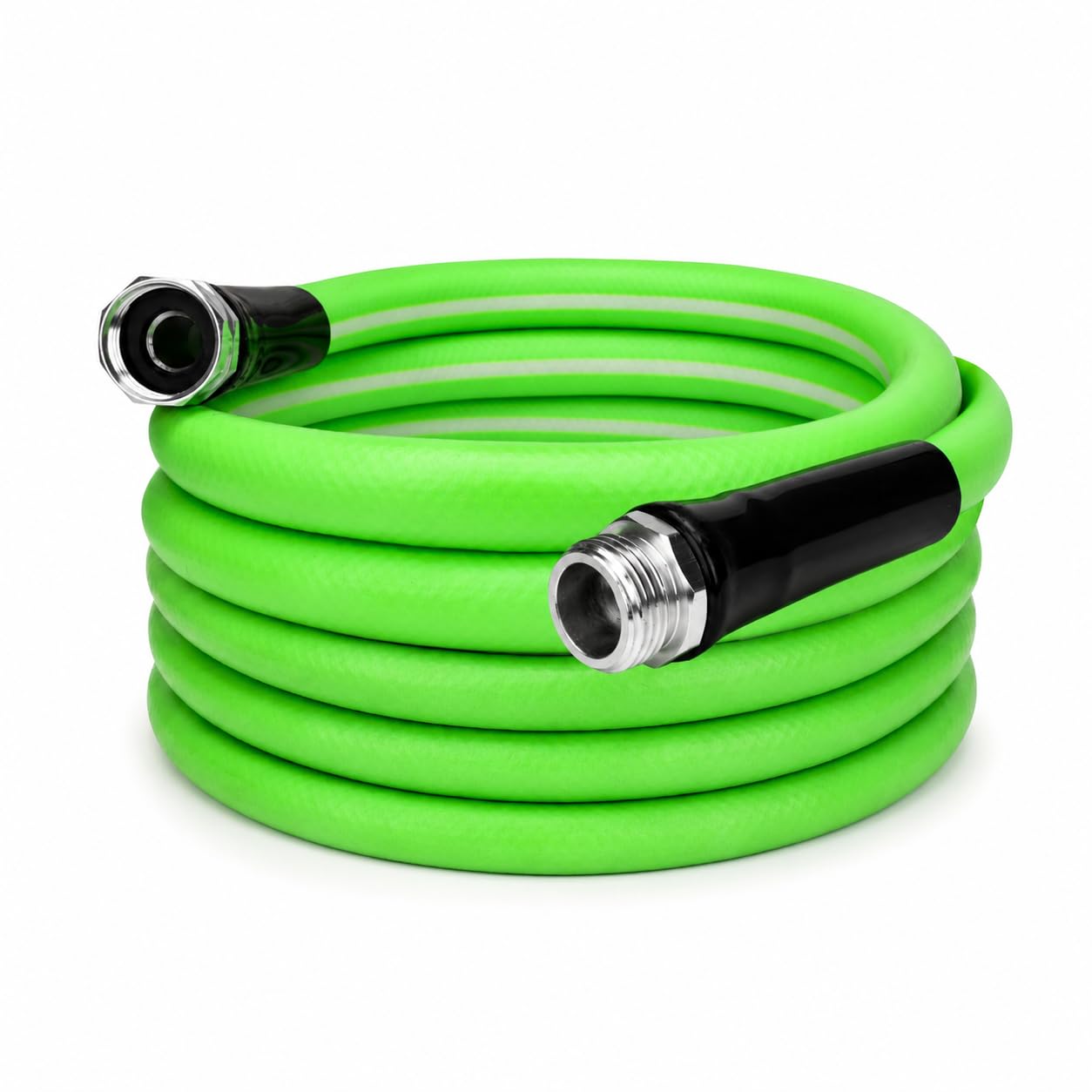
Twelve feet is the length that makes sense on a balcony or a patio, where a full coil is more nuisance than help. The UNCO is a short hybrid-polymer connector with 3/4-inch GHT aluminum fittings and a drinking-water-safe claim.

The bright green body is easy to see against paving, and the 5/8-inch bore gives it a useful flow for a small bed or a hose reel. The aluminum fittings keep the ends light and use the standard garden-hose thread, so it connects without an adapter in most settings.

It is short enough to work as a semi-permanent connector for a dehumidifier drain, a hose reel, or a balcony tap, where a 50-foot hose is absurd. That is the job we picture for it: a neat pigtail rather than a hose you drag across rough ground.

We think it earns its place as a small-job hose, not as the only hose you own. For a patio, a balcony, or a short run to a water softener, the 12-foot length is the point; just treat the crimp ends with some care and keep the run gentle.

Bottom line: The UNCO is a sensible short connector for a patio or balcony, provided you do not expect it to shrug off rough treatment.

6

Aqua Joe 50-Ft

Aqua Joe 50-Ft

Garden watering

Our Score 8.8/10
Check Price

Worth Noting

  • Stiff out of the package
Length
50 ft
Warranty
2 years
Inside Diameter
5/8 in
Maximum Pressure
450 psi
Read the full review

The Aqua Joe is the 50-footer we hand to someone who wants a full-length garden hose without dragging a stiff coil around. It is bright blue, hybrid polymer, and light enough to move from bed to bed without a wrestle.

The 5/8-inch bore and 450 psi burst rating put it in the same working range as the Camco, and the hose is BPA-, lead-, and phthalate-free. The two-year warranty is the unusual bit here: most hoses in this group ask you to trust the construction, while this one backs it for longer.

We think it is the garden-first choice of the bunch. The hybrid body is more forgiving than stiff PVC, and the bright color makes it easy to spot across a lawn. It is not a kink-free promise in practice; a hard pull around a corner can still pinch flow, so leave a little slack at the spigot.

Bottom line: Aqua Joe's 50-foot hose is the lighter, brighter garden-first option when drinking-water safety still matters.

7

WELLUCK 10-Ft

WELLUCK 10-Ft

Short garden runs

Our Score 8.8/10
Check Price

Worth Noting

  • Kinks when dragged
Length
10 ft
Fittings
Lead-free brass
Inside Diameter
5/8 in
Maximum Pressure
600 psi
Read the full review

The WELLUCK is the rare drinking-water hose that is easy to find in tall grass, mostly because it is unapologetically pink. The 10-foot length is just as deliberate: this is a fill-the-can hose, not a reach-across-the-yard hose.

For a short hose, it is built with more margin than expected: a 600 psi burst rating, lead-free brass connectors, and a food-grade rubber body that is BPA- and phthalate-free. We like it for filling watering cans, rinsing boots, and topping off a small pet bowl without dragging out the long hose.

The UV-resistant cover is meant to handle sun, and the short body is easy to coil and hang. The trade-off is reach, which is obvious from the length, and the fittings are the part to check when you first connect it. Keep a spare washer handy and snug it down without over-tightening.

Bottom line: We keep the WELLUCK around for filling cans and small beds where a 10-foot hose is all the reach you need.

8

Gnimihz 50-Ft

Gnimihz 50-Ft

Lightweight watering

Our Score 8.4/10
Check Price

Worth Noting

  • Kinks can persist after uncoiling
Length
50 ft
Material
TPE
Inside Diameter
5/8 in
Maximum Pressure
450 psi
Read the full review

TPE is the reason to notice the Gnimihz. Where most hoses here use PVC or a hybrid polymer, this one is built around a material chosen to be lighter, and the 50-foot version is aimed at gardeners who feel every pound at the end of the day.

The hose is 5/8-inch inside diameter, rated to 450 psi, and described as BPA-free, phthalate-free, and odorless. Gnimihz puts the weight saving at 43% against a conventional 5/8-inch hose, which is the number that matters if you carry the hose to a community plot or coil it on a balcony.

The 50-foot length is generous for a hose this light, and the blue TPE body is meant to stay flexible across seasons. It suits a garden where the hose stays out between waterings more than a campsite where you coil and stow it every morning. The light carry is the feature we keep coming back to.

We think it is the pick when weight matters more than a perfect coil, not the hose to choose for a rough drag across paving. For a small garden or a community plot, the easier carry can be worth more than the last word in kink resistance.

Bottom line: The Gnimihz is worth a look if a full 50-foot hose has to stay light, though its coiling manners are not the tidiest.

How We Chose and Tested Drinking-Water-Safe Hoses

We started with roughly 60 hoses on the market and cut anything that couldn't back up its drinking-water claim with a recognized certification covering both the liner and the fittings. From there we filtered by price per foot, availability in common lengths, and whether the couplings were lead-free brass or plated, then bought 14 to test. Every one of them was used the way a hose actually gets used, not on a lab bench.

Testing ran from April through September, about six months of real watering. Each hose lived on a spigot at a home, got dragged across grass, pavement, and mulch beds, and was coiled onto a hanger at the end of the day. We filled five-gallon buckets, a kiddie pool, and the dog's bowl with them, ran them at full pressure, and left a couple pressurized in direct sun for hours at a time the way most people forget to.

Kink resistance got tested on a deliberate 90-degree pull around a driveway corner while the water ran, and we watched for the flow to drop and had to walk back to straighten it out. For stiffness, we coiled each hose on a cool morning and again after two hours in the sun, noting which ones fought back. Leaks showed up with a dry paper towel wrapped around each connection for ten minutes. For taste, we filled a glass from each hose after the water had sat in the sun, chilled it, and had two of us sip without knowing which was which. By September we were also checking fittings for corrosion and looking for bulges or cracks, since durability only shows up after a season. Value, in the end, came down to cost per foot measured against how each hose looked by fall.

How to Choose the Right Drinking Water Safe Garden Hose

Read the certification before the marketing

Lead-free, BPA-free, and phthalate-free are useful material claims, but they are not the same as a finished hose certified to NSF/ANSI 61 for contact with drinking water. The Camco TastePURE is the one here that names both NSF/ANSI 61 and NSF/ANSI 372; most of the others stop at material claims or CA65 compliance.

For potable fills, we put the strongest certification first and treat the rest as supporting detail. If a hose only says food grade or lists lead-free materials, use it where that level of assurance is enough for you; if certification is the deciding factor, choose the one that names the standard.

Match the length to the spigot, not the shelf

A 50-foot hose is right when the spigot is across a pad or the RV hookup sits far from the post. A 10- or 15-foot hose is better for a patio, a balcony, or filling cans, because you are not coiling excess every time. The RVMATE 15-Ft and WELLUCK 10-Ft make sense where the run is short.

Measure the path the hose actually takes, including around a tire or a planter, and choose the shortest length that reaches with a little slack. Extra length is not free: it adds weight, coiling time, and more places for a kink to form.

Handling: flexibility versus stiffness

PVC hoses tend to be stiff, especially in cool weather, while hybrid-polymer and TPE bodies are built to stay more pliable. That matters if you coil the hose after every use; it matters much less if the hose stays on a reel or a seasonal hookup.

Kink-free is a marketing phrase, not a guarantee. Even flexible hoses can pinch under a hard bend, so leave slack at the spigot and avoid dragging any hose around a sharp corner. If you move the hose often, choose flexibility first; if it stays put, prioritize certification and fitting quality.

Fittings, leaks, and storage

Aluminum and brass fittings hold up better than brittle plastic, and a rubber washer in good condition does more for a tight seal than cranking down on the coupling. The crimp-to-fitting joint is the place to inspect first, especially on a hose that lives outdoors.

A storage bag is not a luxury if the hose shares a wet bay with other gear. Drain the hose before packing it, keep it out of direct sun when you can, and store it indoors before a freeze. The OULEME 25-Ft and Kohree 50-Ft both come with bags that make that routine easier.

Frequently Asked Questions

Final Verdict

For potable water, start with the Camco TastePURE. Its NSF/ANSI 61 and 372 credentials are the clearest match for the job, and the 50-foot length covers most RV and garden hookups. The trade-off is a stiff body that takes patience to coil.

If you move the hose often, the Kohree 50-Ft is the easier daily companion. If your spigot is close, the RVMATE 15-Ft keeps the run tidy.