Lawn Care

Best Crabgrass Preventers of 2026

Crabgrass doesn't announce itself. It shows up in July as a coarse, pale mat creeping along the driveway edge, weeks after the seed behind it germinated — which is why a preventer goes down before the soil warms, not after you spot the weed. These products leave a thin barrier in the top inch of soil, and what separates a good one from a forgettable one is how evenly that barrier lands, how long it holds, and whether your grass comes back thicker and greener or just with pale tips.

I've spent six springs losing the same patch of lawn to crabgrass, so this year my team and I put 12 preventers through a full growing season, from the first April application to the August check that tells you whether any of it worked. Here's what nobody tells a first-timer: two half-rate passes in crossing directions beat one heavy pass every time, since the barrier only works where the granules actually land. The picks below are the ones that held up in real yards.

1

Quali-Pro Prodiamine 65 WDG

Top Pick
Quali-Pro Prodiamine 65 WDG

Large turf areas

Our Score 9.4/10
Check Price

Worth Noting

  • Instructions are terse for first-time users
Form
Water-dispersible granules
Size
5 lb
Application
Tank sprayer
Active Ingredient
Prodiamine 65%
Read the full review

The five-pound jug looks like a lifetime supply, and for a small lawn it nearly is. It holds 65% prodiamine water-dispersible granules, so you measure by weight, mix in a tank, and spray; there are no granules to push through a spreader.

We like it best here for large properties and for people who already own a sprayer. The concentration is the point: a little goes a long way, and the label is built for season-long crabgrass and broadleaf control. Mixing takes more care than opening a bag, but the jug reseals and stores more tidily than a half-used bag.

Once the tank is mixed, the application is clean and quick, and the jug stores easily between uses. For a small lawn, the jug may outlast your need; for larger turf, that concentration is the point.

Bottom line: We recommend Quali-Pro for sprayer users with large lawns, because a small measured dose of prodiamine covers a lot of turf and lasts.
2

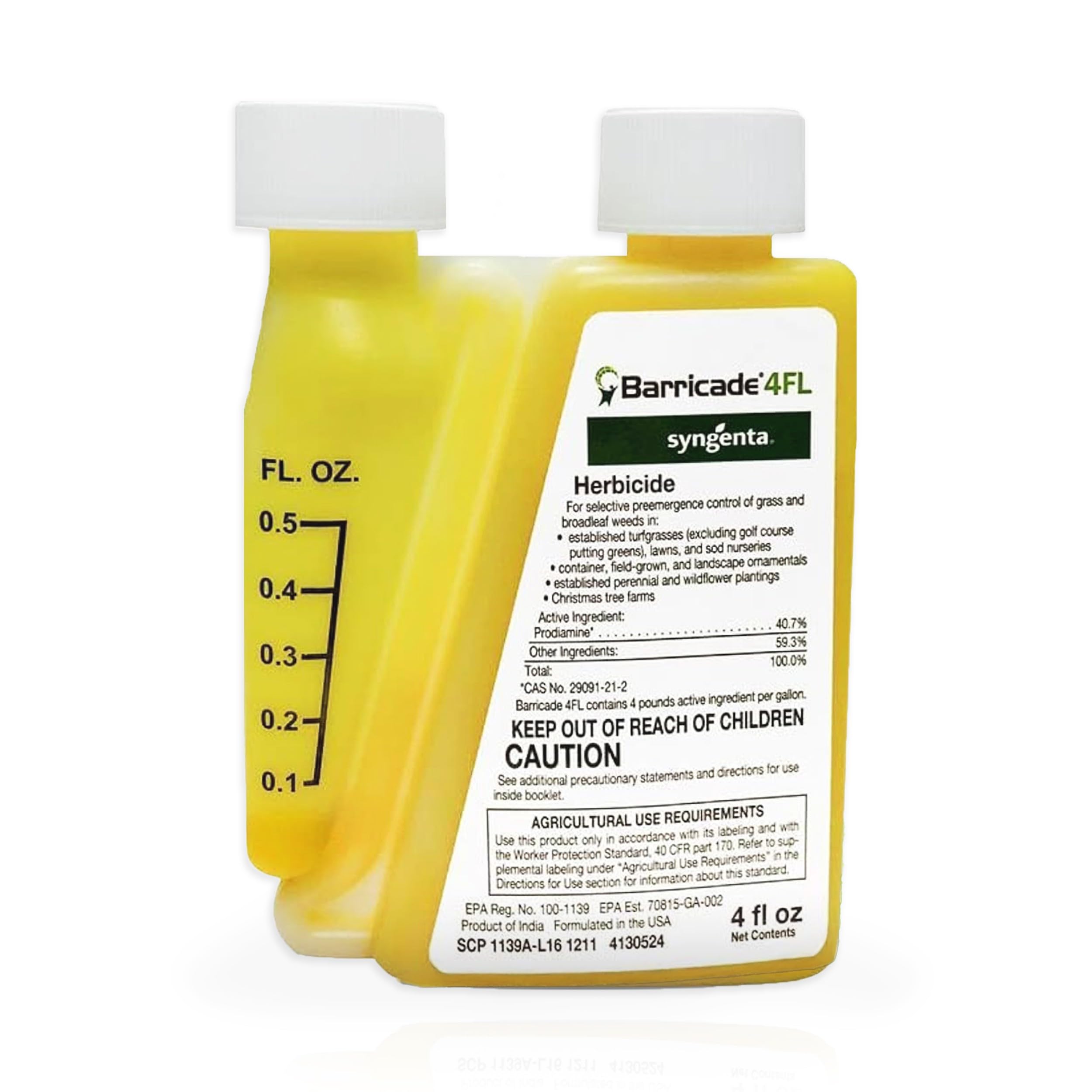
Barricade 4FL Concentrate

Barricade 4FL Concentrate

Spot spraying

Our Score 9.2/10
Check Price

Worth Noting

Form
Liquid concentrate
Size
4 fl oz
Application
Tank sprayer
Active Ingredient
Prodiamine
Read the full review

A four-ounce bottle is the smallest package here, and that is the point. It is a liquid prodiamine concentrate for lawns and turf, not a bag to haul around.

You measure it into a tank, spray the area, and water it in; there are no granules to sweep up or store. The bottle takes up almost no shelf space, and a little goes a long way when the rate is right.

We keep it for small lawns and spot work because the liquid goes exactly where the sprayer goes. The trade-off is the routine: a sprayer, a measuring cup, and a calm hand. If you already own the equipment, that is a fair exchange for precision.

Bottom line: We recommend Barricade 4FL for sprayer users with small lawns or spot work, because a little concentrate goes exactly where you spray.

3

Scotts Halts Crabgrass Preventer

Scotts Halts Crabgrass Preventer

Spring lawn feed

Our Score 9.0/10
Check Price

Worth Noting

Form
Granular
Coverage
5,000 sq ft
Watering-in
1/4 to 1/2 inch within 2-3 days
Added Benefit
Lawn fertilizer
Read the full review

The first warm week of spring is when this bag earns its keep. It is a granular pre-emergent with lawn food built in, and we like that it makes the spring job a single pass: spread it, water it in, and the grass gets fed while the crabgrass barrier goes down. The 5,000-square-foot coverage is sized for a typical suburban lawn rather than an estate.

The application is straightforward: set a spreader, walk the lawn in overlapping passes, and keep the rate even. The catch is granule quality. Hard clumps can form in the bag and clog a spreader, so break them up before loading and do not stretch the bag past its coverage. A second bag up front is better than a thin pass that leaves gaps in the barrier.

What makes it the top pick is the combination: prevention, fertilizer, and a granular format most people can apply without a tank. If your lawn is mostly fine and you want one spring product, start here; if you are seeding or already have crabgrass up, choose a different tool.

Bottom line: We make Scotts Halts our top pick because it turns spring crabgrass prevention into one even spreader pass and feeds the lawn at the same time.

4

The Andersons Barricade

The Andersons Barricade

Big lawns

Our Score 8.8/10
Check Price

Worth Noting

  • No fertilizer or post-emergent weed control
Form
Granular
Coverage
12,880 sq ft
Application
Broadcast spreader
Active Ingredient
0.48% prodiamine
Read the full review

The number that matters on this bag is 12,880. That is the square footage The Andersons claims for the 40-pound bag, and it is the reason to look here first if your lawn is measured in acres rather than a single afternoon.

We think it is the best granular pick here for a big lawn because the small DG granules dissolve quickly and spread evenly. It contains 0.48% prodiamine and is built for early spring and fall applications. The particle size is the detail we appreciate most: smaller granules mean fewer streaks and less chance of a heavy pocket that wastes product.

The limit is the rate. The 12,880-square-foot claim assumes the lightest labeled application; if your grass or weed pressure calls for a heavier rate, the bag covers less. Set the spreader by the label and measure your lawn first.

Bottom line: We pick The Andersons for big lawns that need a pure pre-emergent barrier, because the 40-pound bag covers serious square footage without extra fertilizer or weed killer.

5

Scotts Triple Action1

Scotts Triple Action1

Weed and feed

Our Score 8.8/10
Check Price

Worth Noting

  • Won't kill existing crabgrass
Form
Granular
Coverage
4,000 sq ft
Added Benefit
Fertilizer and broadleaf control
Crabgrass Control
4 months
Read the full review

This is the bag for the lawn that needs more than a crabgrass barrier. We like it because it prevents crabgrass for four months, kills listed broadleaf weeds, and feeds the grass in one pass. That is a lot of spring work in a single spreader.

The coverage is 4,000 square feet, so a larger lawn needs two bags. The application is specific: apply to a wet lawn with a Scotts spreader, then water in after 24 hours. That is more fuss than a straight pre-emergent, but it is all one product.

The timing is early spring, when dandelions are actively growing. Check the grass list on the bag before you buy; this one is not for every lawn. If your lawn is already green and thick, a straight pre-emergent is simpler.

Bottom line: We recommend Scotts Triple Action1 for lawns that need crabgrass prevention plus a spring feed and broadleaf cleanup in one pass.

6

Atticus Torocity Mesotrione

Atticus Torocity Mesotrione

Seeding and repair

Our Score 8.6/10
Check Price

Worth Noting

  • Coverage is only about 1,000 sq ft
Form
Liquid concentrate
Coverage
1,000 sq ft
Use Timing
Pre- and post-emergent
Active Ingredient
40% mesotrione
Read the full review

Torocity is not the set-and-forget spring bag most people picture when they search for a crabgrass preventer. It is a liquid concentrate built around a different timing problem.

It contains 40% mesotrione, the same active ingredient as Tenacity, and it is labeled for both pre- and post-emergent activity. That makes it useful when you are seeding Kentucky bluegrass, tall fescue, perennial ryegrass, or centipedegrass and still need crabgrass control. It is the one here that fits that window.

We keep it for that seeding window because most pre-emergents stop grass seed along with crabgrass; this one is labeled for just-seeded turf, so a renovation can go down with a barrier. The trade-off is speed: the visible kill takes weeks, not days. If you are not seeding, choose a granular product and save yourself the tank.

Bottom line: We keep Atticus Torocity for overseeding and renovation, where its mesotrione can prevent crabgrass without shutting down new grass seed.

How We Tested the Best Crabgrass Preventers

We started with roughly 40 granular preventers sold at garden centers and home improvement stores, then narrowed the field by coverage claims, price per 1,000 square feet, and whether the label called for a single spring application or a split one. Anything that demanded a specialty spreader, or cost noticeably more per square foot than the rest, got cut. That left 12 products, which we ran through a full growing season — April application through the late-August check.

Each one went down on a Saturday morning in April across four yards with different soil and shade, using both a broadcast spreader on the open lawn and a handheld on the tight strips along the driveway and fence line. We weighed the bags before and after to see whether the stated coverage held, watered everything in as directed, and walked the plots weekly.

In July and August we counted crabgrass clumps inside marked squares, which is where effectiveness actually shows itself. We also watched for striping and clumping as the granules left the spreader, noted how much dust we were tracking into the garage, and looked at whether the lawn greened up evenly or came back with pale tips and whitened weeds in the weeks after application. Bags that tore at the handle or wouldn't reseal got marked down, and we tracked whether each product held through the second germination window or faded by midsummer.

How to Choose Crabgrass Preventers

Start With Timing, Not Strength

A pre-emergent crabgrass preventer does not kill plants you can see; it stops seed from rooting. That makes the calendar the first decision. Put it down in early spring, before the soil warms and crabgrass starts to sprout, and do not expect it to rescue a lawn that is already showing crabgrass. We put timing ahead of brand every time, because a perfect product applied late is just an expensive topdressing. If you already have crabgrass up, switch to a post-emergent product and save the pre-emergent for next spring.

Match the Bag to Your Lawn

Coverage claims assume a labeled rate, so measure your lawn before you shop. A 5,000-square-foot bag like Scotts Halts suits a typical suburban lot; The Andersons Barricade stretches to 12,880 square feet, and Scotts Triple Action1 covers 4,000. The number on the bag is not a suggestion to stretch. We buy the extra bag rather than thin the rate, because an uneven barrier leaves gaps that crabgrass finds. Multiply length by width, subtract the house and beds, and buy enough product for the whole lawn.

Choose Granular or Liquid

Granular products are the easiest default: a spreader covers a lawn quickly, and you can see where you have been. Liquid concentrates such as Quali-Pro Prodiamine 65 WDG and Barricade 4FL need a tank sprayer and careful measuring, but they make sense for large properties or spot work. We reach for granular when the lawn is the main job and for liquid when we already have the sprayer out. If you do not own a sprayer, do not buy a concentrate to save shelf space; the equipment changes the decision.

Check Grass Type and Seeding Plans

Pre-emergents are not one-size-fits-all. Some are labeled for a long list of turfgrasses, while others are aimed at Southern lawns or have restrictions around seeding. The biggest trap is overseeding: most crabgrass preventers will stop grass seed along with crabgrass. If you plan to seed, choose a product labeled for just-seeded turf, such as Atticus Torocity, or wait until the new grass is established. Read the grass list on the bag before you buy, not after you have opened it.

Decide Whether You Need Extras

A straight pre-emergent is the simplest choice, but some bags add fertilizer or broadleaf weed control. Scotts Halts includes lawn food, and Scotts Triple Action1 also kills listed broadleaf weeds. Those extras can save a pass, but they also narrow the coverage and commit you to a product with more jobs. We like extras when the lawn needs them and prefer a plain barrier when it does not. If you are already feeding on a schedule, buy the pre-emergent alone and keep the two jobs separate.

Frequently Asked Questions

Final Verdict

Most lawns need one simple spring pass, and Scotts Halts is the easiest good decision: it covers 5,000 square feet, feeds the grass, and does not require a sprayer. If your lawn is much larger or you already own a sprayer, Quali-Pro Prodiamine 65 WDG is the stronger fit because a measured concentrate goes further. If you are overseeding, choose Atticus Torocity instead; that is the exception where a mesotrione product earns its place.