Poultry & Livestock

Best Chicken Coop Heaters of 2026

A heater inside a wooden box lined with straw and feathers sounds like a bad idea, and plenty of chicken keepers will tell you it is. The difference is that a coop heater worth owning isn't really a space heater — the good ones are sealed, low-wattage panels and plates that radiate a gentle warmth instead of blowing hot air across a bedding pack. What you're actually buying is a way to take the sharp edge off a hard frost and keep the waterer from freezing solid by morning, without turning your coop into kindling.

I keep eight hens in a converted shed, and for the past seven months my team and I have rotated 11 different heaters through it and a couple of borrowed coops, checking thermometers at 5 a.m. and sniffing for scorched dust. The surprise was how little wattage mattered next to placement and controls. Warm the birds, not the whole coop — a hot, humid coop is harder on combs than a cold, dry one — and the picks below are the ones I'd trust sitting next to a bale of straw.

1

Premier 1 Prima Heat Lamp

Top Pick
Premier 1 Prima Heat Lamp

Barns and sheds

Our Score 9.2/10
Check Price

Worth Noting

  • Bulb sold separately
  • Higher running cost than a panel
Safety
Tilt shutoff and guard
Mounting
Ceiling hang
Heat Output
Up to 250 W bulb
Bulb Included
No
Read the full review

Start with what's in the box: the lamp, the guard, and a hanging system. No bulb. The Prima takes a standard BR40 or infrared bulb up to 250 watts, so the heat you get depends entirely on what you screw in, and that bulb is a cost you repeat rather than a one-time purchase.

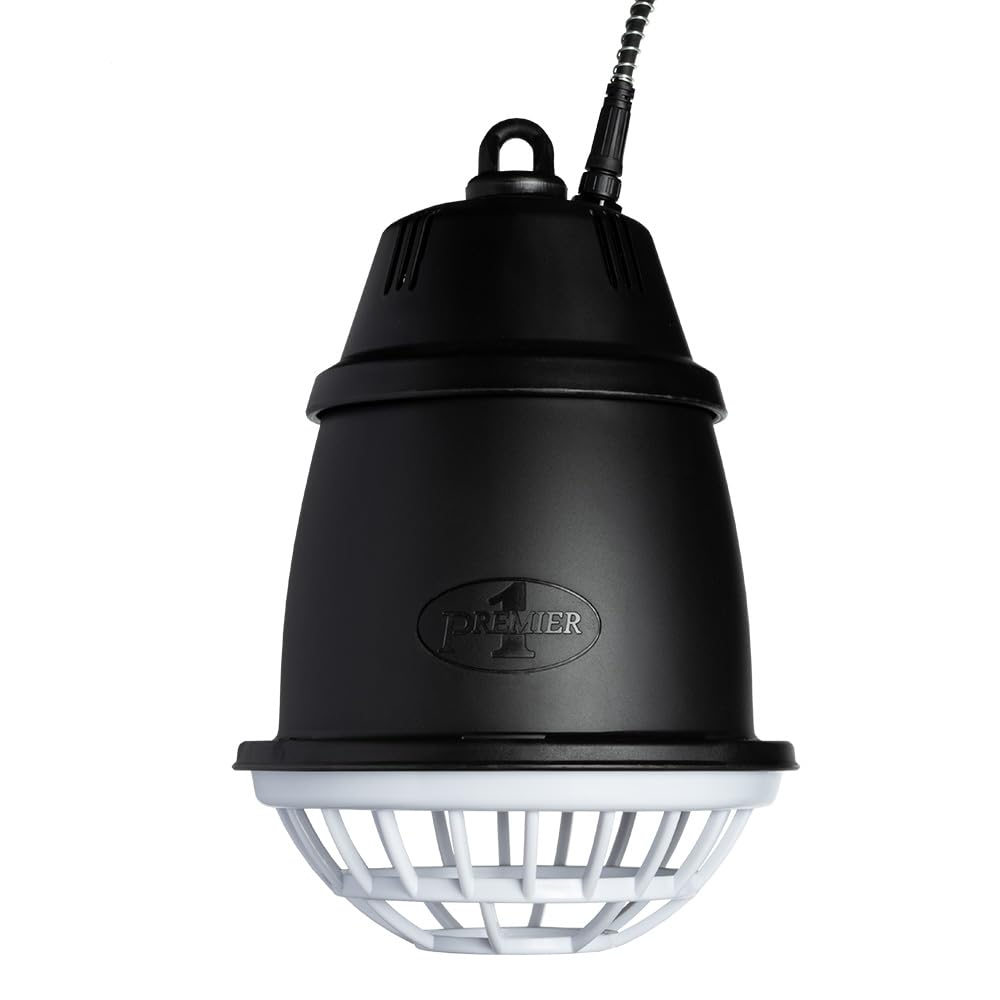
What makes this the lamp to buy instead of a cheap clamp fixture is the safety hardware. There's a heavy-duty plastic grill over the bulb, a glass-reinforced housing that shrugs off knocks from livestock, and an integrated switch that cuts the lamp if it tilts to an unsafe angle. For a barn, a kidding pen, or a drafty shed where a 150-watt panel can't move enough heat, this is the fixture we choose over a bare lamp every time.

Set expectations on running cost: a 250-watt bulb draws more than any panel in this guide, and a lamp heats the air around it rather than putting warmth on a bird's back. It hangs from a ceiling mount on a long cord, which makes it easy to reposition over different pens, and the tilt shutoff is the reason we're comfortable recommending a lamp inside a bedding-filled building at all.

Bottom line: For a barn or a drafty shed where a panel can't keep up, this is the guarded lamp we trust: it cuts out when tilted and takes bulbs up to 250 watts.

2

Sweeter Heater OH11x40

Sweeter Heater OH11x40

Large coops

Our Score 9.0/10
Check Price

Worth Noting

  • Highest price in this group
Mounting
Overhead, chain included
Warranty
3 years
Heat Output
150 W
Heating Area
440 sq in
Read the full review

Forty inches of panel is the number that sold us on the Sweeter Heater: 440 square inches of radiant surface, enough to span the width of a roost rather than put one hot spot in the middle of it. It delivers that on 150 watts, with a uniform heat pattern and no bulb to change. Of everything here, it's the one we keep recommending to anyone with a walk-in coop and a ceiling to hang from.

The design suits a coop. It hangs on an included chain and hooks, throws heat down onto the birds' backs, and has no fan to clog with dust and feathers. Inside, an internal thermostat shuts the unit off if heat can't escape — exactly the failure that matters in a closed box full of shavings. At 7 pounds it wants a proper fixing point in a rafter, not a cup hook in thin plywood.

What the extra money buys is confidence. The three-year warranty is the longest of any heater here, which counts for a lot in a category where panels quit early. The trade-off is physics: radiant heat falls off with distance, so this warms the zone beneath it beautifully and does almost nothing for the air at the far end of a big shed. Hung over the perch, that's fine — the cold hens sit directly under it and the rest stand at the edge.

Bottom line: If your coop has a ceiling to hang from, we think this is the last heater you'll buy for it: broad, gentle heat, a thermostat that shuts it down, and the longest warranty here.

3

RentACoop Heating Plate

RentACoop Heating Plate

Brooding chicks

Our Score 9.0/10
Check Price

Worth Noting

  • Chicks must touch the plate for warmth
  • Leg tabs can bind when adjusting
Capacity
Up to 15 chicks
Plate Size
10 x 10 in
Heat Output
15 W
Height Settings
25, from 1 to 9 in
Read the full review

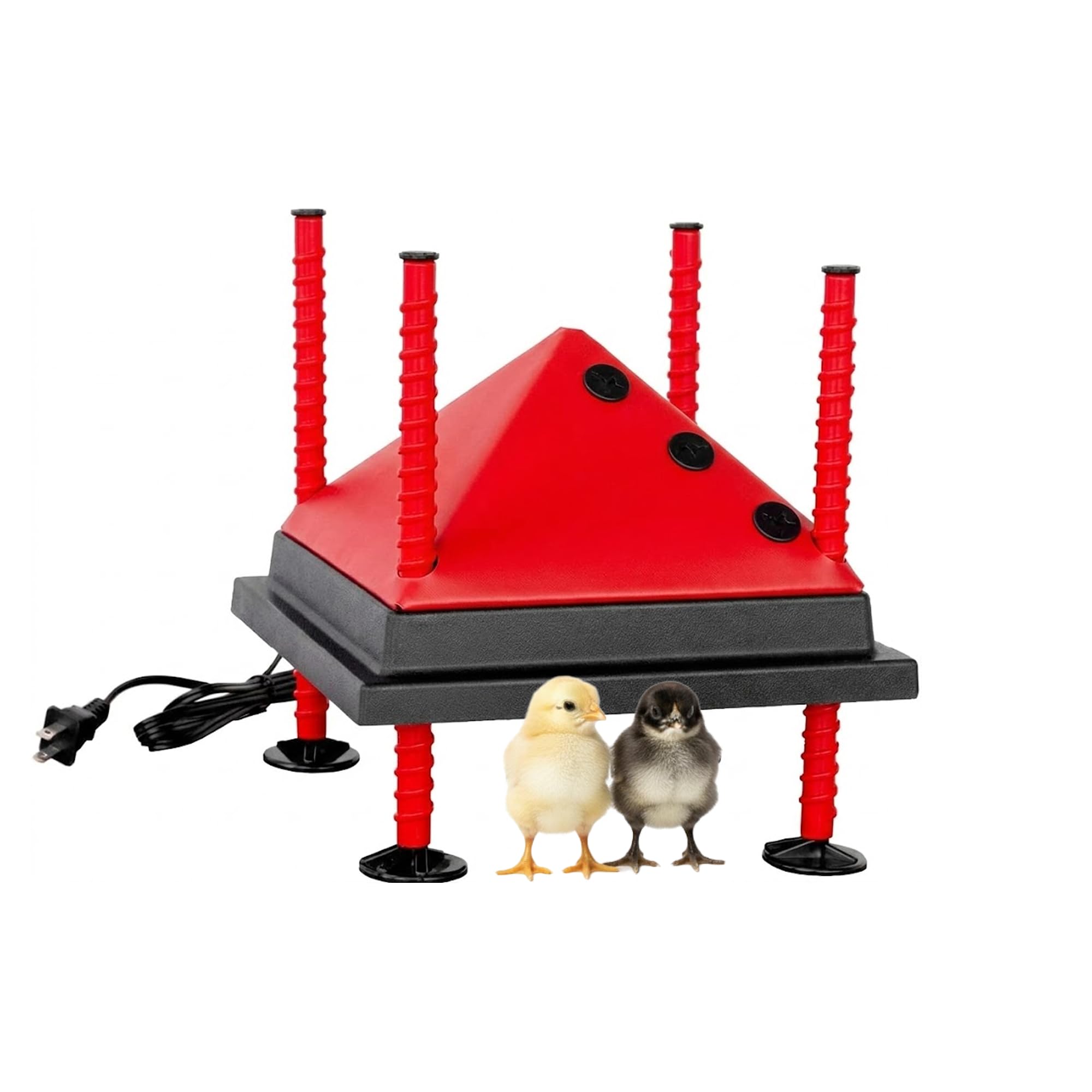
A brooder plate works on a different principle from everything else here. Chicks don't bask in front of it; they walk under it and touch a warm underside, the way chicks tuck under a hen. The 10 by 10-inch plate runs at about 107 °F in the center and does it on 15 watts, against the 250 a heat lamp would pull.

It grows with the brood. Twenty-five height settings take the plate from 1 inch to 9 inches off the floor, so chicks that fit in week one still fit in week four, and the included anti-roost cone keeps the top clear, which we appreciate after a week of chick droppings. Setup is a matter of pushing the legs in — no thermostat to set, no bulb to replace.

The limits deserve saying plainly. Chicks have to be in contact with the plate to get real warmth, so it's a warming station rather than a room heater, and the leg tabs can bind when you're changing height.

We keep it in this guide for the brooding half of the year, not the winter half. It's the safest way here to raise chicks without a bulb, it costs almost nothing to run, and it will not take the chill off a coop of adult hens in January — nor is it meant to.

Bottom line: It's a brooder plate, not a coop heater, and we think it's the safest way here to warm chicks without a bulb.

4

Cozy Coop Heater

Cozy Coop Heater

Small coops

Our Score 8.8/10
Check Price

Worth Noting

  • Six-month warranty
Mounting
Wall or free standing
Warranty
6 months
Heat Output
200 W
Safety Listing
ETL, zero clearance
Read the full review

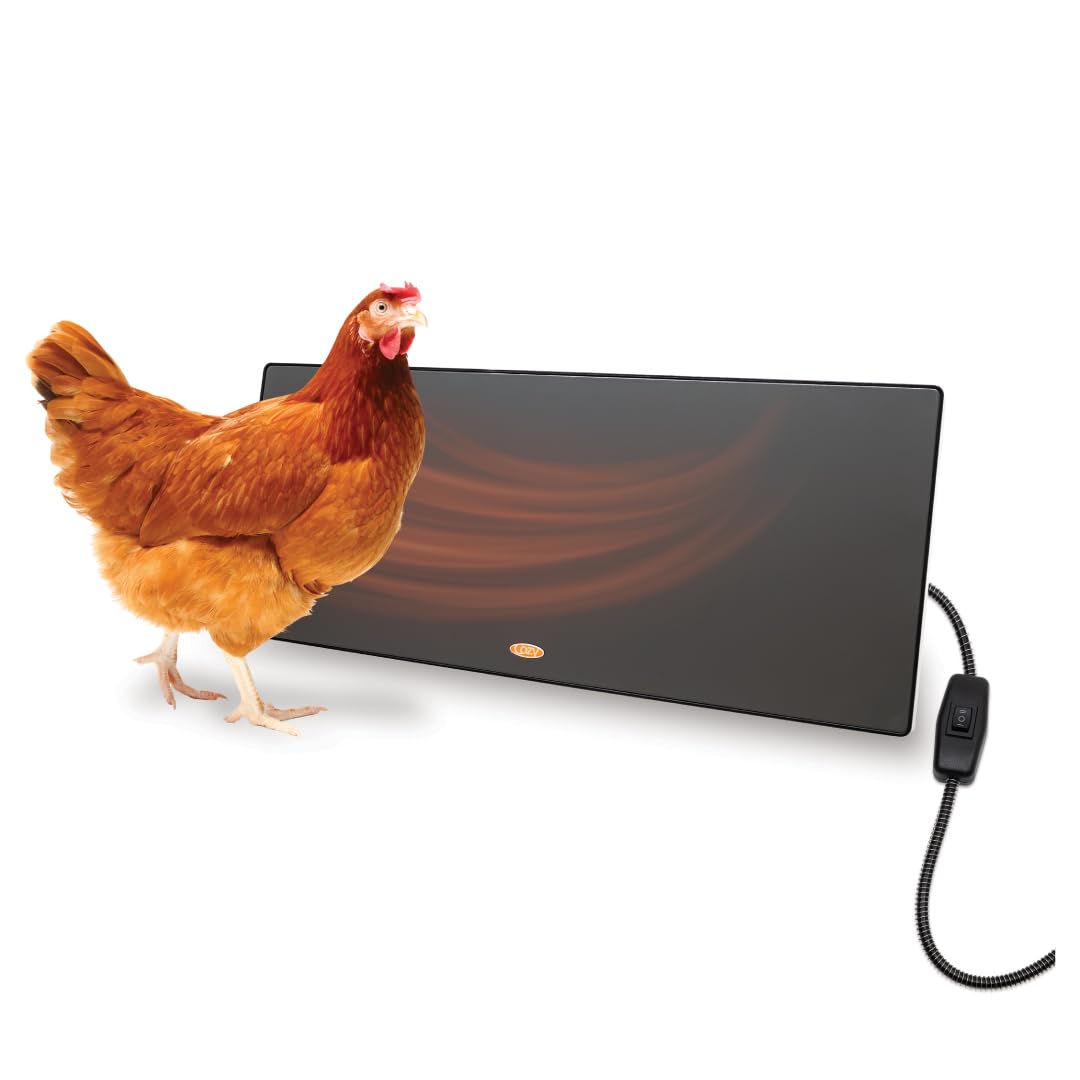
Two inches deep, sixteen ounces, and a wall bracket: the Cozy Coop is the least intimidating heater in this guide. It screws to a coop wall or stands on the floor, has a big rocker switch plus an in-cord switch, and carries an ETL listing with a zero-clearance rating, so it can sit against a wall near bedding without a clearance gap to measure.

At 200 watts it will not warm a building. What it does is put a warm panel in front of a few birds, and it manages that on roughly 13% of the draw of a 1,500-watt space heater — which is the whole argument for a flat panel over a lamp in a small house. For a backyard coop of half a dozen hens, we think that's enough, and it's the least expensive route here to a safety-listed panel on a wall.

Durability is the catch. This is the model in the group with the weakest long-term showing — panels that stop heating within a season are the recurring story — so treat it as something you may replace rather than a fixture you install once. If you want the heater still working in year four, that's the Sweeter Heater. If you want safe heat on a wall this weekend, this one earns its place.

Bottom line: A small-coop budget pick we still recommend: 200 watts, a zero-clearance ETL rating, and a panel you can screw to a wall yourself.

5

Chickcozy Smart Heater

Chickcozy Smart Heater

Brooder to coop

Our Score 8.8/10
Check Price

Worth Noting

  • Legs feel light for the price
Warranty
2 years
Panel Size
16 x 11 in
Heat Output
200 W
Temperature Range
70–190 °F
Read the full review

Most coop heaters do one job. This one is built for two: lay the 16 by 11-inch panel flat on its legs and it works as a brooder plate for chicks, then raise or hang it and the same panel heats grown hens. The range runs from 70 to 190 °F and a built-in sensor adjusts output as the coop cools.

The detailing is better than most here. A plastic top discourages birds from roosting on the panel, the legs adjust for height, and the warranty runs two years — second only to the Sweeter Heater's three. It's a 200-watt panel, so treat it as heat for a coop, not for a barn.

Where it gives us pause is the electronics. On this model, heat that stops mid-winter tends to announce itself as a flashing green light and a cold plate, and that's the one failure that actually costs you birds. The two-year cover is why we're comfortable keeping it near the top of this list: if the sensor quits, you're not starting over at your own expense. For someone raising a flock from chicks, that combination makes it the most flexible heater here.

Bottom line: Our pick for anyone raising chicks now and wanting the same heater in the coop later: it's flexible, well built, and backed for two years.

6

ILOJUST F003

ILOJUST F003

Remote control

Our Score 8.6/10
Check Price

Worth Noting

  • Small panel for a large coop
  • Timer stops at 12 hours
Timer
Up to 12 hours
Heat Range
86–194 °F
Heat Levels
13
Certification
ETL and UL
Read the full review

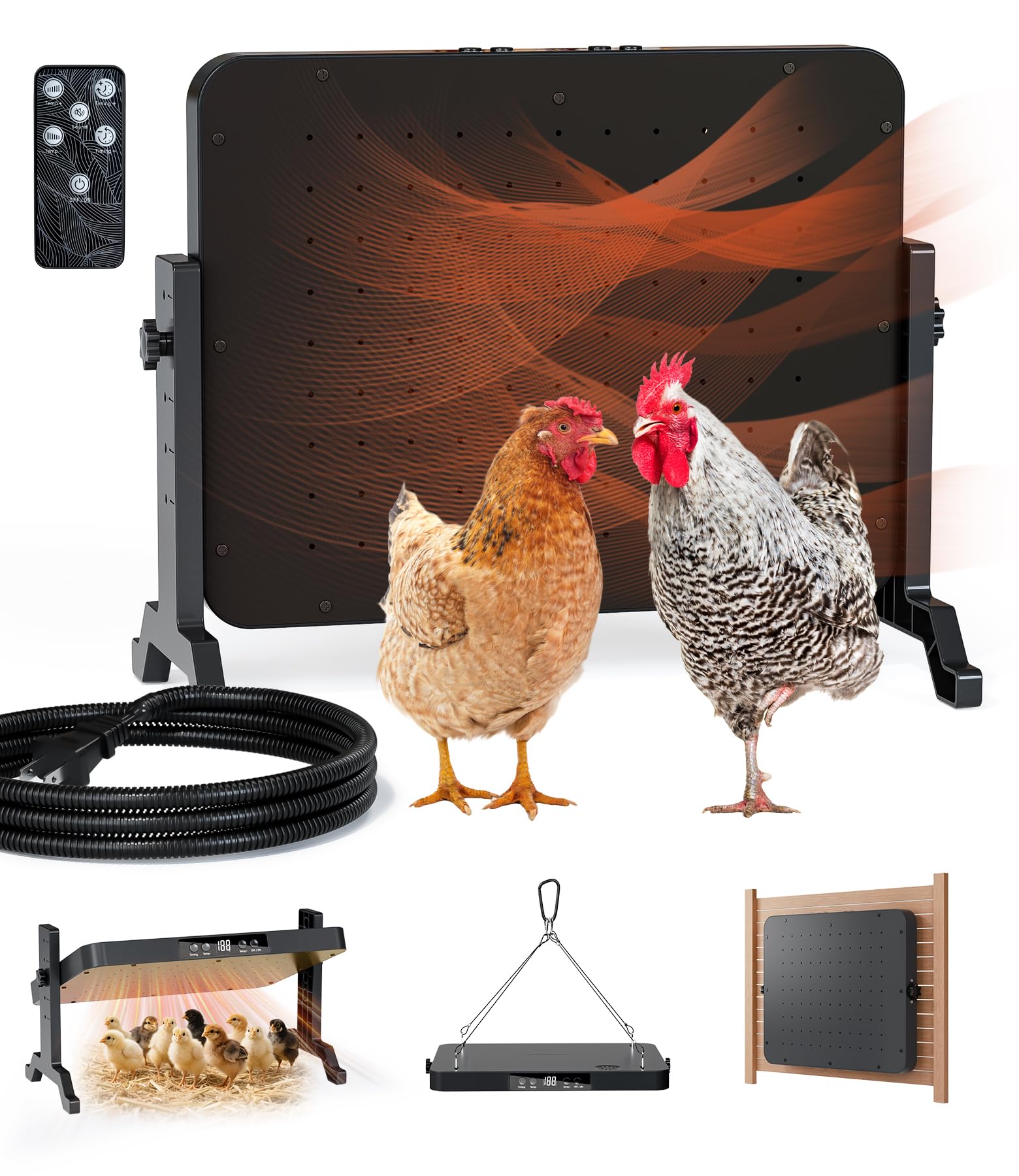
The remote is what earns this one its place. You can drop the heat a level or start the timer without unbolting the coop door in the dark, and with 13 levels between 86 and 194 °F plus a 12-hour timer, it's the most controllable heater in this group.

Behind the controls sits a slim panel — 15.3 by 11 inches, about 1.2 inches thick and 1.34 kg — that stands on legs, hangs from straps, or screws to a wall. It's ETL and UL certified, with overheat protection and a peck-resistant cord. The 86 °F floor makes it useful as a chick plate in spring as well as hen heat in December.

Two things to know before you buy. The panel is 15 inches wide, so in a big coop it's a warm corner rather than whole-coop warmth. And the timer's longest setting is 12 hours, which means a timer started at dusk can leave the coop unheated before dawn on the coldest night of the year. Neither bothers us in a small-to-mid coop, where taking the edge off is the whole job.

Bottom line: For changing the heat without braving the cold, we rate this the best remote-controlled panel here — 13 levels, a 12-hour timer, and a slim panel that hangs anywhere.

7

TIMEBAL Coop Heater

TIMEBAL Coop Heater

Thermostat plugs

Our Score 8.6/10
Check Price

Worth Noting

  • Modest heat in deep cold
Controls
Remote and LED display
Heat Output
200 W
Tilt Cutoff
45 degrees
Power Outage
Keeps settings
Read the full review

Power cuts are the detail most heaters ignore. The TIMEBAL holds its temperature setting and operating mode in memory, switches itself back on when the supply returns, and works happily behind an outlet timer or a thermostatic plug — so it slots into a setup you may already have rather than replacing it.

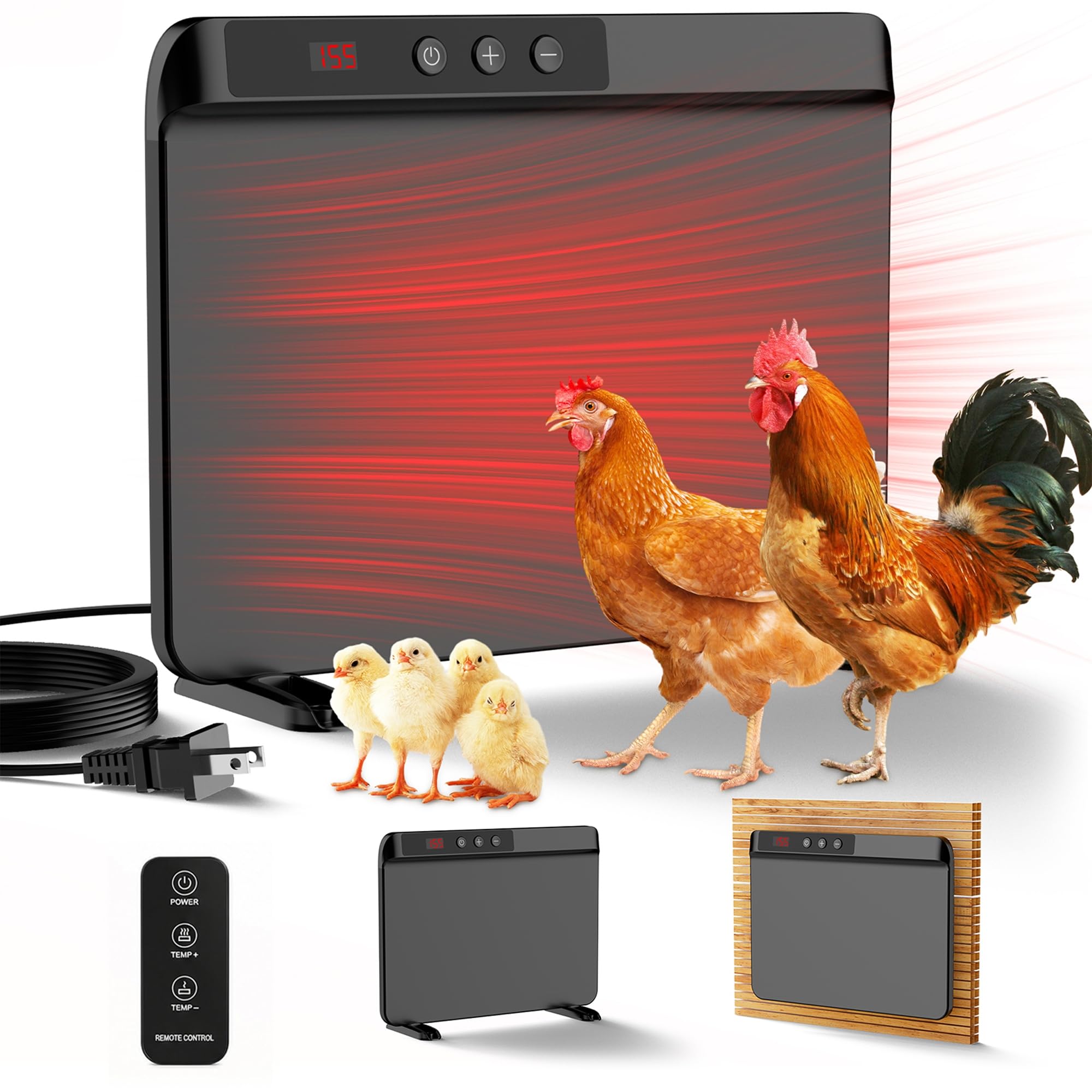
Two hundred watts, a remote, an LED readout, and a panel 15.9 inches long that stands on the floor or hangs on a wall. The anti-tilt cutoff is set at 45 degrees, so a panel knocked off its feet stops rather than lying face-down in the shavings.

None of that is unique on its own. Together, it makes this the heater that fits most neatly into an existing routine, which is why it's here. It is not a deep-cold answer for a large coop: the panel is narrow and the heat is concentrated, so use it in a small house or as a supplement to something bigger.

Bottom line: We rate it the one to get if you already run a thermostat plug: it remembers its settings, comes back after an outage, and shuts off if it tips.

How We Tested Chicken Coop Heaters Through a Full Winter

We started by pulling every coop heater we could find from farm-supply retailers and specialty poultry shops, then cut anything that couldn't answer three questions: is the heating element sealed away from dust and feathers, does it have a thermostat or at least a high-limit shutoff, and are the cord and housing rated for a damp, unheated outbuilding? That left 11 heaters, which we ran from October through April in a converted shed with eight hens and in two borrowed coops of different sizes.

Every unit went in at dusk and stayed in for at least two weeks straight, including one stretch where we never unplugged it. We logged surface temperature with an infrared thermometer at one inch and again at twelve inches, and recorded overnight lows with a data logger to see how far the thermostat actually swung between on and off. Fire safety got its own checks: we packed straw dust against each housing, left it running eight hours, then inspected for scorching and smelled the unit, and we read every listing for a recognized safety certification and noted whether the mount held the heater clear of bedding when a hen knocked into it.

The hens are the real test. We watched whether birds chose to roost near a heater or avoided it, whether the waterer stayed liquid until morning, and how much dust and droppings the housing collected in a week, since a unit you can't wipe down gets grim fast. Cords got yanked, pecked, and coiled for storage; brackets and hinges came down and went back up a dozen times. At the end we weighed what each one cost against how much of the coop it genuinely kept warm, because the biggest number on the box rarely matches the coldest corner of the shed.

How to Choose Chicken Coop Heaters

Radiant Heat, and Why Placement Beats Wattage

Nearly every heater here is radiant: it warms the surface it faces, not the volume of the coop. Hang a panel over the roost and the birds' backs catch the heat; hang the same panel from a tall ridge and most of it goes into the rafters. This is why a 150-watt panel positioned over the perch can do more for a flock than a 250-watt bulb swinging in the middle of the ceiling.

Before you shop, decide what you're heating: a roost, a brooding corner, or a whole shed. The answer changes the product, not just the wattage.

Match the Heater to the Coop You Have

A small backyard house of six hens is a one-panel job. The Cozy Coop or the TIMEBAL will take the edge off without much outlay, and neither needs a big mounting project. A walk-in coop with a long roost rewards coverage instead: the Sweeter Heater's 40-inch panel spans it, and the broad even heat means no single bird guards the warm spot.

A barn, a drafty shed, or an open pen is lamp territory, because a 250-watt bulb moves far more heat than any panel in this guide. Buy for the building you have, not the one you plan to build.

Safety Listing, Clearance, and Lamps

Look for an ETL, UL, or MET listing on the heater itself, then read the clearance rating. A zero-clearance panel like the Cozy Coop can sit against a wall near shavings; anything else needs the gap the maker specifies, and in a coop that gap is measured against bedding that shifts.

If you go with a lamp, the guard and the tilt shutoff matter more than the watts. The Prima has both, and the fixture must be rated for the bulb you fit — a heat lamp that falls into dry bedding is the fire everyone warns you about, so a guarded, tilt-cutoff lamp is the only kind we're comfortable recommending inside a coop.

Controls, Timers, and What Happens at 3 A.M.

A fixed-output panel is fine for a small coop in a moderate climate. A thermostat or stepped control earns its keep where winters swing, and a timer is useful as long as you read the maximum: the ILOJUST tops out at 12 hours, so a timer started at dusk can leave the coop unheated before dawn on the coldest night.

If you already run a thermostatic plug, buy a heater that behaves behind one. The TIMEBAL keeps its settings through an outage and switches itself back on when power returns.

Running Cost and the Parts You Replace

Wattage is the whole running-cost story. A 150-watt panel left on for twelve hours uses a fraction of what a 1,500-watt space heater does, and the Cozy listing puts its draw at about 13% of one. Lamps cost twice: a 250-watt bulb draws more, and the bulb itself is a consumable, so budget for a spare or two each season.

Warranty length is the other quiet cost. Three years on the Sweeter Heater against six months on the Cozy Coop tells you how the makers see their own hardware.

Frequently Asked Questions

Final Verdict

Seven heaters, one conclusion: put the heat where the birds are. The Sweeter Heater does that better than anything else here — 40 inches of panel over the roost, 150 watts, a thermostat that shuts it down if heat can't escape, and a three-year warranty behind it. It's the most expensive pick in this guide, and for a walk-in coop we think it's the one worth paying for.

In a small house on a tight budget, the Cozy Coop does a similar job for far less. In a barn or an open shed where a panel can't keep up, go with the Prima and a guarded bulb.