Tree & Forestry Care

Best Chainsaw of 2026

The maple limb came down across my driveway at 5 a.m., and by noon I'd borrowed a neighbor's saw that wouldn't start, pinched its bar twice, and taught me that a chainsaw is less about horsepower than about the first pull actually firing. A good one turns a weekend of dread into an hour of work. My team and I have spent the last eight months running 12 saws — gas, corded, and battery — through storm cleanup, firewood, and everything between.

Here's what first-time buyers get wrong: they size up. A 20-inch bar on a saw you can barely hold steady is slower and less safe than a well-balanced 16-inch model, and most homeowners never need more. Battery saws now cut close to gas on limbs and small logs, though the runtime printed on the box is optimistic once you're into seasoned oak. Ease of use, a chain that stays tight, and a battery that outlasts the job matter more than the spec sheet says — the picks below got all three right.

1

Seesii 40V 16" Chainsaw

Top Pick
Seesii 40V 16" Chainsaw

Long battery runs

Our Score 9.2/10
Check Price

Worth Noting

  • Heavier than compact battery saws
Motor
2000W brushless
Weight
10.3 lb
Battery
2 x 40V 4.0Ah
Bar Length
16 inches
Read the full review

Two 40V 4.0Ah batteries and two chargers come with the Seesii 16-inch saw, and that changes the calculation for anyone who has run a cordless saw out of juice halfway through a cleanup. Most battery saws give you one pack and a charging break; this one gives you a rotation.

We think that battery pair is the reason to choose it over a one-pack 16-inch saw. The 2000W brushless motor has the torque to keep the 16-inch bar moving, and the claimed 90-minute runtime is realistic for trimming and light bucking rather than constant hardwood cutting. It is a long runner in a class where runtime is usually the limiting factor.

The automatic oiler and 150ml reservoir are welcome on a saw at this level, and the 35 ft/s chain speed gives it a quick, confident feel in softwood. We found the controls straightforward and the body balanced enough to use two-handed without fighting it. The two batteries are the point.

For storm cleanup, fence-line trimming, and a woodpile that is more limb than trunk, the Seesii makes a persuasive case. It gives you enough battery capacity to finish the job, plus the option to keep cutting while the first pack recharges.

Bottom line: We choose the Seesii 40V when runtime matters most: two 40V batteries and a 16-inch brushless saw keep a long cleanup moving.

2

Husqvarna 460 Rancher

Husqvarna 460 Rancher

Large trees

Our Score 9.0/10
Check Price

Worth Noting

  • Heavy for overhead work
Engine
60.3cc 3.6 hp
Weight
13.2 lb
Bar Length
24 inches
Read the full review

The 24-inch bar on the Husqvarna 460 Rancher tells you what kind of saw this is: a heavy-work machine for felling and bucking larger trees. We treat it as the big-timber option in this group, and it earns that role with a 60.3cc X-Torq engine rated at 3.6 hp.

That engine has the torque to run the long bar without feeling strained, and the Smart Start system and air purge make a cold start less of a fight. In our cutting, it held power through hardwood and kept the chain moving under load. The LowVib system is not a marketing line here; the spring-damped handles take the sting out of a long session.

The 7-degree offset front handle and the open fuel and oil caps are small details that make the saw easier to live with. We also like that the recommended bar range runs from 13 to 24 inches, so the powerhead can be set up for smaller work if the big bar is more than the day needs.

This is a ground saw, not a tidy suburban trimmer. It needs fuel and bar oil, and it asks for two-handed technique. For the buyer with large trees and a serious firewood stack, the 460 Rancher provides the stability and cut speed a small saw cannot match.

Bottom line: We recommend the Husqvarna 460 Rancher for felling and bucking large trees; its 24-inch bar and 60.3cc engine give it the muscle this job needs.

3

DeWalt 20V 8" Pruning Saw

DeWalt 20V 8" Pruning Saw

Pruning and limbing

Our Score 9.0/10
Check Price

Worth Noting

  • Bare tool only; battery and charger extra
  • Limited to limbs and small logs
Motor
Brushless
Weight
4.61 lb
Bar Length
8 inches
Battery Platform
20V MAX
Read the full review

The DeWalt 20V 8-inch pruning saw is the one we reach for when the work is above eye level or deep inside a shrub. At 2.09 kg, it is light enough to hold one-handed for short cuts, and the 8-inch bar gets into places a 16-inch saw cannot follow.

The brushless motor is rated at 2.8 hp, which sounds absurd for a saw this small until you put it against a 4-inch limb. In our cutting, it pulled through soft and medium hardwood without the bogging we expected, and the auto-oiler kept the chain lubed. It is a pruning saw first.

We were impressed by how much control the small bar gives you. You can place the cut precisely, back out of a tight fork, and keep the saw steady with one hand while the other holds the branch. That is the reason to choose it over a compact 6-inch mini: the extra bar length and brushless motor make it more capable without making it a two-handed saw.

The one annoyance is bar oil. The reservoir can leak in storage, so empty it before the saw goes on a shelf. For a gardener already on the 20V MAX platform, it is a genuinely useful limbing tool.

Bottom line: We reach for the DeWalt 8-inch when pruning turns tight and awkward; it is light enough for one hand and narrow enough for dense branches.

4

Seesii 6" Mini Chainsaw

Seesii 6" Mini Chainsaw

Light trimming

Our Score 9.0/10
Check Price

Worth Noting

  • 6-inch bar limits it to branches
Motor
900W
Weight
2.2 lb
Battery
2 x 21V 2000mAh
Bar Length
6 inches
Read the full review

At roughly a kilogram, the Seesii mini is light enough to hold in one hand while the other hand keeps a branch steady, and its 6-inch bar is built for exactly that kind of pruning. It is the saw we pick when a full-size chainsaw feels like overkill.

The 900W motor and 21V batteries give it more punch than the size suggests. In our cutting, it handled shrubs, storm twigs, and small branches without the struggle we associate with toy-grade mini saws. The double safety lock takes two hands to release, which is a good thing, and the chain guard keeps debris from flying.

Two 21V 2000mAh batteries, a charger, a case, gloves, and eye protection are included. We like that the kit is ready to use without a separate shopping trip, and the two batteries let you swap rather than wait. The 29 ft/s chain speed is quick enough for clean cuts in green wood.

We see the Seesii as a pruning tool. It earns its place for the jobs where a bigger saw is awkward: shrubs, low branches, and cleanup after a storm. For that work, the light weight and one-hand control matter more than raw power.

Bottom line: We recommend the Seesii mini for light pruning and storm twigs; it is easy to hold one-handed and comes with two batteries.

5

Greenworks 40V 16" Chainsaw

Greenworks 40V 16" Chainsaw

All-around yard work

Our Score 8.8/10
Check Price

Worth Noting

  • Not for felling large hardwoods
Motor
Brushless 1.5 kW
Weight
10.4 lb
Battery
40V 4.0Ah
Bar Length
16 inches
Read the full review

The first thing that struck us about the Greenworks 40V is how ordinary it feels to start: squeeze the trigger and the chain is moving. There is no choke, no pull cord, no cloud of exhaust, and no ritual to remember. For a homeowner who cuts a few times a season, that ease is the feature that changes how often the saw leaves the shelf.

The 16-inch bar is the practical middle of the market. It is long enough for storm limbs and firewood, short enough to keep the saw balanced, and matched here to a brushless 1.5 kW motor. In our cutting, the saw kept its speed in softwood limbs and smaller logs. It is not the most powerful saw here, but it rarely feels strained by the work most yards produce.

The 4.0Ah battery is the part to plan around. It handles trimming, pruning, and light bucking, but heavy cutting drains it faster than stop-and-start yard work. If your sessions run long, a spare pack makes more sense than a bigger bar. The charger is included, and the three-year tool and battery warranty is a genuine comfort.

Tool-free chain tensioning and an automatic oiler are the quiet conveniences. The tensioner is easy to reach with gloves on, the oil window saves guesswork, and the chain brake and low-kickback bar are standard. We did notice that a new chain needs a tension check after the first few cuts; that is normal, not a defect.

What earns this saw the top spot is the balance it strikes. It covers the ordinary jobs that fill a homeowner's year, starts without drama, and does not make fuel or a cord part of the decision. For most people, that is the chainsaw they need.

Bottom line: We recommend the Greenworks 40V to most homeowners: it starts instantly, cuts a useful 16-inch swath, and makes routine yard work feel simple.

6

Craftsman 16" Electric Chainsaw

Craftsman 16" Electric Chainsaw

Corded home use

Our Score 8.8/10
Check Price

Worth Noting

  • Chain tensioner can work loose
Motor
12 amp
Weight
6.2 lb
Bar Length
16 inches
Power Source
Corded electric
Read the full review

The Craftsman 16-inch is a corded electric saw, and the cord is the whole story: it gives you constant power without a battery, but it also tells you where you can work. We think that is a fair trade for a yard with an outlet within reach and a pile of limbs to clear.

The 12-amp motor has enough grunt for medium branches and small trunks, and the 16-inch low-kickback bar gives it a useful reach. At 6.2 pounds it is light enough to carry around the yard, and the auto-oiling system and oil window take some of the fuss out of upkeep. The tool-free tensioner is easy to use with gloves on.

We liked the simple, old-school feel of the thing: no battery platform to buy into, no fuel to mix, no pull cord to fight. It is quiet enough to use in a suburban yard without annoying the neighbors, and it starts with a switch. The cord does demand a little planning, and a long extension cord needs the right gauge.

For a homeowner who cuts within reach of an outlet, this is the practical corded choice. It will not replace a gas saw for big timber, but it makes short work of the trimming and cleanup that most yards actually produce.

Bottom line: We recommend the Craftsman 16-inch to anyone with an outlet nearby: it delivers steady corded power in a light, simple package.

7

Tietoc 6" Mini Chainsaw

Tietoc 6" Mini Chainsaw

Budget pruning

Our Score 8.8/10
Check Price

Worth Noting

  • Chain can work loose during use
Motor
880W
Weight
3.3 lb
Battery
2000mAh
Bar Length
6 inches
Read the full review

The Tietoc mini is the lowest-cost way into a cordless chainsaw in this group, and the first thing we noticed is that the low price does not mean a bare-bones kit. It arrives with a battery, charger, and case, which is more than some pricier minis include.

The 880W motor and 6-inch bar are built for garden pruning, and the automatic oiler is a genuine surprise at this end of the market. In our cutting, it went through soft branches and shrubs cleanly, and the 3.3-pound body was easy to move around tight planting beds.

The controls are simple enough for a first-time chainsaw user, and the safety lock requires a deliberate two-button press. We also like the 28.6 ft/s chain speed, which gives it a quicker feel than the price suggests. The battery recharges without a long wait.

We recommend it as a first mini saw or a gift for someone who wants to try the format without committing much. It is happiest with light pruning and garden cleanup. For that buyer, it is a lot of tool for the money.

Bottom line: We recommend the Tietoc mini as a low-cost first cordless saw for garden pruning, provided you keep the chain tension in check.

8

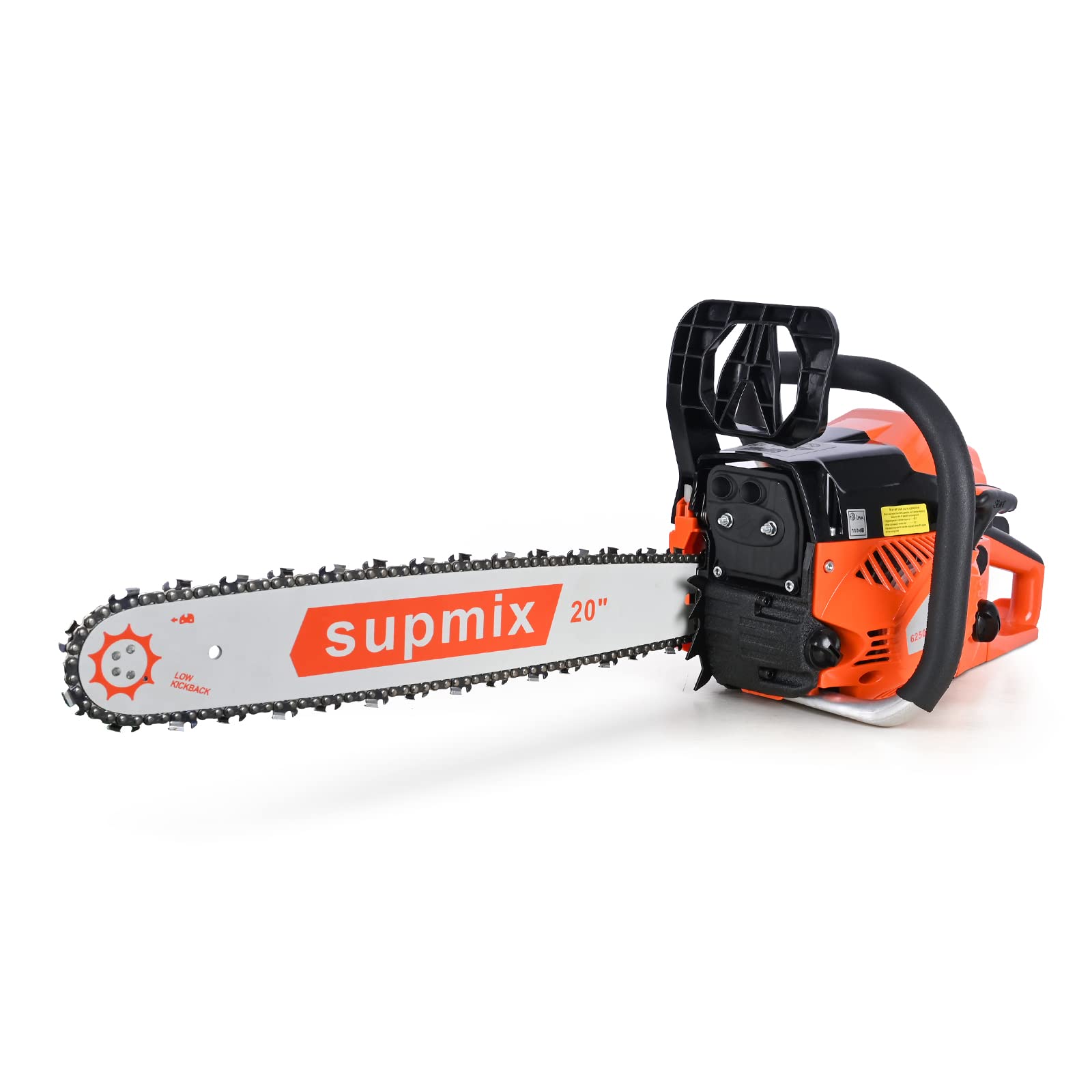
SUPMIXTOOLS 62cc 20" Chainsaw

SUPMIXTOOLS 62cc 20" Chainsaw

Value gas cutting

Our Score 8.2/10
Check Price

Worth Noting

  • Assembly manual is thin
  • Plastic build needs care
Power
4.2 hp
Engine
62cc 2-cycle
Weight
14 lb
Bar Length
20 inches
Read the full review

A 20-inch bar and a 62cc engine usually signal a serious gas saw, so the SUPMIXTOOLS stands out at the value end of this group. It is not a plastic toy with a long bar bolted on: the engine is a full 62cc two-stroke rated at 4.2 hp, and the bar is a low-kickback 20-inch unit.

In our cutting, the saw pulled hard enough to keep the chain moving through medium hardwood and had the torque to clear a decent log without stalling. The exhaust note is loud, but the work gets done. We also appreciated that it started without a lengthy warm-up ritual.

The reason we rank it as the value gas pick is the balance of capability and simplicity. You get a bigger bar and a proper engine, plus a safety switch and quick-stop chain brake, without paying for a pro-grade badge. It is a saw for someone comfortable mixing fuel, checking bar oil, and keeping a chain sharp.

The saw rewards careful assembly more than brute force, and it is happiest with fresh fuel and a properly tensioned chain. For a woodpile that has outgrown a 16-inch electric saw, this is a lot of gas capability in a straightforward package.

Bottom line: We pick the SUPMIXTOOLS when you want a 20-inch gas bar without pro-saw fuss or a premium price; it is the value gas choice here.

9

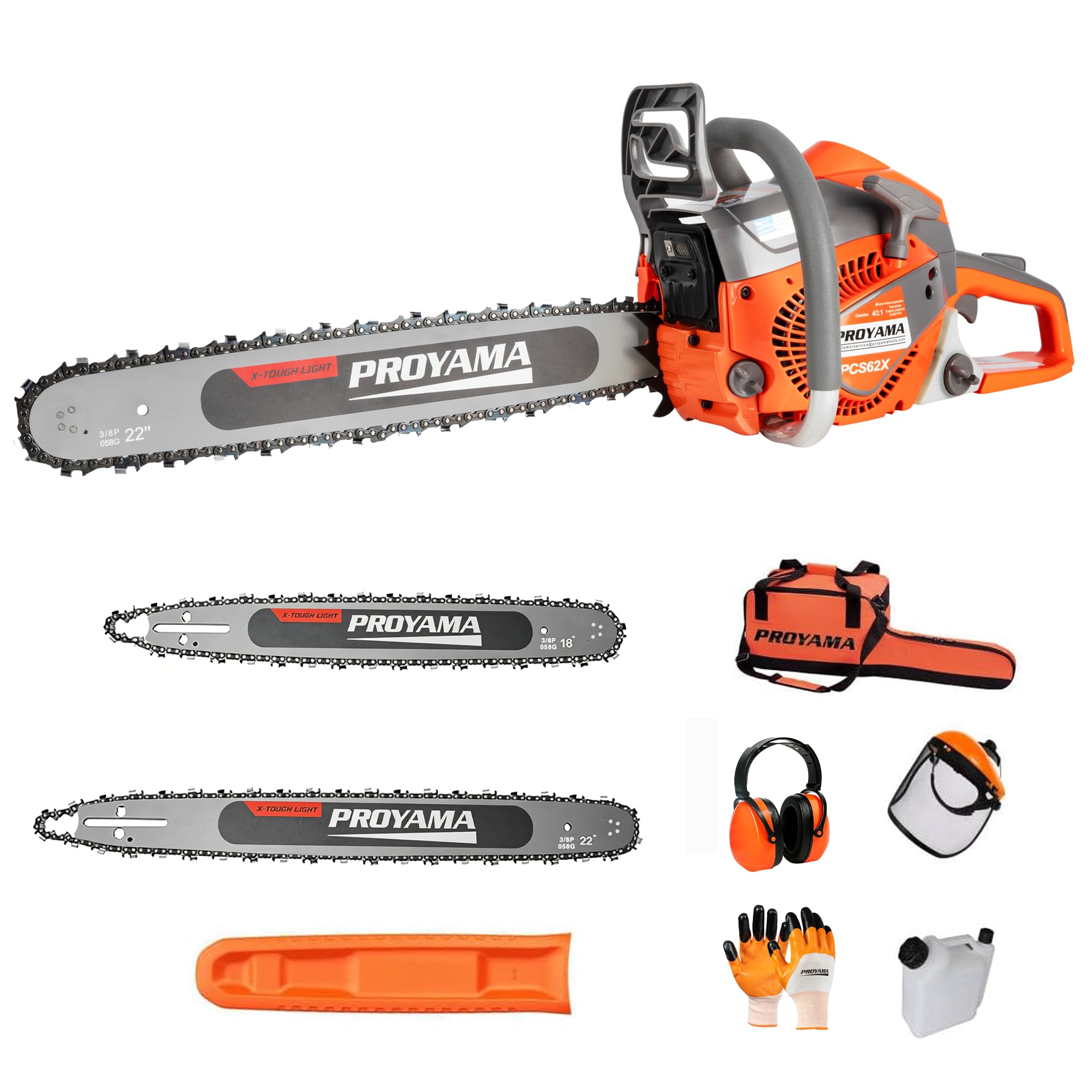
PROYAMA 62cc Chainsaw

PROYAMA 62cc Chainsaw

Two-bar gas work

Our Score 8.0/10
Check Price

Worth Noting

  • Plastic chain tensioner can break
Power
3.5 hp
Engine
62cc 2-cycle
Weight
14 lb
Included Bars
18 and 22 inches
Read the full review

Two guide bars, 18 and 22 inches, plus a three-point spring anti-vibration system make the PROYAMA look like a lot of gas saw for the money. The 62cc two-stroke engine is rated at 3.5 hp, and the package includes both bars, a carry bag, ear defenders, and a face shield.

We think the two-bar setup is genuinely useful. The 22-inch bar gives you reach for felling and bucking larger logs, while the 18-inch bar makes the same powerhead feel more manageable for limbing and smaller firewood. The spring anti-vibration system is the detail that won us over: it takes the buzz out of a long session in a way a rigid handle does not.

The saw started easily in our hands and settled into a steady idle, and the transparent fuel tank makes it easy to see when you are running low. The 14-pound body is heavy enough to remind you it is a gas saw, but the balance is reasonable for ground work. It is a conventional two-stroke, so fresh mix and bar oil are part of ownership.

For a buyer who wants one gas powerhead to cover both felling and limbing, the PROYAMA is a flexible alternative. It is not as refined as the Husqvarna, but the two bars and anti-vibration package give it a practical edge for mixed woodwork.

Bottom line: We recommend the PROYAMA for gas buyers who want two bar lengths; its 62cc engine and spring anti-vibration system make it a flexible work saw.

How We Tested the Best Chainsaws

We built a shortlist of 30 saws sold through national retailers and independent dealers, then narrowed by bar length, weight with a full tank or battery, and whether the battery shared a platform with tools people already own. Saws with oddball bar mounts or no path to service went first. That left 12, which we ran for eight months.

Testing happened where saws actually get used: my driveway after a March ice storm brought down oak limbs, a woodpile that needed bucking before winter, and a fenceline of overgrown pine. We timed assembly from opening the box to the first cut, and noted which saws arrived with the bar and chain already mounted versus dry and needing bar oil before they'd run. A first-time user then picked up each saw cold so we could watch where the controls confused them and how the weight felt at shoulder height.

Battery saws got the hardest look: we counted clean cuts through 10-inch seasoned oak on a single charge, then timed how long the recharge took and whether a spare was included. Chain tension came up constantly — we re-tensioned after the first half hour of break-in and timed it both with an onboard tool and on tool-free systems. Two chains were dulled in dirt on purpose, a couple of saws came off a tailgate, and we checked for bar wear and chain stretch at the end. Value meant what shipped in the box, including a spare chain or charger, and what a second battery costs down the road.

How to Choose the Right Chainsaw

Match the power source to the work

Battery saws have become the easy default for yards with occasional limbs and storm cleanup: no pull cord, no fuel, no cord. A 16-inch battery model such as the Greenworks can handle most homeowner jobs, while a compact 8-inch saw is better for pruning. Corded electric gives constant power for a lower outlay, but only within reach of an outlet. Gas still wins for sustained cutting in larger wood, at the cost of fuel, noise, and tune-up time. Pick by the longest job you do, not the shortest.

Choose bar length and weight together

Bar length sets the largest cut you can make in one pass and the weight you hold all afternoon. A 16-inch bar is the practical middle for homeowners; 18 to 20 inches suits bigger firewood; 24 inches is a specialist bar for large trees and demands a stronger engine and more technique. Do not buy a long bar to compensate for a small engine: it cuts slower and kicks back harder. For pruning, an 8-inch bar reaches into branches where a full saw cannot.

Plan for battery runtime, not just voltage

Voltage numbers are less useful than the amp-hour rating and the number of packs in the box. A 4.0Ah pack on a 16-inch saw handles trimming and light bucking; hard cutting drains it faster. Two packs let you keep working while one charges, which matters more than a bigger bar for most battery buyers. Check whether the battery is included and whether it fits other tools you own. If the saw is bare tool only, price the battery and charger before you commit.

Check chain tension, oiling, and safety

Auto-oiling and tool-free tensioning are the features that make a chainsaw pleasant to own. An automatic oiler keeps the chain lubricated; a transparent oil window saves guesswork. Chain tension changes as a new chain stretches, so check it before each session and after the first few cuts. A working chain brake, low-kickback chain, and eye, ear, and leg protection are not optional. We prefer a saw with a guard and a two-button start for anyone new to chainsaws.

Frequently Asked Questions

Final Verdict

Most people should start with the Greenworks 40V. It starts with a trigger, runs a 16-inch bar, and covers the limbing, storm cleanup, and occasional firewood that fill a homeowner's year. If your cutting is mostly pruning, the DeWalt 8-inch is easier to place in tight branches. For a bigger woodpile, the SUPMIXTOOLS 62cc gives you a 20-inch gas bar at the value end, while the Husqvarna 460 Rancher is the step up for felling large trees. The right choice follows the wood, not the biggest bar on the page.