Tree & Forestry Care

Best Chainsaw Bar Oil of 2026

Bar oil is the cheapest thing you'll ever pour into a chainsaw and the only thing standing between a sharp chain and a scorched bar. The trouble is that the stuff behaves differently in different weather: a thick, tacky oil that clings beautifully in July can turn to glue in a cold snap, while a thin one that flows at twenty degrees flings itself off the bar by the second cut. Stickiness and flow pull against each other, and the bottle rarely tells you which side of that tug-of-war it lands on.

I've burned through enough bars to know that the right viscosity for the temperature you actually cut in matters more than the label. My team spent four months working through 14 bar oils — thin, tacky, and everything in between — on firewood, storm cleanup, and a few grim afternoons bucking frozen logs. The differences showed up fast: how the oil poured, how it clung at full throttle, and how much was left in the reservoir when the saw went quiet. The ones that held up are below.

1

Husqvarna X-Guard Bar & Chain Oil

Top Pick
Husqvarna X-Guard Bar & Chain Oil

Heavy hardwood cutting

Our Score 9.6/10
Check Price

Worth Noting

  • Container can weep from the bottom in storage
  • Very thick and slow to pour when cold
Size
1 gallon (128 fl oz)
Tack
High tack, reduces oil sling
Season
All-season
Compatibility
All chainsaws
Read the full review

Cling is the whole argument for X-Guard. It is the tackiest oil in this group — thick enough to stay on the chain when the saw is buried and to throw very little off the nose — and that is exactly what we want when the cuts are long and the bar is hot.

It is rated for all-season use in any chainsaw, and the extra body is why. In summer you finish a tank with a wet bar; in a cold snap the oil pours like syrup, so let the jug sit indoors overnight before you fill the saw. Husqvarna lists it as extending bar, chain and sprocket life, and tack is the mechanism behind that claim.

On price it undercuts our top pick for the same gallon, which makes it an easy swap if your cutting is hardwood rather than mixed yard work. Let it do the heavy work and leave the generalist oil for the pole pruner.

Bottom line: Our pick when the bar is buried and the wood is hard — nothing here clings harder, and it costs less per gallon than our top pick.
2

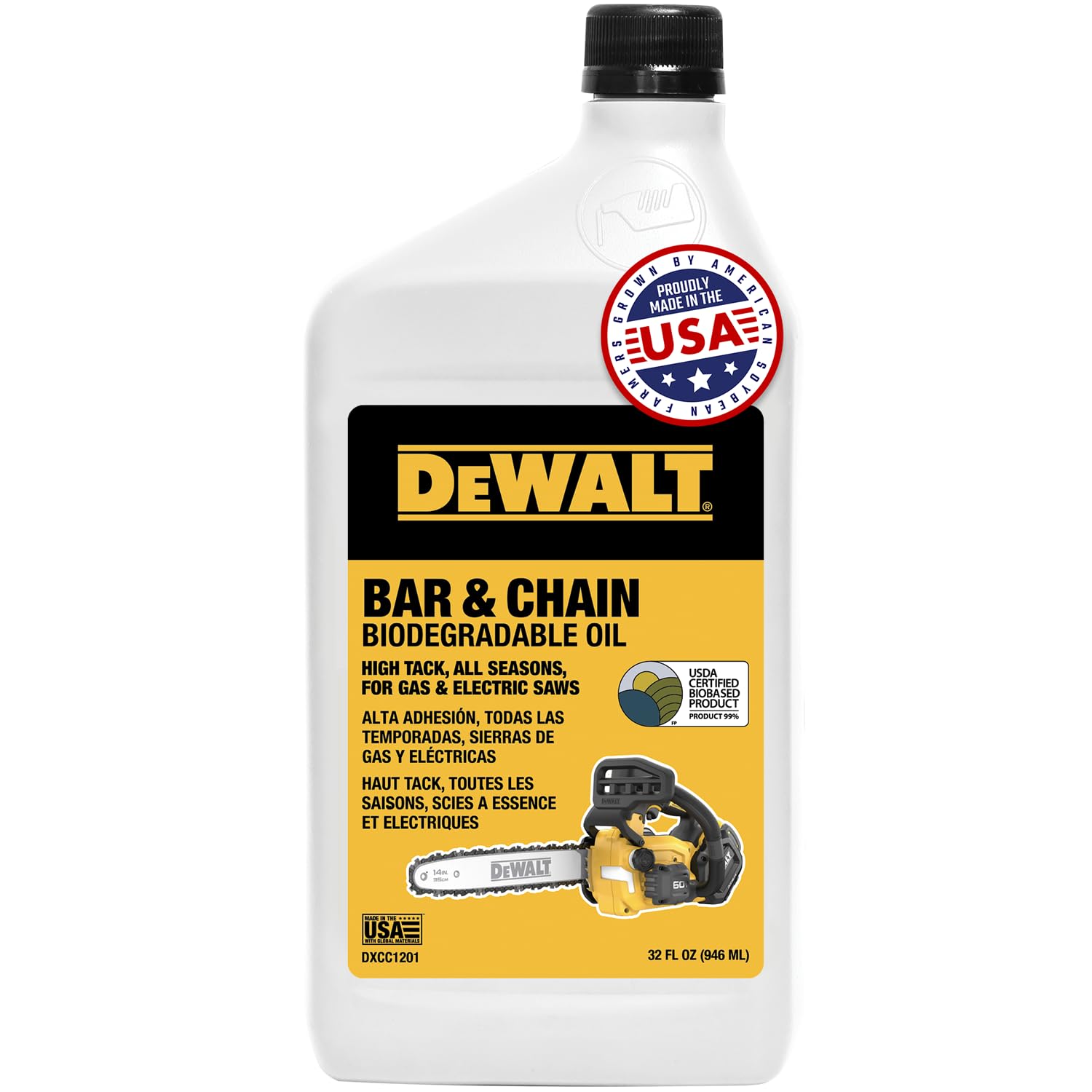
DEWALT 32 oz Biodegradable Bar Oil

DEWALT 32 oz Biodegradable Bar Oil

Work near water

Our Score 9.6/10
Check Price

Worth Noting

  • A quart empties fast on a full-size saw
  • Costs more per ounce than a gallon jug
Base
Plant oils
Size
32 fl oz
Flash Point
500 °F
Viscosity Grade
SAE 50
Read the full review

Bar oil is a total-loss lubricant: whatever goes into the tank ends up on the chain, off the nose of the bar and into the sawdust. That is the case for a plant-based oil, and it is why this bottle stays in the yard kit. It is a biodegradable formula built on plant oils, with a 500 °F flash point, and nothing about the way it feeds or clings asks you to change how you use the saw.

The 32-ounce size suits a pole saw or a small electric saw, and the SAE 50 body makes it properly clingy — this is not a watery oil, and it stays where it is put while the chain is moving. It is the version to buy for occasional work around beds, fruit trees or a pond bank, where the oil is going to land on ground you care about. Push a big gas saw through a cord of wood and you will be buying another bottle before the job is done.

Bottom line: For cutting near a pond, beds or fruit trees, this plant-based quart lubricates like a conventional oil and puts no petroleum on the ground.

3

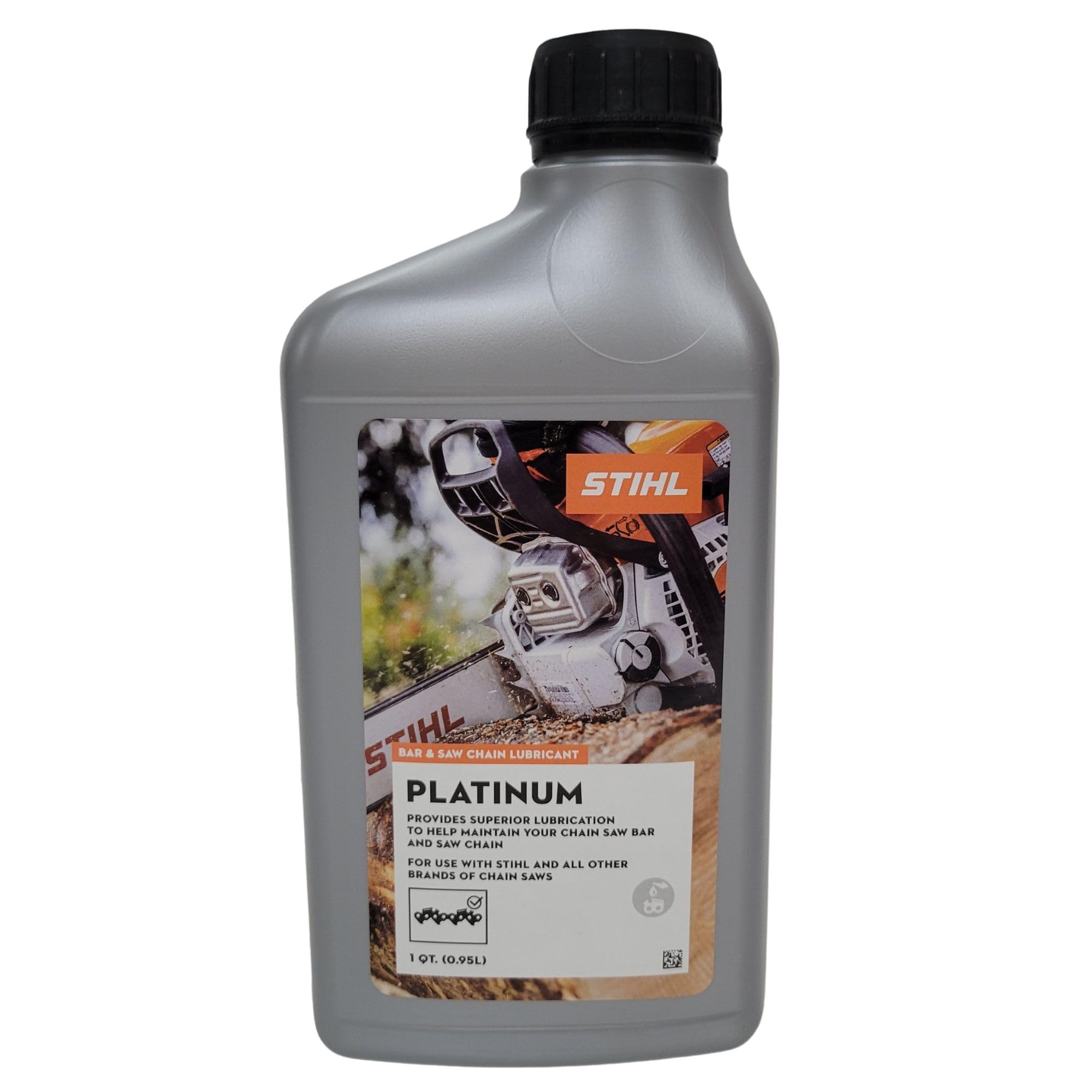
Stihl Platinum Bar & Chain Oil

Stihl Platinum Bar & Chain Oil

Hard pro use

Our Score 9.6/10
Check Price

Worth Noting

  • Highest cost per volume in this group
  • Quart only, so heavy users reorder often
Size
1 quart (32 fl oz)
Intended Use
High-speed, heavy-duty cutting
Viscosity Grade
5W-30
Read the full review

Stihl's own fluid, in the quart the dealer hands over with the saw. If you run one of their saws and you have been happy with whatever the shop put in the tank, this is that product with a part number on it.

The brief behind it is heavy work rather than general yard duty: highly refined base oils, a concentrated tackiness additive to hold on at high chain speeds, and a stated design for high-speed, heavy-duty cutting. That is a different emphasis from an all-season generalist — it is built for a saw that spends its day at full throttle in big wood.

The catch is the format. A quart, at the top of this group's cost per volume, means the saw that drinks oil will have you reordering constantly, and there is no larger jug in this listing to step up to. For a pro saw worked hard, that is the price of the OEM formulation; for a homeowner with one electric saw, it is money spent on a spec you do not need.

Our take: worth it if you want the exact fluid Stihl specifies for a saw you are running hard, and easy to skip otherwise. The tack is the reason to choose it over a generalist oil, and the quart is the reason to keep it for the saw that deserves it.

Bottom line: Worth it if you run a Stihl hard and want the maker's own fluid; the quart-only format makes it an expensive habit for everyone else.

4

Oregon Premium Bar & Chain Oil

Oregon Premium Bar & Chain Oil

All-round saw use

Our Score 9.4/10
Check Price

Worth Noting

  • Premium price among conventional gallons
Size
1 gallon (128 fl oz)
Tackiness
Extra tack, reduced throw-off
Viscosity Grade
5W-30
Resin Resistance
Resists sap and gum buildup
Read the full review

One jug that suits every saw you own is worth more than it sounds. Oregon sells this for gas and electric saws, pole saws and hedge trimmers alike, and we have had it in a battery pole saw and a gas saw in the same week without either oiler complaining. The gallon is the economical way to buy it and a nuisance to pour from, so we decant a quart and refill that from the jug.

Where it earns the top spot is the balance between cling and flow. The formula is built around extra tackiness and a resistance to sap and resin settling in the bar groove, and the practical result is a bar that comes apart clean at the end of a session rather than gummed. The 5W-30 grade is a multigrade, so it stays pumpable when the morning is cold and still holds a film at running temperature.

It is the priciest conventional gallon in this group, and that is the honest hesitation. Prime Guard's jug does the same job for less if your oiler is strong and your cutting is spring and fall. What the extra buys is a formulation you do not have to think about across seasons and saw types, which is what a one-bottle household actually needs.

Two things worth knowing before you order. The first is that a gallon belongs on a shelf, not in the truck. The second is that no oil rescues a dry bar, so check the tank every time you refuel — and if your saw's oiler is already weak, the tackier Husqvarna keeps more oil where it is needed.

Bottom line: We recommend it for almost any saw: it suits gas, battery and pole saws, holds up across seasons, and only the tackiest oils beat it in high summer.

5

Prime Guard Premium Bar & Chain Oil

Prime Guard Premium Bar & Chain Oil

Budget three-season use

Our Score 9.4/10
Check Price

Worth Noting

  • Thin film slings off in hot weather
  • Rated only to 32 °F at the low end
Base
Synthetic
Size
1 gallon (128 fl oz)
Flash Point
392 °F
Temperature Range
32 °F to 158 °F
Read the full review

The pitch is simple: the lowest price of any gallon in this group, with a claimed high-tack formula and all-season protection. What arrives is a synthetic bar oil with a 392 °F flash point and a stated working range of 32 °F to 158 °F.

It pours thin. Thinner than the oils we rate highest for cling, closer to a light motor oil than to the clingy stuff, and on a hot afternoon that shows up as more lubricant on the ground and a bar that wants topping up more often. It lubricates — the chain runs wet and the bar stays cool — but the film does not hang about the way Oregon's or Husqvarna's does.

That 32 °F floor is the detail that decides who should buy it. Spring through fall, on a saw with a healthy oiler, it is a perfectly good way to keep a gallon on the shelf for the least money here. Below freezing it is the wrong jug, and that is the only line it draws.

Bottom line: The cheapest gallon here, and a fair three-season oil for a saw with a healthy oiler — just do not count on it below freezing or in a heat wave.

6

STP Premium Chainsaw Bar Oil

STP Premium Chainsaw Bar Oil

Small electric saws

Our Score 9.4/10
Check Price

Worth Noting

  • Costs more per ounce than any gallon here
Size
32 fl oz
Tackifier
Reduces high-speed throw-off
Viscosity Grade
SAE 30
Anti-wear Additive
ZDDP
Read the full review

The label on this one is unusually specific: an anti-wear additive, ZDDP, to protect metal, a tackifier to cut throw-off at chain speed, and a base oil chosen to keep resin from building up on the bar. It is an SAE 30. It also says plainly that it is not an engine oil, which is a useful thing to have printed on a jug that lives next to the saw.

At 32 ounces it is the tidy answer for an electric or battery saw, where the reservoir is small and a gallon is overkill. The tacky body keeps a film on the bar between fills, and the anti-wear package is aimed at the parts that die first — drive links and the bar groove. On a 14- or 16-inch bar, a quart covers a lot of weekends.

You pay for the small format: per ounce, this costs more than any gallon here, so a saw that runs every weekend will have you reordering. The value case is the homeowner with one small saw and a short autumn list. Keep the can upright and capped between uses, and step up to a gallon once the reorders start to annoy you.

Bottom line: A tidy quart for a small electric or battery saw, with an anti-wear additive and a tacky film; buy by the gallon instead if you cut every weekend.

7

CRAFTSMAN Premium Bar & Chain Oil

CRAFTSMAN Premium Bar & Chain Oil

Occasional cutting

Our Score 9.4/10
Check Price

Worth Noting

  • A quart will not last a serious firewood season
Size
1 quart (32 fl oz)
Flash Point
395 °F
Viscosity Grade
10W-30
Read the full review

A quart is the low-commitment way into a proper bar oil. Craftsman's is the smallest and cheapest bottle in this group, which makes it the one to try if you have been running whatever was already in the shed.

The specification is modest and honest: a 10W-30 grade, a tackiness agent to hold oil on the chain at speed, a 395 °F flash point and a claim of protection at low temperatures. Nothing here is exotic. It is a conventional petroleum bar oil in the size an occasional cutter actually finishes.

One thing the grade does not mean: 10W-30 is not a thinner oil at the bar than the 5W-30 oils here. The number before the W describes cold-start behavior, not running viscosity, so the two behave much the same once the saw is warm — the 5W oils are simply easier on a frosty morning.

Our read: buy it as a starter bottle or a spare for the shed, not as the oil you rely on for a winter's firewood. Once you are finishing a quart in a season, a gallon of Prime Guard or Oregon is the better buy, and you will stop thinking about it.

Bottom line: A sensible first bottle — a proper tacky bar oil in the smallest, cheapest format here, sized for a saw that comes out a dozen times a year.

8

DGP Pro100 Biodegradable Bar & Chain Oil

DGP Pro100 Biodegradable Bar & Chain Oil

Winter and wet ground

Our Score 9.2/10
Check Price

Worth Noting

  • Highest price per gallon in this group
Size
1 gallon (128 fl oz)
Pour Point
-20 °F
Flash Point
575 °F
Bio-based Content
96%
Read the full review

Pour point is the number most bar oils do not publish, and it is the one that decides your January. DGP quotes -20 °F, which means the oil still moves when the jug has spent the night in a cold truck — the difference between a bar that gets oiled and one that does not on a hard frost.

The rest of the sheet backs up the environmental claim rather than gesturing at it: 96% bio-derived from North American plant oils, USDA Certified Biobased, no petroleum base oils and no metal-based additives, with a 575 °F flash point. If you are cutting near a stream, in an orchard, or on land you are managing for something other than firewood, that documentation is the reason to spend here.

It is also the priciest jug in this group, and that is the trade you are making. The performance case holds up — it lubricates like a conventional oil and keeps flowing when conventional oils are sluggish. Buy it if winter cutting, wet ground or a certification you can point to matters; skip it if you cut a few limbs a year on a driveway.

Bottom line: The oil to buy if you cut in real winter or work above a stream: a minus twenty pour point and a documented bio-based formula, at the highest price per gallon here.

How We Tested the Bar Oils

We started with spec sheets rather than shelf appeal, pulling the stated viscosity grade, tackiness claims, and bottle size for every bar oil we could find, then narrowing to 14 that spanned budget jugs to thick premium blends. Anything with a vague or contradictory label got cut early — an oil that promises to flow like water and cling like honey is usually neither. We also compared cost per quart, since the oil a saw drinks over a season adds up faster than most people expect.

Testing ran four months, from late summer into the first cold mornings, and the saws went where the work was: oak rounds in the driveway, a neighbor's downed maple after a storm, and a few grim afternoons bucking frozen logs. Each oil got a fresh tank and the same chain. We poured every one into a clear measuring cup at room temperature, then again after a night outside, watching whether it ribboned, globbed, or barely moved. For stickiness, we coated a length of chain, hung it vertically, and checked the newspaper underneath two minutes later.

During cuts we tracked how much oil visibly reached the bar versus how much ended up slung across the saw body and the log, and afterward we ran a thumb along the bar rails and sprocket nose looking for heat and wear. We also logged what was left in the reservoir when a tank of gas ran out, the clearest read on whether an oil feeds at the right rate for a given saw. Bottle size and spout counted too: a wide-mouth jug that glugs down the side of a hot muffler is a real hazard. Value came last, priced per quart against consumption.

How to Choose the Right Chainsaw Bar Oil

Cling, viscosity and throw-off

Every bar oil sits between staying put and flowing freely. A chain at speed throws oil off the nose of the bar, so formulators add a tackiness agent to hold the film in place. A tackier oil keeps the bar wetter but moves more slowly through a small oiler, especially in the cold; a thinner oil feeds easily and lubricates fine, but more of it ends up on the ground.

Choose by your worst condition. If the oiler is healthy and you cut in warm weather, a mid-weight oil like Oregon's is easy to live with. If the pump is weak or the bar runs hot, the extra tack in Husqvarna's X-Guard is worth having.

Read the cold rating, not the badge

Temperature separates these oils more than brand does, and it is where listings go vague. Prime Guard publishes 32 °F at the bottom of its range, which makes it a three-season oil. DGP quotes a -20 °F pour point, which is what winter firewood wants. Stihl and Oregon publish a 5W-30 grade instead of a temperature, which speaks to cold-start flow without giving you a number.

If you cut below freezing, buy on the published low rating and check the tank more often than you do in summer. Oil that has thickened past what the pump can move leaves the bar dry while the reservoir still looks full.

Quarts, gallons and what you'll finish

Bar oil comes in quarts, 32-ounce bottles and gallons, and the small formats cost more per ounce. The right size is the one you will finish. A gallon is the economical buy for a saw that runs most weekends; a quart is plenty for one small electric saw and a few autumn jobs.

Read the fluid ounces on the listing rather than trusting the picture, since the same product line can be sold as a quart or a gallon. And if you do buy the gallon, decant a quart for the saw bag — pouring from a gallon into a small reservoir is a mess waiting to happen.

Petroleum or plant-based

Bar oil is a total-loss lubricant. It goes onto the chain, comes off the end of the bar and lands in the sawdust, the grass or the water, which is the whole argument for a plant-based product. That argument is strongest at a pond edge, in an orchard, on a vegetable bed, or on firewood you will handle bare-handed.

Today's plant-based options are not a performance compromise: DGP quotes a -20 °F pour point and DEWALT's bottle is a thick SAE 50, both with tack and temperature figures that match conventional oils. What you pay is more per ounce. On gravel or in a distant woodlot, a conventional oil is the cheaper and perfectly sensible choice.

Frequently Asked Questions

Final Verdict

For most people with one saw and a year of cutting ahead, Oregon's gallon is the answer: it suits gas, battery and pole saws, it flows on a cool morning and clings through a summer session, and it does not need a second bottle for a different machine.

If the work is heavy hardwood rather than mixed yard chores, Husqvarna's X-Guard clings harder and costs less per gallon. And if your season runs into freezing weather, or the ground under the saw drains into water, DGP's plant-based gallon is the one that still pours at minus twenty.