Tree & Forestry Care

Best Chainsaw Bars of 2026

A chainsaw bar looks like a simple slab of steel until you are standing over a saw that cuts crooked, throws the chain, or bogs down halfway through a log. The right bar fixes more than cosmetics: it keeps the chain seated, tracks straight through the cut, and lets the powerhead do the work it was built for. I learned that the hard way after too many afternoons spent forcing a dull, worn bar through firewood and pretending the saw was the problem.

Over the past six months, my team and I ran 12 bars through firewood sessions, storm cleanup, and limbing around the yard, paying attention to how each one fit different saws and how well the chain held tension. The lesson that surprised me most is that bar length gets all the attention, but pitch, gauge, and drive-link count decide whether a bar actually works on your saw. The picks below are the ones that cut straight, held up, and felt worth the money.

1

Oregon 14-Inch Bar & Chain Combo

Top Pick
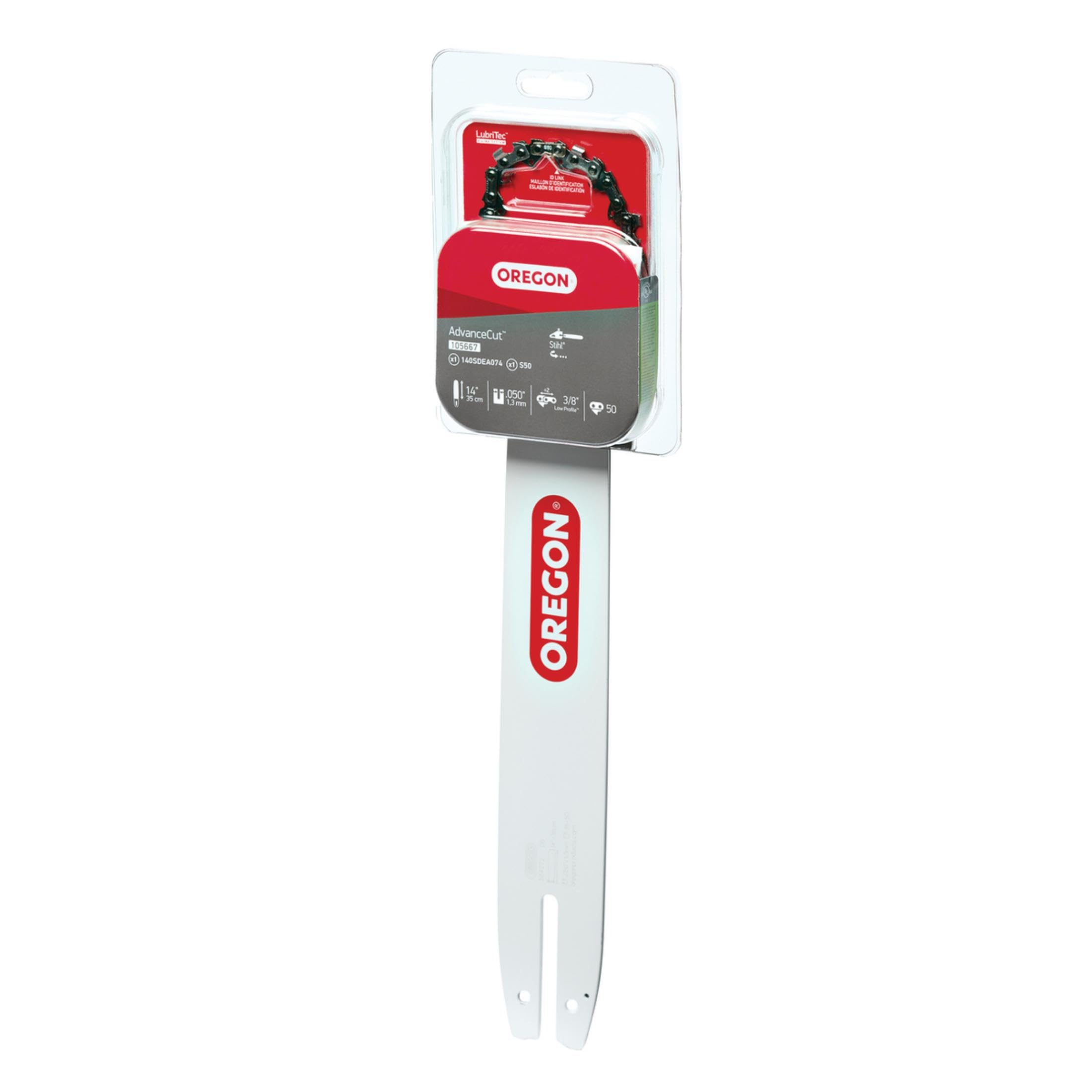
Oregon 14-Inch Bar & Chain Combo

Small Stihl saws

Our Score 9.4/10
Check Price

Worth Noting

  • Laminated bar rated for 42cc saws and under
Mount
A074
Weight
16 oz
Bar Length
14 in
Chain Spec
3/8 in pitch, .050 in gauge, 50 drive links
Read the full review

Fifty drive links, 3/8 pitch, .050 gauge, 14 inches, A074 mount. Those five numbers are the whole purchase: get them right and any bar works, get one wrong and the best bar in the world won't spin. This combo has them right for the small Stihl saws — MS170, MS180 and the long run of 009 through 021 models — and for the small electrics that share the same mount.

We like that it arrives as a matched pair. A bar with rolled rails and a sloppy groove will wreck a fresh chain in an afternoon, so replacing both together is the cheapest way to get a straight cut back out of a tired saw. The chain is Oregon's semi-chisel AdvanceCut with the Lubritec oiling system — a forgiving profile for anyone who isn't filing weekly, and one that shrugs off the odd touch of dirt better than a full-chisel cutter. For limbing, bucking and storm cleanup on a small saw, this is the one we reach for first.

Two things worth knowing before you order. Line the oiler hole in the bar up with the oil slot in the saw before you tension the chain, because a mismatch there is the usual reason a new combo slings oil out of the side cover instead of feeding it onto the bar. And this is a laminated, light-duty bar rated for saws up to 42cc — it's built for firewood, not for burying the nose in a stump. Above that, you're into the bigger Husqvarna bars here and a different class of saw.

Bottom line: Own a small Stihl on the A074 mount? This matched bar and chain is the cheapest way to get that saw cutting properly again.

2

Husqvarna X-Force 20-Inch Bar

Husqvarna X-Force 20-Inch Bar

Husqvarna 400-series saws

Our Score 9.2/10
Check Price

Worth Noting

  • Bare bar, chain sold separately
  • .325/.050 fit is Husqvarna-specific
Fits
Husqvarna 440 through 550XP
Weight
2 lb
Bar Length
20 in
Chain Spec
.325 in pitch, .050 in gauge, 80 drive links
Read the full review

There's no grease hole on the X-Force, and that's the feature worth paying for. The nose bearing is sealed behind support shields, so dirt isn't packed in through a port and you're not hunting for a grease gun before a Saturday's cutting. Husqvarna builds this bar for its 440 through 550XP saws — .325 pitch, .050 gauge, 80 drive links, 20 inches — and the geometry is what we keep coming back to: it goes on the studs, the oiler slot lines up, and the chain sits in the groove without a fight.

Twenty inches on a 50cc powerhead is the balance we like best. It's long enough to buck a decent log without stooping and short enough that the engine isn't gasping through the cut, and at 2 pounds it doesn't make the saw nose-heavy the way a solid 24-inch bar does. The support shields are the sort of detail that reads as marketing until you've spent an afternoon clearing a bar that swallowed grit through the nose.

What the money buys is OEM consistency: the rails stay true, the bearing takes a season of firewood duty, and the whole thing costs appreciably less than the light pro bar above it. It's the middle of this group on price and the middle on weight, and for a 50cc saw that middle is exactly right.

Bottom line: For a Husqvarna 440 through 550XP, this is the bar to buy: exact OEM fit, a sealed nose that needs no greasing, and 20 inches that suit a 50cc saw.

3

Husqvarna X-Tough Light 24-Inch Bar

Husqvarna X-Tough Light 24-Inch Bar

Big Husqvarna saws

Our Score 9.0/10
Check Price

Worth Noting

  • Most expensive bar in this group
  • Fits only the 562/572 family
Fits
Husqvarna 562XP and 572XP
Weight
3 lb
Bar Length
24 in
Chain Spec
3/8 in pitch, .050 in gauge, 84 drive links
Read the full review

Three pounds doesn't sound light until you've spent a day swinging a 24-inch solid bar and felt the nose of the saw dive every time you lift it. Husqvarna's X-Tough Light hangs 24 inches of 3/8 pitch, .050 gauge, 84-drive-link bar on a 562XP or 572XP at that weight, and the saving shows up at hour six rather than minute one, when the saw is still sitting level in your hands instead of pulling forward.

This is the bar in this group we point at people cutting timber rather than firewood. The replaceable sprocket nose is the practical bit: when the tip wears, you swap the nose rather than the whole bar, which matters when the bar costs what this one does. The three-rivet tip mounting and the oil hole design are Husqvarna's answer to friction and heat, and while we're not going to pretend a bar transforms a saw, the balance change on a 70cc powerhead is real and it's the reason to spend.

The 84-drive-link 3/8 chain it takes is a bigger line item than the 14-inch setups here, and that's the ongoing cost of running a long bar. Where it stops making sense is the occasional user: on a saw cutting a cord of firewood a year, a heavier and cheaper bar does the same work and you'll never notice the difference. In the timber with a 572XP, this is the bar that stops the saw fighting you by mid-afternoon.

Bottom line: A 562XP or 572XP in timber deserves this bar: 24 inches at 3 pounds, a replaceable nose, and the balance to keep cutting all afternoon.

4

Fifchall 14-Inch Bar & 3 Chains

Fifchall 14-Inch Bar & 3 Chains

Cheap spare chains

Our Score 8.8/10
Check Price

Worth Noting

  • Cutters dull faster than branded chain
Bar Length
14 in
Chain Spec
3/8 in LP pitch, .050 in gauge, 52 drive links
In The Box
1 bar and 3 chains
Read the full review

Three chains and a bar in one box, and the arithmetic is the appeal: one chain on the saw, one spare in the case and one at the sharpener's. Anyone who has stalled a job because the only chain they owned went into a fence staple knows that having spares within reach is worth more than a small upgrade anywhere else on this page.

The numbers are 14 inches, 3/8 low-profile pitch, .050 gauge and 52 drive links, and the compatibility list runs from the Craftsman S145 and Echo CS310 through the Ryobi RY3714, Poulan, Homelite and the Husqvarna 240 and 135. The chains are low-kickback and stated to meet the ANSI kickback performance requirement, which is what you want on a small saw used at waist height. Fitting is a straightforward drop-on job, and the bar's rails have stayed straight in our use.

Where we temper our enthusiasm is the cutters. They cut well out of the box and cut like anything until they find dirt or a fence staple, but they don't hold an edge the way a branded chain does. Our other note is length: a chain in a set can run long enough that the bar adjuster runs out of travel on a well-used saw, so test-fit each one on the bench before you head out. For a homeowner with a 14-inch electric or small gas saw, the trade is obvious — less edge per chain, three times as many chains.

Bottom line: Three chains in the box is the reason to buy this kit: a spare on hand beats a sharpening session, as long as you accept utility-grade cutters.

5

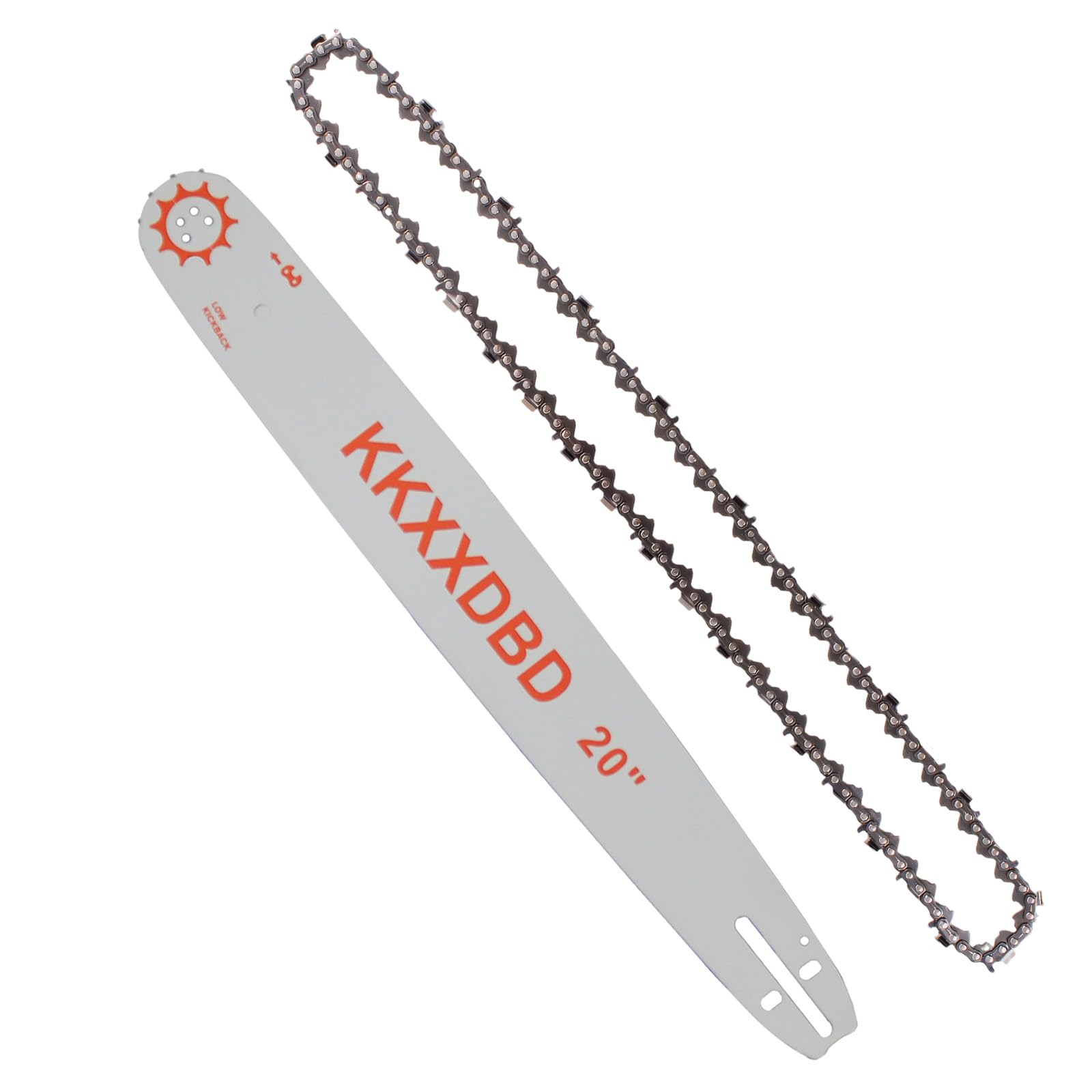
KKXXDBD 20-Inch Bar & Chain

KKXXDBD 20-Inch Bar & Chain

.058 gauge saws

Our Score 8.8/10
Check Price

Worth Noting

  • Fit list names saw families, not models
Fits
45cc to 62cc saws
Weight
1.8 lb
Bar Length
20 in
Chain Spec
.325 in pitch, .058 in gauge, 76 drive links
Read the full review

Gauge is what separates this bar from everything else here: it's .058 inch, where every other bar in this group runs .050. If the old bar on your 45cc to 62cc saw is stamped .058, your shopping list just got very short, and this 20-inch, .325 pitch, 76-drive-link combo is the one we can point you to. Laminated construction, an A041 tail mount and 1.8 pounds — light for the length.

The bar's own numbers matter more than the model names printed on it: measure the mount, count the drive links and check the gauge stamp before you order. Do that and you get a matched bar and chain for less than the OEM bars here, on a saw that has probably done a lot of work and deserves a straight bar again. It's a light-duty part for firewood and cleanup, not a felling bar, and it's priced accordingly.

Bottom line: If your saw's bar is stamped .058 gauge, this is the only match in this group: a 20-inch .325 combo for 45cc to 62cc saws that gets the numbers right.

How We Tested Chainsaw Bars

We started by gathering bars in the sizes and mount patterns that fit the saws people actually run at home and in the woods, then narrowed the list by chain pitch, gauge, drive-link count, and whether replacement chains were easy to source. Price mattered, but only as part of value: a bar that saved a little upfront and wore out in a season was not a bargain. Before mounting, we checked each bar for straight rails, clean oil passages, and a nose sprocket that spun freely. From that pool, we tested 12 bars over six months.

Each bar went onto saws with different powerheads, and the first check was fit: Did the mount slot sit flush, did the oil holes line up, and could we reach the tensioner without cursing? We recorded chain size, including pitch, gauge, and drive-link count, then checked whether a standard replacement chain was easy to find and install. Out in the yard, we used them for bucking firewood, clearing storm-downed limbs, and limbing trees, watching for crooked cuts, chain chatter, and pinching in the kerf.

After each session, we inspected the rails for burrs, spun the nose sprocket, and checked whether the chain held tension through a full tank of fuel. Sharpness got its own tally: we noted how quickly the chain edge dulled and whether the bar seemed to contribute to uneven wear, then compared that against the bar's price and replacement-chain cost. The bars that rose to the top were not the cheapest or the longest; they were the ones that fit correctly, cut straight, and still felt solid after six months of real use.

How to Choose Chainsaw Bars

Match the Mount Before You Shop

Every bar has a tail mount — the shape of the slot and the position of the oiler hole that fit over the saw's studs — and that is the first thing to check, before length and before price. Common patterns in this group include A074, the small Stihl fit, and A041. Take the old bar off and read the stamp near the tail; if it has worn away, look up the mount for your saw model. Five minutes now saves a return later.

The mount pattern belongs to the industry, not to the saw brand. Oregon builds an A074 bar that runs on Stihl saws, which is exactly why a non-Stihl brand can be the right replacement part for a Stihl powerhead.

Pitch, Gauge and Drive Links Travel Together

Pitch is the distance between drive links — 3/8, .325 and 3/8 low profile are three different chains — and gauge is the width of the groove they ride in, usually .050 or .058. Drive-link count is what makes a chain the right length for a given bar. Change any one of the three and the others stop fitting.

The trap is 3/8 low profile, which looks like ordinary 3/8 on a shelf label and is not interchangeable with it. Small homeowner saws take the low-profile version; bigger saws don't. Copy all four figures, length included, straight off the old bar and order against those.

Bar Length Is an Engine Decision

A 14-inch bar suits saws up to about 42cc, 20 inches wants a 50cc powerhead, and 24 inches is big-saw territory — 60cc and up, with the balance to carry it. Hanging a longer bar on a small saw doesn't give you a bigger saw; it gives you a bar that bogs, cuts crooked and works the engine harder than it should.

Weight at the nose matters as much as length. A lighter bar in the same length is what keeps a long bar manageable over a day, and it's the main thing the premium picks here are selling. If you cut occasionally, that saving is invisible; if you cut all day, you'll feel every ounce by mid-afternoon.

The Nose Decides Your Maintenance

Sprocket-nose bars are the standard now; the question is whether that tip is greased or sealed. A sealed, no-grease bearing means no grease gun in the truck and no dirt pumped into the bearing through a port — both Husqvarna bars here use that design, and it's a genuine convenience rather than a marketing line.

Laminated bars are lighter and cheaper; solid bars take more abuse and cost more. Match the bar to the way you actually cut, and don't pay for a solid bar if your saw mostly handles storm damage and firewood.

Combos and Spare Chains

A new chain on a worn bar is a false economy — the chain follows the groove it's given, so a bar with rounded rails will cut crooked and dull a fresh chain early. If the old bar has a few seasons on it, buy the pair rather than the chain alone.

Spare chains are the other thing worth owning. Swapping a dull chain takes about a minute; sharpening one in the field takes considerably longer. A bar sold with three chains is a better buy than a bare bar and a single chain for anyone who cuts more than a couple of times a year.

Frequently Asked Questions

Final Verdict

The Oregon combo earns the top spot by solving the whole problem at once: a matched bar and chain on the A074 mount, at the bottom of this group's price range, for the small Stihl saws — MS170, MS180 and the 009 to 021 family — that so many people learn to cut on.

Step up to a Husqvarna 440 through 550XP and the X-Force is the better buy, with a sealed nose and an exact OEM fit for a 50cc powerhead. Cutting timber with a 562XP or 572XP instead? Go straight to the X-Tough Light, where the weight saving pays you back every afternoon.