Tree & Forestry Care

Best Chainsaw Mills of 2026

A chainsaw mill is a simple idea: a frame that clamps to your saw's bar and guides it through a log so the cut stays flat instead of wandering. The difference between a stack of usable boards and a pile of wavy, tapered slabs comes down to how rigid that frame is and how well it holds its settings. At its best, a mill turns a storm-downed oak into lumber you'd otherwise have to buy. We spent eight months testing 10 chainsaw mills on backyard logs and a borrowed woodlot, and the gap between the good ones and the frustrating ones showed up fast.

What surprised me most is how much the small stuff matters. A mill that takes two people and an hour to assemble rarely gets used, confusing instructions turn a first cut into an afternoon of guesswork, and a clamp that slips mid-cut ruins more than the board. We weighed build quality and durability against ease of use, adjustability, stability at full depth, and whether the finished cut needed planing or planing plus a prayer. The picks below are the ones that stayed tight and cut true after a dozen logs.

1

Granberg G778-48 Alaskan MKIV

Top Pick
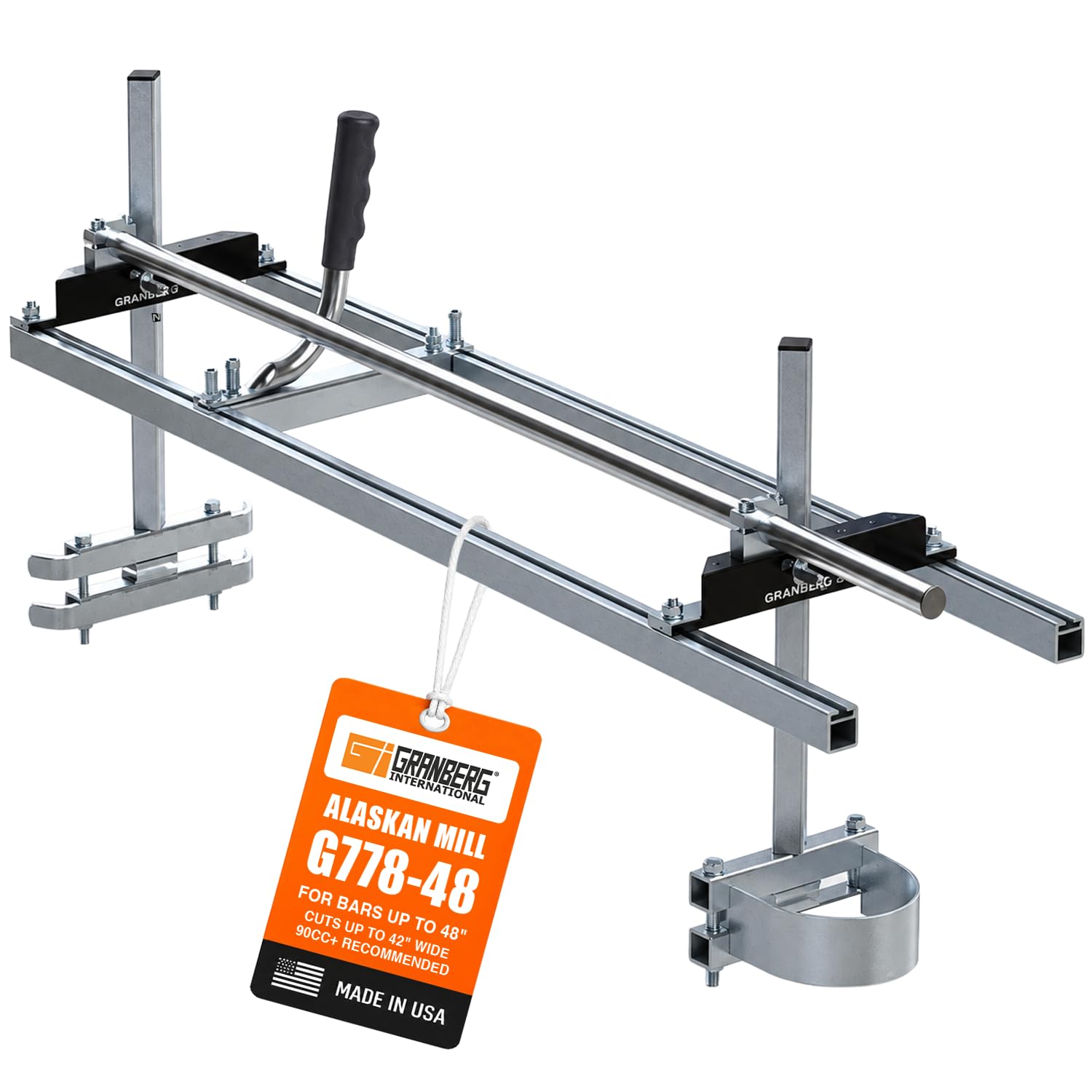
Granberg G778-48 Alaskan MKIV

Frequent milling

Our Score 9.4/10
Check Price

Worth Noting

  • Clamp needs firm torque or it slips
  • 21 lb before you add the saw
Bar Length
Up to 48 in
Bar Mounting
Clamps on, no drilling
Max Cut Width
42 in
Plank Thickness
1/2 to 13 in
Read the full review

The G778-48 is the only mill in this group that clamps onto the bar exactly as it comes, and that one decision is why it's the mill we hand to anyone planning to cut more than a couple of logs. No drilling means it comes off for sharpening and goes back on the same bar without a fresh set of holes. Twenty-one pounds of aircraft-grade aluminum and zinc-plated steel, a 48-inch bar capacity, and 42 inches of cut across a log the 36-inch mills here can't take.

Wide logs are where it earns the premium. Set the depth, torque the clamps down, and the mill keeps that setting slab after slab; the height markings are scored into the metal, so they stay readable after a season of sawdust and rain. We came back to this one every time a log was worth the trouble of setting up properly, and the faces it left needed less planing than anything else we ran.

The clamp is the one place to stay honest with yourself. It needs real torque to hold, and a clamp that's merely snug will slip, polish the paint off the bar and drift a little in the cut. Check both sides between slabs and re-torque after the first log of the day.

There's no way around the work, either: 21 pounds of mill on the end of a big saw in a wide log is a long afternoon. Against bought lumber, though, a mill like this pays for itself over a few decent logs, and that arithmetic is what makes the price sit easier.

Bottom line: Our pick for anyone who mills more than a few logs: it clamps to a standard bar with no drilling and holds its setting through wide, knotty timber.

2

Carmyra 36 in Mill with 9 ft Rail

Carmyra 36 in Mill with 9 ft Rail

First-time millers

Our Score 8.6/10
Check Price

Worth Noting

  • Instructions are skimpy and hard to follow
Weight
30.4 lb
Bar Length
14 to 36 in
Rail Guide
9 ft included
Plank Thickness
0.2 to 11.81 in
Read the full review

The hard part of milling isn't the mill, it's the first cut. A round log gives you nothing straight to run a guide along, so the opening pass needs a datum, and Carmyra supplies one: a 36-inch mill plus a nine-foot rail that clamps along the log and gives the mill something flat to ride. After that pass the mill follows the face it just made, and the rest of the job gets much easier.

That's why we point new millers at this bundle rather than at a bare mill. Plank thickness runs from 0.2 to 11.81 inches, which covers thin panel stock up to a deep beam, and the rail is long enough for the logs most people actually have. The value holds up too — one purchase, one box, and a straight edge you don't have to build.

Assembly takes an evening rather than twenty minutes, and the frame is best put together on a bench where you can square it before it ever meets a log. Once it's on the bar, check the clamp bolts before each session: vibration works them loose, and a mill that shifts mid-cut is how a bar gets pinched. The rail itself goes down quickly once the log is chocked.

Bottom line: The bundle we point new millers to, because the rail answers the first cut and the mill covers everything from thin boards to deep beams.

3

FARMMAC 36 in Chainsaw Mill

FARMMAC 36 in Chainsaw Mill

Tight budgets

Our Score 8.6/10
Check Price

Worth Noting

  • Assembly instructions are thin on detail
Included
Wedges and hardware
Mill Size
36 in
Bar Length
14 to 36 in
Read the full review

Open the box and you find the mill, the hardware and a set of wedges, and the wedges are the detail we noticed first. They tap into the kerf behind the bar as you cut, keeping the slab from closing on the chain — the classic way a milling pass stalls halfway. Plenty of mills here leave you to cut your own; having them in the kit means the first log goes through without a detour to the shop.

Hanging it on a saw is straightforward. It fits a 20-inch bar and a 24-inch bar without argument, and the 36-inch frame covers anything those bars can drive through. Cedar comes off it in clean planks, and the mill never felt like the weak link in the setup.

For the money, this is the mill we recommend when you're buying your first one and aren't sure how much you'll use it. Where it gives ground is the depth-guide bracket, which is the piece that takes the strain when you push a long slab through, so take lighter passes and let the saw do the work instead of leaning on it.

Bottom line: We recommend this one when the budget is tight and the logs are modest — it assembles without drama and the wedges come in the box.

4

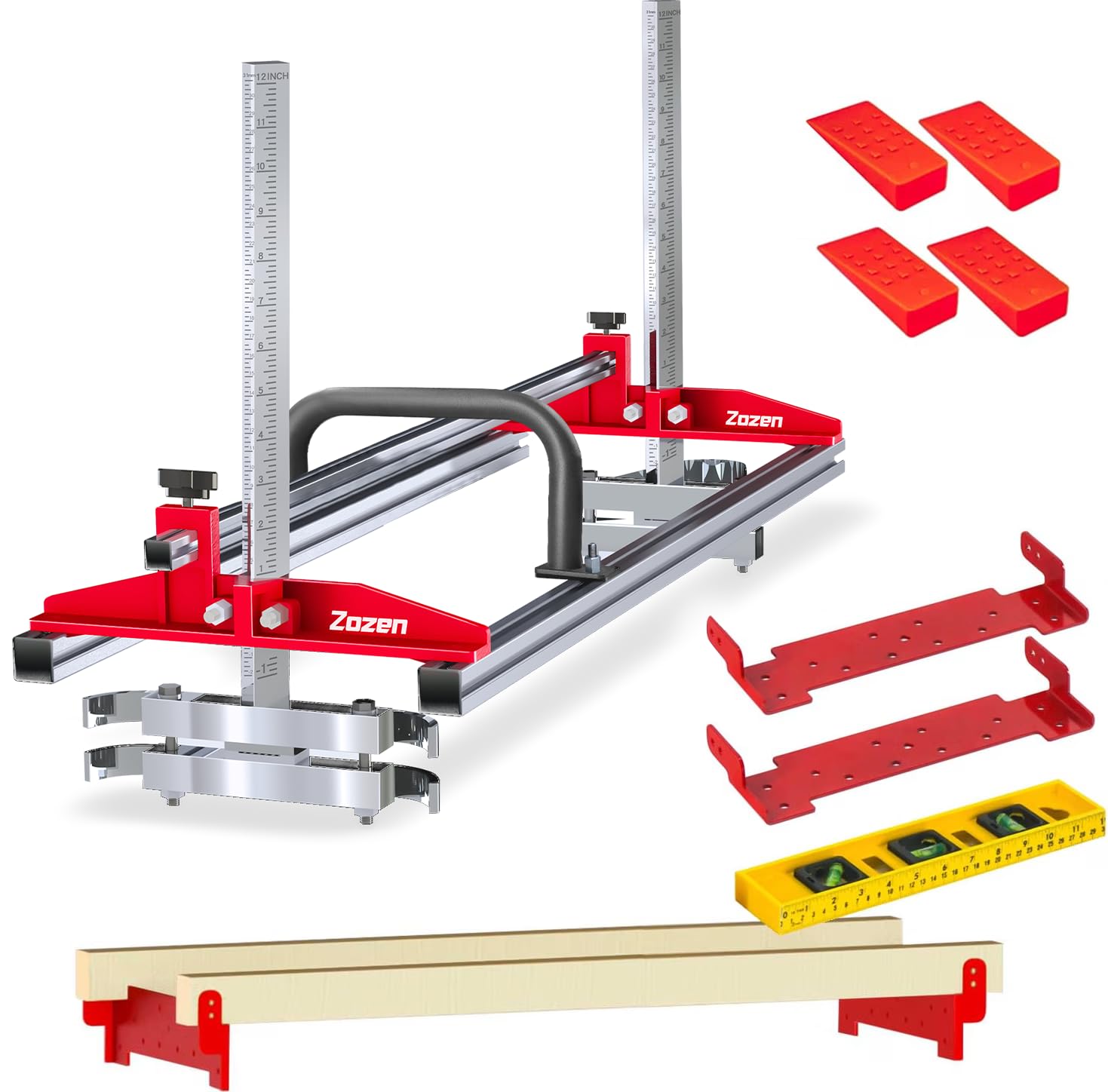
Zozen Mill with Lumber Brackets

Zozen Mill with Lumber Brackets

Compact setups

Our Score 8.6/10
Check Price

Worth Noting

  • Extra splices mean more joints to check
Weight
20.8 lb
Included
Lumber guide brackets
Bar Length
14 to 36 in
Frame Sizes
Three
Read the full review

The frame on this Zozen isn't one piece. It's spliced, so you can build it out at three different sizes and run a smaller mill on a shorter bar — which matters when you own one saw and want the mill matched to it rather than swinging a 36-inch frame off a 20-inch bar.

In the box you get the mill plus a set of lumber guide brackets, a different route to the first cut from the nine-foot rails the other bundles use. You screw a straight 2x4 to the log, clamp the brackets to it, and the mill rides the 2x4 for the opening pass. They're made for logs from 6 to 36 inches across, and they come off when you're done.

The aluminum alloy frame weighs 20.8 pounds, mid-pack here, and the parts arrive uniform enough that assembly doesn't involve filing or drilling to make things line up.

Our reservation is structural. Every splice is another joint that can move, and a mill that moves stops cutting straight, so this one rewards a check-and-re-torque habit before each session and punishes the lack of one. That's a fair trade for a kit that adapts to the saw you already have.

Bottom line: Worth choosing if you want a frame that shrinks to match the saw you already own and a first-cut guide in the same box.

5

XSLOER 36 in Mill with 9 ft Rail

XSLOER 36 in Mill with 9 ft Rail

Short logs

Our Score 8.4/10
Check Price

Worth Noting

  • Rail maxes out at 9 ft with no extensions
Weight
33.3 lb
Bar Length
14 to 36 in
Rail Guide
9 ft or 6 ft
Plank Thickness
0.5 to 12 in
Read the full review

XSLOER's rail ships in three-foot sections, which means you can build it out to nine feet for a long log or stop at six for the short stuff. That sounds like a small thing until you've tried to set a nine-foot rail on a ten-foot log in a yard with a fence along one side.

The kit is aluminum profile and galvanized steel with a lot of quick-release hardware, so the mill comes off the bar and the rail comes apart without hunting for a wrench. Plank thickness runs 0.5 to 12 inches and the cutting width stays under 36 inches, which is the working range of a 36-inch bar anyway.

At 33.3 pounds it's the heaviest kit here, and most of that is the rail. If your logs come to you — a tree service dropping them in the driveway — the weight is a fair trade for a rail that sits solid. If you're carrying the kit any distance into woods, the lighter mills on this list will get used more often.

Bottom line: The bundle for small yards and short logs, where a six-foot rail beats a nine-foot one you can't set up.

6

VEVOR 14-36 in Chainsaw Mill

VEVOR 14-36 in Chainsaw Mill

Occasional use

Our Score 8.2/10
Check Price

Worth Noting

  • No rail or first-cut guide in the box
Weight
13 lb
Included
Gloves, kerf, tool kit
Bar Length
14 to 36 in
Plank Thickness
0.2 to 11.81 in
Read the full review

Thirteen pounds is the number that matters here. This is the lightest full-size mill in the group, light enough to hang on a shed wall between jobs and light enough that carrying it to a log isn't a decision you dread. Galvanized steel pipe, anti-loosening nuts and large washers at the joints, and a bar range that runs from 14 to 36 inches.

What a budget price buys is a mill that does the job without the fit and finish of the Granberg. The scales are carved in rather than printed, the positioning holes hold the saw where you set it, and the depth range runs from 0.2 to 11.81 inches — as much travel as mills costing a good deal more. We think it's the right call for a few logs a year and the wrong one if you're milling every weekend.

It arrives with a pair of gloves, a saw kerf, the hardware and a tool bag, which is more in the box than several kits here supply. Nothing about it feels disposable, and that's more than we expected at this end of the range.

Bottom line: The mill we hand to someone with two logs and no shed: thirteen pounds, straightforward to hang on a bar, and no premium for features you won't use.

7

VEVOR Mill and 9 ft Rail Kit

VEVOR Mill and 9 ft Rail Kit

Uneven ground

Our Score 8.2/10
Check Price

Worth Noting

  • 26.5 lb kit is a two-handed carry
Weight
26.5 lb
Bar Length
14 to 36 in
Rail Guide
9 ft included
Rail Mounts
Four adjustable plates
Read the full review

Four adjustable plates on the rail are the reason to look at this bundle. A log lying in the dirt is never level, and the plates let you pin the rail down at four points and square it to the log instead of shimming a ladder with offcuts.

The mill half is the same galvanized-steel design VEVOR sells on its own: anti-loosening nuts and large washers at the joints, carved scales, positioning holes that hold the saw where you set it, and a bar range of 14 to 36 inches.

Allow an evening to get it square. The rail sections and plates have to be lined up before the first cut, and that first cut is the one every later slab inherits, so it's worth doing slowly with a level rather than quickly by eye.

Our read is that the rail is what you're buying. If you already own a straight edge you trust — a long level, a ladder jig, a screwed-down 2x4 — buy a mill on its own and put the difference into a better chain. If you don't, the plates here do levelling work that a bare rail can't.

Bottom line: A sensible choice if you're buying the rail and the mill together and your logs sit on ground that isn't level.

How We Tested These Chainsaw Mills

We started with a shortlist of 18 mills sold for standard saw bar lengths, then narrowed it to 10 after reading manuals, checking hardware specs, and ruling out frames with plastic clamps or vague assembly instructions. Each mill arrived unassembled. I timed the first setup solo, then timed it again with a second person, and noted where the instructions lost me, which bolts needed a second wrench, and whether the frame stayed square after tightening.

Out in the woodlot and my backyard, we milled storm-downed oak and pine into slabs. We adjusted each mill for three log diameters, checked whether the rails and clamps stayed put after each pass, and watched for flex when the saw was buried at full depth. Stability got tested by leaning into the cut the way you do when a log is wider than the mill's sweet spot; if a frame shifted, we marked it. We measured slab thickness at four corners with calipers and ran a straightedge down the length of each board to catch taper, ripple, and washboard.

Build quality and durability came down to repeated use: we ran at least a dozen logs through each mill over eight months and checked for stripped threads, bent rails, and clamps that loosened between cuts. Ease of use and functionality were judged at the saw, not on paper—how quickly the mill switched between log sizes, whether the throttle linkage stayed clear, and how much fiddling a first-time user needed. Value for money was the final filter: a mill that cut true but fought us on every adjustment did not rank as highly as one that stayed simple and solid.

How to Choose Chainsaw Mills

Start With the Saw, Not the Mill

A mill is a guide; the powerhead does the work. A 36-inch frame bolted to a 20-inch bar doesn't cut a 30-inch slab, it bogs, overheats and leaves a face you'll be planing for an hour, and that mismatch is the most common disappointment here. Match the mill to the longest bar your saw will pull in hardwood, and to the logs you have rather than the logs you imagine.

If your biggest log is 20 inches across, a 36-inch mill is plenty and a 48-inch model is capacity you'll never use. Measure the bar first, then buy.

Solve the First Cut Before You Buy

A round log gives the mill nothing to ride on, so the opening pass needs a datum: a nine-foot rail clamped along the log, a straight 2x4 screwed down with guide brackets riding it, or a ladder jig you already own. A rail pinned at four points holds level on rough ground better than one resting on the log in two places.

If you don't own something straight and long enough, buy a bundle. The bare mill will sit in the shed until you build a jig for it.

Decide Whether You'll Drill Your Bar

Some mills bolt through holes you drill in the bar, which commits that bar to milling for good. Others clamp around the bar as it comes, so the same saw goes back to felling and bucking in a minute. If one saw does everything on your place, pay for the clamp-on design.

If you keep a dedicated long bar with a ripping chain on it, drilling costs you nothing but that bar.

Weigh Portability Against Rigidity

The mills here run from thirteen pounds to a thirty-three-pound rail kit, and the difference shows up in two places: how far you'll carry it and how much the frame flexes in a deep cut. Lighter aluminum is easier on your back and easier to store; heavier frames and rails hold a line with less fuss.

Bolted, spliced frames add joints, and every joint is somewhere the mill can shift. Check torque before a session, not during one.

Know Your Plank Thickness and Cut Width

Depth ranges here run from about a fifth of an inch up to twelve or thirteen, which covers thin panel stock up to a deep beam. Remember that a 4x4 measures 3.5 inches, so a mill that stopped at 3 would leave you short.

Width is set by the bar, not the frame — the frame only has to be wide enough to carry it. Buy for the thickest beam and the widest board you'll cut this year.

Frequently Asked Questions

Final Verdict

Buy the Granberg G778-48 if milling is going to be a habit. It clamps to a standard bar without drilling, holds its setting through wide, knotty logs, and it's the only mill here built for a 48-inch bar. That combination is worth the premium the first time a big walnut lands in your yard.

If the budget or the shed won't stretch that far, the Carmyra bundle is the sensible second stop: mill and nine-foot rail together, with a first cut that comes out straight once you've bench-fitted the frame. And if you'll mill three logs a year, VEVOR's thirteen-pound mill does the job without asking for shelf space.