Lawn Care

Best Battery Backpack Sprayers of 2026

The worst part of a backpack sprayer isn't the spraying. It's twenty minutes in, when something cold starts running down the back of your shirt and you realize the tank has been leaking the whole time — or the moment the battery dies with four gallons still riding on your shoulders. A good battery-powered unit is meant to end both problems: no hand-pumping, no cord to drag, just a steady mist and two free hands. When it works, a job that used to eat a Saturday afternoon takes an hour.

I've spent the past seven months wearing nine of these sprayers around a half-acre of garden rows, fruit trees, and gravel driveway, and the pattern showed up fast. The box sells you capacity; your back pays for it — four gallons of water is roughly 33 pounds before you've added anything else. What really separates a keeper from a regret is the lid seal, an honest battery gauge, and whether the harness stays put. The ones below are the ones I kept reaching for.

1

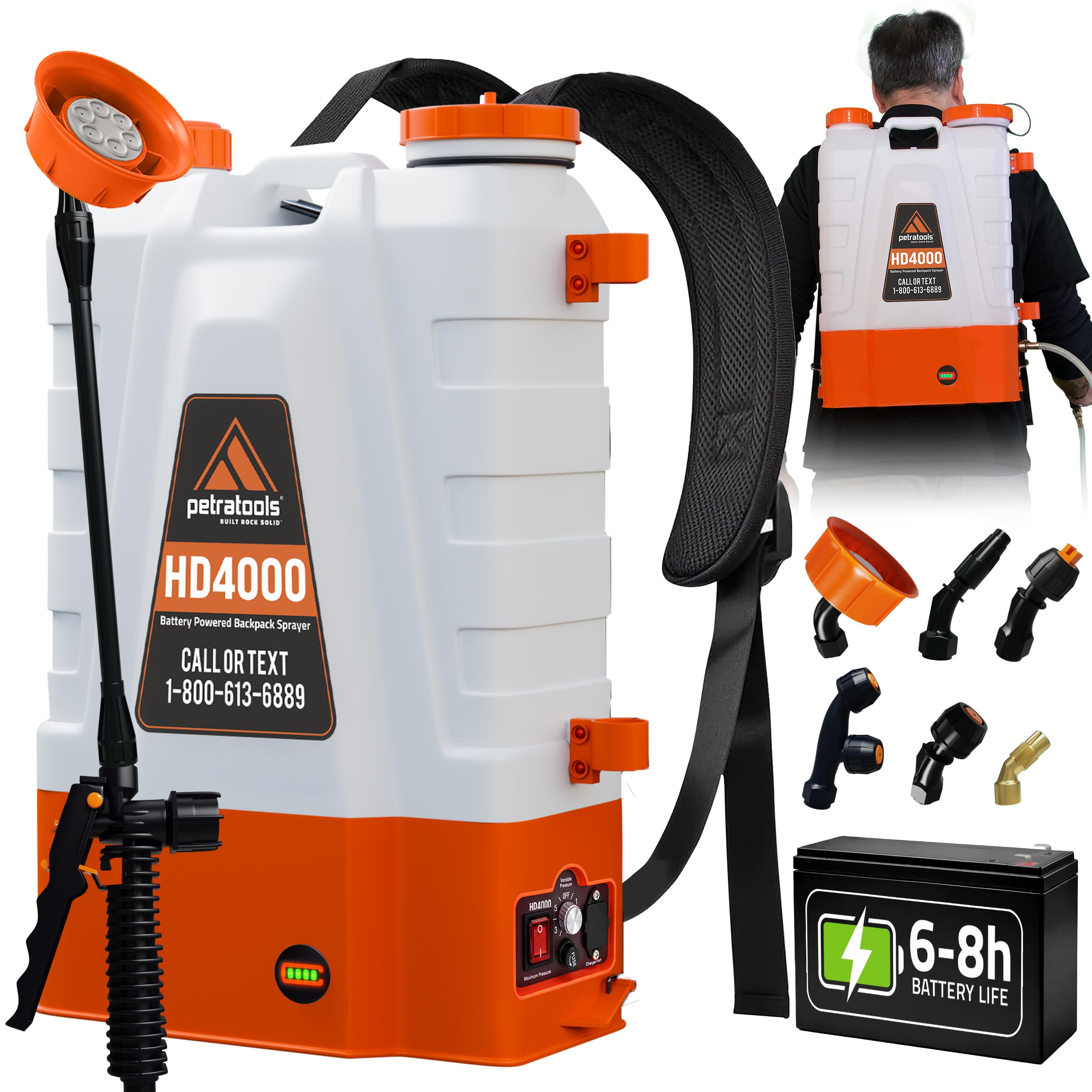
PetraTools HD4000

Top Pick
PetraTools HD4000

Most home lawns

Our Score 9.2/10
Check Price

Worth Noting

  • Wand and hose are the durability weak points
Battery
12V 8Ah included
Nozzles
6
Tank Capacity
4 gallons
Maximum Pressure
90 psi
Read the full review

Four gallons is the size we reach for first in a home garden. It is enough for a serious pass along fences, beds, and driveways without turning every refill into a project, and it is still a load one person can manage. The HD4000 pairs that tank with adjustable 40–90 PSI pressure and six nozzles, so you can move from a fine mist on seedlings to a stream along a fence line. The battery meter is the detail we appreciate most: it takes the guesswork out of whether you have another tank in reserve.

The included 12V 8Ah battery is rated for 200-plus gallons and six to eight hours, which is more runtime than most homeowners need in a session. The wide-mouth lid and 34.5-inch wand matter just as much as the pump; filling and reaching are the chores that make a sprayer feel slow, and this one is designed to shorten both. We also like the double-padded straps and back pad for longer sessions.

Beyond the tank, the HD4000 arrives as a full kit: charger, measuring cup, six nozzles, and a long wand. The wide-mouth lid is the sort of detail that saves time at the fill point, and the padded back pad makes a loaded pack easier to tolerate. We keep coming back to the battery meter, though; it turns maybe one more pass into a decision rather than a guess.

Bottom line: We recommend the HD4000 first for most lawns and gardens: four gallons, adjustable pressure, and a six-nozzle kit make it a complete all-round sprayer.

2

DEWALT DXSP190681B

DEWALT DXSP190681B

DeWalt batteries

Our Score 9.2/10
Check Price

Worth Noting

  • Heavy once the tank is full
Weight
16.3 lb
Battery
20V, tool only
Hose Length
50 inches
Tank Capacity
4 gallons
Read the full review

The DXSP190681B arrives as a bare tool, and that is the whole proposition. If you already own DeWalt 20V batteries, you skip the charger clutter and put packs you trust to work in the garden.

The hardware is aimed at control: a 4-gallon tank, a 50-inch hose, Variflo flow adjustment, and a triple-filtration system. The filtration is the sleeper feature. Clogs are what turn a quick spraying job into a wand-cleaning session, and the extra filtration is a sensible defense. The 50-inch hose also gives you more reach before you have to move the tank.

The harness has a padded back and waist belt, and the controls sit within reach when the pack is on. That matters when the tank is full and you are working along a fence line. The 4-gallon capacity is enough for a serious home pass without making the sprayer impossible to manage.

This is the sprayer we point to when the battery shelf is already full of yellow packs. It feels like a tool rather than a kit, and the filtration and flow control are the details that make it worth choosing over a generic budget model. The bare-tool math only works if the batteries are already yours.

Bottom line: We recommend the DeWalt for anyone with a shelf of 20V packs: it turns those batteries into a comfortable, controlled backpack sprayer.

3

CRAFTSMAN CMXCAFG190682

CRAFTSMAN CMXCAFG190682

Complete kit

Our Score 9.2/10
Check Price

Worth Noting

  • Heavy once the tank is full
Battery
20V 2.0Ah included
Nozzles
4
Tank Capacity
4 gallons
Maximum Pressure
90 psi
Read the full review

The Craftsman's strongest argument is that it arrives ready to use: a 2.0Ah 20V battery and charger are in the box, along with four nozzles. That makes it the simplest choice for someone who does not already own a compatible battery system and does not want to build one around a sprayer.

The rest of the design is sensible for a larger yard. The 4-gallon tank, 90 PSI, and 50-inch hose give you a useful working radius, and the sealed battery compartment protects the pack from splashes and dust. We like the padded shoulder harness with a waist belt; it is the kind of support that matters when the tank is full.

The 2.0Ah battery is a modest pack for a 4-gallon sprayer, but it is enough for a typical yard session and the tool accepts larger Craftsman batteries. That flexibility keeps the kit useful as your needs grow, and the sealed compartment means you can swap packs without worrying about splashes. For a first battery sprayer that arrives ready to use, this is the complete-kit pick we recommend.

Bottom line: We recommend the Craftsman as the complete-kit pick: battery, charger, and a comfortable harness come together without a separate shopping list.

4

EGO Power+ BSP3500

EGO Power+ BSP3500

High-pressure jobs

Our Score 9.0/10
Check Price

Worth Noting

  • Battery and charger not included
  • Heavy with battery and full tank
Battery
Tool only
Flow Rate
0.6 GPM
Tank Capacity
4 gallons
Maximum Pressure
350 psi
Read the full review

350 PSI is far more than most garden jobs need, and that is the point. The BSP3500's brushless motor gives you pressure for reaching tall brush, rinsing equipment, or pushing a stream across a fence line. The pressure knob is mounted on the wand, which is exactly where it should be: you can adjust the spray without reaching back or taking the pack off.

The rest of the package is aimed at comfort and control: a 4-gallon tank, premium back padding, waist support straps, and four nozzle types including cone, fan, shower, and foam. The 0.6 GPM flow rate is enough to empty the tank quickly at high settings, so this is a sprayer to use with purpose rather than a gentle all-afternoon mist.

This is the model to choose if you are already invested in EGO's battery line; it rewards that investment with the highest pressure in this group. The 0.6 GPM flow rate is enough for fast coverage, and the wand-mounted knob lets you back off when you want a finer mist. It is a serious tool for large jobs, not a gentle sprayer for a few pots by the door.

Bottom line: We recommend the EGO for EGO battery owners who want the most pressure here and can handle a heavy pack.

5

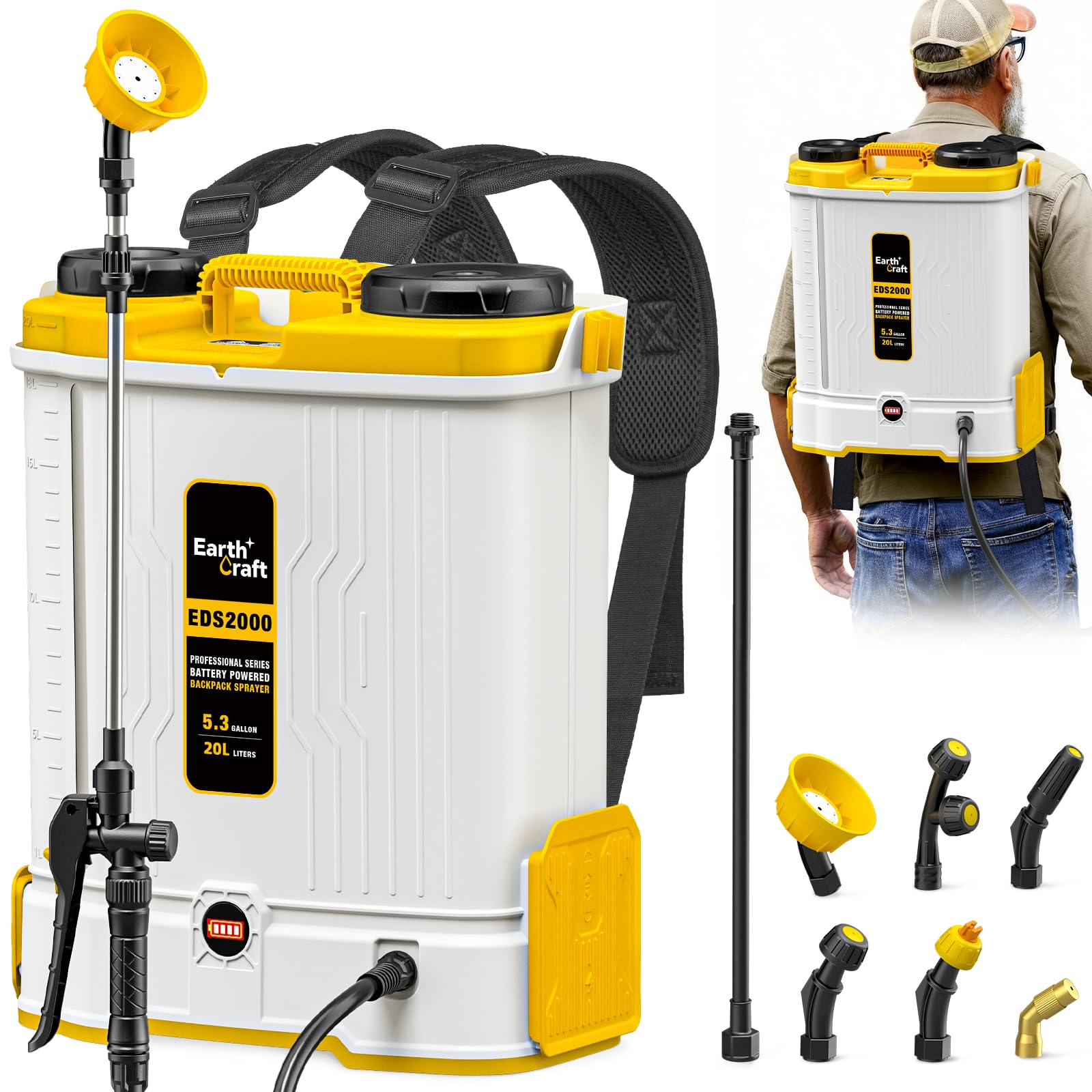
EARTHCRAFT AC20

EARTHCRAFT AC20

Large properties

Our Score 9.0/10
Check Price

Worth Noting

  • Battery and charger not included
  • Heavy at a full 5.3 gallons
Battery
DeWalt 20V, not included
Nozzles
6
Tank Capacity
5.3 gallons
Maximum Pressure
90 psi
Read the full review

The AC20 is the biggest-tank sprayer here, and that changes how you work. At 5.3 gallons it swallows a lot of mix, so you spend less time walking back to the fill point and more time covering fence lines, orchards, or a large garden. The tank is also the reason to think twice: a small yard does not need that capacity.

The built-in mixer is the feature that sets it apart. It keeps wettable powders and settling products moving while you spray, so you are not stopping to shake the tank. The mixer runs while you hold the button rather than as a set-and-forget stirrer, which is a reasonable trade for the control it gives you. We also like that it is a DeWalt 20V tool, so the battery question is settled for anyone already on that platform.

The 39-inch wand and six nozzles give you reach and pattern choice once the tank is on your back, and the adjustable 45–90 PSI range covers everything from a fine mist to a stronger stream. If the job is large enough to justify the capacity, this is the most purpose-built sprayer here for mixing and covering ground.

Bottom line: We recommend the AC20 for big properties and tank-mix jobs: the 5.3-gallon tank and built-in mixer cut down on refills and shaking.

6

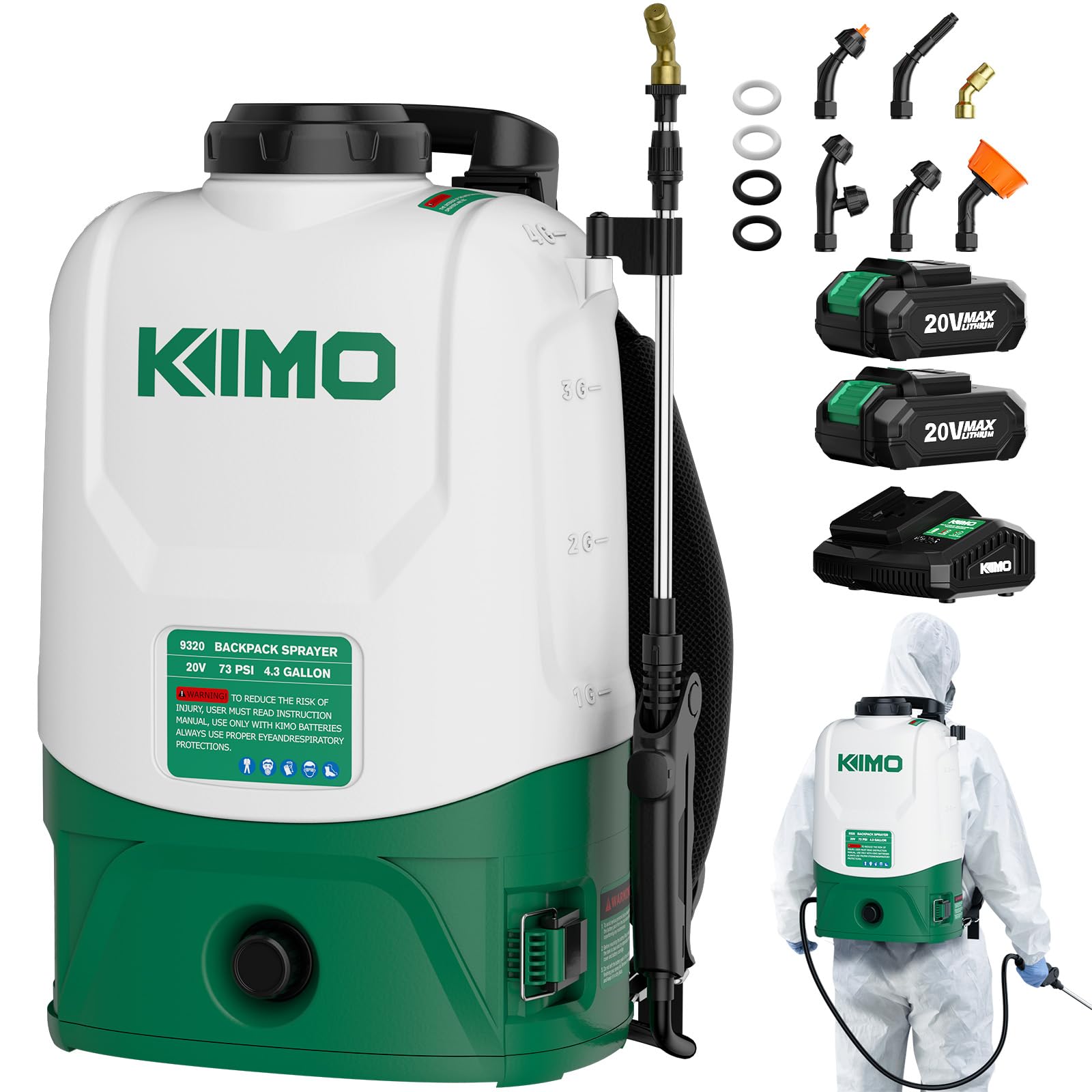
KIMO 9320

KIMO 9320

Spare-battery kit

Our Score 9.0/10
Check Price

Worth Noting

  • 73 PSI maximum limits long-range spraying
Battery
Two 20V 2.0Ah included
Nozzles
6
Tank Capacity
4.3 gallons
Maximum Pressure
73 psi
Read the full review

Two 2.0Ah 20V batteries are the reason the KIMO stands out. One pack runs the sprayer while the other stays charged, so a long session does not end with a hunt for an outlet. The sealed battery compartment is a smart companion to that idea; it keeps splashes and dust away from the packs.

The 4.3-gallon tank gives it a useful working range without going to the bulk of the Earthcraft, and the six nozzles and 35-inch telescoping wand give you room to work. Pressure tops out at 73 PSI, which is lower than the 90–100 PSI models that dominate this group. That is enough for spot spraying, foliar feeding, and most garden chores, but it is not the pick for blasting a long fence line.

The 35-inch telescoping wand, six nozzles, and padded straps make it comfortable for beds, fence lines, and spot work. The battery indicator on the pack is a small convenience, but a useful one when you are switching packs mid-job. The 4.3-gallon tank gives it a useful working range without going to the bulk of the Earthcraft.

This is the sprayer we recommend when a spare battery matters more than a spare charger. It is a complete kit, comfortable enough for a long session, and the sealed compartment is a sensible touch. It earns its place on convenience and completeness.

Bottom line: We recommend the KIMO when two batteries matter more than maximum pressure: it is a complete 4.3-gallon kit with a sealed battery compartment.

7

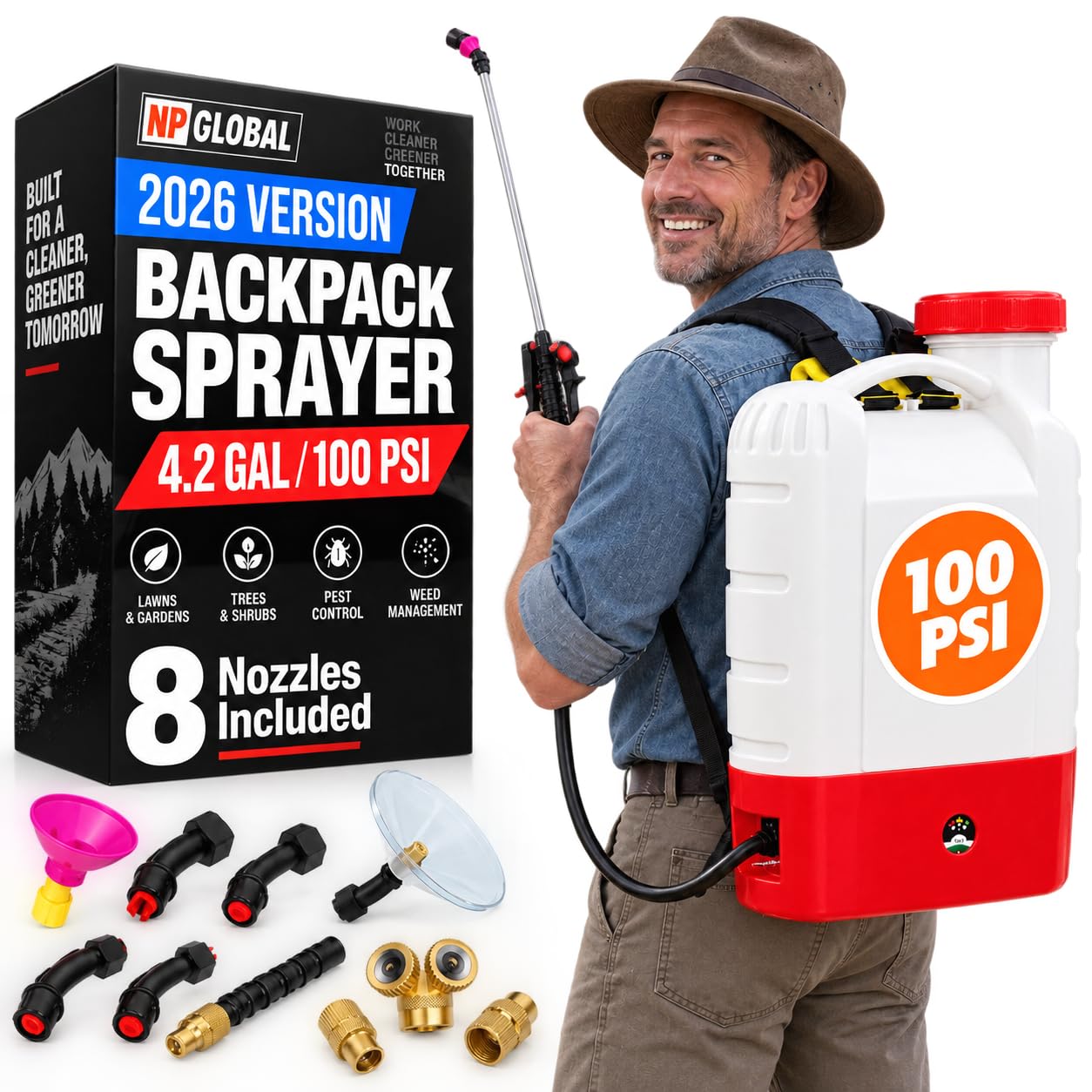
NPGLOBAL NPG-120

NPGLOBAL NPG-120

First sprayer

Our Score 8.8/10
Check Price

Worth Noting

  • Leaks can develop at handle and connections
Nozzles
8
Hose Length
4.26 feet
Tank Capacity
4.2 gallons
Maximum Pressure
100 psi
Read the full review

The NPG-120's appeal starts with what it includes: a 4.2-gallon tank, 100 PSI, and eight nozzles at the budget end of this group. The translucent tank is the practical detail we like most. You can see the mix level without opening the lid, which makes topping up less of a guess.

Performance is the reason it earns a place rather than just a price tag. It has the pressure to reach weeds up high and enough nozzle choice for spot spraying, broadcast work, and rinsing tools. For occasional use and a first battery sprayer, that is plenty; for daily professional work, the build is not the one to count on.

Comfort is decent for the price, with padded shoulder straps and a 4.2-gallon tank that stays manageable on a shorter job. The eight nozzles give you room to experiment without buying extras. It is the sprayer we hand to someone who wants to stop pumping and see whether battery power fits their routine; if it becomes a weekly tool, the better-built picks above are worth the step up.

Bottom line: We think the NPG-120 is the budget pick to beat: 100 PSI, eight nozzles, and a translucent tank make it a lot of sprayer for a first battery setup.

8

VAXMAY XAR4000G

VAXMAY XAR4000G

Makita batteries

Our Score 8.6/10
Check Price

Worth Noting

  • Durability is uneven over time
  • Spray distance is modest
Battery
21V 2.6Ah included
Tank Capacity
4 gallons
Maximum Pressure
100 psi
Battery Compatibility
Makita 18V
Read the full review

Makita compatibility is the reason to look at the XAR4000G first. If you already have 18V packs on the shelf, this sprayer slots into the kit you own. VAXMAY also includes a 2.6Ah battery and charger, so it works out of the box even before you raid your tool bag.

The rest of the package is aimed at longer jobs: a 4-gallon tank, 100 PSI, five nozzles, a 39-inch hose, and a waist support strap. We like the digital voltage display, which tells you more about the battery than a simple low-charge light. The adjustable pressure knob is easy to reach while the pack is on your back, and the five nozzles cover the usual range from mist to a targeted stream.

The XAR4000G is the Makita-friendly pick we recommend first for a mid-sized yard. It has enough tank and pressure for real work, and the waist belt makes a full load easier to carry. The included battery and charger mean it is a complete kit on day one, while the Makita compatibility keeps it useful if you already have packs. That combination is what earns it a runner-up spot.

Bottom line: We recommend the XAR4000G for Makita battery owners who want a ready-to-run sprayer: it accepts your 18V packs and includes its own battery and charger.

How We Chose and Tested These Sprayers

We started with a shortlist of 20-odd sprayers from brands that publish real tank and flow specs and, more importantly, sell replacement seals, wands, and batteries — a sprayer you can't re-seal is one you'll throw away. That got us to nine units, run over seven months, from first spring spraying through fall cleanup in garden rows, around fruit trees, and along a gravel driveway.

Battery life got the most attention, since it's the reason to buy one of these at all. We charged each to full, then sprayed continuously on the widest fan setting until the motor cut out, timing it with a stopwatch and noting whether the gauge dropped in honest steps or sat on full and then simply died. We also clocked recharge time and checked whether the battery could be swapped mid-job without unstrapping the whole unit.

Leakage is the complaint that ruins these things, so we hunted for it. Each tank was filled to the line, strapped on over a white T-shirt, and worn through a half hour of walking a sloped yard and bending to spray under low branches — then we checked the shirt, the lid threads, and the wand connection. A few of them spent a night full of water on the concrete shop floor to see what seeped out by morning.

We weighed every sprayer empty and again with a full load of water, then wore each for a 45-minute session to find where the straps dug in. We dropped them off a tailgate, tipped them over in a truck bed, and left them in the sun to see whether the lid or wand threads cracked. And we checked the small stuff: swapping nozzles with gloves on, clipping the wand to the harness, and whether the whole thing fits on a shed shelf without being taken apart.

How to Choose Battery Backpack Sprayers

Start with the full-tank weight, not the tank size

Four gallons of water weighs about 33 pounds before you add the sprayer, hose, and battery; a 5.3-gallon model like the Earthcraft AC20 adds roughly another 11 pounds of liquid. That is why the biggest tank is rarely the best default. For a suburban yard, a 4-gallon sprayer such as the PetraTools HD4000 is the sensible balance: enough capacity for a full pass without making every lift a chore. If you have a large property or mix a lot of product at once, the bigger tank earns its weight. If you are small-framed or spraying a few beds, buy smaller and refill.

Decide whether you are buying a tool or a battery system

Included battery and charger kits, like the Craftsman and KIMO, make the most sense if you do not already own a compatible pack. Tool-only models such as the EGO BSP3500, DeWalt DXSP190681B, and Earthcraft AC20 are better value only when the batteries are already on your shelf. Check the voltage and the charger before ordering, not after: a bare tool with no pack is a paperweight. If you own Makita 18V batteries, the VAXMAY XAR4000G is the straightforward bridge; DeWalt owners have two compatible choices here.

Pressure is a tool, not a score

40 to 90 PSI covers most weed, fertilizer, and garden spraying. A 100 PSI model gives you more reach and a stronger stream, while the EGO's 350 PSI is in a different class: useful for rinsing and tall brush, but easy to turn into drift or an empty tank at high settings. More important than the peak number is a pressure control you can reach while wearing the pack. Six nozzles are useful only if the patterns are different enough to matter; four good ones beat eight near-duplicates.

Look at the parts that fail first

Wands, hoses, seals, and battery compartments are where backpack sprayers usually disappoint, not the pump. A 50-inch hose gives you more reach than a 39-inch one, and a wand with a replaceable tip is easier to live with than a proprietary assembly. Before you fill, check that the lid gasket sits flat and the hose connection is tight; after spraying, rinse the wand and nozzle rather than storing chemical residue in them. A cheap sprayer with good support can beat a premium one with no replacement parts.

Match the harness to the way you move

Padded shoulder straps are the minimum; a waist belt is what keeps a full tank from pulling you backward. If you will carry the sprayer up ladders, around tight rows, or over uneven ground, prioritize a compact tank and a harness you can adjust without help. The EGO and DeWalt are built for a full load, while the lighter KIMO and VAXMAY make more sense for shorter sessions. Try the fit with the tank empty, then imagine another 30-plus pounds before you commit.

Frequently Asked Questions

Final Verdict

For most lawns and gardens, the PetraTools HD4000 is the sprayer we recommend first. It has the capacity, pressure range, and nozzle choice to handle weeds, fertilizer, and cleanup without making you stop constantly, and the padded harness and battery meter make the work easier to manage. If the budget is tight, the NPGLOBAL NPG-120 is the value alternative. If you already own Makita, DeWalt, or EGO batteries, choose the model built around that platform; the battery you own is worth more than a small difference in headline pressure.