Pest & Weed Control

Best Weed Killers for Lawns of 2026

A lawn weed killer has to walk a narrow line: knock back dandelions, plantain, and crabgrass without leaving turf worse than the weeds did. That line is thinner than most labels admit. Some formulas scorch grass in summer heat, others need a calm, dry day you may not get for weeks, and a few are so weak you're back out there a week later. What you're really buying is control, and we spent a full growing season testing 14 weed killers on real lawns to see which delivered it.

I've mixed enough concentrate to know dilution is where products lose people: too weak and the weeds shrug; too strong and you get pale, whitened patches along the driveway. We watched sprayers and wands, too, because a missing measuring cup or a leaking hose fitting can turn a quick spot treatment into a wasted afternoon. The ones that earned a spot below were effective at the label rate, easy to measure and spray evenly, and priced sensibly for the area they cover. The rest are why my shed has a shelf of half-used jugs.

1

Southern Ag Amine 2,4-D

Top Pick
Southern Ag Amine 2,4-D

Whole-lawn broadleaf control

Our Score 8.8/10
Check Price

Worth Noting

  • Can injure St. Augustine and centipede lawns
  • Broadleaf only; no crabgrass or nutsedge control
Form
32 fl oz concentrate
Label Rate
1 to 4 pints per acre
Weed Spectrum
Broadleaf weeds and woody plants
Active Ingredient
2,4-D amine
Read the full review

The label rate is one to four pints per acre, which tells you most of what you need to know about Southern Ag's 2,4-D. A 32-ounce bottle is a multi-season supply for a normal suburban lawn, and you will be measuring in tablespoons rather than hauling jugs home. The economy is pleasant, but what put this at the top of our list is the kill: dandelions and clover curl and brown out, and this is the one product here where the results held up most consistently across the lawns we treated.

It is a broadleaf herbicide, which happens to be the right starting point for most lawns. Dandelion, clover, plantain, ground ivy, henbit, and chickweed all respond, and the amine formulation mixes cleanly into water without the oily film some ester products leave in a tank. Spray while the weeds are growing rather than when the lawn is half dormant, and give it a week before you decide anything.

Dilution is the part that takes attention. The label says little beyond the per-acre rate, so convert that to your sprayer's actual volume before you start, mix small batches, and write the ratio on a strip of tape on the tank. Over-application is how a lawn ends up with browned edges and a bare patch where the weeds used to be.

One habit worth adopting if you go this route: keep a dedicated sprayer for herbicide and never let it do anything else. Rinse it, label it, store it dry, and it will outlast several bottles of concentrate. A tank that gets borrowed for foliar feeding is how broadleaf damage turns up in a flower bed nobody sprayed.

Bottom line: Our top pick: the most consistent broadleaf results in this group come from a bottle so concentrated that one season barely dents it, as long as you bring your own sprayer.
2

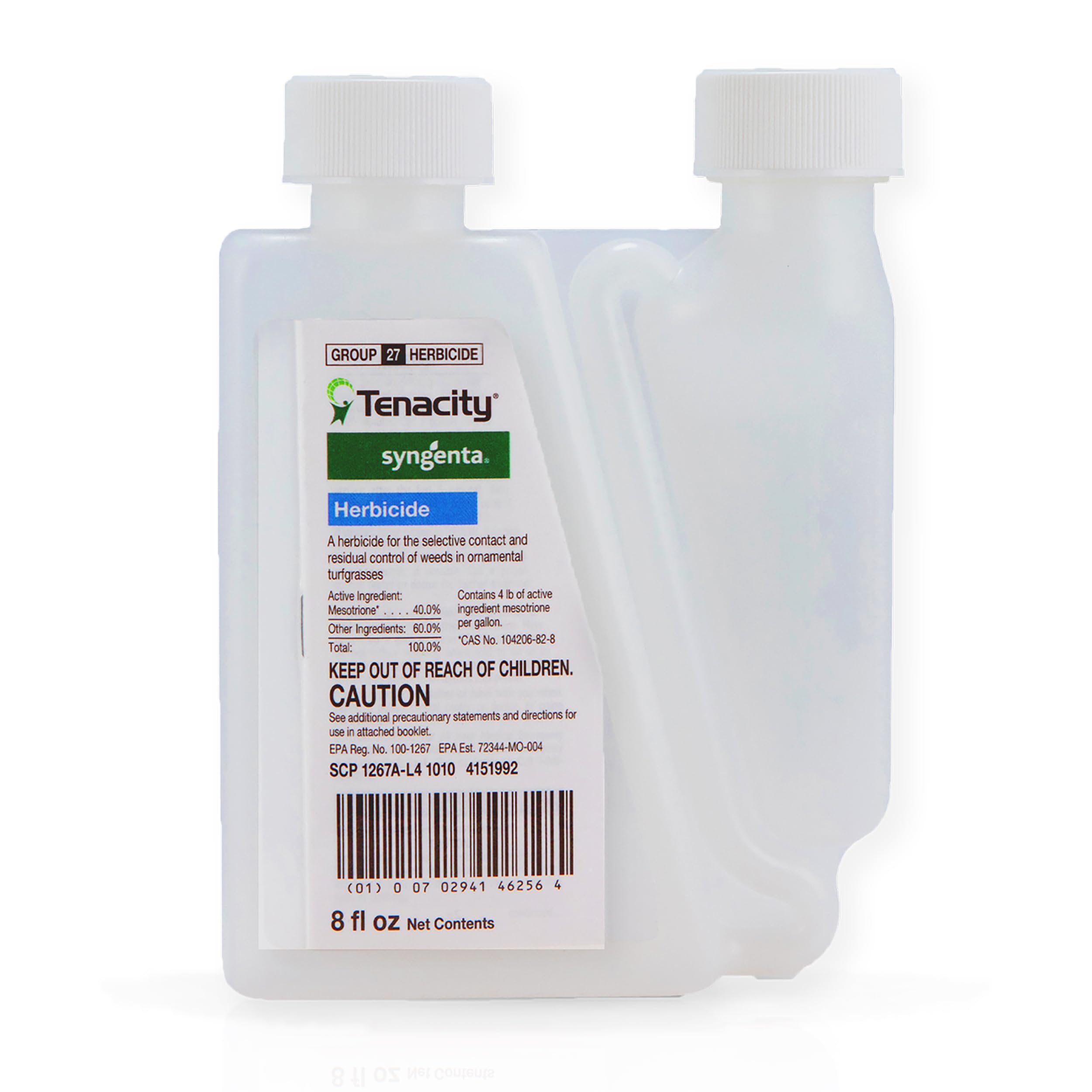
Tenacity Turf Herbicide

Tenacity Turf Herbicide

Crabgrass prevention

Our Score 8.8/10
Check Price

Worth Noting

  • Slow to show results compared with the rest
  • Expensive up front next to the other picks
Form
8 fl oz concentrate
Timing
Pre- and post-emergent
Shelf Life
5 to 8 years
Active Ingredient
40% mesotrione
Read the full review

A few days after spraying Tenacity, the weeds turn white. Not yellow — white, like something bleached them, and then they die. That is the mesotrione working, and it is the strangest-looking success in this group: a lawn speckled with pale weed skeletons before the grass closes back over them.

Eight ounces sounds like nothing; it is not. The bottle is 40 percent mesotrione and goes out at a teaspoon scale, so the container lasts seasons. What earns it a place here is range: it is labeled as both a pre-emergent and a post-emergent, so it stops listed weeds as they come up and kills the ones already growing, and the list runs to crabgrass, clover, dandelion, foxtail, and yellow nutsedge.

That combination is why we kept it despite the fuss. Tenacity does jobs nothing else here does from a single jug, and for a lawn with crabgrass seed sitting in the soil, stopping the next flush matters more than burning down what is already visible.

The measuring is the fiddly part, with a tiny volume going into a couple of gallons. Measure over a bucket rather than over the lawn, and store the bottle out of sunlight and heat — the label puts shelf life at five to eight years when it is stored properly, which is how an eight-ounce bottle ends up economical per treatment.

Bottom line: The specialist of the group: one jug covers crabgrass, clover, and nutsedge before and after they sprout, and eight ounces lasts years if you measure carefully.

3

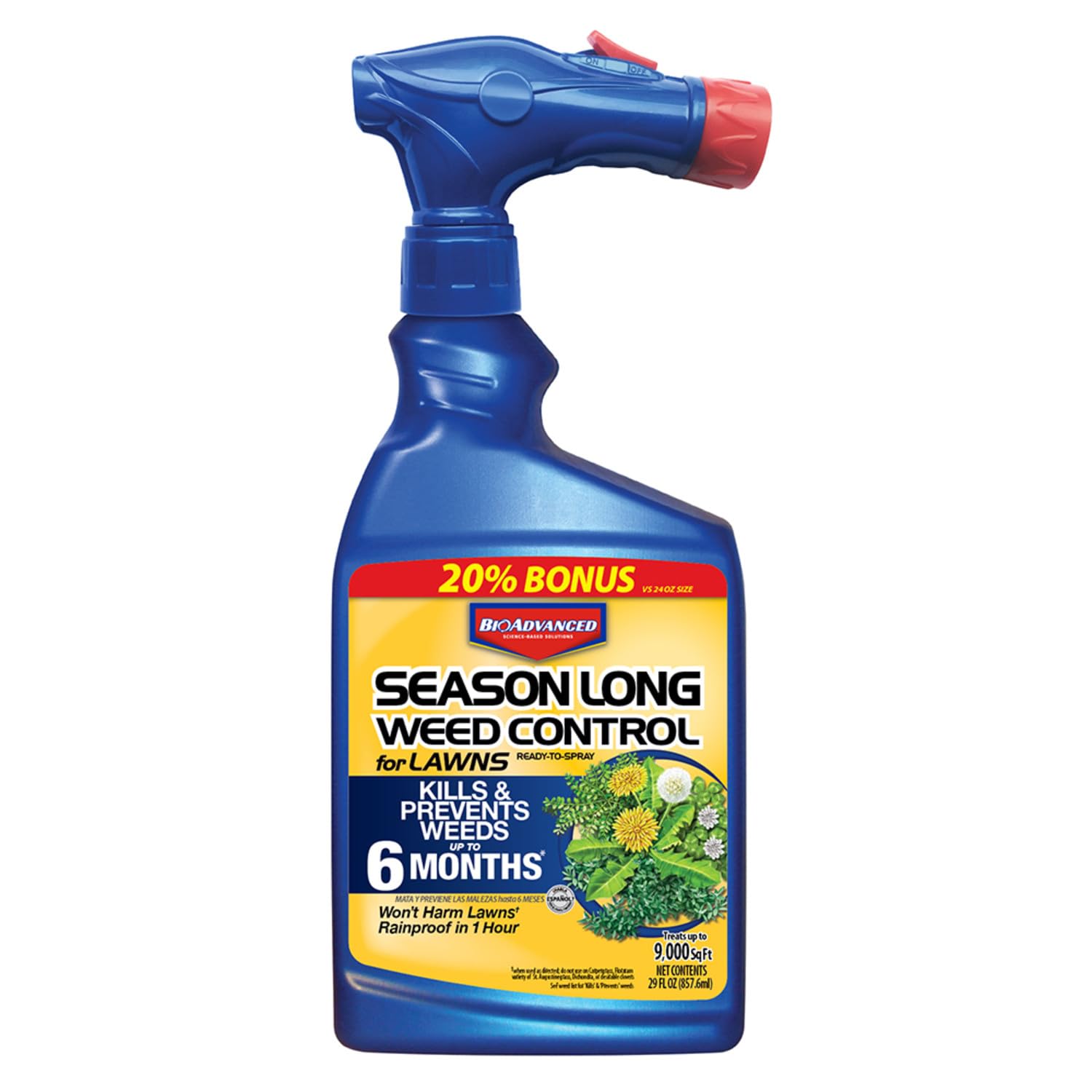
BioAdvanced Season Long

BioAdvanced Season Long

Six-month prevention

Our Score 8.4/10
Check Price

Worth Noting

  • Not available in New York
Form
29 fl oz ready-to-spray
Coverage
9,000 sq ft
Rainproof
1 hour
Protection
Kills and prevents up to 6 months
Read the full review

Killing weeds and preventing them are different jobs, and this is the only bottle here that puts a number on the second one: up to six months of protection against listed weeds, from a hose-end sprayer that is rainproof in an hour. Twenty-nine ounces treats 9,000 square feet, which is a comfortable single pass on most suburban lots.

It suits a lawn that grows the same dandelions and dollarweed in the same places every spring. One pass early in the season, while the weeds are up but before they have set seed, does the killing and lays down the barrier in the same walk. Of everything here, this is the least work for a full season of control, and the two-in-one formula means you are not buying a separate pre-emergent.

Watch the siphon. Hose-end bottles meter concentrate as the water flows, and a bottle that is not drawing looks exactly like one that is — you find out weeks later when nothing died. After you turn the water on, spend a few seconds watching the bottle: the level should drop and the stream should change color. If neither happens, stop and send it back.

Bottom line: The one to buy when the same weeds return every spring: it kills what is up and blocks listed weeds from emerging for up to six months.

4

Roundup for Lawns1

Roundup for Lawns1

Northern grass lawns

Our Score 8.2/10
Check Price

Worth Noting

  • Labeled for Northern grasses only
Form
1.33 gal ready-to-use with wand
Coverage
5,000 sq ft
Grass Types
Kentucky bluegrass, ryegrass, fescue, zoysia
Weeds Listed
253 types
Read the full review

Kentucky bluegrass, perennial ryegrass, tall, red, and fine fescue, and zoysiagrass — that is the complete list of grasses this bottle is labeled for. It is a Northern-lawn product, and reading the grass list first saves you from a wasted afternoon and a browned lawn.

Within that group it is the most complete single bottle in the set. The weed list runs to 253 types, including crabgrass, yellow nutsedge, dandelion, clover, oxalis, and purslane, and it is rainproof in three hours with up to three months of control as listed. It starts working on contact and kills down to the root when it is used as directed.

The extendable wand is the most useful thing about this version: you can treat a hillside or a fence line standing upright, and the reach gets spray under shrub canopies without soaking the mulch. Check the box the moment it arrives, though. The wand ships attached to the bottle, and it is not always in there — if yours is missing, decant into your own sprayer or get a replacement before you start treating. When it is present, it is the reason to pick this over a plain jug.

Bottom line: The cool-season bottle we reach for on bluegrass, fescue, ryegrass, and zoysia, with a wand that saves your back and a weed list that runs to crabgrass and nutsedge.

5

Ortho WeedClear Ready-To-Spray

Ortho WeedClear Ready-To-Spray

Hose-end convenience

Our Score 8.0/10
Check Price

Worth Noting

  • Results on tough, mature weeds are uneven
Form
32 fl oz ready-to-spray
Coverage
Up to 16,000 sq ft Southern, 8,000 sq ft Northern
Rainproof
1 hour
Weeds Listed
250+ broadleaf
Read the full review

There is nothing to measure with Ortho WeedClear. Screw the bottle onto the garden hose, slide the switch to ON, and walk. It is rainproof in an hour, visible results show up in hours, and one container treats up to 8,000 square feet on a Northern lawn or 16,000 on a Southern one. For anyone who has lost an afternoon to a pump sprayer that would not hold pressure, that is the entire appeal.

We hand this bottle to someone with a dozen dandelions and no interest in owning equipment: connect, make a steady pass, disconnect, done. The three active ingredients give it a broader reach than a straight 2,4-D product, covering clover, chickweed, dollarweed, and poison ivy as well as dandelion, and the visible burn-down gives you something to check within a day or two.

Read the coverage numbers twice, because the 16,000-square-foot figure is the Southern one and Northern lawns get half of it. On a big lot, buy two containers up front. Running dry halfway through a pass leaves you with a half-treated lawn and a decision about whether to start the whole thing over.

Bottom line: The simplest application here — hose on, spray, hose off — and a sensible buy for scattered broadleaf weeds, though tough clumps may need a second pass.

6

Spectracide Weed Stop + Crabgrass

Spectracide Weed Stop + Crabgrass

Crabgrass and nutsedge

Our Score 8.0/10
Check Price

Worth Noting

  • Refill jug
Form
1.33 gal AccuShot refill
Weeds Listed
470+ types
Visible Results
As fast as 5 hours
Read the full review

Five hours is the fastest visible-result claim in this group, and Spectracide backs it with the widest weed list of the seven: more than 470 types, including the grassy ones most lawn weed killers quietly ignore. Crabgrass and yellow nutsedge are both named, which is not true of the 2,4-D products here.

That list is why it earns a place. If your issue is dandelions, almost anything on this page will handle them; if it is crabgrass creeping through a fescue lawn, your options narrow fast. This is the bottle in our set that covers broadleaf and grassy weeds in a single pass, and the contact action browns small weeds within a day.

Screwed onto an AccuShot handle, the extendable wand reaches under shrubs and along fence lines without you kneeling in the dirt, and the continuous power spray saves your grip compared with a trigger bottle. Our advice with this one is patience: give it a full week before deciding it failed, because a weed that looks untouched at day two is often curling by day seven.

Bottom line: Buy this one when crabgrass or nutsedge is the problem, not just dandelions — the widest weed list here, with visible results in as little as five hours.

7

Scotts Weed Control for Lawns

Scotts Weed Control for Lawns

Granular application

Our Score 8.0/10
Check Price

Worth Noting

  • Not for Floratam St. Augustine, carpetgrass, bentgrass, or dichondra
Form
14 lb granules
Coverage
5,000 sq ft
Weeds Listed
200+ broadleaf
Read the full review

Granules are the odd one out here, and that is the point. No hose, no measuring cup, no sprayer to rinse: fill a spreader, walk the lawn, put it away. One 14-pound bag covers 5,000 square feet, and the timing is spelled out on the label — spring or early fall, while broadleaf weeds are actively growing, which is when this kind of product actually has a chance.

It is here for that application method, not for the results. Of the seven, this is the least dependable weed killer we tested: some lawns came out cleaner, plenty showed no change at all, and where it did work, regrowth from roots a month later was the usual follow-up. It also has the narrowest margin for error. A spreader set too light leaves you with green grass and untouched dandelions, and the label's four turf exclusions mean a lot of Southern lawns cannot use it at all.

The other thing to get right is where the granules land. They bounce, and a pass along a bed line throws product into the mulch, where it does nothing useful and plenty of damage. Keep the spreader on the lawn side of that line and sweep strays back onto the grass rather than into the planting bed.

Bottom line: The pick only if you already own a spreader and would rather walk the lawn than mix a batch — its weed kill is the least reliable in this set.

How We Tested the Best Lawn Weed Killers

We started by reading labels and spec sheets for more than 60 lawn weed killers, then narrowed the field to formulas labeled for the grass types on our test lawns, with coverage rates and application methods that made sense for a homeowner. We ruled out anything that required a commercial license or a sprayer we didn't already own, and we made sure the final group included both ready-to-use hose-end bottles and concentrates. That left 14 products, which we tested from early spring through late summer—about eight months.

The testing happened on real lawns, not nursery plots. In spring we spot-treated dandelions and plantain along sidewalks and driveways, marking each patch with a small flag and counting live weeds before spraying, then again at two weeks and four weeks. In summer we used hose-end sprayers across whole lawns, timing setup and noting whether the dial mixed evenly or dumped concentrate in one pass; we also mixed concentrates in tank sprayers, checking whether the label's measuring instructions matched what was in the box and whether a missing cup or adapter sent us hunting through the garage. After each application we walked the edges and overspray zones looking for pale, bleached blades—the kind of whitening that tells you a formula is too hot for the turf.

Effectiveness came down to regrowth: if weeds were still pushing new leaves at the four-week check, the product lost points, even if the first burn-down looked dramatic. Ease of use covered the whole job—measuring, mixing, priming a hose-end bottle, spraying an even pattern, and cleaning up—because a clever formula doesn't help if the nozzle clogs halfway through. To judge value, we calculated cost per 1,000 square feet at the label rate, not just the sticker on the jug. The products that rose to the top killed weeds without whitening the lawn, came with the parts needed to spray, and didn't ask us to reapply a week later.

How to Choose Weed Killers for Lawns

Check Your Grass Type Before Anything Else

Warm-season Southern grasses are where lawn weed killers go wrong most often. The 2,4-D in our top pick can injure St. Augustine and centipede, and Scotts' granules are off-limits on Floratam St. Augustine, carpetgrass, creeping bentgrass, and dichondra. Roundup for Lawns1 is a Northern-grass product — bluegrass, ryegrass, fescue, zoysia — and nothing outside that list.

Find your grass on the label before you read a single weed name. If you are not sure what you have, a county extension office will usually identify it from a close photo of a mown leaf, and that answer decides which half of this list you can shop from.

Match the Product to the Weed You Actually Have

Dandelion, clover, plantain, and ground ivy are broadleaf weeds, and a 2,4-D concentrate handles them for very little money. Crabgrass, foxtail, and yellow nutsedge are grasses, and a broadleaf herbicide will not touch them — you need something labeled for grassy weeds, like Spectracide's 470-plus list or Tenacity's mesotrione.

Walk the lawn before you buy and count what is actually there. A lawn that is half crabgrass needs a different jug from one with a dozen dandelions, and buying for the wrong one is the most common way this purchase goes wrong.

Decide How Much Equipment You Want to Own

There are four application methods here, and they cost you different amounts of effort. Granules need a spreader and no water at all. Hose-end bottles need nothing but a garden tap — the least fuss, and the least control over where the spray lands. Concentrates need a sprayer, a measuring cup, and a rinse afterward. Refills such as Spectracide's AccuShot jug need the matching handle, so buy one or choose something else.

If you already own a pump sprayer, concentrates are the better value by a wide margin, and our top pick is the cheapest way to treat a lawn repeatedly.

Time the Application and Respect the Rain

Every product here works best on weeds that are actively growing — spring and early fall, not the dead of summer or midwinter. Rainfastness varies more than most people expect: Ortho and BioAdvanced claim an hour, Roundup for Lawns1 three hours, so a shower two hours after spraying is harmless for some bottles and a wasted afternoon for others.

Then be patient. Spectracide claims visible results in five hours while Tenacity can take a week or two, and judging either one at day three tells you nothing useful.

Buy for the Square Footage You Have

Coverage claims are where an inexpensive bottle gets expensive. Ortho's 32 ounces covers 8,000 square feet on a Northern lawn and 16,000 on a Southern one — the same bottle, twice the lawn, depending on where you live. A concentrate looks like the pricier purchase until you work out that a pint treats an acre.

Measure your lawn, length times width minus the house, before you compare anything. Then buy enough for two applications, because few of these kill everything on the first pass.

Frequently Asked Questions

Final Verdict

Southern Ag's Amine 2,4-D is the bottle we keep for our own lawns: the most consistent broadleaf results in this group, a mix rate so low that one container outlasts the season, and no premium for the privilege. It is a broadleaf product, so it will not help with crabgrass, and it stays away from St. Augustine and centipede.

If you do not want to own a sprayer or do the dilution math, Ortho's hose-end bottle is the one to hand someone who just wants to walk the lawn. And if prevention matters more than rescue, BioAdvanced's six-month claim is the reason to start there.