Pest & Weed Control

Best Organic Weed Killers of 2026

Organic weed killers have a reputation problem: the ones that are gentle around pets and kids are often the ones that barely make a dandelion flinch. I’ve watched a “natural” spray bounce off a plantain in a patio crack and do nothing for a week. The good ones exist, though, and they solve a very specific worry—you get to knock back weeds without wondering what your dog is walking through or what your kids are brushing against.

My team and I spent eight months testing 12 organic herbicides—ready-to-use sprays, concentrates, and a few oddball formulas—on weeds that actually show up in real yards: dandelions along lawn edges, clover in garden beds, plantain wedged into driveway seams. The first thing you learn is that “organic” is not one thing; some rely on acetic acid, some on essential oils, some on soap-based salts, and that difference shows up in how fast leaves curl and whether the root comes back. We also noted the unglamorous stuff: spray quality, lingering odor, and how many repeat applications it took before new growth stopped.

1

Calyptus 50% Vinegar Concentrate

Top Pick
Calyptus 50% Vinegar Concentrate

Large driveways and patios

Our Score 9.2/10
Check Price

Worth Noting

  • Corrosive concentrate needs gloves, glasses, and care
  • Sold as a cleaner, with no weed directions
Size
2 gal concentrate (2 x 1 gal)
Weight
17 lb
Dilution
1:12.5 with water
Concentration
50% vinegar
Read the full review

Two gallons of 50 percent vinegar is an odd entry in a weed-killer lineup until you do the arithmetic. Diluted 1:12.5 as the label directs, each gallon becomes 12.5 gallons of standard 4 percent vinegar — so one order here fills a sprayer more times than every ready-to-use jug in this guide combined.

Using it is a different kind of job. The box weighs 17 pounds, the jugs are awkward to pour from, and the concentrate is strong enough to sting bare skin and make your eyes water. Gloves and glasses are not optional. Mix outdoors, label the bottle you decant into, and stay upwind, because the smell while you are spraying is the sharpest of anything we tested.

For hard surfaces, though, this is the most economical and most powerful option here. Driveways, gravel, paver cracks, the strip along a foundation — places where you want a hard burn and do not care what happens to the soil underneath — are exactly what a 50 percent acetic acid concentrate is for. Nothing else in this set gives you that much killing power per bottle of mixed spray.

Two caveats worth knowing before you order. It is sold as a cleaning vinegar, not a registered herbicide, so there are no weed directions on the jug — follow the printed dilution exactly and treat it as the strong acid it is. And like everything here it only kills what it touches: the tops die, the roots do not.

Bottom line: Buy it if you spray a lot of hardscape and do not mind mixing: it makes the cheapest, strongest spray in this guide, provided you suit up.

2

Natural Elements Weed Killer

Natural Elements Weed Killer

Pet-safe spot treatment

Our Score 8.6/10
Check Price

Worth Noting

  • Salt stays in the soil where you spray
Form
Ready to use, no mixing
Size
128 fl oz
Targets
Broadleaf weeds and grasses
Active Ingredients
Vinegar, salt, soap
Read the full review

Natural Elements arrives as the least impressive package in this group: a plain gallon jug, no wand, no batteries, no mixing chart. What is inside is the oldest recipe in the category — vinegar, salt, water, and soap — already blended, so there is nothing to measure at the tap before you head outside.

That plainness is exactly why it is our top pick. Of the ready-to-use jugs we sprayed, this is the one that browned weeds most consistently, and it did it without a synthetic ingredient anywhere on the label. It is a contact killer: the spray burns what it lands on, so annual weeds and grass burn down and stay down, while anything with a taproot comes back and needs a second pass. We are comfortable with that trade, because nothing in this category kills roots.

The pet question is why most people end up here, and this is the formula we trust most around a dog that eats grass. Salt is the piece worth thinking about: it does not break down the way vinegar does, so we keep this off vegetable beds and off anywhere we plan to plant next spring. Gravel, pavers, fence lines, and driveway cracks are its natural home.

There is no sprayer in the box — we poured ours into a pump sprayer and got a much finer, more accurate spray than a trigger bottle gives you. A gallon also goes further than you expect when you are dosing individual weeds instead of broadcasting over a lawn, which is the only way any of these should be used.

Bottom line: For a yard with pets and kids, this is the organic weed killer we point people to: it browns weeds as reliably as anything here and costs the least per gallon.

3

Spruce Power Wand Kit

Spruce Power Wand Kit

Easy wand spraying

Our Score 8.6/10
Check Price

Worth Noting

  • Smallest bottle here, so refills add up
  • Wand can quit after a battery change
Size
64 fl oz
Results
Visible in 1 hour
Coverage
Up to 400 weeds
Applicator
Battery-powered wand, 2 AA included
Read the full review

The hardware is the reason to buy this one. Spruce pairs a 64-ounce bottle of ready-to-use killer with a battery-powered wand, two AA batteries included, and the difference shows up in your hand: a paddle you hold down instead of a trigger you squeeze until your forearm complains. We noticed it most working a fence line, where a trigger bottle would have had us stopping to shake out a cramp.

The formula needs no mixing and no pouring, and the label promises visible results in an hour, dead weeds in a day. Broadleaf weeds in full sun is where it looks best; shaded, waxy leaves took longer and sometimes needed a second go. It is also the mildest-smelling option here — nothing like the vinegar jugs — and it is the most specific safety claim in the set, covering people, pets, and bees when used as directed.

What you pay for is the wand and the small bottle. Sixty-four ounces is the least liquid here, so a long driveway means refills, and refills are where the cost settles. Check the slide switch before you assume the wand has died: it has a lock position, and a locked wand feels exactly like a dead one.

Bottom line: If you want the easiest application here and a formula labeled safe around pets and pollinators, the Spruce kit is the one to hand someone who hates spraying.

4

Eco Garden Pro Weed Killer

Eco Garden Pro Weed Killer

Moss and poison ivy

Our Score 8.2/10
Check Price

Worth Noting

  • No sprayer or nozzle included
Size
128 fl oz
Results
Within 24 hours
Targets
Clover, moss, poison ivy
Coverage
1,000 sq ft
Read the full review

Eco Garden Pro is the only bottle here that names moss and poison ivy on the label, alongside the usual clover, chickweed, and dollar weed. That list is the reason to consider it: if your problem is a shady patch of moss or ivy creeping up a fence, this one is aimed at exactly that. One gallon, no mixing, and about 1,000 square feet of coverage by the listing's own figure.

We got the most uneven results from this one. Some patches browned and stayed brown; others sulked for a few days and pushed new growth straight back up, and ivy on a fence took more than one pass. It is still a reasonable pick for a narrow job the others do not name — just do not expect one coat to settle an established ivy problem.

Two practical notes. There is no nozzle in the box, so pair it with a pump sprayer if you want to hit moss without soaking the grass around it. And the formulation is a vinegar-and-salt blend like the rest, so it kills grass as readily as it kills weeds. It sits at the low end of the price range here, which takes some of the sting out of a second application.

Bottom line: Reach for Eco Garden Pro when moss or poison ivy is the target; for mixed weeds along a driveway, a more consistent bottle here is the better spend.

5

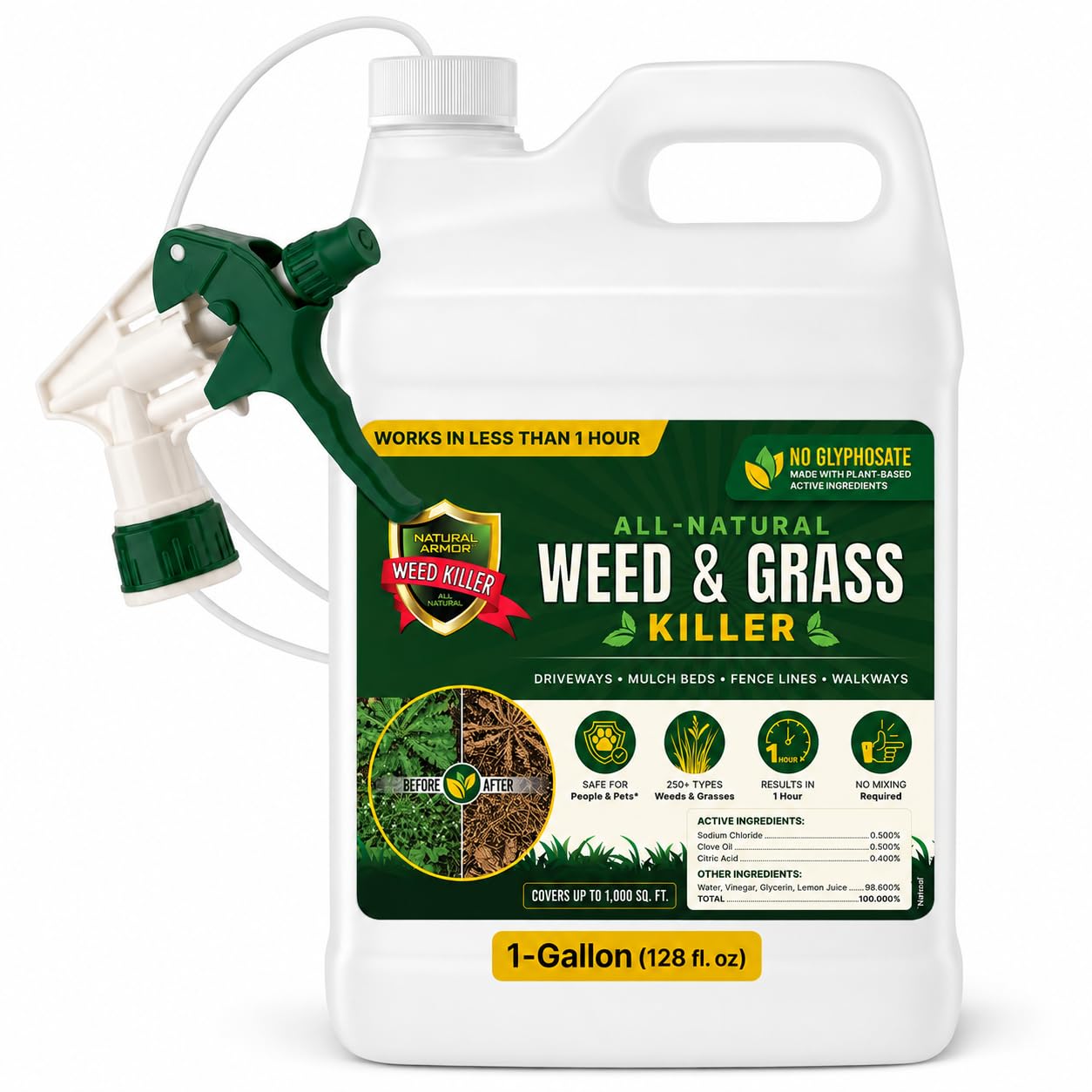
Natural Armor Weed & Grass Killer

Natural Armor Weed & Grass Killer

Gravel and fence lines

Our Score 8.0/10
Check Price

Worth Noting

  • Included sprayer sprays unevenly
Size
128 fl oz
Targets
250+ weeds and grasses
Applicator
Included sprayer
Active Ingredient
Vinegar
Read the full review

Natural Armor looks like the best value in the bunch: a gallon of vinegar-based killer with a sprayer thrown in. The liquid is decent. The sprayer is why this one lands in also-consider rather than higher, because the nozzle sprays unevenly and the trigger is the part that lets the kit down.

The formula itself is straightforward vinegar with no glyphosate, and the label lists more than 250 weeds and grasses along with the settings it is written for — gravel, pavers, fence lines, foundations, pool areas. In sun, on small annual weeds, it does what it says: visible results within an hour is the claim, and wilting is what you get. Tough perennials and anything with a taproot come back and need another round.

Pour it into an applicator you already own and this becomes a serviceable gallon for gravel, paver cracks, and the strip where the lawn meets the fence. It is not the bottle to hand someone who wants to start spraying the minute the box lands.

Bottom line: A solid vinegar formula let down by the sprayer in the box — buy it for the liquid and pour it into an applicator you trust.

How We Tested Organic Weed Killers in Real Yards

We started by pulling every organic herbicide we could find that was labeled for lawn and garden use and sold as a ready-to-use spray or concentrate. We narrowed that list by reading labels for active ingredients, coverage area, and re-entry times, then cut anything that required equipment we did not already have or cost so much per application that it didn’t make sense for a typical yard.

We tested 12 products over eight months, from early spring through late fall, in yards shared with two dogs and a cat. Each product got its own marked patch: dandelions and plantain along lawn edges, clover in a vegetable bed, and weeds growing out of driveway seams and patio cracks. We sprayed on dry, windless mornings using each bottle’s own nozzle, and noted whether the spray came out as a stream, a mist, or a soggy dribble, how much hand fatigue the trigger caused, and whether the bottle leaked or clogged between uses. For concentrates, we mixed exactly to label and compared the mixed strength with the ready-to-use formulas; we also followed re-entry times and kept the dogs off treated areas until dry, watching for residue that could stick to paws.

We checked each patch at 24 hours, 72 hours, one week, and two weeks, counting how many weeds wilted, browned, or stood back up. We marked regrowth at four and eight weeks to see whether the root had died or just been knocked back. We sniffed each spray at application and again a few hours later, because a vinegar-based formula can clear a patio faster than the weeds do, and calculated cost per square foot based on how much of the bottle it took to get a clean patch.

How to Choose Organic Weed Killers

Contact Killers, Not Root Killers

Every product here works the same way: the spray burns the leaf it lands on and the plant dies from the top down. That is why a dandelion looks finished on Tuesday and is leafy again three weeks later — the taproot was never touched. Spray on a sunny morning with no rain forecast for a day, when the leaf is dry and the sun will bake the burn in, and plan on two or three passes for anything established.

A brown top is not a dead root, and none of the jugs on this page changes that. If you want perennials gone for good, you are looking at digging, smothering, or repeated spraying over a season.

The Sprayer Decides More Than the Jug

Three of the five products here ship with nothing to spray them with, and an included sprayer is no guarantee — the weakest applicator in this set came in the box. A coarse trigger jet soaks the leaf and overshoots onto whatever is behind it, which matters when the formula kills anything green.

A pump sprayer with an adjustable nozzle gives you a finer mist and somewhere to aim, and it is the single upgrade that changes how these products perform. If the job is a long fence line, a battery wand like the Spruce kit's turns an afternoon of squeezing into a walk.

Non-Selective Means What It Says

These sprays cannot tell a weed from a peony. Vinegar, salt, and soap burn any green tissue they touch, which is why every label here carries some version of a warning that grass will die too. Overspray in a breeze reaches further than you expect, and a coarse spray drifts.

Use a narrow nozzle, spray on a still morning, and hold a sheet of cardboard between the nozzle and anything you want to keep. On a lawn, spot-treat individual weeds rather than broadcasting — there is no selective organic herbicide in this group.

Pet-Safe Still Means Let It Dry

Every formula here is sold as safe around pets and children, and the labels are careful for a reason: they mean when used as directed, on the target plant, and dry. Keep animals and kids off the treated area until the spray has dried, and do not let a dog graze weeds you have just soaked.

Pollinators are a separate question. Spruce states its formula is safe around bees when used as directed; either way, spraying in the evening, when foragers are back in the hive, and never onto open flowers, is the habit worth keeping.

Cost Per Spray, Not Cost Per Bottle

A ready-to-use gallon is the easy purchase and the expensive one. A concentrate costs more at the register and covers far more ground: the Calyptus jug dilutes 1:12.5, so every gallon of concentrate becomes 12.5 gallons of spray.

Buy ready-to-use when you have a couple of dozen weeds by the back step and want to start the day it arrives. Buy concentrate when the job is a driveway, a gravel apron, or a fence line, and put the difference into a sprayer you will keep for years.

Frequently Asked Questions

Final Verdict

Start with Natural Elements. It browns weeds as consistently as anything in this set, it is the cheapest of the ready-to-use gallons, and it is the one we are comfortable spraying where a dog runs.

If the squeezing is what keeps you from getting outside, the Spruce kit's battery wand fixes that for the price of refills. And if your weed problem is a driveway and a gravel apron rather than a flower bed, buy the Calyptus concentrate and a pump sprayer — nothing here goes further for the money.