Garden Tools

Best Transplanting Trowels of 2026

A transplanting trowel looks like the simplest tool in the shed, which is exactly why a bad one is so irritating. The failure almost always happens in the same place: the neck bends the first time you hit a root, the handle works loose by midsummer, or the blade rusts solid in the shed. A good one should slip between established plants, scoop a seedling out with its root ball intact, and feel steady in your hand through a whole flat of starts.

I've moved everything from tomatoes to hellebores with a cheap hardware-store trowel, so I know the difference a proper one makes. Over the past growing season, our team put 16 transplanting trowels through spring planting, summer divisions, and fall cleanup — some stainless, some carbon steel, a few with depth markings and a couple without. The pattern was clear: the ones that stayed comfortable and didn't bend were the ones with a full tang and a handle that matched the hand, not just the price tag. The picks below are the ones I kept reaching for.

1

Fiskars Ergo Garden Trowel

Top Pick
Fiskars Ergo Garden Trowel

All-round transplanting

Our Score 9.6/10
Check Price

Worth Noting

  • Blade can take a set if levered sideways
Weight
6.4 oz
Warranty
Lifetime
Head Material
Cast aluminum
Overall Length
12.25 inches
Read the full review

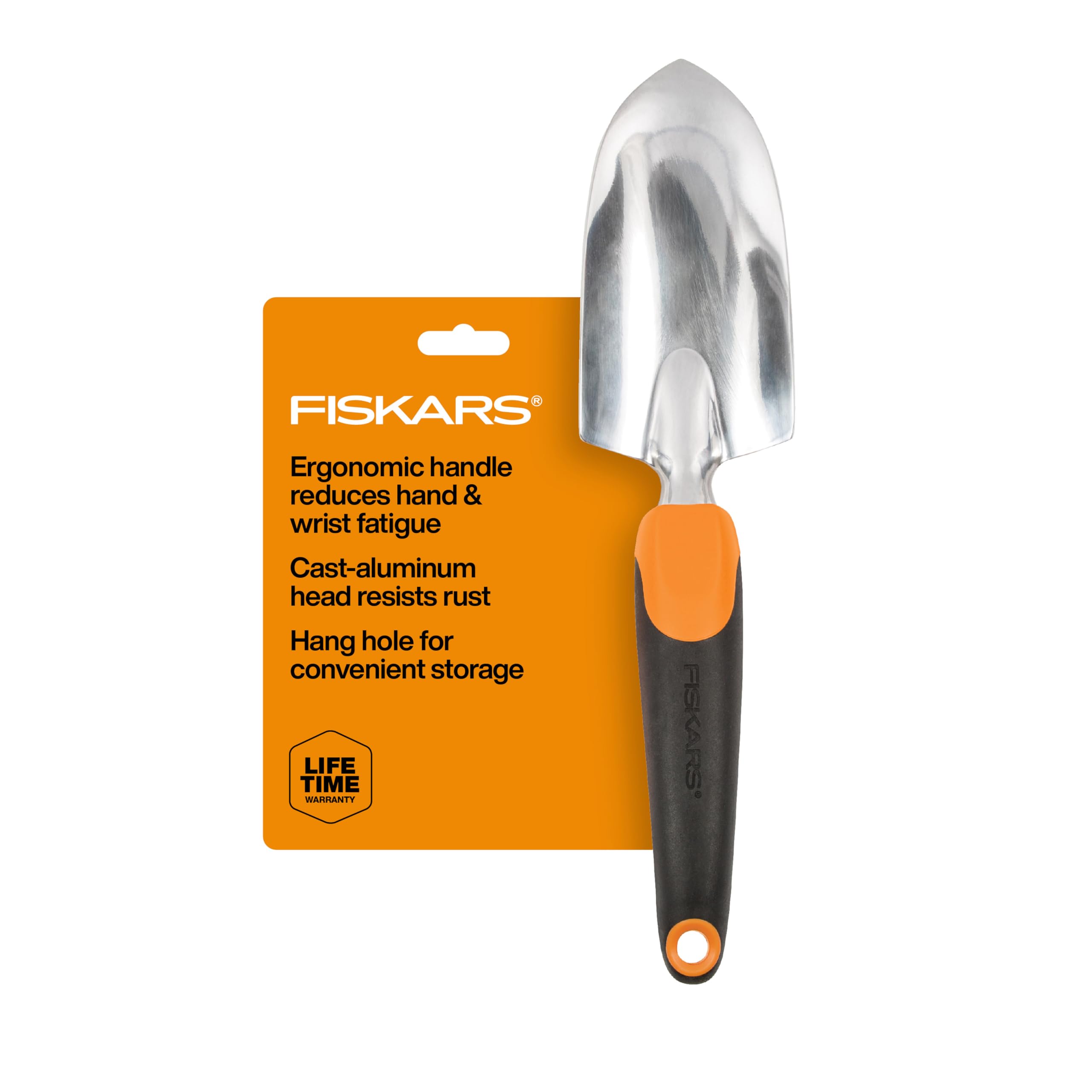
One trowel covers nearly everything a transplanting season asks for, and for us that's the Fiskars Ergo. The head is cast aluminum rather than stamped sheet, so it keeps its dish when you lean on it, and at 6.4 ounces the tool more or less disappears into the job — you can hold a seedling in one hand and work the soil with the other.

The grip is the part people notice when they pick it up. It's shaped to fill the palm rather than turned like a plain dowel, and after an afternoon of setting out lettuce and brassicas we came in with nothing to say about our wrists, which is the review. A hang hole in the end means it lives on a nail by the potting bench instead of rattling around a bucket.

The polished head rinses clean in a bucket between beds, which sounds like a small thing until you've carried mud through a kitchen, and the warranty runs for life. We also like that the whole tool is essentially one piece — there's no socket to loosen and no wooden handle to split after a wet week left outside, which is how a lot of trowels quietly end.

It's the least expensive trowel in this guide, so buying a second for the car or the shed isn't a decision. Where it isn't the answer: ground that's a mat of old roots, where the Root Slayer's teeth do the job, or a tray you want planted at an exact, repeatable depth, which is what the Edward Tools' markings are for. For ordinary beds and ordinary seedlings, this is the one we hand people.

Bottom line: We recommend the Fiskars Ergo as the default transplanting trowel: the cast-aluminum head holds its shape in clay, the grip is easy on the wrist, and it's the least expensive pick here.

2

Edward Tools Transplanter Trowel

Edward Tools Transplanter Trowel

Consistent planting depth

Our Score 9.6/10
Check Price

Worth Noting

  • Edge struggles in hard, compacted ground
Handle
Soft rubber with palm rest
Weight
5.6 oz
Depth Guide
Engraved markings
Blade Material
Aluminum
Read the full review

Depth is the part of transplanting most trowels leave to guesswork, and it's where the Edward Tools transplanter earns its place. Graduated marks are engraved into the blade, so a tray of seedlings can go in at one level and bulbs can go in at the depth printed on the packet without a ruler coming out to the bed.

The rest of the tool is built for one-handed work. At 5.6 ounces it's among the lightest trowels here, and the soft rubber handle has a palm rest that puts the pressure on the heel of your hand rather than the base of your fingers. The curve of the blade suits the way you actually plant — scoop, drop, firm — better than a flat spade shape does. The aluminum blade comes with a replacement promise if you manage to bend it, and the warranty is lifetime. We treat the pointed tip as a hole-maker rather than a cutter: it starts a clean hole in prepared ground and lifts a root ball without a fight.

Bottom line: If you want every transplant at the same depth, we point you to the engraved scale on this one — it's among the lightest trowels here and the easiest to plant a whole tray with.

3

Kemaier Heavy Duty Trowel

Kemaier Heavy Duty Trowel

Hard, rooty soil

Our Score 9.6/10
Check Price

Worth Noting

  • Moves less soil per scoop than a dished trowel
Joint
Fully welded
Blade Steel
65 manganese steel
Blade Length
6.3 inches
Blade Thickness
2.5 mm
Read the full review

Set the Kemaier next to the aluminum trowels here and the difference shows in the hand: a 6.3-inch blade cut from a 2.5 mm plate of 65 manganese steel, ground to a sharp V. It's the most workmanlike thing in this guide, and it feels it.

This is the one we take to ground that has gone hard. The blade bites into clay and slices turf and thin roots instead of skating over them, and against the other picks it's the strongest for clay and rooted soil. The neck is welded to the blade as one continuous piece rather than pressed into a socket, and that joint is where most cheap trowels give up first.

The edge arrives genuinely sharp, and the job it does better than we expected is re-cutting the edge of a bed — slicing a clean line through turf where a full spade is overkill. It's midrange money for steel this thick, and the blade has enough mass that you stop handling it carefully.

Bottom line: We reach for the Kemaier when the bed has gone hard: the thick, sharp steel blade goes in where aluminum skates, and the welded neck shows no play.

4

Garden Weasel Transplanter

Garden Weasel Transplanter

Root-bound nursery pots

Our Score 9.6/10
Check Price

Worth Noting

  • Teeth can slice fine roots on a delicate lift
Edge
Serrated
Blade Length
6 inches
Blade Material
AluminIron
Overall Length
13 inches
Read the full review

A shrub that has spent a season in a nursery pot comes out with its roots wound into a ring, and a smooth blade slides right off it. The Garden Weasel transplanter puts serrated edges on a 6-inch blade, and those teeth saw through the ring instead of bouncing — the difference between a planting you finish quickly and one you fight.

That makes it our pick for plants bought in pots rather than trays. The blade is long enough to slide under a root ball and lift it, and the 13-inch overall length keeps your knuckles clear of the soil while you do it. The thermoplastic rubber grip stayed secure with wet, muddy hands, which matters more in October than in May.

It's a multi-use tool by design — the same edges cultivate and cut furrows — and it carries a lifetime guarantee. If your planting is bare-root or cell trays going into open ground, the Fiskars is the simpler, cheaper tool; the Weasel's advantage shows up the moment there's a pot involved.

Bottom line: For plants that come home in nursery pots, this is our pick: the serrated 6-inch blade saws through circling roots and gets under a root ball.

5

WORKPRO Narrow Trowel

WORKPRO Narrow Trowel

Tight planting gaps

Our Score 9.6/10
Check Price

Worth Noting

  • Flat blade carries little soil per scoop
  • Two-year warranty, the shortest here
Blade
Polished stainless steel
Handle
Wood
Weight
6.7 oz
Overall Length
12.6 inches
Read the full review

Most of the planting we do after the first season isn't planting at all — it's slotting one more thing into a border that's already full. The WORKPRO narrow trowel is built for that: a 12.6-inch stainless tool with a flat blade that goes down in a slot rather than scooping out a crater.

One edge is serrated and the other scrapes, so it cuts small roots and slices through the mat of a raised bed without a tool change. The handle is wood, which is warmer and grippier when wet than most plastic, and it will want an occasional rub of oil to stay that way. At 6.7 ounces it's light enough to work one-handed from standing height.

We keep it for gaps — between established perennials, along the edge of a raised bed, anywhere a wide trowel would take out roots you want to keep. The long shaft makes it the easiest of these to use without kneeling, which counts for something by the third bed. It's the tool we reach for when the border is full and the gaps are small.

Bottom line: We keep this one for filling gaps in a crowded border: a narrow blade that goes down between established plants without lifting their roots.

6

Garden Guru Hand Trowel

Garden Guru Hand Trowel

Potting and backfilling

Our Score 9.6/10
Check Price

Worth Noting

  • Wide blade is clumsy between closely spaced plants
Blade
Polished stainless steel
Weight
9 oz
Blade Length
5.5 inches
Overall Length
12 inches
Read the full review

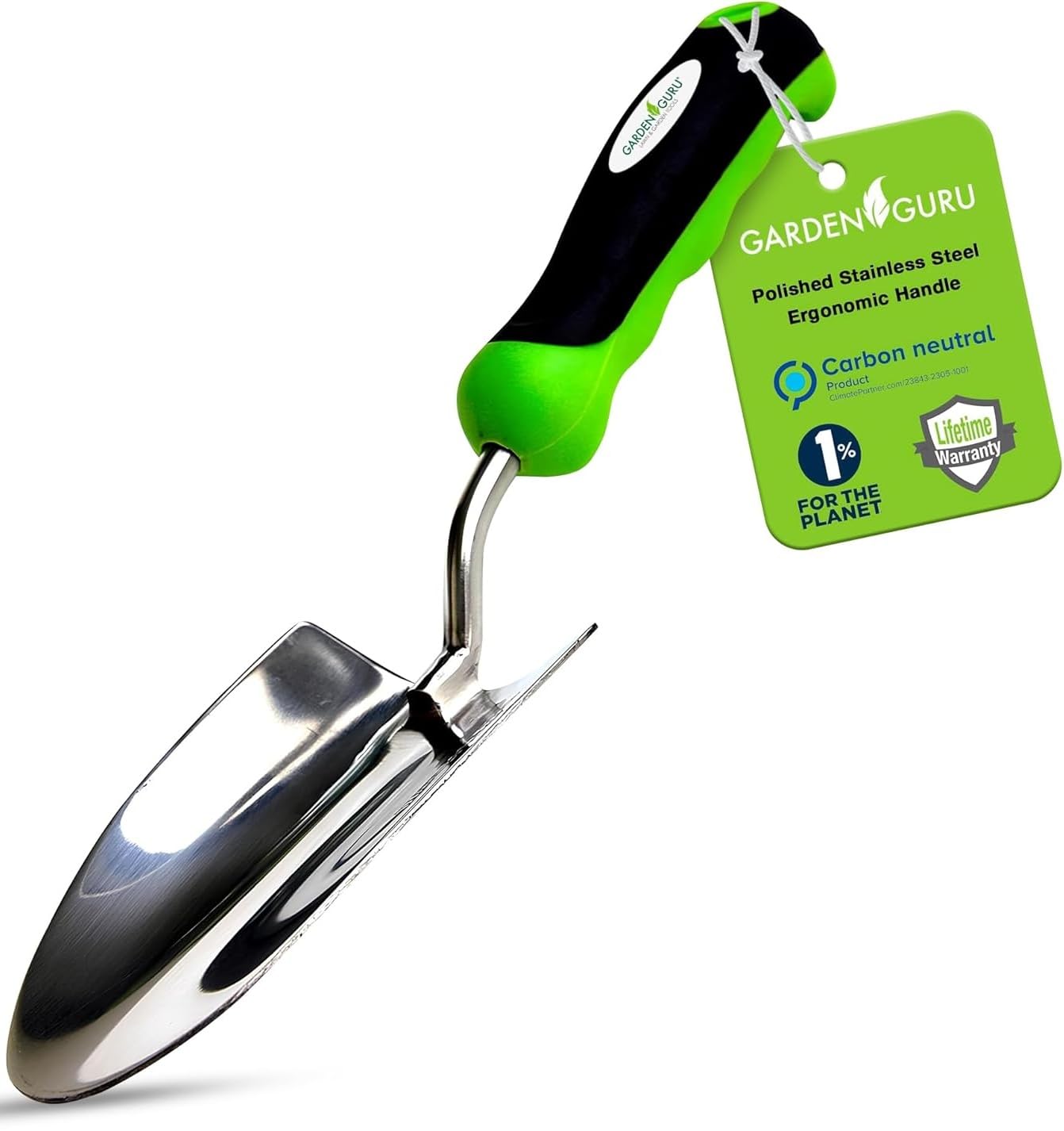
Nine ounces is heavy for a hand trowel, and the Garden Guru spends that weight on a wide, thick, concave stainless blade — the opposite approach to the narrow tools in this guide.

That bowl is the whole point. Scooping a bag of compost into a raised bed, backfilling around a new shrub, or mixing soil and fertilizer on a board: a wide concave blade moves material in a way a flat trowel simply can't, and it saves real time on a planting day. We fill pots with it rather than reaching for a scoop.

The handle is the other well-resolved part — large, with a thumb rest on top and finger grooves underneath, and enough bulk that a gloved hand still has something to hold. The stainless blade is polished, so it rinses clean and doesn't rust when it gets left out in the rain, which happened more than once.

Where it earns its place in our kit is the potting bench and the backfill pile: it moves compost faster than anything else here, and the fat handle suits anyone who finds a thin grip hard work. It's midrange money with a lifetime warranty, and if most of your planting starts at a bench with a bag of soil, this is the trowel that saves you the most time.

Bottom line: This is the potting-bench trowel we reach for: a wide stainless bowl that moves compost fast, with a grip that keeps your thumb where it wants to be.

7

LRLXE Stainless Trowel

LRLXE Stainless Trowel

Bulbs and deep weeds

Our Score 9.6/10
Check Price

Worth Noting

  • Heavier than the aluminum picks at 10.56 ounces
Blade
2.5 mm stainless steel
Weight
10.6 oz
Depth Scale
Built-in ruler
Overall Length
13 inches
Read the full review

There's a lot of steel in the LRLXE. The blade is 2.5 mm stainless on a 13-inch tool that weighs 10.56 ounces, and the heft is the first thing you notice when you lift it out of the box.

Two features do the real work. A three-inch serrated section on one edge cuts weed roots and thin stems, and a ruler is marked along the blade, so you can check how deep a bulb hole actually is without putting the trowel down and going for a measure. The grip is rubber over a welded steel tube.

That weld matters more than it sounds. The join between handle and blade is where hand trowels break, and this one is welded metal to metal rather than pushed into a socket, with the rubber bonded over the top. Nothing has worked loose on ours.

For bulbs and deep-rooted weeds, and for anyone who wants the depth to be a number rather than a guess, this one earns its place. We've come to prefer it in autumn, when everything going into the ground has a required depth printed on the packet. It's midrange money, and the ruler is the feature we use most.

Bottom line: We rate it for bulbs and deep-rooted weeds, where the built-in ruler and sharp serrated edge earn their place in the tool bag.

8

Root Slayer 16011 Trowel

Root Slayer 16011 Trowel

Root-choked beds

Our Score 9.4/10
Check Price

Worth Noting

  • Heaviest of these picks at 340 grams
Edge
Ripsaw serrations
Blade
Powder-coated carbon steel
Weight
12 oz
Overall Length
12.75 inches
Read the full review

Some planting holes are really demolition jobs. Put a shrub into ground that's a mat of old grass roots and most trowels bounce; the Root Slayer 16011 goes in because its powder-coated carbon steel blade carries dozens of ripsaw serrations and an inverted V tip that starts a cut where a smooth edge would skate.

The handle is the other half of the design. It's a natural radius grip — a curved shape that keeps your wrist straighter than a straight dowel — and the difference shows when you're pulling the tool back toward you through a root rather than pushing straight down. The blade is carbon steel under a powder coat, and the lifetime warranty covers the tool itself.

For ground that fights back, this is the strongest trowel in the group, and it's what we hand someone reclaiming a neglected bed. It's also the most expensive tool here, and that only makes sense if you have the root problem it solves — in open, worked soil a plain trowel plants a seedling just as well. Buy it for the bed you're taking back, not the one you've already won.

Bottom line: Buy this one for ground that's more root than soil; the ripsaw teeth and V tip get a shrub in where a smooth trowel just bounces.

What We Put These Trowels Through

We started by pulling together every transplanting trowel we could find from garden centers and hardware stores, then narrowed the list by blade width, handle material, and whether the blade was stamped or forged. We ended up with 16 trowels and used them for a full growing season — roughly eight months of seed starting, bed planting, dividing perennials, and fall cleanup. Each one went into the same heavy clay and the same rocky raised beds, so the differences were mostly about the tool, not the soil.

In the field, we used each trowel the way a gardener actually does: punching through crusted soil, levering under a root ball, scooping potting mix, tapping the blade clean against a bucket rim, and checking planting depth against the etched marks. We noted where the blade flexed under pressure, whether the tip stayed sharp enough to break a root, and if wet soil slid off or stuck in the corners. After each session we washed and dried them, then left a few outside overnight on purpose.

The ergonomics showed up over time rather than in the first five minutes. We gardened with and without gloves, planted a full flat of seedlings in one sitting, and paid attention to hot spots, wrist angle, and whether the handle got slick with sweat or mud. Durability got the same treatment: we checked for rust at the weld, wobble where the handle meets the tang, and cracks in wooden handles after repeated wet-dry cycles. Versatility was easy to judge — the trowels we kept reaching for could scoop, weed, divide, and measure without being swapped out, and the best ones stayed straight when levered, felt secure in a wet glove, and had depth marks that were stamped rather than painted.

How to Choose Transplanting Trowels

Blade shape decides the job

The trowels here split into three shapes. A wide, dished blade like the Garden Guru's moves soil by the scoopful, which is what you want when you're backfilling a hole or filling pots. A narrow, flat blade like the WORKPRO's makes a slot you can drop a root ball into without excavating the bed around it. Most of the picks sit in between, with a shallow dish and a pointed tip.

Look at the widest part of the blade against your planting spacing before you buy. A wide trowel is the wrong tool in a crowded border, and a narrow one will have you scooping twice as long when you're moving compost.

Serrations are for ground you're taking back

A smooth edge slides off a root; a toothed one saws through it. If your plants arrive in nursery pots with roots wound into a ring, the Garden Weasel's serrated blade or the Root Slayer's ripsaw teeth will get through roots that stop a plain trowel dead.

The same teeth cut fine roots indiscriminately, which is the last thing you want when you're lifting a seedling you intend to keep intact. We keep one serrated trowel for reclaiming and one plain edge for the trays.

Steel, aluminum, and the joint that fails first

Cast aluminum, like the Fiskars head, is light and rustproof and holds a shallow dish well. Carbon and manganese steel, like the Kemaier's, take a keener edge and drive through clay and roots, at the cost of some weight and a little care.

Whatever the blade, look at how it meets the handle. A welded or continuous one-piece neck lasts; a blade pressed into a socket works loose. That joint, more than the blade, is what ends a trowel's working life.

Weight and grip, for the hundredth hole

The trowels here run from 5.6 ounces to 340 grams, and the difference shows at the end of a session rather than the start. Light tools suit trays, pots and one-handed work; heavier ones push through hard ground with less effort.

Grip shape matters more than padding — a palm rest, a thumb rest or a radius curve all keep the wrist straighter, and that's what you feel the next morning. Match the weight to the soil you actually have, not to the one on the shelf that feels impressive.

Frequently Asked Questions

Final Verdict

Start with the Fiskars Ergo. It's the least expensive trowel here, it holds its shape in ordinary soil, and the grip is comfortable enough that you stop thinking about it — which is what you want from a tool you'll pick up a hundred times in an afternoon.

Change one requirement and the answer changes with it. If every transplant needs to go in at the same depth, take the Edward Tools and its engraved scale. If your beds are baked hard or matted with roots, the Kemaier and the Root Slayer will get you further than any aluminum blade. Buy for the ground you have.