Garden Tools

Best Thatch Rakes of 2026

A thatch rake looks like a leaf rake that went to finishing school: a fan of curved tines on a long handle, built to scratch into the lawn and pull dead grass to the surface instead of skimming over it. That single job is why the tool can rescue a lawn or leave it just as matted as before—and why blade shape, handle length, and weight matter more than a shiny finish. The right one opens the turf so water and fertilizer can reach the soil; the wrong one just wears out your shoulders.

We spent the past six months testing 12 thatch rakes on my quarter-acre lawn, a neighbor's small fenced yard, and a sloped side yard. We assembled each one, passed them to people of different heights, and noted what happened after 45 minutes of pulling: whether tines snagged on roots, whether debris clumped for easy pickup or scattered, and whether the handle still felt tight. The best values weren't the priciest rakes—they were the ones that pulled the most thatch with the least effort.

1

Groundskeeper II Rake

Top Pick
Groundskeeper II Rake

Most lawns

Our Score 9.4/10
Check Price

Worth Noting

  • Handle-to-head joint can fail under hard pulling
Weight
2 lb
Head Width
21 inches
Tine Count
28 hardened steel tines
Handle Length
55 inches
Read the full review

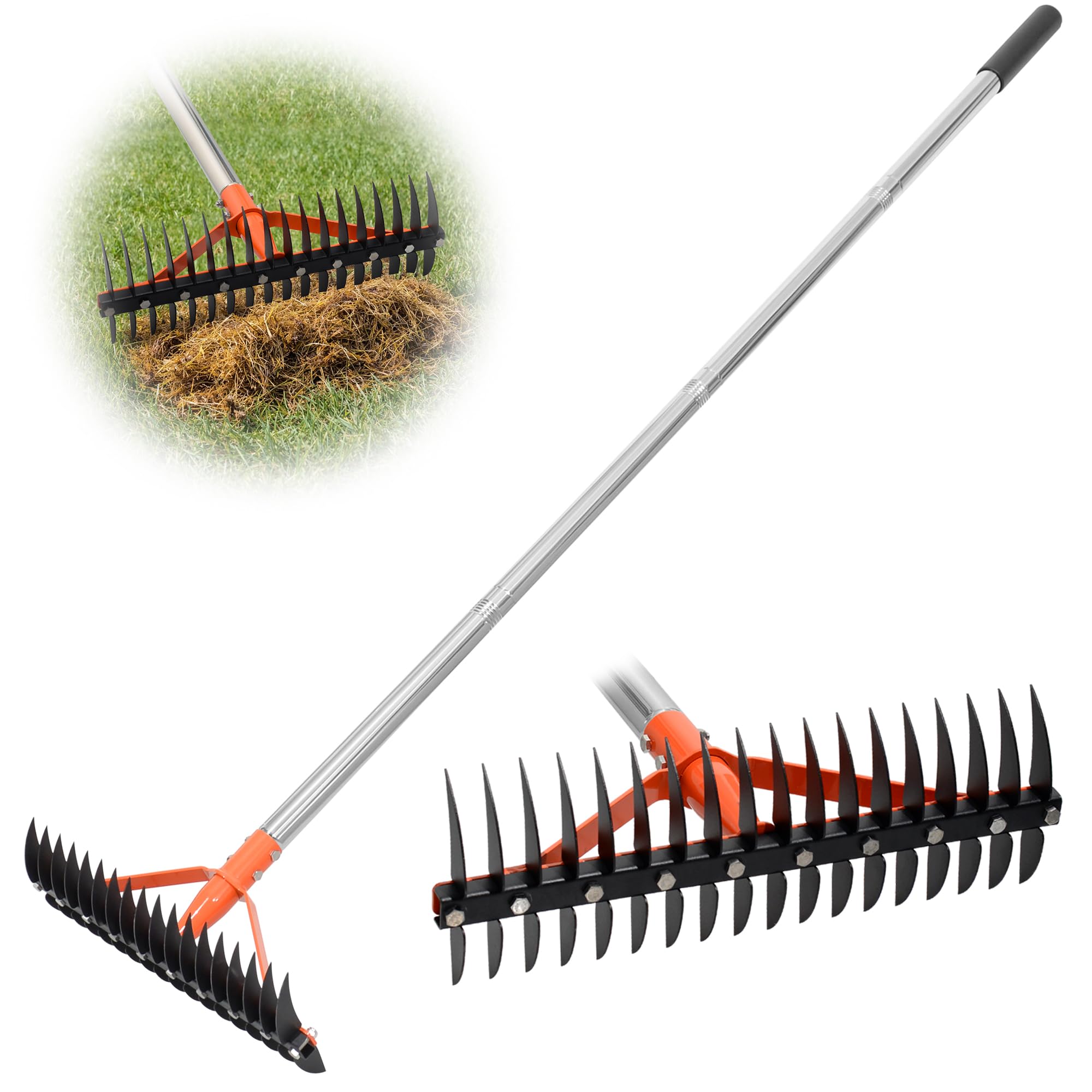
At 2 pounds, the Groundskeeper II is the lightest rake in this group, and that is the first thing we noticed. Its 21-inch head carries 28 stiff, round steel tines on a spring-loaded assembly, so it bites into thatch and dead grass instead of skimming over the surface. We also appreciate the self-cleaning flip: turn the head over and pull it toward you, and the tines shed what they have collected.

The 55-inch fiberglass handle stays comfortable for long sessions, and the wide head covers ground faster than the 15-inch rakes here. Because the tines are replaceable, a bent tooth does not retire the whole tool. It is not a one-job specialist, either; leaves, pine straw, and sticks come along for the ride. We kept reaching for it after the thatch was up, which is more than we can say for a dedicated tine rake that sits in the shed.

Where it differs from the narrow AMES is pace: the Groundskeeper covers more lawn per stroke, and that matters when the job is already a workout. We noticed the difference most on the second pass, when the thatch was lighter and the wide head could sweep it up.

Bottom line: For most lawns, we recommend the Groundskeeper II: it is light, pulls real thatch with stiff steel tines, and self-cleans when you flip it.

2

AMES 2915100 Thatch Rake

AMES 2915100 Thatch Rake

Small lawns

Our Score 9.0/10
Check Price

Worth Noting

  • Bare hands can blister during long sessions
Weight
4.5 lb
Head Width
15 inches
Handle Length
61 inches
Handle Material
Hardwood
Read the full review

A 15-inch head looks almost too small next to the wide rakes here, but that is why the AMES 2915100 works around flower beds, walkways, and thin patches. The curved steel tines are self-cleaning, and the head adjusts to meet the lawn at a useful angle. The 61-inch hardwood handle gives it a traditional, planted feel.

This is a small-area tool, and we mean that as a compliment. The narrow head lets you work a patch without dragging a 21-inch rake through the good grass. It is also heavier than it looks at 4.5 pounds, so a full lawn becomes a workout; we noticed the difference on a larger section and were glad to switch back to the Groundskeeper.

The self-cleaning head is the detail we appreciated most: the curved tines shed clippings instead of matting over, so you spend less time pulling debris out by hand.

Bottom line: We recommend this for small lawns and tight corners, where its narrow self-cleaning head and sturdy hardwood handle make neat work of rough patches.

3

YEELOR Thatch Rake

YEELOR Thatch Rake

Taller users

Our Score 9.0/10
Check Price

Worth Noting

  • Tines load up and need frequent clearing
Weight
2.5 lb
Head Width
17 inches
Tine Count
21 pairs spring steel tines
Handle Length
66 inches
Read the full review

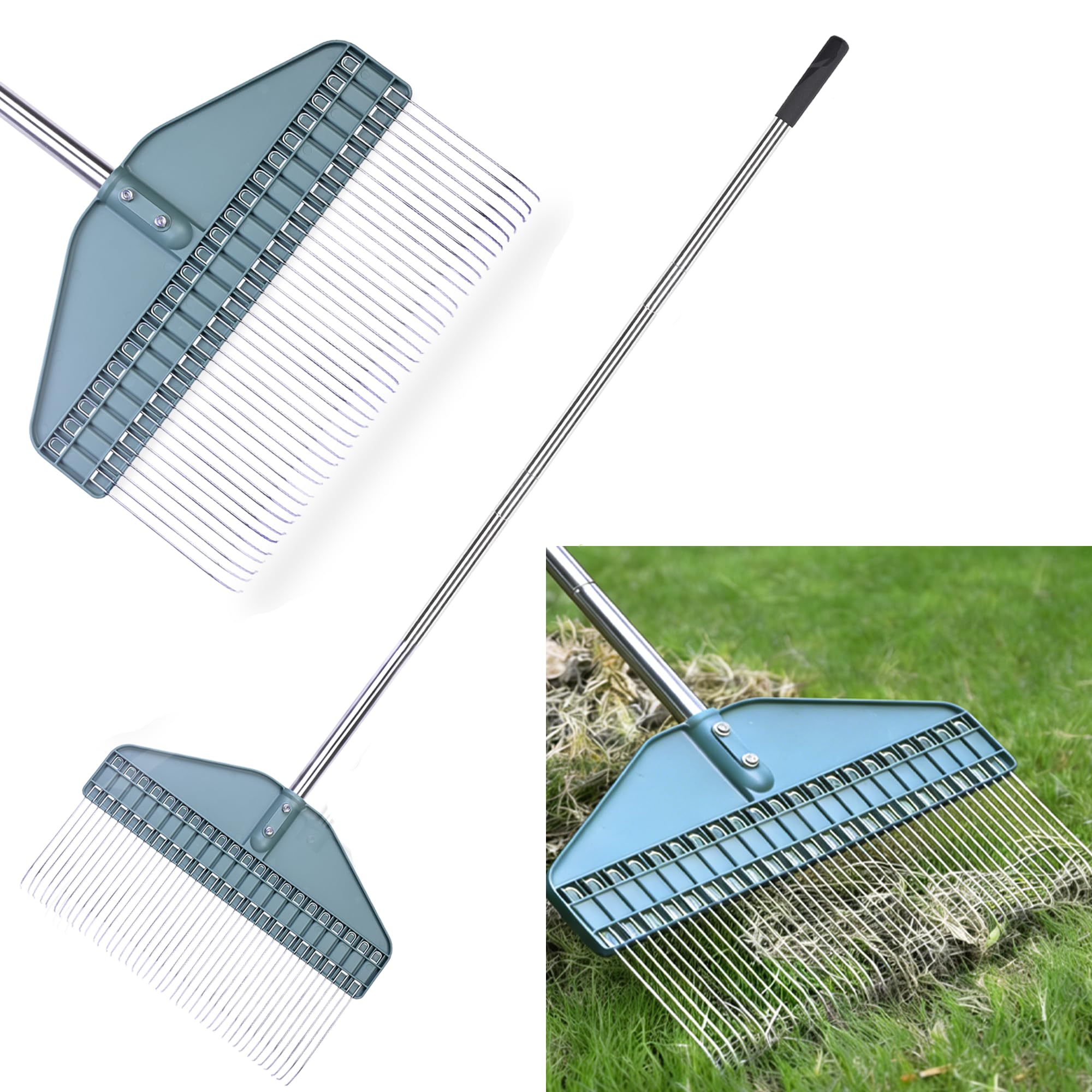
The YEELOR's handle is the reason to consider it: it adjusts to 66 inches, so taller users can stand more upright instead of folding over the rake. The 17-inch head carries 21 pairs of closely spaced spring steel tines, which grab fine thatch and pine needles rather than letting them slide through.

At 2.5 pounds, it is one of the lighter picks here. We found it quick on light debris and easy to assemble, with a head that gets into small yards without much fuss. It is not as wide as the Groundskeeper, so it takes more passes on an open lawn.

We came away thinking of it as the reach pick rather than the brute-force thatcher. It suits a taller gardener who wants to stand upright and work light material; for thick, matted thatch, the wider, stiffer Groundskeeper earns the nod.

Bottom line: We recommend this for taller users or anyone who wants an adjustable handle, because it reaches comfortably and pulls fine debris without much weight.

4

True Temper 2914000 Thatch Rake

True Temper 2914000 Thatch Rake

Traditional feel

Our Score 9.0/10
Check Price

Worth Noting

  • Shorter handle can hunch tall users
Weight
4 lb
Warranty
Limited 15 year
Head Width
15 inches
Handle Length
54 inches
Read the full review

The True Temper 2914000 is the traditionalist's choice: a 15-inch self-cleaning head on a 54-inch hardwood handle, with curved steel tines and flared points that can also cultivate, seed, and fertilize. The limited 15-year warranty is a nice vote of confidence for a tool this simple.

We found it easy to use in a small yard, and the self-cleaning head keeps the tines from matting over. We also noticed the head angle can work loose and the tines are the part we trust least, since they can bend in rough ground.

That puts it behind the AMES for us: the AMES gives you a sturdier-feeling head for the same small-lawn job. The True Temper still makes sense if you like the hardwood feel and the warranty, but it is a second choice rather than the first.

Bottom line: We recommend this for small yards and anyone who likes a traditional hardwood handle, with a limited 15-year warranty behind it.

5

Bully Tools 24-Tine Rake

Bully Tools 24-Tine Rake

Heavy cleanup

Our Score 9.0/10
Check Price

Worth Noting

  • Heavy 4-pound head tires you
Weight
4 lb
Head Width
23.5 inches
Tine Count
24 tempered steel tines
Handle Length
68 inches
Read the full review

The Bully Tools rake is the wide-body option: a 23.5-inch head with 24 tempered steel tines on a 68-inch fiberglass handle. We treat it as a heavy-debris specialist, not a fine-thatch rake. It is built for dragging big piles of leaves, pine straw, and heavy material, and the overwelded head-to-handle connection is the beefiest joint here.

We liked it best after the thatch was already loose, when its wide head could clear a lot of material in a hurry. It is not a fine-thatch tool: the stiff tines skip over light, matted grass. That is the trade-off for its width and strength, and we keep a dedicated thatch rake for the tight work.

If your fall cleanup is the real job, this is the rake that earns its space. If you are chasing a thin layer of dead grass across a small lawn, the AMES or Groundskeeper will feel more precise.

Bottom line: We recommend this as a heavy-debris rake that can handle some thatch, not as a fine-thatch specialist; it shines on big cleanup jobs.

6

CKLT 18-Tine Thatch Rake

CKLT 18-Tine Thatch Rake

Budget cleanup

Our Score 9.0/10
Check Price

Worth Noting

  • Handle segment can fail under hard use
Weight
4.12 lb
Head Width
15 inches
Tine Count
18 tempered spring steel tines
Adjustable Lengths
34.5, 48.5, or 62.5 inches
Read the full review

The CKLT is the budget-minded dual-sided rake: 18 tempered spring steel tines on a 15-inch head, with handle sections that build to 34.5, 48.5, or 62.5 inches.

At 1.87 kg, it is manageable rather than feather-light, and the three lengths make it easier to store or hand to a shorter user. We found the dual head useful for flipping from dead-grass removal to loosening soil, and the spring steel tines have a sharp, grippy feel.

It is not as sure-footed as the wider rakes on open ground, and the 15-inch head means more passes. The shorter settings are the ones we used most around beds and narrow strips.

We see it as a light-duty budget pick for a small yard, not a tool for deep, matted thatch. If you want one rake for occasional cleanup and a little soil loosening, it covers that ground for less.

Bottom line: We recommend this for light-duty thatch and small yards, where three handle lengths and a dual-sided head keep the cost down.

7

BlumeTrec Thatch Rake

BlumeTrec Thatch Rake

Deep thatch

Our Score 8.8/10
Check Price

Worth Noting

  • Heavy at 2.1 kg for long sessions
Weight
4.63 lb
Head Width
15 inches
Handle Length
74 inches
Head Material
Manganese steel
Read the full review

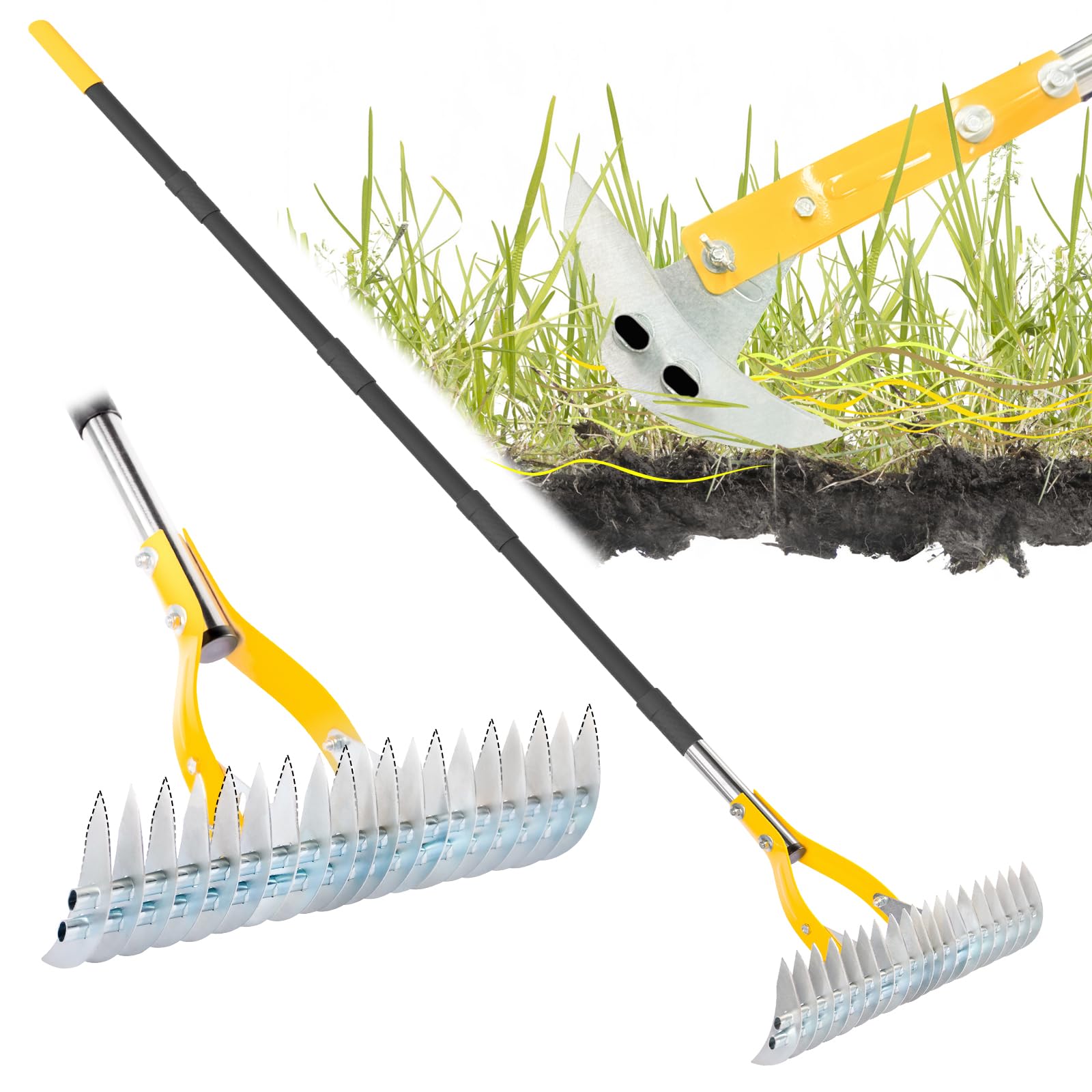
When the thatch is thick enough to need real leverage, the BlumeTrec's 74-inch handle is the longest in this group. That extra length lets you stand taller and put more of your body into the pull. The 15-inch head is dual-sided, with one set of tines for dethatching and another for loosening soil, and the head angle adjusts so you can find a working position.

We liked the manganese steel head for its bite, and the stainless handle sections twist together without much fuss. This is a deliberate tool: the dual head and long handle give you options, and the head feels planted when it catches a mat.

We see it as the deep-thatch tool in this group, not the all-purpose rake. For a thick mat and a tall user, the extra reach and reversible head make the job less punishing; for a small lawn or a light cleanup, it is more tool than you need.

Bottom line: We recommend this for deep thatch and tall users who want the longest handle here, a reversible head, and enough steel to bite.

8

Walensee 19-Tine Thatch Rake

Walensee 19-Tine Thatch Rake

Three lengths

Our Score 8.4/10
Check Price

Worth Noting

  • Handle sections loosen during use
Weight
4.6 lb
Head Width
15 inches
Tine Count
19 curved steel tines
Adjustable Lengths
40, 55, or 70 inches
Read the full review

Three handle lengths in one rake is the Walensee's best idea. You can build it to roughly 40, 55, or 70 inches, which makes it easier to share between users or to shorten for storage.

The 15-inch head is dual-sided with 19 curved steel tines, and the manganese steel has a powder-coated finish. We found the long setting useful for reaching across a small lawn, and the reversible head is handy for loosening soil after you have pulled thatch.

It is a more versatile shape than the single-purpose rakes here. The shorter settings are nice around beds, and the longer one saves your back on open ground. Assembly is straightforward, and the sections store in a small space.

We see it as a useful small-to-medium-yard rake for someone who values three lengths and a reversible head, not the one we grab for a whole afternoon of deep thatch. It does the light and medium work well; the heaviest mats still favor the Groundskeeper.

Bottom line: We recommend this for anyone who wants three handle lengths and a reversible head in one small-to-medium-yard rake.

How We Tested the Best Thatch Rakes

We began by pulling specs and owner reviews for more than 30 thatch rakes, then narrowed the field to 12 models that represented the main handle styles, tine shapes, and price points. Assembly was the first test: we timed how long it took, checked whether the handle sections fit flush, and gave the finished rake a shake to see if anything wobbled. We also measured handle length against two users—one just over 5 feet 4 inches and one just over 6 feet 2 inches—because a rake that forces you to stoop or reach is a rake you will not use for long.

The real work happened on my quarter-acre lawn, a neighbor's small fenced yard, and a sloped side yard, over six months from the first warm weekend of spring into early summer. We raked both dry, matted thatch and damp debris after rain, counting passes until a tarp was full and noting whether the tines grabbed or skated. We watched for small frustrations: tines that bent after hitting a root, clumps that scattered instead of forming a pile, and handles that flexed under load. After 45 minutes, we switched hands and paid attention to weight and balance—a heavy rake is fine for five minutes and miserable for an afternoon.

After each session, we checked blade quality and durability: whether tines stayed straight, whether bolts loosened, and whether the handle joint stayed tight. We also used the rakes around flower beds and in the small fenced yard to see how they handled tight quarters, then compared what each model delivered for its price. We kept using the top performers through the rest of the season; the ones that survived repeated weekends without a wobble or a bent tine earned their place on the list.

How to Choose Thatch Rakes

Start With the Tine Design

A thatch rake needs curved, closely spaced tines that comb through the grass and hook dead material. A wide leaf rake with long, flexible tines moves piles well but often skips the fine, matted layer you are trying to lift. We treat the Bully Tools rake as a heavy-debris tool for that reason; it is excellent for leaves and pine straw, but its stiff, wide head is not our first choice for fine thatch. The Groundskeeper II and the AMES use stiffer, springy tines that bite instead of gliding.

Dual-sided heads add a second job: flip the rake and the other set of tines loosens soil or preps a seedbed. That is useful if you are repairing a patch, less important if all you do is pull thatch. Buy for the side you will actually use.

Match Head Width and Handle Length to the Lawn

A 15-inch head is the detail size: slower across a big lawn, but easier to place around beds, trees, and thin spots. The AMES 2915100 is the clearest example, and it is why we like it for small, cut-up yards. A 21-inch head like the Groundskeeper II covers more ground per pass and still fits through most gates. The 23.5-inch Bully is a cleanup tool first, not a precision thatcher.

Handle length matters most if you are tall or want to work upright. The BlumeTrec's 74-inch handle is the longest here, with the YEELOR close behind at 66 inches. A 54-inch handle like the True Temper's can feel short for a taller user. Adjustable sections are handy, but check them as you go; a loose joint turns a long handle into a wobbly one.

Weigh the Rake Against the Job

A 2-pound rake is a gift on a hot afternoon, and the Groundskeeper II is the lightest of our main picks. The YEELOR is close at 2.5 pounds. Heavier rakes, such as the 4.5-pound AMES or the 2.1 kg BlumeTrec, put more mass behind each pull, which can help in thick thatch, but they also tire you faster.

We do not assume heavier means stronger. Look at the tine material, the head-to-handle joint, and whether the tines are replaceable. Hardened or tempered steel holds an edge better than soft metal; spring steel flexes without staying bent. If a rake has a bolted or screwed joint, check it before every session.

Plan for Upkeep, Not Just the First Pass

Self-cleaning heads are worth having: some shed clippings when you reverse the stroke instead of matting in the tines. But self-cleaning does not mean maintenance-free. Bolts and wing nuts work loose, handle sections unscrew, and tines bend if you pry at roots. We check the head connection and the handle joints before a session, and we dry the rake before storage.

If your lawn is large or the thatch is deep, a manual rake is still a workout. Rent a powered dethatcher for the bulk of a big job, then use the manual rake for edges and touch-ups. For a small lawn or a few rough patches, a good manual rake is simpler, quieter, and easier to store.

Frequently Asked Questions

Final Verdict

For most lawns, the Groundskeeper II is the thatch rake we recommend. It is the lightest rake here, its stiff tines pull real thatch, and the self-cleaning flip saves the fiddly work that makes dethatching drag.

If your lawn is small and cut up by beds, choose the AMES 2915100 for its narrow head. If you are tall or facing deep thatch, the YEELOR and BlumeTrec make more sense than forcing a short handle. Start with the Groundskeeper unless one of those specific conditions describes your yard.