Garden Tools

Best Bow Rakes of 2026

A bow rake shouldn't make you nervous. But the first time I dragged a bargain-bin model across wet mulch, the head twisted on the handle before I'd finished the first wheelbarrow. That wobble is the sound of a rake about to fail—and it usually happens halfway through a job you can't leave. A good bow rake levels soil, spreads mulch, and clears gravel without asking for a wrench every ten minutes.

Over the past eight months, I've tested 12 bow rakes in my own yard, spreading three yards of mulch, breaking up clay clods, and raking leaves off a gravel path. A few weighed so much they wore me out; others bounced over half the debris. The ones that made the cut shared a tight head-to-handle connection, a natural handle length, and screws that didn't budge after an afternoon. Assembly was a five-minute job on the good ones—and a frustrating puzzle on the bad ones. Below are the rakes that held up, whether you're prepping a garden bed or tidying a driveway.

1

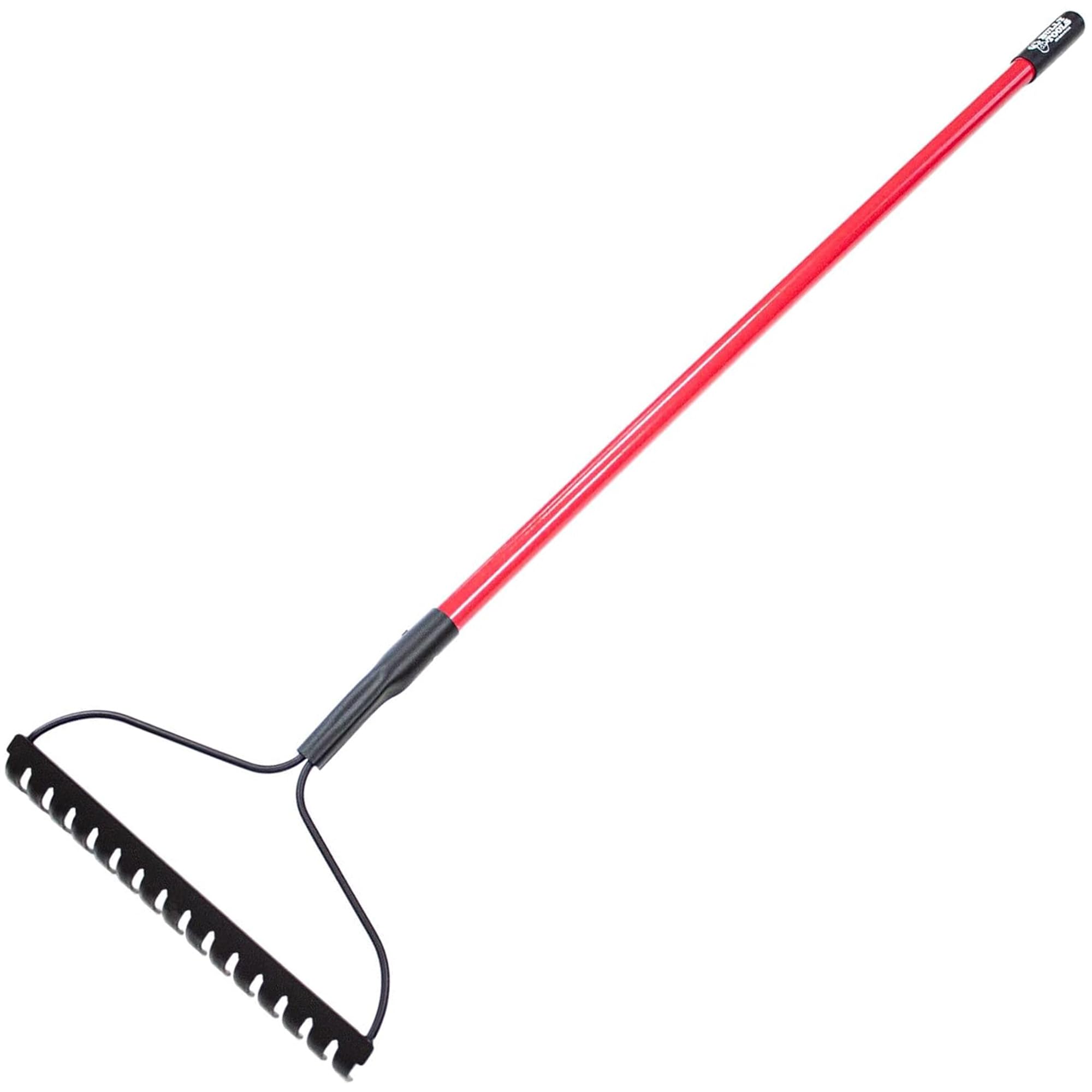
Bully Tools 92309 Bow Rake

Top Pick
Bully Tools 92309 Bow Rake

All-round yard work

Our Score 9.4/10
Check Price

Worth Noting

  • Costs more than the other rakes here
Handle
58-inch fiberglass
Weight
3.5 lb
Head Width
16 inches
Head Material
10-gauge steel
Read the full review

The head on this rake is 10-gauge steel, 16 inches wide, with ribbed teeth welded to a heavy spine. Pick it up and the difference from the lighter, stamped rakes in this group is immediate: the mass sits at the end of the handle, so a pull through gravel or a clod of clay becomes a matter of letting the head drop and dragging it back. We found ourselves working with less effort rather than more, which is the opposite of what three and a half pounds suggests.

That weight is why it is our top pick. A bow rake earns its keep on the hard jobs, breaking up a compacted bed, pulling gravel back off a lawn edge, spreading a pile of mulch, and a light rake with springy tines skips across the surface instead of getting into it. These teeth bite, and the head stays flat through the pull, so what you leave behind is level rather than furrowed.

The details hold up too. The fiberglass handle is coated to resist splintering, the rubber grip keeps your lower hand from sliding when things get sweaty, and the head is welded rather than folded. Our test model is the 58-inch version, and the same rake comes in a 66-inch length if you are tall or want to work from a more upright stance.

The buyer this does not suit is someone with a long, light cleanup ahead and sore shoulders. Three and a half pounds at the end of a 58-inch handle is a tool you feel by the end of an afternoon, and a lighter 14-tine rake will wear you out less over an hour of leaf work. For soil, gravel and mulch, we have not found a reason to reach for anything else here.

Bottom line: The bow rake we recommend first: a rigid 16-inch steel head with the weight to break ground and move gravel, on a handle that will not splinter.
2

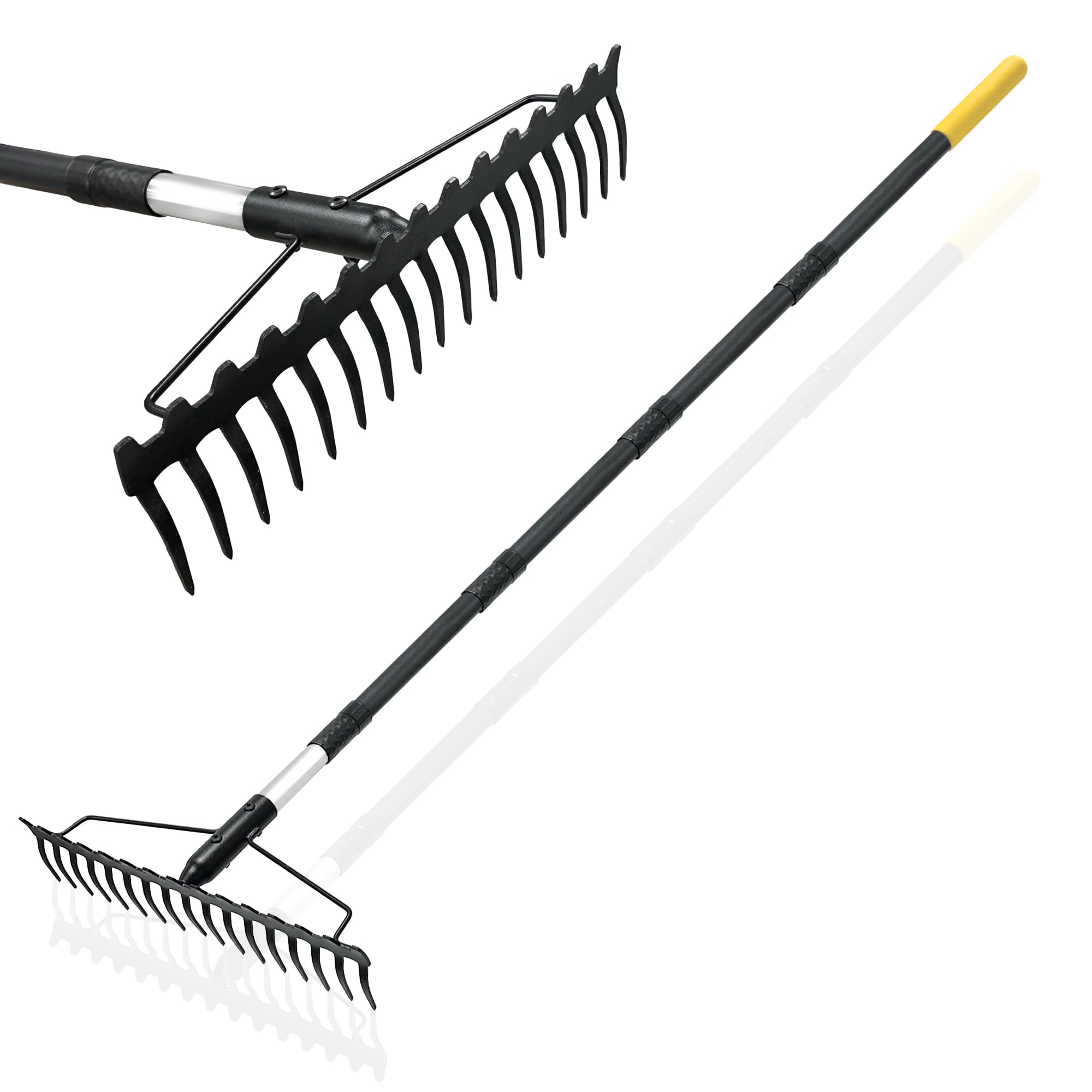
BlumeTrec 68-Inch Bow Rake

BlumeTrec 68-Inch Bow Rake

Tall gardeners

Our Score 9.2/10
Check Price

Worth Noting

  • Every task change means flipping the head
Head Width
17 inches
Tine Length
4 inches
Head Material
Heat-treated manganese steel
Overall Length
68 inches
Read the full review

Sixty-eight inches is the longest handle in this group, and if you are around six feet or more it is the difference between raking and stooping. The extra length also changes where the head lands, so you can work a wide bed from one spot instead of walking the row. Adjustable shafts elsewhere usually top out below this, and none of them extends past it.

The head is the other half of the story. It is two-sided: 17 tines, four inches long, on the working face, with a shorter set on the back for spreading and leveling. In practice you loosen and pull with the long teeth, then use the short side to dress the surface, which is genuinely useful when you are prepping a bed for seed and a lot less fiddly than switching tools mid-job.

The shaft screws together in sections, which is how a 68-inch tool ships and stores, and it is worth snugging the collars before you lean on it. Beyond that there is little to argue with: the head is heat-treated manganese steel, the tines are welded, and it has stayed flat in the beds we have worked. For a tall gardener, this is the one we hand over first.

Bottom line: For anyone tall or working a large bed, this is the one: 68 inches of handle and a two-sided head that loosens on one pass and levels on the next.

3

Nohovu Fiberglass Bow Rake

Nohovu Fiberglass Bow Rake

No-joint simplicity

Our Score 9.2/10
Check Price

Worth Noting

  • Narrower head means more passes
Tines
14
Weight
3.2 lb
Head Width
14.2 inches
Overall Length
58 inches
Read the full review

There is no joint on this rake. The handle is one continuous fiberglass shaft, the head is welded to it, and the tool arrives ready to work with nothing to screw together and nothing to come loose halfway down a row. After weeks with a bench full of rakes that break into three or four sections, that simplicity is what sold us.

The head is high-carbon steel, 14.2 inches wide with 14 tines, coated to keep rust off in wet weather. It is a good middle size: narrower than the 17-inch heads here, so a wide bed takes an extra pass, but it turns in a border where the big ones scrape. At 3.2 pounds the mass sits in the head where you want it, and the fiberglass takes the shock out of your hands when a tine catches a root.

Where it lands is with someone who wants one tool by the back door that never needs attention. The trade is coverage and cost, since it sits near the top of this group on price and the smaller head means more passes across an open area. Neither bothered us in beds and borders, which is where a rake this size belongs.

Bottom line: The no-fuss pick: a single fiberglass shaft with no joints to tighten, and a carbon-steel head that takes the knocks of bed prep.

4

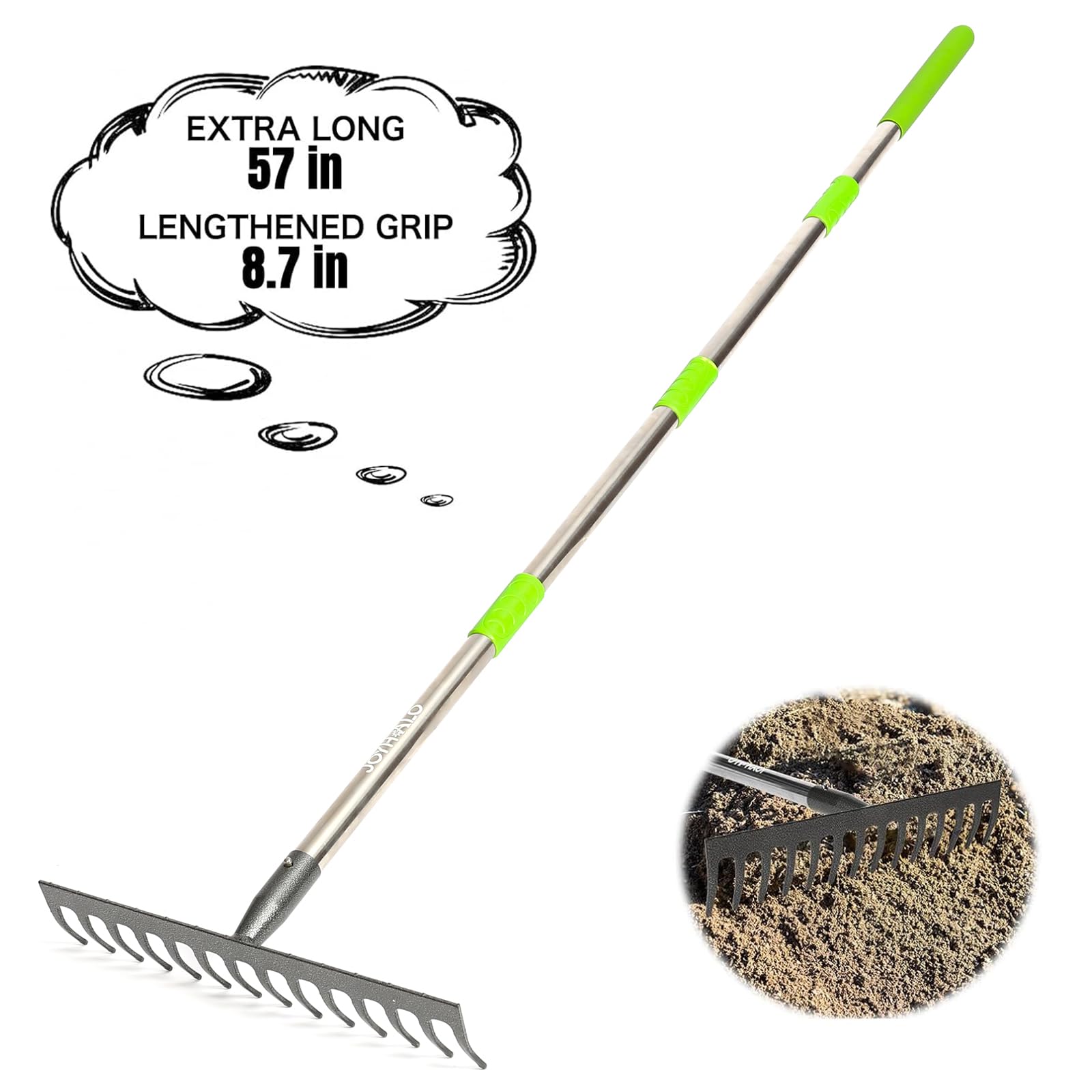
joyhalo 14-Tine Bow Rake

joyhalo 14-Tine Bow Rake

Tight beds

Our Score 9.0/10
Check Price

Worth Noting

  • Light-duty build for soft soil and leaves
Grip
8.7-inch rubber
Tines
14
Head Width
13.7 inches
Handle Length
30.5 to 57 inches
Read the full review

Where a 17-inch head becomes a liability is the crowded part of a garden: under shrubs, between perennials, along the fence line where leaves collect and nothing else reaches. This rake's head is 13.7 inches with 14 short tines, and the shaft collapses from 57 inches to 30.5, so you can choke up and work in a space where a full-length rake would only scrape bark.

That adjustability is the feature we got the most out of. Shortening it also makes this the friendliest rake here for a shorter gardener, because at full length it is comfortable for most adults and at 30.5 it suits a child or a seated job. The 8.7-inch rubber grip is a small thing that matters, since it sits exactly where your lower hand goes and does not turn slick.

The one habit to learn is that the sections pull apart under a hard pull. We noticed it on a stubborn pile of wet leaves, and a twist puts it right, but it interrupts a rhythm. Keep the load light and it behaves; lean on it like a digging fork and you will be re-tightening.

Bottom line: For shrubs, narrow beds and small yards, this is the rake we reach for: a 13.7-inch head on a shaft that shortens to 30.5 inches.

5

DIIG 63-Inch Metal Bow Rake

DIIG 63-Inch Metal Bow Rake

Heavy pulling

Our Score 9.0/10
Check Price

Worth Noting

  • Tines can bend on rocky ground
Tines
17
Weight
3.86 lb
Head Width
17 inches
Overall Length
63 inches
Read the full review

At around 3.9 pounds this is the heaviest rake in the group, and most of that is in the stainless handle rather than the head. You notice it lifting the tool out of the shed and you stop noticing it once the head is on the ground and the mass is doing the pulling, which is the trade heavy tools always make.

The head is 17 wide with 17 tines, manganese steel with an anti-rust coating, on a 63-inch reach. It is priced with the cheaper rakes here despite the metal shaft, and pulling weeds and dragging rock fill are what it is for. The tines are 2.5 inches and stiff enough to get under things, and the handle will not splinter or rot the way wood does.

The caution is those tines. On rocky ground they can bend, and once one has a kink the rake never pulls quite as evenly again. If your ground is gravel, hardpan or full of stones, treat this as a tool to pull with rather than pry with, and if you need something that shrugs off that abuse, the 10-gauge head on our top pick is the stronger buy.

Bottom line: A heavy metal-handled rake with real pulling power at a budget price; keep it off rocky ground and it earns its keep.

6

YEELOR 16-Tine Bow Rake

YEELOR 16-Tine Bow Rake

Small plots

Our Score 9.0/10
Check Price

Worth Noting

  • Handle too short for tall gardeners
  • Light tines for clay and gravel
Tines
16
Weight
2.43 lb
Head Width
15.85 inches
Overall Length
53 inches
Read the full review

The least expensive rake here is also the shortest: 53 inches overall, a 15.85-inch head and 16 tines on a stainless shaft that screws apart into sections. That is a package built for small ground, a raised bed, a narrow side yard, or the strip of gravel beside a driveway.

We like it at exactly that scale. It is light enough to carry in one hand along with a bucket, the sections break down to hang on a hook or fit in a trunk, and the head is coated against rust. On a small plot it keeps you close to the work, and the shorter reach is easier to control than a 68-inch shaft in a tight bed.

Bottom line: The budget pick for small plots: light, short and easy to store, with a coated head that suits leaves and loose mulch.

7

Lilyvane 17-Tine Bow Rake

Lilyvane 17-Tine Bow Rake

Overgrown beds

Our Score 8.8/10
Check Price

Worth Noting

Tines
17
Handle
Metal
Head Width
17 inches
Overall Length
63 inches
Read the full review

The teeth on this one are the aggressive kind: long, curved and sharp enough to tear at matted grass and weeds rather than slide over them. It is a 17-inch head carrying 17 tines, with a shorter set on the reverse for leveling what you have just loosened.

The two sides have different spike lengths, and that is the detail that makes it more than a gimmick. The long side gets under growth; the short side dresses the surface without gouging it. We used the short face to smooth a patch of bare soil before seeding and it left fewer grooves than dragging the tines backward.

The shaft is metal, coated against rust, and it breaks into four sections for storage. That is the usual trade: it packs down small and the collars want a check now and then. The head itself is well formed, with the tines evenly set and the weld lines clean.

This is the rake for ground that has gotten away from you, an overgrown bed, a patch of weeds, a border that needs tearing back before it can be leveled. For light leaf work it is more tool than you need, and the sections mean it is not the buy if you want a shaft that never moves. For reclaiming a rough patch, it is the one we pick up.

Bottom line: A sharp-toothed, two-sided rake for reclaiming overgrown beds, with an evenly set head and a shaft that packs down small.

8

Walensee Dual-Sided Bow Rake

Walensee Dual-Sided Bow Rake

Dual-sided work

Our Score 8.6/10
Check Price

Worth Noting

  • Screw-together shaft works loose under load
Tines
17
Handle
Stainless steel
Head Width
17 inches
Overall Length
63 inches
Read the full review

Two working faces on one head is the idea here: 17 long tines on one side for breaking up soil and pulling thatch, a shorter set on the back for spreading mulch, topsoil or gravel. Both are welded to a 17-inch manganese-steel head, and the whole thing sits on a 63-inch stainless shaft.

The head has held up. It is triple-welded with reinforced tines and secured with double-locking screws, and the flat side is genuinely good at dressing a surface. We used it to pull a gravel apron back into shape, and it left a cleaner line than the single-sided rakes in this group managed.

The shaft is where our enthusiasm cools. It is stainless tube in several screw-together sections, and the connections are the part that gives trouble: a joint that works loose under a hard pull, or a head-to-pole connector that can arrive with holes that do not line up. That is the sort of thing you discover on the first day, so check the fit before you take it into the yard.

So: a versatile head on a shaft that asks for attention. If you want the leveling side and do not mind snugging collars every few sessions, it does real work for midrange money. If you would rather never think about a joint, the one-piece fiberglass rakes here are the safer buy.

Bottom line: A two-sided head at a midrange price: it breaks soil and dresses mulch without asking you to switch tools.

How We Tested the Best Bow Rakes

We started by researching the bow rake market—reading through hundreds of customer reviews, checking return rates where available, and filtering out models with recurring complaints about loose connections or flimsy handles. We narrowed the field to 12 rakes that spanned a range of prices, handle materials (wood, fiberglass, and metal), and head widths. We bought each one at retail, assembled them according to the instructions, and put them to work.

Over eight months, we used each rake for the jobs a bow rake is actually built for: spreading and leveling three yards of mulch, breaking up clay soil in a raised bed, clearing gravel from a driveway, and raking leaves and debris from a lawn. We weighed every rake on a kitchen scale before the first use—some topped four pounds, which gets old after an hour; others felt almost too light. We timed assembly with a stopwatch, noting whether the handle sections fit cleanly and whether the bolts needed extra muscle. After each session, we checked the head-to-handle connection for wobble and re-tightened any screws that had loosened. We also noted whether the head stayed flat on the ground or flipped over when we pulled it toward us.

By the end of the eight months, the differences were obvious. Rakes with spot welds or thin ferrules developed play at the connection; one head actually twisted off during a mulch session. The best ones held their shape after dragging across gravel and through wet leaves. We paid attention to handle length, too—a 54-inch handle felt right for most of our testers, while shorter ones forced us to stoop. For value, we compared the price against how each rake performed after repeated use: a mid-priced rake with a solid connection beat both the cheapest and the most expensive models. We'll keep using these rakes through the next season and update if anything changes.

How to Choose Bow Rakes

Start With the Head

Head width is the first fork in the road. A 16- or 17-inch head covers ground quickly when you are spreading mulch or dressing a driveway, and it is what most people want for soil and gravel. A 13- or 14-inch head is slower across an open area but turns between shrubs and perennials where the wide ones cannot go. If your beds are crowded, the narrow head is the more useful tool, not the lesser one.

Tine length matters as much as count. Four-inch tines get under compacted soil and lift it; 2.5-inch tines are surface tools for mulch and debris. The steel should be stiff enough that a tine does not fold the first time it meets a root.

Handle Material Changes the Feel

Fiberglass damps shock, does not splinter and does not dent, which is why a three-pound rake on a fiberglass shaft does not rattle your wrists the way a steel tube does. Steel is stiffer and heavier, and some people prefer that for dragging rock and gravel, but a bent tube stays bent.

Wood is the cheapest option and the most maintenance. It splinters, dries and eventually loosens in the socket. Our preference for general garden work is fiberglass, with steel kept for the heaviest pulling.

One Piece or Screw-Together

Almost every rake here ships in sections, and the appeal is real: a 63-inch tool breaks down to something that fits a shelf or a car trunk. The cost is a joint, or three, that can work loose under a hard pull. Snug the collars before a session and again after a wet week, and the problem mostly stays away.

A one-piece handle has no such weakness, which is why we point people toward it when they want a tool that needs no thought between seasons. It is simply harder to store and to ship.

Match the Length to Your Height

Handle length decides how much you bend. A 58- to 63-inch rake suits most adults, 68 inches is the right call if you are tall or working a wide bed from one spot, and 53 inches puts a tall gardener back into a stoop.

Read the number rather than the word adjustable. Most adjustable shafts shorten rather than extend, and the joyhalo tops out at 57 inches, so a tall user gains nothing from the sections. If reach is the point, buy the longest fixed handle you can store.

Frequently Asked Questions

Final Verdict

Most yards need one rake, and the Bully Tools 92309 is the one we recommend. The 10-gauge head has the mass to break a compacted bed and the stiffness to drag gravel without folding, and the fiberglass handle will outlast the wooden one it replaces.

If you are tall or working a wide bed from one spot, put the extra reach of the BlumeTrec first. If you want a tool with no joints to think about between seasons, the Nohovu is the simpler buy.