Soil & Fertilizer

Best Soil NPK Test Kits of 2026

A soil test kit works on a simple premise: you take a scoop of dirt, shake it with a powder or capsule, and the liquid changes color to tell you what's in it. That color card is where kits live or die — I've squinted at a well of pale green trying to decide whether it read "low" or "just enough." What a decent kit actually buys you is a decision: whether to fertilize the tomatoes, whether the lawn needs lime, whether that raised bed has been quietly starving all season.

We've spent the past five months running 14 kits through the same soil samples — raised beds, patio containers, a patch of thinning lawn — and checking every reading against a professional lab test. The gap between kits is mostly in the instructions and the color card, not the chemistry: a kit that makes you guess at a shade hands you a wrong answer with full confidence. The ones below are the ones whose numbers I'd stake a tomato crop on.

1

MySoil Soil Test Kit

Top Pick
MySoil Soil Test Kit

Complete nutrient report

Our Score 9.2/10
Check Price

Worth Noting

  • Premium price for four tests
Analysis
Mail-in laboratory
Tests Per Kit
4
Recommendations
Organic and conventional rates
Nutrients Reported
13, including nitrogen and pH
Read the full review

What comes back after you mail a sample is a full nutrient panel — 13 plant-available nutrients including nitrogen, plus pH — and then the part that actually changes your spring: what to apply, how much, and when. The recommendations come in organic and conventional versions, which matters when the vegetable bed is staying organic and the lawn is not.

A lab analysis answers the question that separates this from every capsule kit on this page: does the reading depend on your eyes and the light in the garage? That is why it takes the top spot even at a premium price. You are buying one number per bed that you can plan a season around, not a shade you have to argue with at the kitchen table.

Four tests is the trade-off, and it's a real one. On eight beds you have to choose which four get sampled, and the cost per test lands closer to a consultation than to a drugstore kit. We think spending it once is the right call: baseline the beds you amend most, then retest next season and see whether what the report told you to spread actually moved the numbers.

Sketch out your zones before you order, because four tests disappear fast on a big yard. Log the sample online before the bag goes in the mail, too — results come through the website, and that registration step is where a test gets wasted.

Bottom line: This is the kit we recommend to anyone who'll act on a full nutrient panel: four lab tests, thirteen nutrients, and rates to apply instead of guesses.
2

LaMotte Turf & Garden Kit

LaMotte Turf & Garden Kit

Hands-on learning

Our Score 9.0/10
Check Price

Worth Noting

  • Premium price with no lab report
  • Potassium reading takes practice
Format
At-home reagent tests
Weight
2.9 lb
Included
Garden Guide and Soil Handbook
Nutrients Tested
Nitrogen, phosphorus, potassium, pH
Read the full review

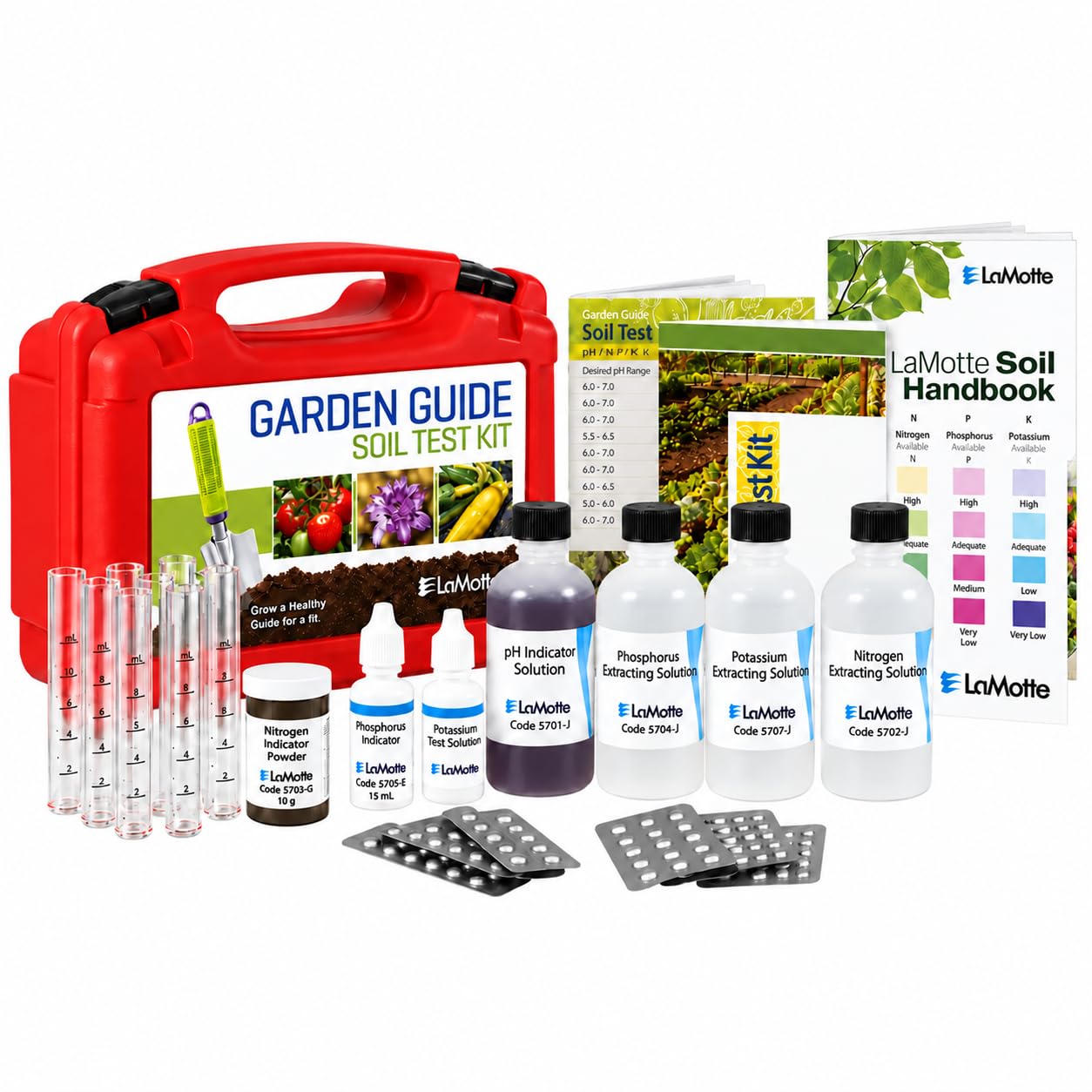
Two books come in the box — a garden guide and the LaMotte soil handbook — and they are most of the reason this kit costs what it does. If you want to know why potassium reads low and what that means for next year's tomatoes, the handbook answers it in a way a color chart never will.

The tests are reagent procedures with diagrammed steps, closer to a lab exercise than to dropping a capsule into a tube, and the kit covers nitrogen, phosphorus, potassium and pH. We like that for a specific gardener: someone who takes a clean sample, runs the procedure properly and keeps notes season to season. Nothing here gets mailed, so a test happens whenever you want one.

Two things to accept. It's the second-priciest kit in this group, and it spends that money without returning a report — you do the reading and the interpretation. Potassium is the trickiest of the four to call, which is exactly where the handbook earns its keep.

At 2.9 pounds it takes up shelf space, so it belongs on a bench or in a potting shed rather than in a tote bag — and for the gardener who tests the same bed every month, that shelf presence is the point.

Bottom line: For the gardener who wants to understand the chemistry and retest the same bed all season, we pick this over every capsule kit here.

3

Whitetail Institute Lab Kit

Whitetail Institute Lab Kit

Cheap mail-in test

Our Score 8.8/10
Check Price

Worth Noting

  • Report geared to food plots and forage
  • Postage is extra and a mailed kit can't be returned
Analysis
Mail-in laboratory
Turnaround
Within one week
Consultation
Included
Tests Per Kit
1
Read the full review

Ignore the deer on the box. Underneath the food-plot packaging this is a mail-in laboratory test, and it is the least expensive way in this guide to get a real lab reading on a lawn, a plot or a big vegetable bed. The report is built around forages; the analysis underneath is still your soil.

We like it for the person who wants a lab number without lab-kit money: bag the sample, fill in the form, mail it, and results come back by mail or email within a week, with a consultation included if you want to talk through what to spread. The lime and fertilizer guidance is the practical part, and it's written plainly enough to act on.

Two things to plan for. Postage is yours to pay, unlike the prepaid mailers on some kits, and once the sample is in the mail the kit can't be returned — so keep a note of what you sent and when, and follow up if a report doesn't appear. The other is scope: a forage-tuned report reads differently from one tuned to a tomato bed, and you may do some translating yourself.

For a hunting plot or a big lawn where the question is simply what to spread and how much, that trade is a good one, and the included consultation is the part to use when a number looks strange.

Bottom line: We keep this for lawns and food plots on a tight budget: a genuine lab reading for the least money here, with a forage-minded report.

4

SoilKit Mail-In Test

SoilKit Mail-In Test

Mid-price lab panel

Our Score 8.6/10
Check Price

Worth Noting

  • One test per kit
  • Garden soil only, no potting mix
Mailer
Postage-paid
Analysis
Mail-in lab, Mehlich III
Tests Per Kit
1
Nutrients Reported
pH, buffer pH, organic matter, CEC
Read the full review

One sample, one postage-paid envelope, and a lab report that runs past N-P-K into organic matter, CEC and buffer pH. Set that against our top pick and the case is easy: you get the part that doesn't depend on your eyes for a fraction of the money, and nothing has to be boxed or stamped at the counter.

We reach for this when the question is about one bed or one lawn and four samples is overkill. Mehlich III is a standard lab extraction, and CEC and organic matter tell you how well that soil will hold whatever you spread on it — the context a bare NPK number leaves out. The report comes with recommendations rather than raw figures alone.

It's a single test, and it's for garden soil only: potting mix is explicitly out, so don't buy it for a porch full of containers. The online dashboard asks for a little patience the first time you log in. The mailer, though, is the detail we appreciate most — it removes the excuse that keeps most people from ever sending a sample.

Bottom line: We point gardeners here when one bed needs real lab numbers and four tests is more than they need: prepaid mailer, CEC and organic matter included.

5

Rapitest 1601 Kit

Rapitest 1601 Kit

Budget starter kit

Our Score 8.4/10
Check Price

Worth Noting

  • Nitrogen and potash colors are hard to call
Format
Capsule system, color comparators
Weight
4 oz
Plant pH List
More than 450 plants
Tests Per Kit
40 (10 each of pH, N, P, K)
Read the full review

Ten tests each for pH, nitrogen, phosphorus and potash, in a four-ounce box. What that buys isn't precision — it's repetition. You can test the same bed in April and again in July and see whether the number moved, which a single lab sample can never tell you.

The method is straightforward: soil, water, a capsule, a shake, then a color comparison against the comparator. Your first test takes a while, mostly because you're reading instructions; the routine settles quickly. The pH preference list covering more than 450 plants is the sleeper in the box — it turns a number into a decision about what will actually grow there.

Color matching is the weak point, nitrogen and potash especially, where the liquid can sit between two patches on the chart. Read in daylight against something white, use the same water every time, and treat a between-steps color as a range rather than a number. Do that and it's a good trend-watcher, which is what we want from a kit at this price; expect it to agree with a lab to the decimal and you'll be disappointed.

Four raised beds and a suspicion that the tomato bed is hungry is exactly the job for it. Store the box indoors: capsules that have sat in a hot shed or gone damp are one reason a test reads nothing at all.

Bottom line: For cheap, repeated readings we take the forty-test capsule kit: four measurements per sample and enough capsules left to retest after you amend.

6

Mosser Lee Soil Master

Mosser Lee Soil Master

Seed-starting prep

Our Score 8.2/10
Check Price

Worth Noting

  • Costs more than our budget pick for 40 tests
  • Colors can land off the printed chart
Support
Phone and email
Included
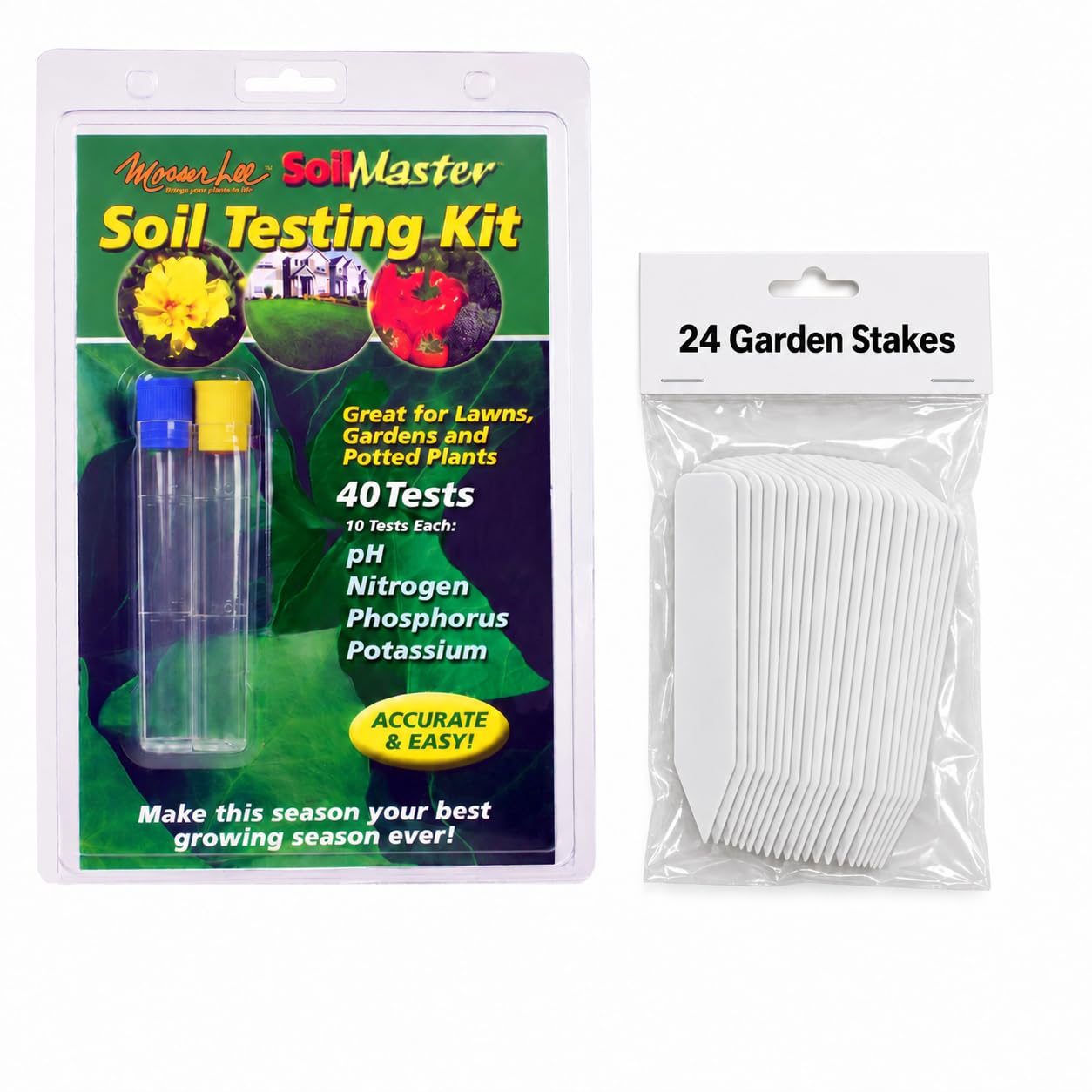
24 plastic plant tags
Tests Per Kit
40 (10 each of pH, N, P, K)
Read the full review

Twenty-four plant tags in a soil-test box looks like a gimmick until February, when you're staring at six seed flats and can't remember which cell is which. That's where this kit makes sense: forty capsule tests, ten each for pH, nitrogen, phosphorus and potassium, with the labeling handled in the same box.

The procedure is the familiar tablet-and-tube routine read against a color chart, and it asks for the same care the other colorimetric kits do. Strong readings run off the end of the printed scale, and a sample that comes back bright blue is telling you the level is high rather than handing you a number.

What sets it apart is support: phone and email help from a Wisconsin manufacturer that has been making garden products since 1932, and a kit used in Master Gardener training. For a first-time tester who wants to ask whether a color looks right halfway through a test, that's worth more than ten extra capsules.

It costs more than our budget pick for the same test count, so the tags and the helpline have to be worth the difference to you. For a seed-starting gardener who likes having someone to ask, we think they are.

Bottom line: We hand this to first-time testers who want backup: forty tests, twenty-four tags, and a helpline for when a color confuses you.

How We Chose and Tested These Soil Test Kits

We started with roughly 40 kits sold at garden centers and online and cut the list to 14 by dropping anything that couldn't report nitrogen, phosphorus, and potassium alongside pH, anything whose instructions assumed a chemistry background, and anything priced so that a single lab test would have been the cheaper move.

Testing ran five months, from spring planting into late summer, and every kit saw the same dirt. I pulled cores from four raised beds, three patio containers, a patch of lawn that had gone thin, and a community garden plot, then split each sample so each kit was reading identical soil. From there I timed every test from box open to final reading, counted the steps, and noted whether it came with a dropper, gloves, or a tube with a fill line you could actually see.

Ease of use came down to fumbling: capsules that dissolved cleanly versus powders that clumped, charts printed on a laminated card versus a flimsy sheet that soaked through. For color accuracy, I photographed each well beside its chart under the same lamp and had two people match the shades without knowing the lab numbers. Rapid results varied more than I expected — some read in under two minutes, others wanted ten. I cross-checked pH against the lab report and a standalone meter, worked out cost per test for anything that came with reagents for more than one season, and noted whether the booklet told you what to do with the number once you had it.

The kits that held up weren't the fanciest or the most expensive. They were the ones that told you exactly how much soil to use and never left you guessing at a shade on the card.

How to Choose Soil NPK Test Kits

Lab analysis or a color chart

A capsule or tablet kit is chemistry you can see: the reagent reacts with the nutrient in your soil solution, and the shade maps to a step on a printed chart. That makes it cheap and quick, but the reading is a step judged by eye and the steps are wide. A lab extracts the sample with a standard method such as Mehlich III and reports actual levels, usually with more nutrients and with application rates attached.

Choose by how you'll use the result. Making one set of decisions a year about fertilizer and lime? The lab earns its money. Testing again and again to watch a bed respond? Capsules win on cost per sample. The trap is buying a cheap kit and expecting lab-grade agreement — a capsule kit is a trend tool, not a referee.

What the report should tell you beyond N-P-K

Nitrogen, phosphorus and potassium are the headline, but pH decides whether a plant can reach them, while buffer pH, organic matter and CEC tell you how much lime you need and how well the soil holds what you apply. A report that lists numbers without rates leaves you to do the agronomy yourself; MySoil returns organic and conventional rates, and SoilKit includes CEC and organic matter alongside its recommendations.

A kit that only says low, medium or high is fine for a direction and weak for a plan. Match the depth of the report to what you intend to buy afterward.

Count your zones before you count tests

A kit tests one sample, not a garden. Split the yard into zones that share soil and treatment — the raised beds, the front lawn, the shady border — and each zone needs its own test. Four tests is generous for a small garden and thin for a half acre with three soil types. Capsule kits stretch further because the count is higher and retesting costs little.

Getting a sample worth testing

Most disappointing results are sampling problems. Take soil from root depth rather than the crust, pull several cores across the zone and mix them in a clean bucket, and keep fertilizer granules out of the sample. For colorimetric tests, use the same water every time — tap water chemistry varies and can shift a reading — and read the tube in daylight against a white background.

Treat a color that falls between two steps as a range, and write down what you applied and when. A result you can compare against the same bed next season is worth more than a precise number you never repeat.

Frequently Asked Questions

Final Verdict

Start with the MySoil four-pack if you're making one set of decisions a year: a real lab panel, thirteen nutrients, and rates attached, so the result ends in a shopping list rather than a puzzle. If four samples is more than your garden needs, SoilKit gets a lab reading on a single bed, with CEC and organic matter, for far less.

And if you want to test often, buy the Rapitest capsules and accept their limits. Lab test for the plan, capsules for the habit.