Outdoor Power Equipment

Best Small Engine Tachometers of 2026

Small engines rarely announce what's wrong. They just idle rough, bog under load, or refuse to settle into a steady rpm. A tachometer gives you the number you need to adjust a carburetor with confidence instead of guesswork. I've spent Saturday afternoons hunched over a mower deck, and a wrong reading is worse than none: you chase screws in circles and end up further from the spec. What you want is a tool that clips on quickly, holds a steady number, and stays legible in sun.

The appeal is simple: a small tach should be affordable, easy to install on a spark plug lead, and versatile enough for a chainsaw, trimmer, generator, or riding mower. But cheap models vary wildly in accuracy, battery life, build quality, and how much RPM detail they show. Four months with 14 of them, across our own equipment and a few borrowed machines, made the differences obvious. The ones that earned a spot were boring in the best way: clear numbers, stable readings, and no fuss when you're wearing gloves — those are the ones below.

1

ES 328 EZ Tach Plus

Top Pick
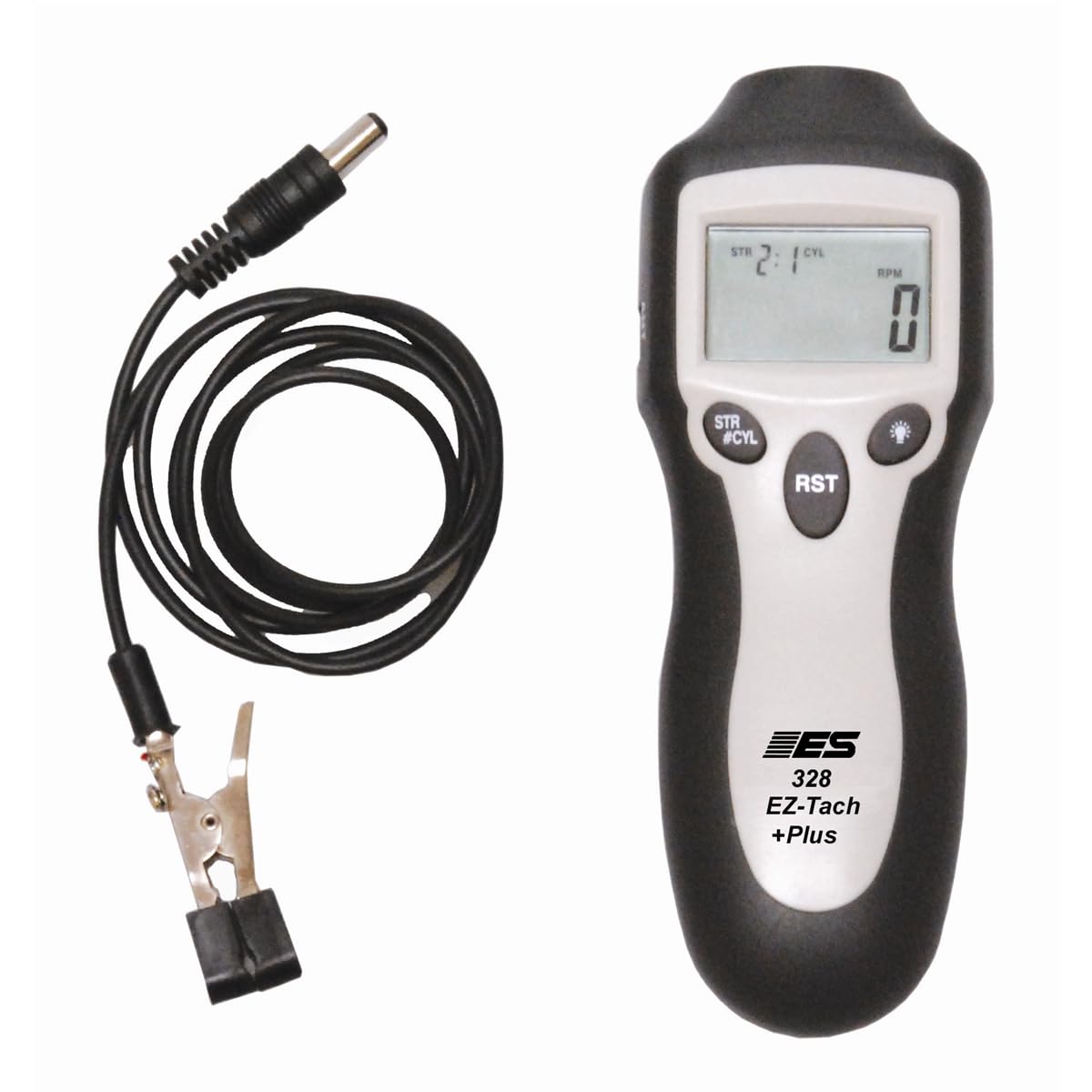
ES 328 EZ Tach Plus

Shop and multi-cylinder

Our Score 8.8/10
Check Price

Worth Noting

  • Wireless pickup needs the unit almost against the lead
  • Can drift a few hundred rpm at idle
Pickup
Wireless or inductive clip
RPM Range
0 to 20,000 RPM
Engine Support
2- and 4-cycle, 1-8 cylinders
Stated Accuracy
±10 RPM
Read the full review

This is the tachometer for the person whose work moves between engines. It is the only unit here that can be told what it is looking at, two-cycle or four-cycle, one cylinder through eight, and that setting is what turns a pulse count into a number you can trust across a mower, an outboard, and a motorcycle in the same afternoon. We needed the manual for the first few engines and after that the sequence stuck.

The hardware backs up the price. A backlit LCD and a built-in LED flashlight are the sort of feature you don't value until you are squinting into an engine bay at dusk, and the clip lead gives a firm connection on a plug wire. The range runs to 20,000 rpm with a stated plus or minus 10 rpm, it runs on a 9V battery, and at under two ounces it disappears into a toolbox drawer until you need it.

The wireless mode is the weak half of the design. It wants the meter almost against the plug lead to pick anything up, and the reading you get that way is the least steady in this group, so we stayed on the clip lead for everything that mattered. Expect a beat of lag before the number arrives, too: hold the throttle steady for a second or two and it settles on something you can use. Clip placement, more than the display, decides whether you get a clean figure.

As the most expensive pick here, it asks you to pay for capability you may never use. If you only ever tune a single-cylinder two-stroke, the extra modes are dead weight on the shelf; if you keep a fleet of outboards, mowers, and bikes running, nothing else in this group covers the same ground.

Bottom line: Worth the premium if your work crosses engine types: it is the only one here you can tell about cylinder count, and the backlit screen and flashlight earn their keep in a dim bay.

2

HTPREC Small Engine Tachometer

HTPREC Small Engine Tachometer

Occasional carb work

Our Score 8.8/10
Check Price

Worth Noting

  • Tiny printed instructions leave mode choice to guesswork
Pickup
Inductive or signal wire
Pulse Modes
4 modes (01-04)
Power Saving
Auto sleep with engine off
Engine Support
2- or 4-stroke, 1-8 cylinders
Read the full review

The screen blanks when the engine stops and comes back on the next pull. That sounds like a small thing until you have left a meter switched on over winter and found it flat in spring, and it is the reason this HTPREC suits a machine that sits between uses. It reads two- and four-stroke engines from one to eight cylinders, takes a signal from a copper clip on the plug wire or from the pickup lead, and clears its stored data with a two-button press when you want a clean slate. For a trimmer that lives in a shed, that is the behaviour that matters.

Once the mode is right, the rest is quiet competence: a clip that stays put, a legible display, and an ABS body that shrugs off living in a toolbox. Modes 01, 02, and 03 step up in a doubling relationship and mode 04 resets the unit, so matching the meter to a two-stroke saw or a four-stroke mower is a matter of picking the right step. That done, this is the meter we reach for on a saw or a trimmer, because there is nothing else to configure.

Bottom line: A quiet, competent meter for occasional carb work: the display blanks between uses, the clip holds, and the only real hurdle is decoding the mode chart on the slip of paper in the box.

3

HFWHOK Small Engine Tachometer

HFWHOK Small Engine Tachometer

All-around small engines

Our Score 8.6/10
Check Price

Worth Noting

  • Small 40 x 22 mm display in bright sun
RPM Range
0-18,000 RPM
Refresh Rate
0.5 seconds
Run-hour Range
0-9999 hours
Stated Accuracy
±10 RPM
Read the full review

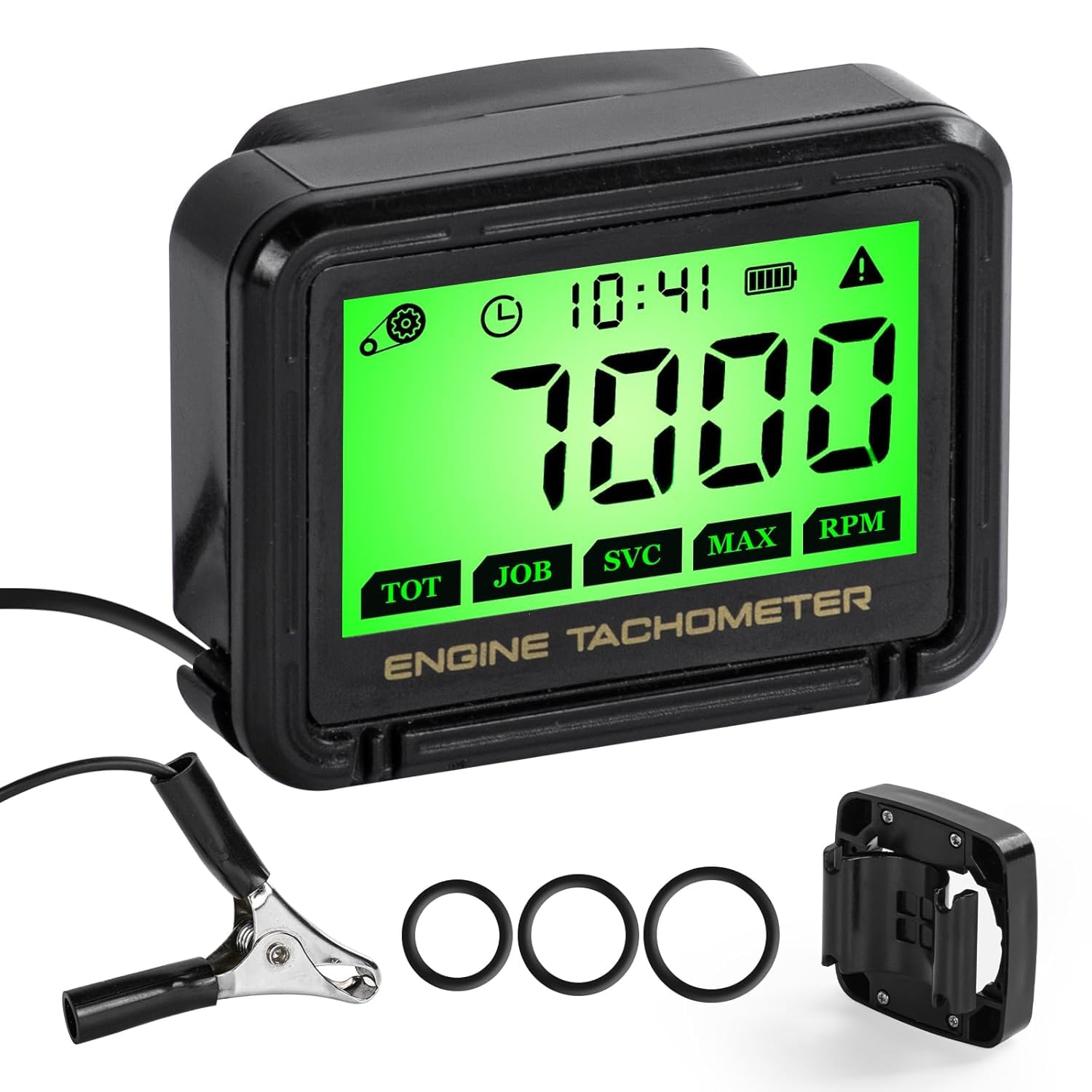
A tachometer is only worth having if the number stops moving. At idle on a mower, a readout that hunts by a couple hundred rpm tells you nothing about which way to turn the mixture screw, so the first thing we watched was how quickly each unit settled on a figure we could act on. This one got there faster than anything else here, and the alligator clamp on the plug lead is why we kept reaching for it: no counting wraps of wire, no guessing whether the pickup is tight enough. The lead runs about 2.2 m, long enough to lay the display on the deck while you work the throttle.

The rest of the feature set is unusually complete. Total hours, a job timer, a max-rpm hold, an rpm alarm that flips the backlight red, a clock, and a service countdown that defaults to 50 hours. That default happens to line up with the oil-change interval on a lot of walk-behind equipment, so you can set it once and let it remind you. We like the alarm more than we expected to: set it near the top of a trimmer's range and the backlight tells you you're there without a screen-staring contest.

Set the pulse mode before you trust anything. The selector covers the usual two-stroke and four-stroke cases, and getting it wrong gives you a figure at double or half the real engine speed, which is the single most common way any of these meters misleads. Do that at the bench rather than crouched over a hot deck, because the mode list runs across a small screen.

Small is the one real compromise: 40 by 22 mm of display on a plastic body, readable at arm's length and less so in full sun. The bracket that clamps onto tubular bars offsets it, since you can park the meter on a mower handle or a generator frame and glance over mid-job instead of holding a light and a readout at once. For a tool that lives in a toolbox and comes out for tuning, that's a fair trade.

Bottom line: Our pick for most small-engine work: the clamp lead makes every check quicker, the reading settles fast, and the service timer keeps it useful after the carburetor is dialed in.

4

Runleader HM011F Hour Meter 2-Pack

Runleader HM011F Hour Meter 2-Pack

Permanent hour tracking

Our Score 8.6/10
Check Price

Worth Noting

  • Display washes out in sun and can fog when wet
Battery
Replaceable CR2450
Pack Count
2 meters
Service Timer
Programmable SVC countdown
Hour Precision
0.1 hour
Read the full review

Two meters arrive in the box, each in its own package, which tells you what this product is for: one goes on the mower, one on the generator, and neither comes off again. This is a panel instrument rather than a diagnostic handheld. The pickup is a wire you wrap around the ignition lead and then leave wrapped, and the display is meant to be mounted where you will see it while the engine is running.

For that job it is more capable than most. Total hours read to a tenth and can be reset, a programmable service countdown flashes an icon when maintenance falls due, and the tachometer has ignition-mode settings for different engine types so the rpm figure is not nonsense on a two-stroke. We appreciate that the CR2450 inside is replaceable and that the hour count is retained through the swap; a meter that loses its history every time the cell dies is a meter you stop believing.

Treat it as a handheld and it disappoints. The number of wraps around the lead changes the reading, so the install has to be tidy and repeatable, and the display is the hardest of this group to read outdoors. It can fog after a wet night on a boat or an open trailer. Mount it somewhere sheltered, and check the first readings against a known-good rpm before you write anything down.

Where it wins is the arithmetic of ownership: two engines' worth of run-hour history, with a service reminder on each, for roughly what one handheld costs. If your problem is remembering when the oil was last changed on two machines, this is the more useful purchase on the page.

Bottom line: Buy it for maintenance records, not for tuning: two meters you bolt to two machines and leave there, counting hours to a tenth with a service reminder that flashes when the oil is due.

5

Moly Magnolia Tach and Hour Meter

Moly Magnolia Tach and Hour Meter

Budget carb tuning

Our Score 8.6/10
Check Price

Worth Noting

  • Plastic housing is not built to sit out in the weather
Pickup
Spark plug wire wrap
Functions
Tachometer and hour meter
RPM Range
0-25,000 RPM
Pulse Modes
9
Read the full review

A small plastic housing, a wire that wraps around the spark plug lead, and one display doing double duty. The Moly Magnolia covers the two things most people actually want to know: engine speed while the machine is running, and total run time once it stops. Setup is a wrap, a mode selection, and a pull of the starter.

For a once-a-season check on a chipper, a generator, or an outboard, that is enough. This is the unit we hand over when someone wants to confirm a machine still hits its top-end spec without buying a tool they will use twice a year, and its nine pulse modes mean there is a setting for almost any small gasoline engine you point it at.

Getting a trustworthy number takes care. The wrap around the lead has to be even and repeatable, since three tidy turns one day and four sloppy ones the next will move the reading by several hundred rpm, and the wire needs to sit clear of the coil and any other leads. Do that and the figure steadies. The body is claimed waterproof, but plastic and weather are not friends, so this is not the meter to bolt to an open trailer and forget.

Bottom line: The least expensive pick here and still a usable one: rpm and hours from a single small unit, provided you take the time to wrap the lead properly.

6

BIBARAJM Inductive Tachometer

BIBARAJM Inductive Tachometer

Scooters and mowers

Our Score 8.6/10
Check Price

Worth Noting

  • Sealed housing: the battery cannot be replaced
Pickup
Inductive clip
Dimensions
4.72 x 3.54 x 0.9 inches
Hour Capacity
10,000 hours
Max RPM Display
99,999 RPM
Read the full review

The lead between the clip and the display is the detail that makes this one pleasant to use. Clip it on the plug wire, set the unit down where you can read it, and keep both hands free for the mixture screws, which on a scooter or a walk-behind mower is a real convenience. It will also pick up without the clip if you hold it close to the lead, and it sleeps when the engine stops and wakes on the next pull.

What it shows is the pair you need: rpm while it runs, total hours when it does not, plus a service icon you can set for whatever interval you actually use. The hour count runs to 10,000 and then rolls back to zero, which is generous for a lawn mower and worth knowing if you keep long-term records.

Day to day, the hookup is what sells it. On a scooter, a mower, or a trimmer, clipping on and taking a reading takes less time than finding the right screwdriver, and the clip grips a plug wire without fuss. It lacks the mode chart of the fancier units and the figure is a guide rather than a gospel at the top of a chainsaw's range, but for setting idle and confirming a machine still reaches its working speed, it earns its place in a toolbox.

Bottom line: The friendliest hookup of the cheap units: a long clip lead puts the readout within reach on scooters and mowers, and it wakes and sleeps with the engine.

7

Linkstyle ZSB-03 Tachometer

Linkstyle ZSB-03 Tachometer

Maintenance hour logs

Our Score 8.6/10
Check Price

Worth Noting

  • Pulse-mode setup has little guidance and takes trial and error
Pickup
Clip or 3-5 cm proximity
Battery
Replaceable
Dimensions
2.87 x 2.8 x 1.85 inches
Reset Function
Total hours and service time
Read the full review

Compared with our top pick, this one takes longer to give you a number. The refresh feels slow, and at wide-open throttle on a chainsaw the reading we watched was shakier than the HFWHOK's; if you are chasing a top-end mixture setting, that difference decides it. It costs less, and it brings one thing the others make awkward: a long press of the RST button clears both the total hours and the service timer at once, so starting a fresh maintenance log is a single motion.

That reset is the reason to choose it, and it pairs well with the job this meter suits: tracking hours on a generator, a pressure washer, or a mower you service on a schedule. It clips to the plug wire or reads at close range without a clip, the battery is replaceable, and the two buttons toggle between hours and service without a menu.

Set against the rest of the group, it is a maintenance instrument first and a tuning tool second. If you want to know when the oil is due on a machine you run hard, it does that job for less than most of the picks here. If the rpm number itself is the point, one of the clamp-lead units above will serve you better.

Bottom line: A maintenance-hour tracker more than a tuning tool: the one-press reset and replaceable battery are genuinely useful, but the rpm figure takes its time arriving.

How We Tested Small Engine Tachometers

We started by sorting through owner reviews, small-engine forums, and repair-shop recommendations, filtering out anything with vague RPM ranges, no replaceable battery, or a display that looked impossible to read at a glance. That left us with 14 tachometers — a mix of clip-on and wire-lead designs — which we tested over four months on push mowers, string trimmers, chainsaws, and a generator.

Most of the work happened in my driveway and a neighbor's shed on weekend mornings, with a few evening sessions under shop lights. We ran each unit on the same engines before and after carburetor adjustments, comparing its reading against a known-good shop tach and noting whether the number jumped, lagged, or held steady. We also timed installation from opening the battery door to first reading, and we did it with gloves on to see how easily the buttons and clamps handled real-world fingers.

Accuracy got checked at idle, mid-range, and wide-open throttle; we noted drift and whether the display rounded to the nearest 10 or 100 rpm. Battery life we tracked by leaving units on between adjustments and recording how many sessions they lasted, including any auto-off quirks. Power was mostly about signal pickup — some units needed a clean lead and a firm clip, while others picked up reliably even with a greasy plug wire. Readability was judged in sun, shade, and at arm's length; durability got a fair amount of accidental abuse in a tool bag, plus a few drops onto concrete. At the end we weighed price against what each unit actually delivered, because a cheap tach that needs constant rechecking isn't a value.

How to Choose Small Engine Tachometers

Pickup: Clamp, Wrap, or Hold It Close

There are three ways to read a spark ignition and they are not equal. An alligator clamp over the plug lead is the quickest to attach and the easiest to repeat, which is what you want if the meter moves between machines; the HFWHOK and the BIBARAJM both work this way. A wrap-around lead suits a permanent install, because you can route and tape it once and then forget it.

Proximity sensing, with no clamp at all, is a fallback rather than a method. It wants the meter sitting almost against the plug wire, and the reading you get that way is the least stable of the three. The ES 328 offers it alongside a clip lead, and the clip is the half worth using.

The Pulse Mode Is Most of the Accuracy

A two-stroke fires every revolution and a four-stroke every second one, and a twin with a wasted spark can look like something else again. Every meter here solves this with a mode setting, and the wrong one gives you a figure at double or half the truth. That is the classic symptom of a tach that reads 9,000 rpm on an engine that cannot turn that fast.

Check the number against your manual or the spec plate before you touch a screwdriver. If the reading is exactly double, step the mode down rather than reaching for a tool; the HTPREC lays its modes out as a doubling sequence, which makes that correction easy once you know the rule.

Refresh Rate and a Number That Sits Still

Accuracy claims of plus or minus 10 rpm are common and largely beside the point at the roadside, because the limiting factor is signal quality, not the display. What actually matters is whether the readout settles at a fixed throttle. A half-second refresh, as the HFWHOK lists, is quick enough to watch a mixture screw bite; slower units leave you waiting on a number that never quite stops.

Judge any tachometer the same way: hold the throttle steady for a count of two and see whether the figure holds within a couple hundred rpm. If it keeps hunting, move the clip along the lead before you blame the meter.

Display, Mounting, and Where It Lives

Handheld or mounted is the first decision. A handheld with a backlit screen and a built-in light suits diagnostic work in a dim bay, while a bracket-mounted panel meter like the Runleader suits a machine you want run hours from. Screens at this scale are small, and full sun beats all of them, so picture where the display sits when you read it: angled toward the operator, not buried behind a fuel tank.

For a permanent install, mount the meter where you can reach the buttons, because you will want to reset the service timer eventually. A bracket that clamps to a tubular bar is more forgiving than one that needs drilled holes.

Frequently Asked Questions

Final Verdict

For most small-engine work, buy the HFWHOK. The clamp makes every check quicker, the number settles fast enough to tune against, and the service countdown keeps it useful on the machine long after the carburetor is dialed in. Step up to the ES 328 only if your work crosses cylinder counts and engine types; its extra modes are what the price buys.

If what you need is a maintenance log rather than a tuning tool, the two Runleader meters will do more for you than any handheld here — one on the mower, one on the generator, and a reminder that flashes when the oil is due.